
VAT OSS and IOSS Rules for E-commerce Businesses in the EU
VAT OSS and IOSS Rules for E-commerce Businesses in the EU
Selling into the EU can feel simple until the first VAT letter arrives. EU VAT compliance is less about paying more tax and more about paying the right VAT, in the right country, at the right time.
For non EU sellers, the biggest shift is that VAT follows the customer, not your warehouse. EU VAT compliance therefore starts with mapping where you store stock, where you sell, and how goods enter the EU.
This guide breaks down OSS and IOSS in plain language and shows when you still need local VAT numbers. EU VAT compliance becomes manageable once you separate “distance sales” from “import sales” and set a repeatable process.
Many non EU sellers realise too late that EU VAT compliance affects pricing, logistics, and customer experience from day one.
L’Tax by Lovat helps businesses design the right VAT setup before problems appear
EU VAT compliance for non EU e-commerce brands
If you are established outside the EU, you can still use OSS or IOSS in many cases. EU VAT compliance depends on your supply chain, your Incoterms, and whether you sell direct or via marketplaces.
The EU cares about three questions: where the goods start, where they end, and who is the deemed supplier. EU VAT management is fast when you document those answers for every sales channel.
A practical mindset is to design VAT like you design shipping. EU VAT obligation is a system, not a one time registration.
VAT for e-commerce EU when you ship from outside
Many sellers confuse “VAT on imports” with “VAT on sales.” VAT for e commerce EU becomes clear when you see there are two VAT moments: import into the EU and supply to the customer.
When you ship Delivered Duty Paid (DDP) you often become responsible for import VAT and customs, not the buyer. VAT management then requires either IOSS or another import model, plus strong paperwork.
If you ship Delivered At Place (DAP) and the customer pays import charges, the checkout experience can suffer. VAT compliance is also customer experience, because surprise fees drive returns and chargebacks.
Later in the article we return to VAT for e-commerce EU with examples you can copy.
Choosing between DDP and DAP is not only a logistics decision, but a VAT strategy choice.
L’Tax by Lovat helps non EU sellers align Incoterms, IOSS, and VAT registration to avoid delivery issues and unexpected tax costs.
OSS IOSS explained in plain language
Here is the simplest split: OSS is for EU distance sales within the EU, while IOSS is for imports of low value goods. OSS IOSS explained this way prevents most wrong registrations.
Union OSS is mainly for EU established sellers, but non EU sellers can use the non Union OSS for certain services. EU VAT compliance for goods is usually about Union OSS when stock is already in the EU, often via an EU warehouse.
IOSS is for goods imported in consignments up to EUR 150. EU VAT compliance improves when you treat IOSS as a “VAT at checkout” mechanism that removes import VAT for the customer.
Below is a quick comparison you can share with your logistics team. EU VAT compliance gets easier when tax and ops use the same vocabulary.
| Topic | OSS | IOSS |
| What it covers | Intra EU B2C distance sales of goods | Import B2C sales of goods up to EUR 150 |
| VAT point | At sale to customer | At sale to customer |
| Import VAT | Still exists, handled via customs model | Not charged to buyer when IOSS used |
| Typical need | You store goods in the EU | You ship from outside the EU |
| Key risk | Wrong “place of supply” | Missing IOSS data on customs declaration |
We will use OSS IOSS explained again when we map real scenarios.
Still unsure whether OSS or IOSS fits your business model
L’Tax by Lovat reviews your supply chain and sales flows and recommends the correct VAT scheme for your EU sales.

OSS registration steps and timing
For many brands with EU fulfilment, OSS registration is the fastest route to simplify filings, because it can replace multiple distance sales VAT returns.
You still need strong invoicing rules and correct VAT rates by customer location. EU VAT compliance here is about data quality: billing address, delivery address, and proof of location.
A common mistake is to register and forget the effective date. EU VAT compliance requires you to charge VAT correctly from the first eligible sale, not from “when you feel ready.”
Use this checklist to keep OSS registration practical:
- Confirm goods are already in the EU at dispatch
- Confirm B2C supplies and eligible distance sales
- Choose member state of identification and submit application
- Configure VAT rates per destination country
- Build a monthly reconciliation, even if OSS is quarterly
When teams handle OSS registration with a checklist, errors drop quickly.
Need help with OSS registration and ongoing EU VAT compliance
OSS looks simple on paper, but mistakes in setup or timing often lead to backdated VAT liabilities and penalties.
L’Tax by Lovat helps non EU e commerce businesses with OSS registration, VAT configuration, and ongoing reporting, so you can sell across the EU with confidence.
Our team supports the full process, from choosing the correct member state of identification to setting up VAT rates and preparing OSS returns.
With L’Tax by Lovat, EU VAT compliance becomes a controlled process, not a recurring risk.
Apple for OSS Online | Book a demo for our L’Tax
IOSS registration and import VAT basics
If you ship low value goods from outside the EU, IOSS registration can remove import VAT friction at delivery and reduce failed deliveries.
Non EU sellers usually need an IOSS intermediary, with limited exceptions. EU VAT compliance here includes contractual steps, because the intermediary often requires audits of your data flow.
You must pass the IOSS number and correct values to the customs declaration. EU VAT compliance fails when marketplaces, carriers, and ERP systems do not share the same parcel data.
If you cannot use IOSS, you may rely on special arrangements handled by the carrier, but the buyer pays on delivery. EU VAT compliance then moves from “tax accuracy” to “customer support volume,” which can be costly.
After initial IOSS registration, the ongoing work is disciplined reporting and evidence storage.
Apple for IOSS Online | Book a demo for our L’Tax
EU VAT thresholds that still matter
Many sellers hear “the threshold is gone” and stop paying attention. EU VAT thresholds still matter in practice, but in different ways than before.
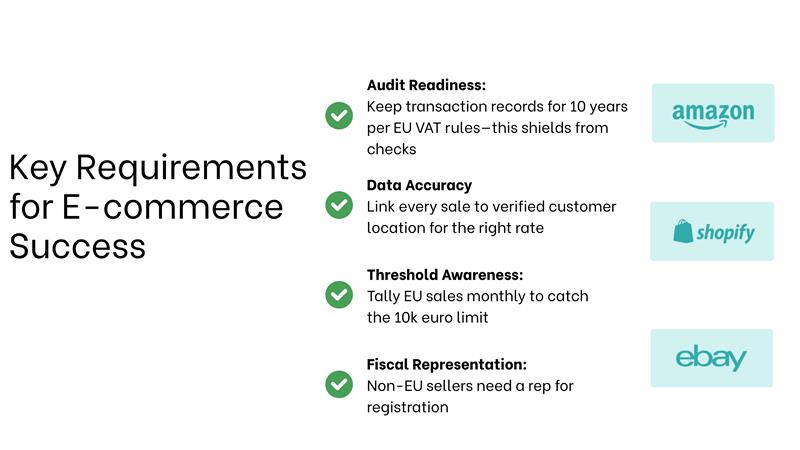
For intra EU distance sales, the EU introduced a single EUR 10,000 threshold, but it mainly benefits EU established micro sellers. EU VAT management for non EU sellers usually reaches the threshold quickly, or it does not apply because of how your business is structured.
For imports, the EUR 150 line is crucial because it gates IOSS eligibility. EU VAT compliance should include a pricing rule that flags orders above the threshold before checkout.
Some products also create local obligations regardless of turnover, such as excise goods. EU VAT compliance is not only about amounts, it is also about product category.
Later we will revisit EU VAT thresholds in a scenario table.
VAT registration EU scenarios beyond OSS
OSS simplifies reporting, but it does not remove every local need. VAT registration EU becomes mandatory when you hold stock in a country, do local B2B supplies, or run certain domestic flows.
If you use Amazon FBA, stock can move across borders. EU VAT compliance then requires local VAT registrations where inventory is stored, plus OSS for distance sales from those stocks.
If you import goods into the EU in your own name, customs often requires an EORI and may trigger local VAT registration needs. EU VAT compliance improves when you align importer of record, Incoterms, and VAT model before the first shipment.
Some sellers try to use OSS to cover everything and later discover gaps. EU VAT compliance is safer when you treat OSS as one tool inside a broader VAT architecture.
VAT for online sellers marketplace and direct sales
Marketplaces can become the deemed supplier for certain transactions, which shifts who reports VAT. VAT for online sellers is therefore different on Amazon, Etsy, or your own Shopify store.
When the marketplace is deemed supplier, it may collect and remit VAT, but you still need clean documentation. EU VAT compliance then includes reconciliation between marketplace reports, payouts, and your accounting entries.
When you sell direct, you control checkout VAT, which is good, but you also carry the risk of wrong rates and wrong country mapping. EU VAT compliance becomes a product setting issue, not only a tax issue.
If you use multiple channels, build one VAT logic layer and feed all channels. EU VAT compliance is harder when each channel has a different “VAT truth.”
We will reuse VAT for online sellers when we cover reporting and audits.
VAT reporting EU returns records and audits
OSS and IOSS do not end with registration, they start there. VAT reporting EU needs steady routine:: reconciliation, corrections, and evidence storage.
You must keep records for the required retention period and be able to explain how you determined customer location. EU VAT compliance is often won or lost in the evidence, not the VAT rate.
Treat returns and refunds with care, because they change your taxable amount. EU VAT compliance improves when your returns tool shares data with your tax reporting.
Below is a compact view of what “good” looks like for VAT reporting EU:
- Weekly sales and VAT reconciliation by country
- Monthly customs and parcel data checks for imports
- Quarterly OSS return preparation and review
- Continuous documentation archive and audit trail
If you run these steps, EU VAT compliance becomes predictable.
Decision table for common non EU seller setups
Different setups lead to different VAT paths. EU VAT compliance is faster when you decide from a scenario table instead of guessing.
| Your setup | Typical VAT route | Notes |
| Ship from non EU to EU buyers, order value up to EUR 150 | IOSS | Best for smoother delivery experience |
| Ship from non EU to EU buyers, order value above EUR 150 | Import model without IOSS | Buyer may pay import VAT unless you run DDP |
| Store goods in an EU warehouse and sell B2C acrOSS the EU | Local VAT where stock is held plus OSS | OSS covers distance sales, not stock holding |
| Use marketplace fulfilment with stock movements | Multiple local VAT registrations plus OSS | Watch inventory locations and transfers |
If your setup matches one of these scenarios, your VAT obligations are already defined.
L’Tax by Lovat can implement the correct VAT structure and handle registrations and reporting for your specific model.
How L’Tax by Lovat supports VAT compliance at scale
Many teams can understand VAT rules, but struggle to operationalize them. VAT compliance services are useful when you want a repeatable process, not a one off fix.
L’Tax by Lovat helps with registrations, ongoing returns, and process design for multi country sellers. EU VAT compliance becomes simpler when you have one partner coordinating data, deadlines, and local requirements.
Typical support areas include: VAT and OSS strategy, IOSS setup with intermediaries, local VAT registrations when needed, and ongoing filings. EU VAT compliance also improves with proactive monitoring, because late filings and wrong rates are common sources of penalties.
If you want to grow across the EU without growing tax overhead, VAT compliance services should include automation friendly reporting and clear responsibilities.
This is also where VAT reporting EU connects with real business KPIs like margin and delivery success.
Practical steps you can apply this week
If you want fast progress, focus on basics first. EU VAT compliance is mostly about clean inputs, not complex theory.
Start with a simple operational plan:
- Map each sales flow by channel and shipping route
- Tag orders as EU stock or imported goods
- Flag consignments near the EU VAT threshold for IOSS
- Reconcile marketplace VAT data against payouts
- Build a calendar for filings and payment dates
Once you do this, VAT for online sellers becomes much easier to manage across channels.
If you prefer to focus on growth instead of VAT administration, L’Tax by Lovat supports EU VAT compliance as an ongoing managed service.
Key takeaways for non EU sellers
The fastest wins come from choosing the right scheme and keeping data consistent. EU VAT compliance should be treated as an operations project with tax leadership.
Use OSS when you dispatch from within the EU and sell B2C acrOSS borders. EU VAT compliance for imports is usually about IOSS when goods are low value and shipped from outside.
When your model includes EU warehousing or complex fulfilment, expect local numbers as well. EU VAT compliance stays safe when you review inventory locations and importer roles every quarter.
If you want a guided setup and ongoing support, L’Tax by LoVAT can run the registrations and reporting while you focus on sales. EU VAT compliance is then a managed workflow, not a recurring fire drill.
Apple for IOSS Online | Book a demo for our L’Tax