
Complete EPR Guide for Amazon Sellers
Complete EPR Guide for Amazon Sellers
Selling on Amazon across European markets is exciting — and increasingly demanding. Every year, new environmental laws make things harder, and producers who don’t follow packaging rules could have their accounts suspended or be fined heavily
Any seller who ships physical goods to the EU, the UK, or other markets that have adopted extended producer responsibility rules must now understand EPR compliance.
This guide tells you everything you need to know to keep your Amazon store running smoothly, from registration deadlines to fee structures.
If you’re a seasoned pan-European seller or just starting your first international listing, going through a good Amazon EPR guide early will save you time, money, and a lot of stress later. That’s why it’s important to have a structured, step-by-step approach: the rules change depending on the country, product category, and marketplace. Some markets require you to register months before your first shipment, while others charge you fees after the fact if you register late. It’s much cheaper to get the order right the first time than to fix it under pressure. Let’s go over everything you need to know.
EPR Regulations Compliance Overview for Online Sellers
The basic idea behind EPR regulation compliance is that whoever puts packaged goods on the market is responsible for getting that packaging back after customers throw it away. The European Union codified this logic in the Packaging and Packaging Waste Directive, and individual member states have since translated it into national law with their own registration bodies, fee structures, and reporting calendars.
For marketplace sellers, this means obligations do not disappear just because you use a fulfilment partner. You, the producer on record, are responsible for your products getting into France, Germany, Spain, or any other regulated area. Since 2022, EPR regulations have become much more strict, and now e-commerce businesses have to follow rules that used to only apply to big manufacturers. In the strictest markets, even sellers who only sell a small amount of packaging each year—sometimes as little as one tonne—must now register and report, with no grace period for first-time sellers.
Authorities make sure these rules are followed by making agreements between businesses in the marketplace. Platforms are requiring sellers to prove that they are following the rules before listings can go live more and more. This is why online sellers need to take action before they get a suspension notice. Every Amazon seller needs to know the full EPR regulations compliance framework, which includes who regulates, what they need, and when the deadlines are. This framework is not set in stone, which is important. Every year, national authorities change the threshold volumes, add new material categories, and change the fee rates. This means that sellers who do business in more than one European market need to review their obligations more than once
Understanding Amazon EPR and Its Legal Basis
Amazon EPR is the name for the set of extended producer responsibility rules that only apply to sellers who use Amazon’s marketplace. In most places, you are the one who is responsible, not Amazon. Amazon’s job is to help people follow the rules by collecting registration numbers, suspending listings that don’t follow the rules, and, in some countries, offering optional compliance services directly through the platform.
The laws that make these duties possible are different. The Packaging Act (VerpackG) in Germany says that you must register with LUCID before you can sell anything. The AGEC law in France says that people must register with eco-organizations that have been approved, like Citeo. The Producer Responsibility Obligations rules say that the Environment Agency in the UK is in charge of registering producers. Each framework is for a different country, but the one thing they all have in common is that Amazon EPR sellers must register before their goods leave, not after.
Not registering has a chain reaction of effects. During regular audits, Amazon flags ASINs that don’t follow the rules, takes down listings, and in some markets, tells national authorities about violations. Sellers who don’t meet their amazon EPR obligations may also have to pay fees for volumes that were already on the market before they registered, which makes the financial penalty much worse. For example, in Germany, a seller who was found to have been trading without a valid LUCID number for twelve months can be fined based on the full estimated tonnage that was put on the market during that time. This amount is often many times more than the annual compliance cost.
What EPR Compliance Means for Amazon Sellers in Practice
There are three separate workstreams that make EPR compliance happen: registration, reporting, and paying fees. When you register, you become a legal producer with the national government. Reporting means giving correct information about the weight and materials of the packaging you sold during a certain time period. Fee payment sends money to the take-back programs that actually pick up and recycle the packaging.
For most Amazon sellers, the packaging that matters is not just the product itself, but also the boxes, void fill, tape, and labels that were used to ship it. One of the most common compliance mistakes is not reporting the weight of packaging correctly. Auditors can easily find this mistake by comparing the declared tonnage with the shipment volumes. If you follow solid EPR compliance Amazon documentation practices, you’ll be safe during an inspection. A seller’s best habit for staying safe is to keep a simple log of packaging specifications for each ASIN and update it every time a supplier changes the size of a box or adds new void fill.
The time it takes to fully comply varies by market. Germany and France have the most developed systems and the shortest deadlines. After that, Austria, Spain, and Italy all stepped up enforcement starting in 2023. New markets like Poland and the Czech Republic are still changing their EPR compliance rules. Because of this, any seller who does business in more than one EU country needs to regularly check their obligations. Sellers who set up their compliance systems in 2021 or 2022 often find that their original registrations don’t cover everything that is now required. This gap leads to unintentional non-compliance even though they tried to comply in good faith.
Amazon EPR Registration — Step by Step Process
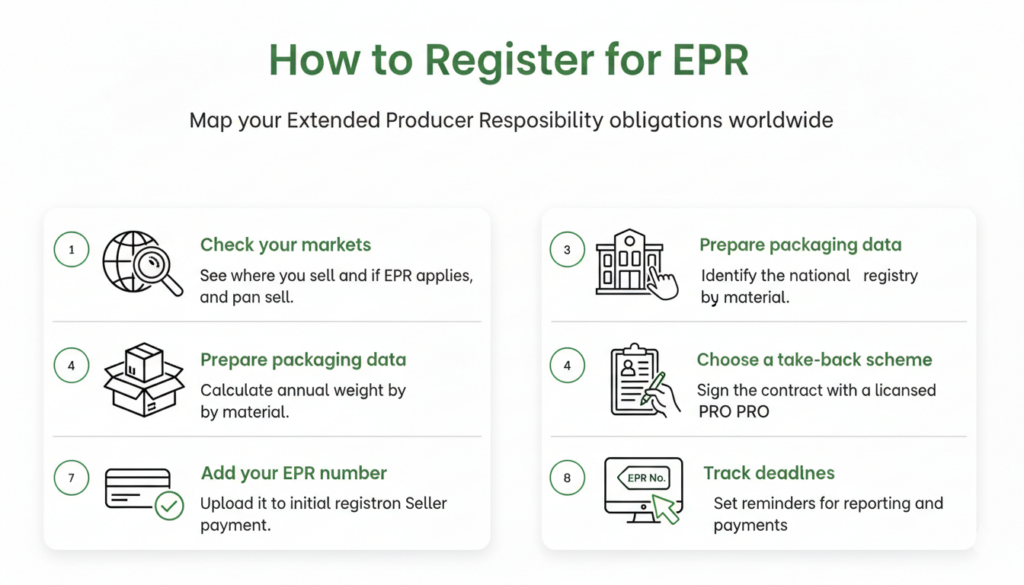
The first real thing a seller needs to do is finish registering for Amazon EPR. The steps are mostly the same in every country, but they may be done in a different order. You need to create an account with the national registry, declare how much packaging you have, choose a take-back scheme, pay an initial membership fee, and get your registration number to send to Amazon. In most places, this can be done online in a few business days. However, some countries need extra paperwork, like a company registration certificate or a VAT number from that country, before the application can be approved.
Amazon keeps track of registration numbers at both the account level and the ASIN level in some markets. Germany’s LUCID number, France’s unique identifier number, and Spain’s SIC numberA number of credentials, such as a number, must be sent through Seller Central before listings can be activated. When Amazon tightens its verification cycles, sellers who register for Amazon EPR in all relevant markets don’t have to go through the hassle of emergency compliance sprints. Amazon usually only gives sellers a short notice period—usually only two to four weeks—to provide missing credentials before deactivating listings. This is rarely enough time to register again from scratch in a market that is new to them.
The table below shows the registration authorities and important deadlines for six major European markets. When making your registration timeline, use this as a quick reference. Each market listed has active enforcement and requires you to send credentials to Amazon before your listings can stay live. Keep in mind that deadlines that say “Before first sale” mean that you have to register before you send a single unit to that country, not before you reach a certain number of units.
| Country | Registry / Authority | Key Deadline |
| Germany | LUCID (Central Agency Packaging Register) | Before first sale |
| Germany | LUCID (Central Agency Packaging Register) | Before first sale |
| France | ADEME / eco-organisation (e.g. Citeo) | Before first sale |
| Spain | SICA Registry | 1 January annually |
| Italy | CONAI Consortium | Before first sale |
| Austria | ARA / national registry | Before first sale |
| United Kingdom | Environment Agency (NI: NIEA) | By 7 April each year |
Follow this numbered list to finish your amazon EPR registration requirements in any new market. Follow the steps in order. Skipping ahead usually leads to problems that need to be fixed by going back to earlier steps. If you’re registering in more than one country at the same time, make a separate tracker for each market so that you don’t miss any deadlines or document requirements:
- Find out which countries you sell to and see if EPR applies to the type of product you sell.
- Find the national registry or eco-organization that is in charge of your type of product
- Get information about the packaging, such as how much it weighs in kilograms per year for each type of material.
- Sign up for an account with the registry and send in your producer declaration.
- Choose a licensed take-back program and sign a contract to take part.
- Pay the first membership or registration fee as it is due.
- Get your registration number and put it into Amazon Seller Central.
- Set reminders in your calendar for the dates when you have to file your taxes and pay your fees.
EPR Amazon Marketplace Requirements by Country
The EPR Amazon obligation landscape is not the same in every country. Each country sets its own limits, thresholds, and levels of enforcement. Many people think that Germany has the strictest market. Any seller who sends even one packaged item to a German customer, no matter where their business is located, must be registered. There is no de minimis exemption based on volume, and German authorities keep a close eye on LUCID for any gaps between declared producers and sellers on Amazon’s marketplace. German inspectors often use cross-referencing customs import data with LUCID registration records as a standard way to enforce the law.
France set up a system of “responsible producer” identifiers that goes into public databases. This lets both consumers and inspectors check compliance in real time. Italy and Spain use consortium models in which producers join groups that handle the physical recovery of packaging for them. After Brexit, the EPR amazon rules in the UK were different from those in the EU. This meant that sellers couldn’t just use their EU registrations to meet the new reporting requirements.
Selling to Nordic countries is even harder for sellers. Sweden, Denmark, and Finland all have national registries. Deposit return schemes for beverage packaging add more rules on top of the standard EPR rules. To handle epr amazon sellers’ obligations in eight to ten markets at once, you need either a dedicated internal resource or a compliance partner with a lot of experience.
Amazon EPR Services and How They Work for Sellers
Amazon EPR services are available in some markets as an optional in-platform solution that takes care of registration and fee collection for sellers who sign up. The program is currently available in Germany, France, Italy, Spain, Sweden, Poland, the Czech Republic, and the Netherlands. When a seller signs up, Amazon gathers information about the packaging, registers the seller with the appropriate government agencies, and pays the fees to the appropriate take-back programs.
Joining the program does not get rid of all of the seller’s duties. Sellers still have to give the right packaging weight data for each ASIN, answer requests for data verification, and check that annual reports are correct. Sellers in markets that aren’t yet part of the in-platform program have to make sure they follow the rules on their own, usually by working with a third-party provider or directly with national registries.
In supported markets, using Amazon EPR services has practical benefits: the registration timeline matches Amazon’s internal processes, the seller doesn’t have to deal with national authorities in other languages, and all fees are combined into one invoice through the platform. But the program might not be the cheapest option for all sellers, especially those who ship a lot of packages and can get better rates by negotiating with independent schemes.
Every seller should check the amazon epr services system against independent compliance providers as part of their yearly cost review. The best choice depends on how much you need, how many markets you have, and how much administrative work you can handle. For sellers who only work in one market and don’t need a lot of features, the in-platform option may be enough and easy to use. People who run complicated businesses with multiple categories often benefit from providers who can negotiate scheme rates, give advice on eco-modulation opportunities, and handle correspondence with national registries in other languages on their behalf.
Country Fee Structures and What Sellers Actually Pay
The costs of packaging vary greatly from one European market to another because of differences in recycling infrastructure, material targets, and competition among schemes. Sellers often don’t realize how much their total annual costs will be because they only look at per-kilogram rates and don’t include membership fees, minimum annual contributions, and administrative fees on top of that. The table below shows a realistic range of costs for small to medium-sized sellers who put two to five tons of mixed packaging on each market every year.
| Country | Registration Fee | Avg Fee per kg (plastic) | Estimated Annual Cost* |
| Germany | €0 (LUCID free) | €0.35 — €0.65 | €400 — €1,400 |
| France | €0 — €150 | €0.12 — €0.50 | €300 — €1,100 |
| Italy | €100 — €200 | €0.18 — €0.55 | €450 — €1,200 |
| Spain | €0 — €100 | €0.10 — €0.45 | €300 — €1,000 |
| United Kingdom | £0 — £200 | £0.20 — £0.60 | £350 — £1,100 |
| Netherlands | €0 | €0.18 — €0.65 | €450 — €1,300 |
| Poland | €50 — €130 | €0.05 — €0.30 | €200 — €700 |
| Sweden | €0 | €0.20 — €0.70 | €500 — €1,400 |
* Annual cost estimate assumes 2 — 5 tonnes of mixed packaging per market. Actual figures depend on material composition, chosen scheme, and applicable eco-modulation rates.
You can actively manage the costs of following EPR rules in one area: packaging design. A lot of programs use eco-modulation, which means that fees are lower for packaging that contains recycled materials, is made to be recyclable, or stays below certain weight limits. One of the best ways to cut down on total EPR costs is to improve packaging before the annual reporting cycles.
Amazon EPR Guide to Staying Compliant Long Term
A good Amazon EPR guide will help you with more than just the initial registration. For long-term compliance, there needs to be a living system. This means that updated packaging data needs to flow into registry accounts, annual fee reconciliations need to be filed on time, and registration credentials need to be updated whenever company information changes. Sellers who think of EPR as a one-time task often find out in the middle of the year that their registration has expired or that the volumes they reported don’t match their actual sales.
A quarterly packaging audit should be part of internal processes. This is when someone looks at every active ASIN to see if the weight, material, or supplier of the packaging has changed. You could be charged a different amount if you switch from a cardboard mailer to a padded envelope. In most EU member states, keeping accurate records is not only a good idea, it is also the law.
Most compliance experts agree that the amazon EPR guide principles are simple: sign up early, report accurately, pay on time, and keep records of everything. People who sell things in this way don’t often get in trouble with the law. People who skip steps build up back-liabilities that can add up to thousands of dollars by the time they are found. A simple shared folder with registration certificates, annual fee invoices, and emails confirming reports is enough to show that you are following the rules during an authority audit. This could mean the difference between a warning and a formal penalty.
EPR Compliance Amazon Enforcement and Penalty Risks
Since 2022, enforcement of EPR compliance on Amazon has gotten a lot stricter. Amazon started automatically deactivating ASINs in Germany for sellers who didn’t give a valid LUCID number. This set a precedent for other market-specific enforcement actions that have happened since then. The platform now checks registration databases in real time in several markets. This means that listings that don’t follow the rules can be taken down within hours of a database update.
National governments don’t just depend on Amazon to make sure everyone follows the rules. Environmental agencies do their own audits by comparing customs import data with registry records. Sellers who put packaging on the market without registering can be fined based on how much they think it weighs, and these fines can go back several years. Penalties for willfully not following the rules are much worse than those for making mistakes in the office.
Sellers who don’t follow Amazon’s EPR compliance standards face a wide range of consequences, and the severity of those consequences rises quickly once a national authority starts an official investigation. What starts as a simple listing deactivation on Amazon can turn into letters from law enforcement in other countries, legal fees, and fees that are recalculated for sales made in the past few years. The most common results of enforcement are:
- Immediate deactivation of ASINs in one or more Amazon marketplaces.
- Account-level suspension in markets where compliance verification is required.
- Fees that go back up to three years for sales that weren’t registered.
- Fines given out directly by national authorities in charge of the environment or waste management.
- Being publicly listed as not following the rules on national registry databases.
- Damage to reputation with wholesale customers and partners in the marketplace.
Sellers can better prioritize when they know how long Amazon will take to enforce epr compliance. Germany and France are the quickest to act, usually within a few weeks of a database mismatch. In the past, Southern and Eastern European markets have given people more time to pay their debts, but this is changing quickly as enforcement resources grow and digital verification tools become standard. Spain’s SICA registry now sends Amazon compliance status directly on a rolling basis. This means that an ASIN can be deactivated just as quickly in Spain as it can in Germany if it is not registered. Sellers shouldn’t think that being far away from Brussels means that enforcement will be more lenient. Instead, compliance checks are getting stricter, faster, and more automated everywhere.
Practical Steps for Managing Your Amazon EPR Obligations
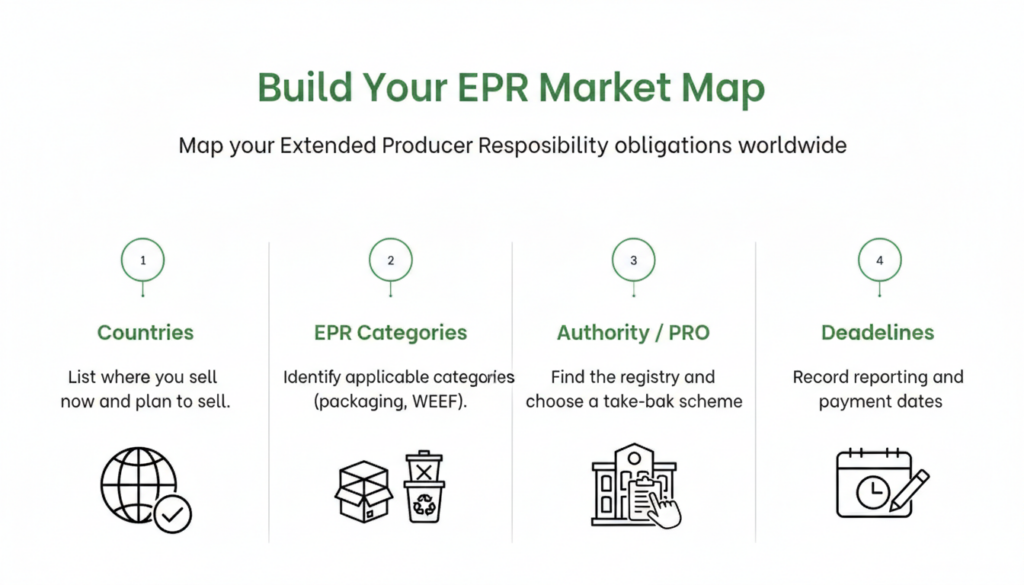
A market map is the first step in making a compliance workflow that will last. Write down every country you sell to now and every country you want to sell to in the next year. For each market, write down the relevant EPR categories, the authority that handles registrations, the deadline for reporting, and the take-back plan. This one document is the most important part of your compliance program.
Decide early on if you want to handle registrations yourself or hire a service to do it for you. The Amazon ePR Services Systemin-Platform program covers more and more markets, but independent providers often give more personalized help to sellers who sell in more than one category. As the program’s market coverage and prices change, look at both options every year. When comparing, important factors to look at are the number of markets covered, the per-kilogram fee rates agreed upon with take-back schemes, how quickly they respond when rules change in the middle of the year, and the quality of the reporting documents they give you for your own records. Don’t choose a provider just because they have the lowest price. A cheap service that files wrong reports is more dangerous than it is worth.
Lastly, think of EPR as an ongoing compliance area instead of a project that ends. Every year, rules change: new markets join, thresholds move, and fee rates change. If you want to stay ahead of enforcement actions and avoid the expensive scramble that catches unprepared sellers off guard, you should sign up for regulatory update services, go to compliance webinars, and review your packaging data every three months.
How to Collect and Manage Packaging Data for EPR Reporting
Every EPR report is based on correct packaging data. You can’t figure out the right fees without accurate information on the type and weight of the material sold per unit. If an audit finds a mistake, you are responsible for the extra costs. But sellers are always surprised by the step of collecting packaging data, especially those who get their products from many different suppliers in different countries.
The first step is to make a packaging specification sheet for each ASIN that is still active. This document lists the weight in grams of each part of the packaging, including the main consumer pack, any secondary grouping pack, the postal or fulfillment box, the void fill material, and the labels or tape. Each part is put into one of these material groups: paper, cardboard, plastic film, rigid plastic, glass, aluminum, steel, wood, or composite. These groups match up perfectly with the items on national EPR reporting forms, so keeping this level of detail from the start means less work at reporting time.
Sellers who use Amazon FBA have a special problem: Amazon may add its own packaging on top of the seller’s product packaging. In most European markets, this extra packaging counts toward the seller’s EPR obligation because they are the ones who hired Amazon to fulfill the order. Before sending in an EPR report, you should ask Amazon’s Seller Central help team for a packaging specification or look at the FBA packaging guidelines that are already out there.
Once the specifications are set, the reporting calculation is simple: just multiply the weight of each packaging part by the number of units sold in the country during the reporting period. A lot of sellers use a simple spreadsheet for this. Compliance software platforms, on the other hand, get sales data directly from Seller Central through an API and do the math for you. Either way works, as long as the underlying packaging specifications are correct and updated whenever the packaging changes.
Choosing Between In-House Compliance and a Third-Party Provider
One of the first big decisions an Amazon seller has to make is whether to handle EPR compliance themselves or hire a third-party company to do it for them. Both methods are valid and widely used, but which one is best for you depends on how big your business is, how many markets you sell in, and how many people you have on staff who can handle a regulatory function that changes every year.
In-house management is a good choice for sellers who only sell in one or two markets and have a small selection of products with simple packaging. If someone in the company is in charge of the annual reporting cycle and keeps track of deadlines, it is easy to handle. The only costs are the registration fees, the membership fee for the take-back scheme, and the time spent on the project. There is a chance that rules will change, thresholds will move, and a busy quarter could mean missing a deadline that starts enforcement.
Third-party compliance providers come in all shapes and sizes, from big international companies that work in many countries to small specialists that only work in one market. Their fees usually cover things like registration, annual reporting, figuring out how much to pay for take-back programs, and keeping an eye on changes in the law. For sellers who work in five or more markets, the time savings alone are often worth the provider’s fee. Providers also have professional liability insurance, which protects them even more in case a mistake in reporting leads to a fine from the government.
A hybrid model is also common for mid-sized sellers. They handle the biggest or most familiar market themselves and hire a provider to handle the rest. No matter what structure you choose, make sure the duties are clear. If a registration lapses, regulators won’t accept “my provider handled it” as a defense. The legal responsibility lies with the producer, not the service company.
Eco-Modulation — Reducing Your EPR Fees Through Packaging Design
Eco-modulation is one of the best ways for Amazon sellers to cut costs, but it is often ignored in favor of pure compliance management. The idea is simple: in more and more European markets, take-back programs change the fee per kilogram based on how easy or hard it is to recycle the packaging. Packaging that meets certain recyclability standards costs less, while packaging that is hard to sort or process costs more.
In Germany, the dual systems give modulation bonuses to packaging that is made from recycled materials, packaging that is under certain weight limits, and packaging that is easy to separate by material type. Citeo’s eco-modulation system in France goes even further by giving positive scores to recycling instructions on the packaging and negative scores to materials that pollute recycling streams. The overall effect on your annual fee can be very big. Sellers who design packaging with EPR in mind from the start can get discounts of 15% to 30%.
The first step to getting the benefits of eco-modulation is to do a packaging audit with your packaging supplier. The audit should compare the materials that are currently being used to the modulation standards set by the take-back program in each market. If a simple material change, like switching a mixed-material pouch for a mono-material one, lowers the surcharge, the cost of redesigning the packaging often pays for itself in just one reporting year. You should write down any changes and send them to the scheme before the start of the reporting period in which you want the benefit to apply.
Packaging optimization helps Amazon customers keep their promises to be more environmentally friendly, which is becoming more important to them. Amazon’s Climate Pledge Friendly program gives awards to products that meet certain sustainability standards. Packaging design is one of the most important factors for several of these standards. So, aligning your EPR strategy with your packaging sustainability roadmap gives you business benefits that go beyond just saving money on compliance costs.
Expanding into New European Markets — EPR Readiness Checklist
Whenever you open a new Amazon marketplace or start shipping to customers in a country where you weren’t already selling, you might have to follow a new EPR rule. It’s a common mistake to plan for market growth and EPR readiness as two separate tasks. Sellers who launch first and then look into compliance later will always have to pay retroactive fees and deal with the stress of emergency registration under commercial pressure.
It makes more sense to include an EPR readiness review in every market entry process, along with financial modeling, logistics planning, and product localization. Before the first product ships, the review should answer these four questions: Is there EPR law in this market that covers my type of product? What is the registration body, and what information do I need to sign up? What are the deadlines for reporting and the fees for my packaging profile? And does Amazon offer a compliance service on its platform in this market, or do I need to find a separate provider?
Belgium, Switzerland, Norway, and several Central and Eastern European countries are some of the markets that Amazon sellers often add after they set up shop in Western Europe. There are some differences in the rules for each. Switzerland is not part of the EU, but it has its own rules for the return, taking back, and disposal of electrical and electronic equipment, as well as its own system for recovering packaging. Norway, which is not in the EU, has a well-established deposit return scheme for beverage packaging that works with general EPR rules. Belgium has a federal structure, so both regional and national rules apply. The Fost Plus scheme covers household packaging in all three regions.
The only thing that always stops compliance emergencies is making market-entry EPR checklists for each target territory and checking them against current laws before launch. Laws change faster than most sellers think. For example, a country that didn’t have a formal EPR program eighteen months ago may now have a fully operational registry and enforcement in place. Staying in touch with sources of regulatory updates, like a compliance provider, an industry group, or a service that only watches legislation, keeps your plans for growth based on what is happening right now.
The European EPR rules are here to stay and will only get more strict. The sellers who put money into the right compliance infrastructure now will be able to grow into new markets without any problems with the law. LOVAT helps Amazon sellers set up that infrastructure by helping them with everything from registering their business to filing annual reports and managing fees in all of the major European markets.
FAQ
Do I need to register for EPR if I only sell small volumes on Amazon in Europe?
Yes. In most European countries (especially Germany and France), there is no minimum sales threshold for packaging EPR. Even if you sell just one unit to a customer in that country, you are considered a “producer” and must register before the first sale. Waiting until you scale can result in retroactive fees and listing suspension. If you have doubts – submit a form and our team will give you a fast reply
If I use Amazon FBA, is Amazon responsible for my EPR obligations?
No. Even if you use Fulfillment by Amazon (FBA), you remain the legal producer. This means you are responsible for registering, reporting packaging volumes, and paying fees. In some markets, Amazon offers EPR services, but enrollment is optional and does not automatically cover all obligations unless you actively join the program.
What happens if I don’t provide a valid EPR registration number to Amazon?
Amazon may:
- Deactivate specific ASINs
- Suspend your selling privileges in that marketplace
- Prevent new listings from going live
Additionally, national authorities may impose retroactive fees and fines, sometimes covering multiple past years of sales. In strict markets like Germany, enforcement can happen within weeks of non-compliance being detected.
What packaging do I need to report under EPR?
You must report all packaging placed on the market, including:
- Product packaging (primary packaging)
- Grouping packaging (secondary packaging)
- Shipping cartons
- Void fill, bubble wrap, padding
- Tape, labels, and inserts
For FBA sellers, Amazon’s additional fulfillment packaging may also count toward your obligation in most EU countries.
How can I reduce my EPR costs
You can lower fees through:
- Reducing total packaging weight
- Switching to mono-material packaging
- Increasing recycled content
- Designing packaging that meets eco-modulation criteria
Many European schemes offer 15–30% fee reductions for recyclable or sustainable packaging. Reviewing packaging annually can significantly reduce long-term compliance costs.