
Household or Industrial Packaging for Belgium and EPR Compliance
Household or Industrial Packaging for Belgium and EPR Compliance
The country has some of the strictest rules in Europe for managing product waste. Every business that sells goods locally must obey the law. These rules apply to all companies, regardless of size or sector. They cover both items sold to private customers and containers used in B2B supply chains.
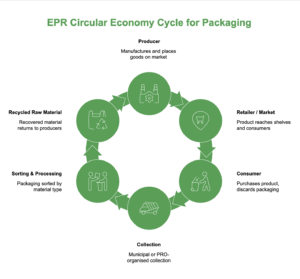
Understanding these distinctions is not optional. It is a business-critical requirement. Extended Producer Responsibility, known as EPR compliance, forms the foundation of the regulatory framework. This principle holds producers accountable for the entire lifecycle of their protective supplies, both financially and operationally.
The article targets business owners, compliance officers, and logistics managers. It explains how the rules work in practice. It covers key material categories, reporting duties, and actionable strategies. It also helps businesses choose the right industrial solutions that satisfy local requirements.
Belgium consistently achieves the highest recovery rates in Europe for packaged goods. A well-organized producer responsibility system underpins this success. Companies must fully understand how the framework operates to benefit from it and avoid penalties.
EPR Compliance Requirements for Packaging in Belgium
Extended Producer Responsibility is a policy tool rooted in EU law. It shifts waste management costs from governments to producers. The EU Packaging and Packaging Waste Directive provides the legislative foundation. Belgium applies this directive through its regional and federal regulatory structures.
EPR compliance in Belgium operates through a federated model. The Brussels-Capital Region, Wallonia, and Flanders each have their own regulations, forms, platforms, and deadlines for reporting. Every region has its own environmental agency and enforcement priorities. However, the core obligations are broadly aligned across all three.
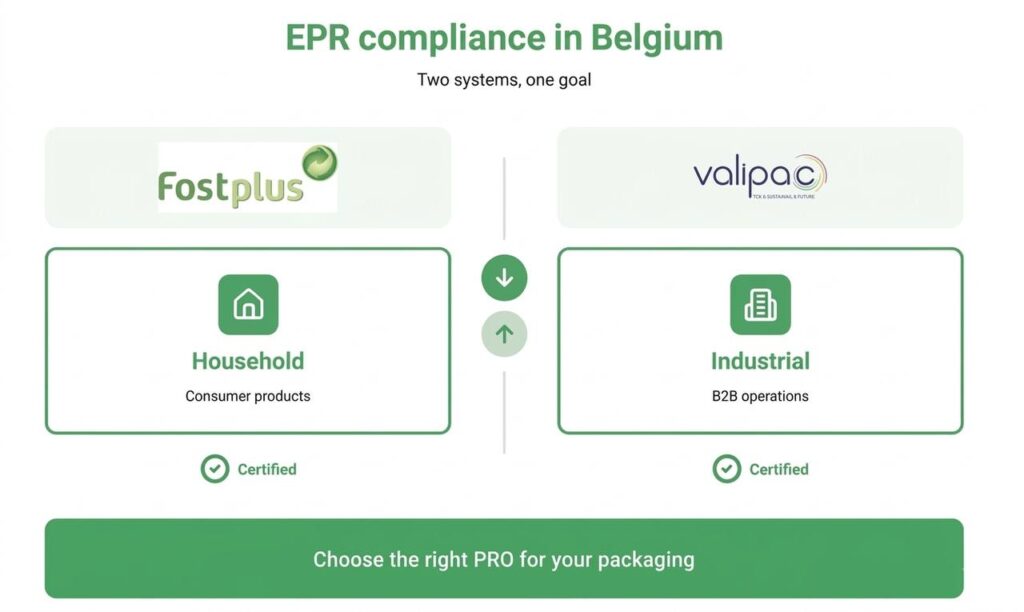
In actuality, adhering to regulations begins with registration. Every company introducing products to the local market must register with an approved producer responsibility organization (PRO). The appropriate PRO depends on the type of material. Fost Plus manages household packaging nationally. Valipac handles commercial and industrial packaging.
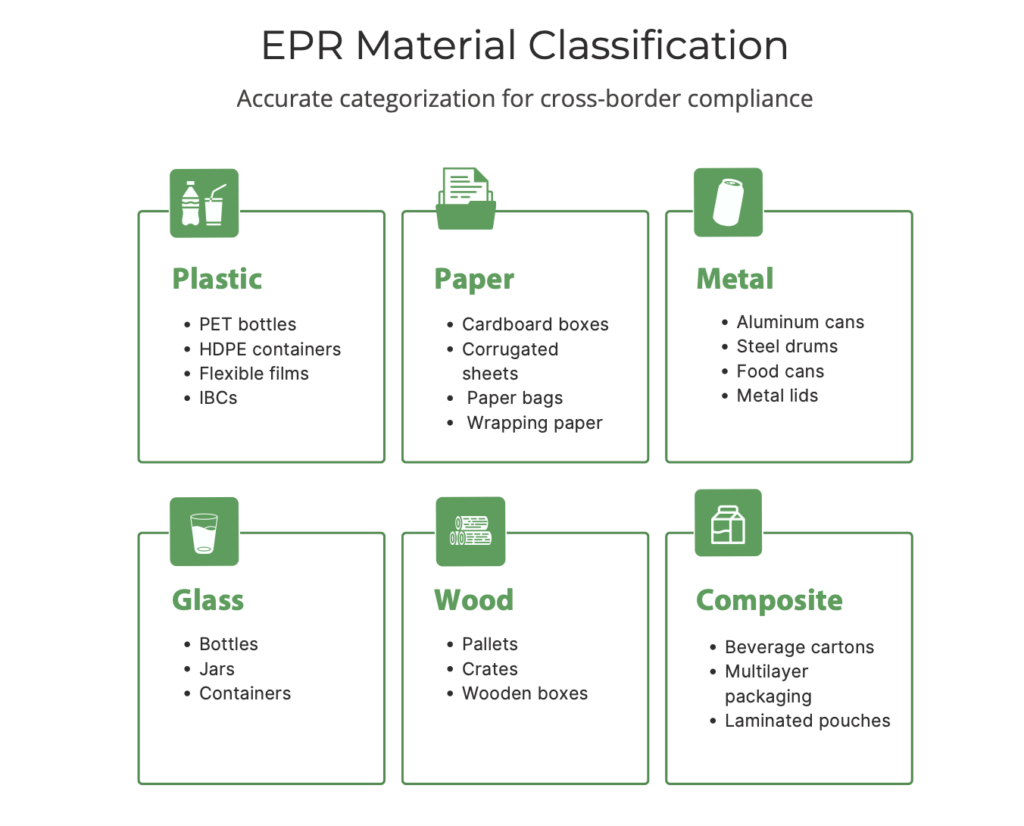
The annual declaration is the centerpiece of EPR compliance in Belgium. Companies must report the weight of supplies placed on the market during the preceding calendar year. The report must cover all categories separately. These include plastic, paper and cardboard, glass, steel, aluminum, and wood.
The scheme also establishes specific collection and recycling targets. These targets are updated periodically to reflect evolving EU directives. Companies do not collect or recycle their discards. Instead, they pay contributions to their PRO based on declared tonnage. The PRO uses these funds to finance national collection and sorting infrastructure.
Here are the key steps to achieving full regulatory compliance for containers locally:
- Determine whether your formats are classified as household packaging or commercial packaging
- Register with the relevant PRO — Fost Plus or Valipac — before market entry
- Build an internal system to track volumes by material type and weight
- Submit accurate annual weight declarations by the regulatory deadline
- Pay contribution fees based on declared volumes and applicable material rates
- Ensure new designs meet EPR Belgium standards for eco-design and recyclability
- Retain supporting documentation for at least five years in case of audit
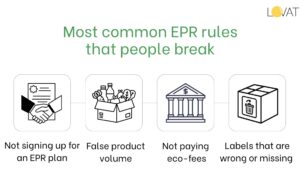
Non-adherence carries serious consequences. Administrative fines can be substantial. Local environmental authorities conduct periodic audits. Repeated failures can lead to enforcement notices. They can also damage relationships with retailers and trade partners who require proof of regulatory compliance from suppliers.
Types of Industrial Packaging Used by Businesses in Belgium
Commercial formats are fundamentally different from consumer material. They are not designed for the end consumer. They function within B2B supply chains. Their purpose is to protect, transport, and store products between manufacturing and distribution points.
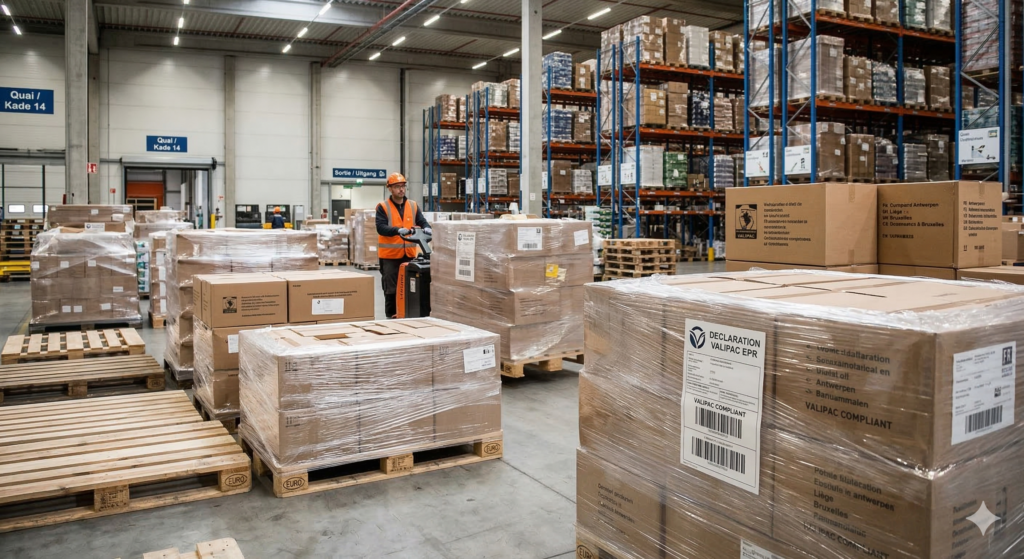
Industrial wraps used across local industries cover a broad range of formats. The most common types include corrugated cardboard boxes, wooden pallets, plastic stretch film, intermediate bulk containers, steel drums, fibre drums, and rigid plastic crates. Each format serves a distinct logistical purpose.
The most common material used for local distribution and warehousing is still corrugated cardboard. It is lightweight, cost-effective, and accepted within mainstream recycling streams. Large-format boxes serve food, pharmaceutical, electronics, and retail sectors across the country.
Wooden pallets are ubiquitous in local logistics. They form the structural foundation of most distribution networks. Many businesses operate pooled systems through providers such as CHEP or LPR. These arrangements reduce the volume of declared materials under Belgium EPR rules.
Intermediate bulk containers (IBCs) are essential in chemical manufacturing, food processing, and agriculture. They hold between 500 and 1,250 liters of liquid or granular product. IBCs are frequently reconditioned and reused, which reduces waste volumes considerably.
Steel and fiber drums serve industries dealing with hazardous substances, lubricants, and concentrated chemical formulations. They offer structural integrity and resistance to environmental factors. End-of-life management for these formats is mandatory under local law.
Plastic stretch film is extensively used for pallet stabilization. It protects goods during road and rail transit. Despite its prevalence, stretch film presents significant recycling challenges. It requires dedicated collection infrastructure and large-scale sorting to meet the program’s targets.
The choice of format has direct implications for EPR compliance contribution levels. Heavier, harder-to-recycle components attract higher per-kilogram rates. Companies that audit their materials portfolio carefully can often identify opportunities to reduce costs and environmental impact simultaneously.
Industrial Packaging Solutions for Companies Operating in Belgium
Selecting the right approach to product protection is a strategic decision. It affects operational expenses, environmental performance, and regulatory compliance. Companies in Belgium now have a growing range of industrial supply solutions to consider.
Reusable systems represent one of the most effective strategies under the producer responsibility framework. When containers circulate multiple times, the declared volume per unit of product decreases significantly. This directly lowers annual EPR compliance contribution payments. It also strengthens a company’s environmental credentials.
Many products are packaged and stored in reusable plastic containers (RPCs). Supermarket groups, fresh produce distributors, and dairy producers rely on closed-loop RPC systems. These formats move between supplier and retailer without entering the waste stream between trips. Several logistics companies offer RPC pooling services nationwide.
Refillable IBCs provide an effective industrial storage solution for liquid goods. The container returns to the supplier after emptying. Thereafter, it is examined, cleaned, and replenished for future usage. Over a full lifecycle, one refillable IBC can replace dozens of single-use alternatives.
Lightweighting is another well-established method. Engineers reduce material thickness without compromising structural performance. Less material per unit means lower production costs. It also reduces EPR compliance contribution fees, since these are calculated by weight.
Mono-material design is gaining traction locally. Goods enclosed in a single material type are far easier to sort and recycle than multi-layer alternatives. Local sorting facilities handle mono-material plastic, paper, and metal formats efficiently. Mixed-material laminates frequently wind up in residual waste, which lowers recycling efficiency overall.
Digital traceability tools are transforming how businesses manage their EPR compliance obligations. Dedicated software automatically tracks volumes by material type, market destination, and reporting period. The data feeds directly into annual declarations. It reduces manual errors and improves audit readiness across all operations.
Companies that invest in well-designed industrial protective solutions benefit in multiple ways. They cut costs, improve sustainability metrics, and demonstrate genuine commitment to the country’s circular economy goals.
Comparison of Household and Industrial Packaging in Belgium
EPR Belgium rules treat household packaging and industrial packaging as two distinct regulatory categories. The distinction is not simply about size or material. It is about the end user and the distribution channel through which the container reaches them.
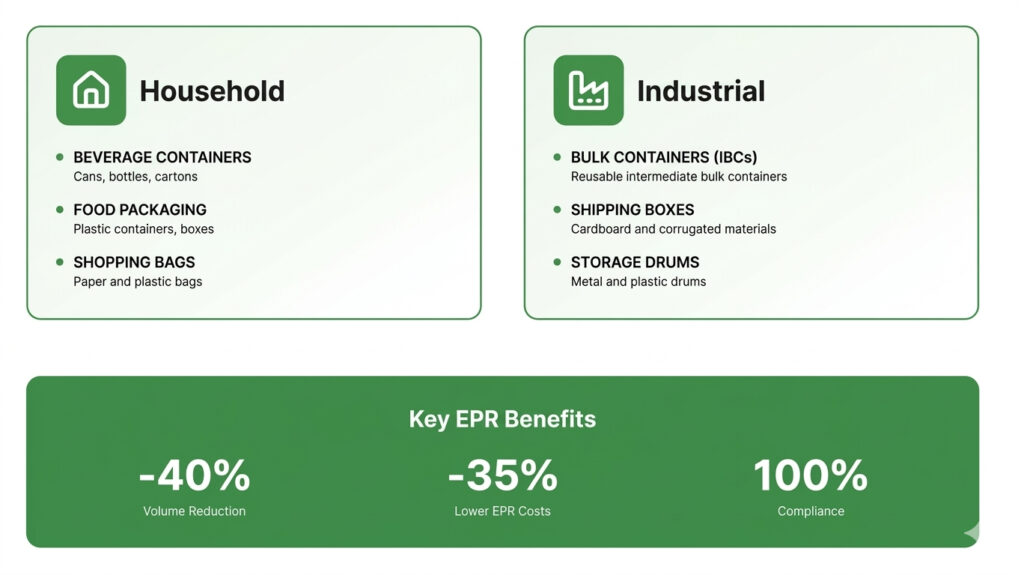
Household packaging includes items that reach a private consumer. This includes the outer box of a cereal product, a plastic bottle of shampoo, or a glass jar of pasta sauce. These items are collected through municipal waste streams. Consumers deposit them in colour-coded bins. Fost Plus funds and coordinates collection, sorting, and recycling across the country.
Industrial packaging, in contrast, circulates exclusively within B2B supply chains. It never reaches a private household. Valipac manages this category. It operates a nationwide collection network, gathering materials from factories, warehouses, and distribution centres. Companies pay EPR contributions based on annual declarations to maintain EPR compliance.
The table below provides a structured comparison under the EPR framework:
| Feature | Household | Industrial / Commercial |
| End user | Private consumer | Business or professional buyer |
| Collection route | Municipal bins / kerbside | Business waste contractor / Valipac point |
| PRO in Belgium | Fost Plus | Valipac |
| Typical formats | Bottles, boxes, bags, trays | Pallets, drums, IBCs, stretch film, crates |
| Contribution basis | Declared weight (kg) per material | Declared weight (kg) per material |
| Eco-design focus | Consumer visibility, sorting ease | Sortability and reusability |
| Reporting period | Annual calendar year | Annual calendar year |
| Audit exposure | Moderate—retail sector focus | Annual calendar year |
The boundary between categories is not always clear. Some formats are genuinely dual-use packaging. A cardboard outer box may reach both retail consumers and food service businesses. In such cases, companies must split their declaration proportionally. Declaring all volumes as commercial to reduce obligations is a regulatory risk.
Authorities take misclassification seriously. Declarations are cross-referenced against customs data, invoicing records, and industry benchmarks. Businesses should document their categorization process and utilize it consistently each year.
Ready to register for EPR in Germany? Skip the paperwork headaches — Lovat handles your EPR registration across all categories, so you can start selling without compliance risks. Get registered today or book a free consultation with our EPR specialists.
How Companies Achieve EPR Compliance with Industrial Packaging
Achieving sustained EPR compliance for industrial packaging requires more than an annual declaration. It demands an ongoing internal management process. Companies that treat it as a daily operational priority consistently outperform those that address it only once a year.
The journey begins with a thorough material audit. Every item used within the business must be identified and catalogued. This covers primary, secondary, and tertiary packaging. The audit should capture material type, unit weight, annual consumption, and the market where each item is placed.
Once the audit is complete, each item must be classified correctly. The central question is simple: does the container ever reach a private household? If yes, it falls under Fost Plus. If not, it falls under Valipac. Some items will require a split declaration to maintain full EPR compliance.
Registration with Valipac is mandatory before placing commercial goods on the Belgian market. Late registration attracts penalties. Companies entering Belgium should prioritise this step from their very first day of market entry.
Annual contribution calculations are based on declared weight. Contribution rates differ by material. Plastic typically carries a higher rate per kilogram than cardboard. Wood and metal rates reflect specific recycling economics. Businesses should obtain the current rate schedule from Valipac at the start of each reporting year.
Appointing a dedicated compliance manager is highly recommended. The manager coordinates data collection across procurement, logistics, and production teams. They maintain accurate records throughout the year. They also manage communication with Valipac and monitor regulatory updates.
Technology plays an important role in modern EPR compliance management. ERP systems can be configured to flag procurement events. Dedicated platforms automatically aggregate volume data by material and reporting period. This eliminates the end-of-year reconstruction of records.
Eco-design is an increasingly important dimension of industrial packaging compliance. Products put on the market must be recyclable according to local rules. It means avoiding materials and coatings that contaminate sorting streams. Valipac publishes design-for-recycling guidelines that members should consult before ordering new formats.
Engagement with Valipac should be ongoing, not annual. Valipac provides member tools including weight calculation guides, FAQ resources, and regulatory support. They also deliver advance notice of legislative changes. Companies with active memberships are better positioned to adjust to changes in rates or targets.
Industry networks further support regulatory readiness. The Belgian Packaging Institute and sector trade associations share best practice and regulatory intelligence. Participation helps compliance officers stay ahead of legislative developments rather than reacting to them.
Training is the final and often underinvested element. Procurement staff make specification decisions every day. Logistics teams determine how containers are used and stored. Without awareness of these implications, employees may inadvertently increase a company’s compliance risk. Brief, regular sessions on classification and environmental targets deliver measurable value.
The country has built one of the most rigorous Extended Producer Responsibility frameworks in the European Union. The system covers both household packaging and industrial packaging with precision. For businesses operating locally, EPR compliance is both a legal obligation and a reputational priority.
Companies that invest in accurate classification, robust reporting, and well-chosen industrial packaging solutions will meet their requirements efficiently and cost-effectively. We should not minimize EPR compliance. It is an opportunity to demonstrate environmental leadership.
Organizations that embrace this perspective align with Belgium’s circular economy goals and earn the trust of regulators, customers, and partners alike.

Related articles