
How to Manage EPR Across Multiple EU Countries
How to Manage EPR Across Multiple EU Countries
Why managing Multi Country EPR Compliance Across Countries in the EU Is Difficult
At the point a business begins to sell in a second or third market in the EU, dealing with EPR compliance is usually not the top priority.
There are often more immediate pressures:
- Logistics to be organized;
- VAT registrations to be completed;
- Localization work to be done.
Usually, just a few weeks before the first shipment is due to leave, a voice asks: “Do we need to be packaging compliant in Germany?” And the answer is almost invariably: “Yes, you’re entering a minefield!”
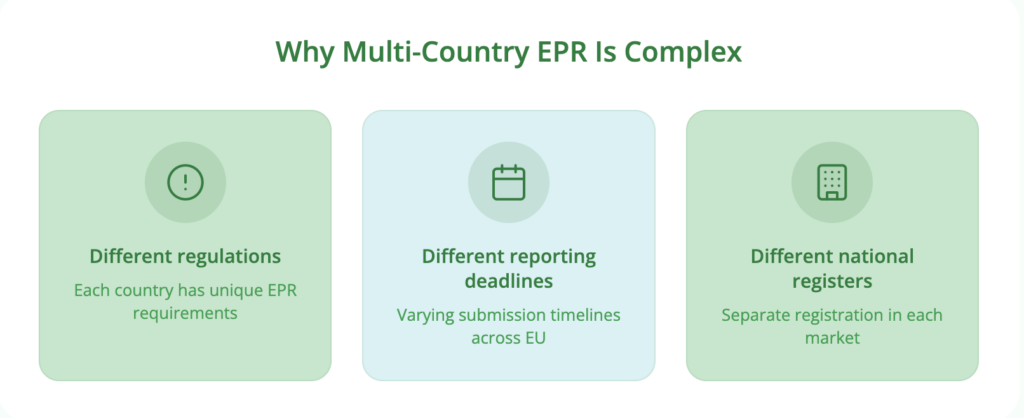
Why Multi-Country EPR is Complex Multi-country EPR compliance is not a one-person problem. It consists of a set of interdependent yet autonomous compliance requirements, characterized by:
- Distinct rules for every jurisdiction;
- Progressively set thresholds that trigger obligations;
- Different monitoring bodies across member states.
A business that considers this a single task will suddenly find, more likely than not, that it is far more complex than anticipated.
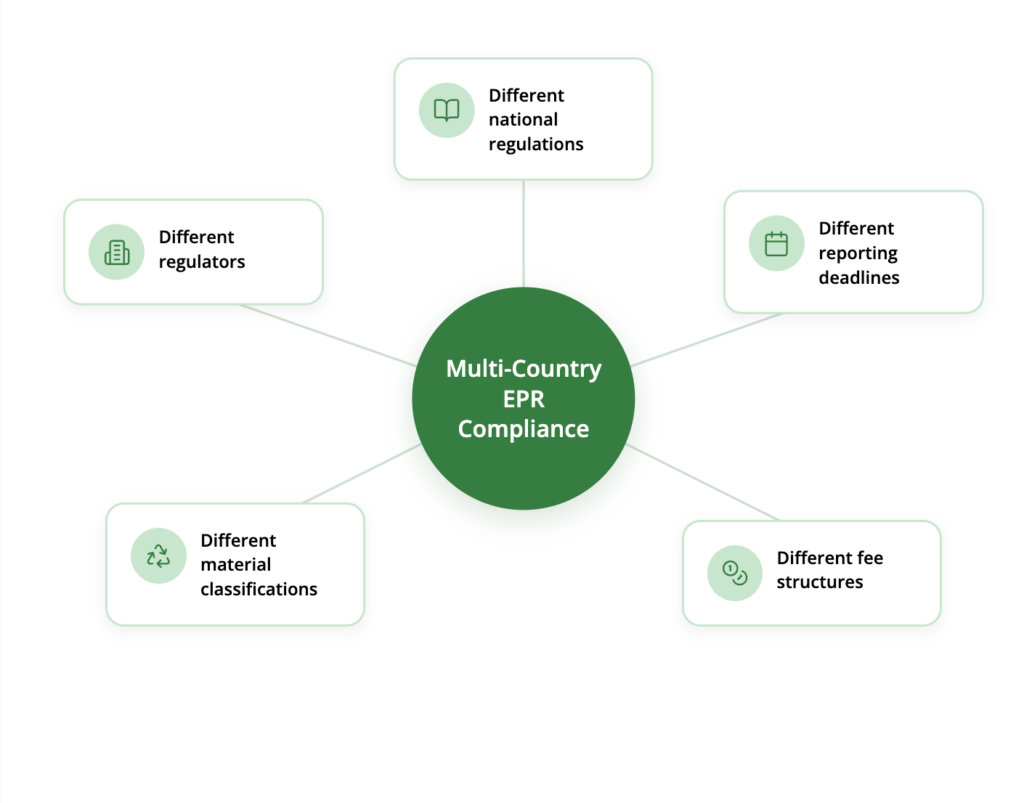
The “Complex Quilt” of Regulations The EU doesn’t have a single EPR scheme. While the EU Packaging and Packaging Waste Directive sets the general principle, each individual country imposes its own national law version. This creates a complex quilt of regulations where several factors may differ by country:
- Timing of decisions: When you are required to take action;
- Fee levels: The cost of compliance and environmental contributions;
- Material classification: Rules on how to categorize packaging (e.g., plastic vs. paper);
- Registration requirements: Specific documentation and reporting formats.
The Risk of a Non-Structured Approach Companies managing EPR compliance across multiple countries without a systematic approach may effectively find themselves running five, ten, or even fifteen parallel compliance programs, each carrying distinct regulatory requirements and risks.
Practical Guide for Businesses Managing EPR Compliance
This business guide covers everything you need to know about EU-wide EPR compliance, from the first question of whether you need to register at all to material classification, authorized representative obligations, and reporting cycles in different countries. It is for e-commerce operators, finance teams, and compliance leads who need to know exactly what they need to do, not just a general overview of EU policy.
A full guide for businesses that operate in EPR jurisdictions doesn’t start with the rules. The foundational element is granular packaging data. Prior to producer registration, an entity must perform material classification of all packaging components. That one set of data is the basis for every declaration, every fee calculation, and every audit defense for all of multi-country EPR compliance.
Understanding EPR Product Categories Across Countries in the EU
When people hear the phrase “Guide for business,” they usually think of packaging. For most e-commerce businesses, packaging is the most important thing they have to do. But EPR product categories go far beyond the box your product comes in. You may have to follow different EPR streams at the same time, depending on the markets you sell to and the types of products you sell.
The EU directives set up the main EPR product categories, which are:
- Packaging includes primary, secondary, transport, and service packaging.
- Electrical and electronic equipment (WEEE) includes anything that needs a plug or battery to work.
- Batteries and accumulators, such as the ones that come with portable devices.
- Textiles and shoes are required in France and are becoming more common in other member states.
- Furniture is currently available in France and is being considered in other places.
- Tyres — this applies to businesses in the automotive aftermarket sector.
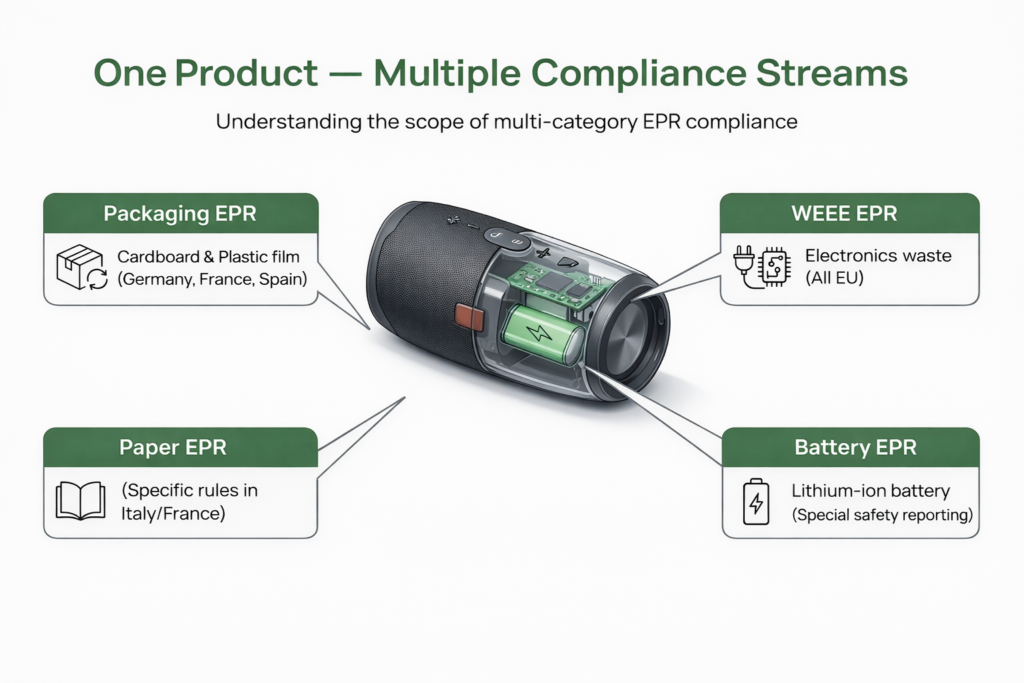
Not all businesses will have to follow the rules for all of these EPR product categories. But a business that sells a Bluetooth speaker in a cardboard box with a battery inside has to deal with three different EPR streams at the same time: packaging, WEEE, and batteries. They have to handle each one separately. Before you start registering, you must get the scope right. This is the first step in any serious multi-country EPR compliance program
How EPR Categories Differ Across Member States
The EPR categories set by the EU are a good starting point, but each country has its own way of putting them into practice. France has added textiles, shoes, and furniture to the list of EPR categories. These obligations are not the same in Germany or Poland. Spain uses tiered EPR categories by distribution channel, which means that the same product sold through an online store and a physical store may have different obligations.
Even within packaging, which is the most consistent EPR category across the EU, the definition of what counts varies a lot. In some places, service packaging (tissue paper, void fill, and branded bags used at the point of dispatch) is included, but in others, it is not. Some markets require reports on country packaging, while others do not require producers to do so. For multi-country EPR compliance, you need to know not only that packaging is covered, but also which packaging, in which country, which guide for businesses to use and under which definition.
Country Packaging Requirements Across Countries in the EU
The rules for packaging in different countries don’t just change the fees. They differ in the basic structure of how packaging is defined, sorted, and reported. This is where businesses always think it’s easier than it is.
The foundational element is granular packaging data. Prior to producer registration, an entity must perform a material classification of all packaging components, and each stream must have its own weight declaration. Austria uses a different way to classify things. The same physical product—such as the same box and materials—has different reporting requirements depending on the country-specific packaging framework you are using.
The ways that countries charge for packaging are also very different. Germany’s dual systems charge fees based on the declared weight of each material fraction. Each licensed operator sets the rates each year. France’s Citeo uses an eco-modulation coefficient to change those base rates based on how recyclable the product is and how well it was designed to be reused. A company that knows what it needs to do to package its products in Germany may find that the rules for doing the same thing in France are very different and require a different set of data and way of doing things.
The compliance risk inherent in these country packaging discrepancies is not hypothetical. If you misclassify a composite material category for a whole year of shipments, you could either be underpaid, which regulators will actively pursue, or you could be overpaid, which just eats into your margin for no reason.
EU Directive Framework and Packaging Regulation
The EU Packaging and Packaging Waste Directive, also known as Directive 94/62/EC, has been the main law that governs packaging EPR in the EU for thirty years. The directive set minimum recycling goals, made producers responsible for their products, and told member states to set up national systems for dealing with packaging waste. It didn’t make those systems work together, though. Each member state put the directive into effect in its own way, at its own pace, and with its own administrative structures. The result is the broken-up landscape that businesses have to deal with today.
The new Packaging and Packaging Waste Regulation (PPWR) will go into effect on August 12, 2026. A regulation, on the other hand, applies directly to all member states without having to be changed in each country. This means that, in theory, there will be one standard that replaces the current patchwork of national interpretations. The transition will take time in real life, and the current national systems will still work during the changeover period.
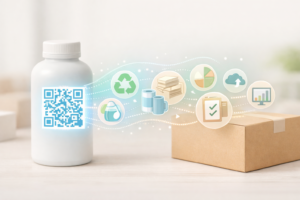
Three parts of the PPWR are important for operations right away. First, the rule sets a single standard for reporting data, which will eventually replace the country-specific declaration formats that businesses now have to deal with in many different systems. Second, a PFAS ban starts in 2026. This means that food, drink, and grocery businesses will have to stop using per- and polyfluoroalkyl substances in food-contact packaging. Third, digital product passports sent through QR codes will show recyclers and regulators the data about the packaging materials at the point of processing. If your packaging data is wrong today, the new rule will make that wrongness clear in ways that the old rule never did.
Multi Country Registration Process for EPR Compliance
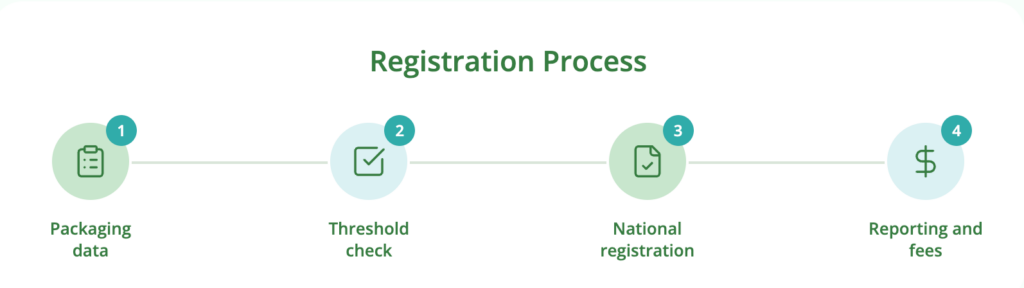
A Step-by-Step Guide to Multi-Country Registration Multi-country registration is the process of getting compliant producer status in each EU country that is relevant. There isn’t just one thing that happens. It is a series of actions that must be taken in the right order and on time for each country. One of the most common mistakes businesses make is treating multi-country registration as a one-time task instead of an ongoing compliance issue.
- Step 1: Make the data for your packaging base You need to have a full picture of your packaging portfolio before you can start registering in more than one country. That means keeping track of all the parts of your packaging, including the primary, secondary, transport, and service parts, for all of your products. You should also record the type of material and weight of each unit and figure out how many of each product are sold in each country each year. This data set is the basis for all of your declarations, fee payments, and audit defenses for your entire multi-country EPR compliance program.
- Step 2: Find out what each country is responsible for Check to see if you meet the registration threshold in each target market by looking at your packaging data. Each country and material category has its own threshold. For example, you might be above the threshold for plastics in Germany but below it for glass. Don’t think that one threshold determination applies to all materials or all markets. At this point, you should also check to see if your duties go beyond packaging and into other EPR product categories.
- Step 3: Finish registering with each National Producer Register Now that your data is ready, you can register with each national register. Before any packaged goods can be sold in Germany, they must be registered with LUCID. There is no grace period for this. You need to sign up for ADEME’s producer register in France. The BDO system is used in Poland. Austria works through the EDM portal. Every portal has its own rules for documents, its own processing time, and its own administrative fee. Being registered in more than one country in one market does not mean you are compliant in another.
Role of the Authorized Representative in EPR Compliance
If your business is based outside of the European Union, you can’t register directly with most national producer registers. You must choose an authorized representative, which is a legal entity set up in the EU member state where you are registered, to handle your EPR duties and register on your behalf.
Being an authorized representative means you are legally responsible. Your representative is responsible for the accuracy of the declaration they submit to a national register according to the laws of that jurisdiction. If you pick the wrong authorized representative—one that is slow, unclear, or not experienced enough in the relevant national system—you risk not being compliant, and that risk grows with each reporting cycle.
When a business works in more than one EU market, the question of who is their authorized representative quickly becomes more complicated. In Germany, France, Poland, and Austria, a different representative may be needed. Each one would be chosen through a different agreement and would report back to the producer in their own way. Managing those relationships by hand makes an already difficult compliance program even harder to run. For most businesses that operate on a large scale, the best way to do this is to centralize coordination through a platform that manages authorized representative services across multiple jurisdictions.
EPR Compliance Across Countries in the EU Comparative Overview
Even when they have the same underlying directive, the EU countries do not have the same compliance architecture. The table below shows the most important factors that affect most e-commerce businesses that have to follow EPR rulesin more than one country.
| Country | Primary EPR Focus | Key 2026 Deadline | Registration Threshold | Mandatory Symbol |
| Germany | Packaging & WEEE | Annual report by 15 May | Material-specific (e.g. 50 kg plastic) | None — LUCID ID required |
| France | Packaging, Textiles, Furniture | Typically Q1 (varies by PRO) | From first unit placed on market | Triman + Info-tri |
| United Kingdom | Packaging (pEPR) | Bi-annual reporting | Large vs. small organisation | None — OPRL optional |
| Poland | Packaging & Batteries | Annual report by 15 March | Per material category | BDO Number |
| Austria | Packaging | Annual declaration | 15 tonnes per year | None |
| Spain | Packaging | Varies by autonomous region | Tiered by material and channel | None |
EPR compliance is getting stricter, not looser, in all EU countries. Germany has stepped up enforcement in online marketplaces. For example, Amazon and eBay now block listings from sellers who can’t show a valid LUCID registration number. Before the PPWR goes into effect, France is making the eco-modulation criteria stricter. Poland’s BDO system actively compares declarations to customs data. As the 2026 regulatory transition gets closer, the EU countries that were once thought to be lower-risk enforcement environments are also moving toward systematic monitoring.
Operational Challenges of Multi Country EPR Compliance
It is tempting to think of EPR compliance as a paperwork problem. Fill in the form, pay the fee, move on. The reality is messier than that.
The first genuine difficulty is material classification. EPR fees are calculated by material type and weight, but the packaging taxonomy used in Germany is not identical to the one used in France. A composite packaging — say, a cardboard sleeve with a plastic window — might be reported as a single mono-material stream in one country and split across two material fractions in another. Get that wrong consistently across a full year of shipments and you are either overpaying or underpaying. Both create problems.
The second difficulty is eco-modulation. Several EU countries now adjust EPR fees based on recyclability scoring and design-for-circularity criteria. France has been applying fee modulation coefficients directly tied to packaging end-of-life performance through Citeo for years. Germany’s dual systems have followed. If your packaging qualifies for a reduced rate under the applicable eco-modulation matrix but you do not know to claim it, you are leaving money on the table — sometimes significant amounts.
The third difficulty is the authorised representative requirement, covered above. Underneath all of this sits a data governance problem that most teams do not anticipate until they are already in it. Numbers drift between spreadsheets. Deadline reminders live in one person’s inbox. By the second reporting cycle, it becomes genuinely unclear which baseline dataset was used for which country’s declaration — a circumstance with direct implications for audit defensibility.
How L EPR Supports Multi Country EPR Compliance
It is possible to manually keep track of EPR compliance in more than one country, and some teams do. But there isn’t much room for mistakes, the administrative costs are high, and the rules and regulations are always changing. There are new types of EPR products coming out. The rules for eco-modulation are getting stricter. Before PPWR goes into effect, the way reports are made is changing. What works as a manual process in three markets usually stops working long before it gets to ten.
This is exactly what L-EPR was made for. The platform collects packaging data from all active markets, sorts it into the right material categories and reporting requirements for each country, and creates declarations in the way that each national register wants them. Threshold monitoring runs all the time. When your sales volume in a new market goes over a registration threshold, the platform warns you before it becomes a compliance breach, not after.
At the system level, deadline management works. Based on the features of your packaging, eco-modulation changesare made automatically. For businesses outside the EU, authorized representative coordination is handled by a single point of contact instead of having a different local arrangement in each country. L-EPR makes multi-country EPR compliance a controlled, auditable process instead of a bunch of manual tasks spread out over many teams and inboxes.
Most teams find that the work that used to take weeks of manual effort runs smoothly in the background after the first full reporting cycle on the platform. The numbers don’t move around. You don’t miss the deadlines. And when a regulator asks a question, the evidence is already in order and ready.