
Recommendations for marking labeling packaging in Slovakia
Recommendations for marking labeling packaging in Slovakia
Slovakia merges EU regulations with national laws for packaging labeling. Manufacturers upgrade used labeling equipment to meet updated requirements while extending machinery lifecycle. The labeling equipment market expands as regulatory demands grow more detailed across Europe, protecting the environment and informing consumers about material composition, waste disposal, and recycling.
Act No. 79/2015 governs packaging and plastics, establishing producer responsibility and labeling packaging rules. Producers selling packaged goods fund collection, recovery, and recycling of waste through extended producer responsibility.
Regulations No. 373/2015 and 371/2015 simplified Waste Act implementation, clarifying manufacturer responsibilities for Slovak companies.
Symbol for packaging recycling in Slovakia
Recycling symbols are critical for environmental compliance and consumer education. The marking symbol system lets consumers, waste professionals, and facilities identify materials quickly. Slovakia follows harmonized EU standards for material identification codes. This ensures consistency across member states and facilitates cross-border trade.
Marking and labeling requirements in Slovakia
Directive (EU) 2019/904 targets single-use plastics, defining how producers communicate material content and disposal rules through marking and labeling requirements. Implemented by Member States in July 2021, it transformed labeling packaging approaches across Europe to protect water, environment, and human health.
EU Regulation 2020/2151, enforced from July 3, 2021, establishes detailed rules for single-use plastic markings – specifying placement, size, appearance, colors, image quality, and font sizes.
Act No. 79/2015 Coll. defines mandatory and voluntary marking and labeling provisions for packaging producers. While material composition marking remains optional, producers choosing it must follow Decree No. 373/2015 Coll. on EPR standards for consistency.
Registration rules require companies importing over 100 kg annually to register, join recycling programs, and pay fees. Imports below 100 kg need only registration, balancing administrative burden with environmental protection.
How the European Union regulates marking and labeling of packaging
Directive (EU) 2019/904, Annex Part D lists single-use plastics requiring special markings to inform consumers about plastic content and disposal methods. Markings clearly show products contain plastic, explain proper disposal, and highlight littering harm. Required products include sanitary towels, tampons, wet wipes, filtered tobacco items, and drink cups.
The marking symbol uses standard visual elements. This graphic symbol follows unified EU design for immediate recognition across all product categories. Each marking features two equal-sized boxes side by side – one red, one blue – with a black information box below. The three-box layout creates visual consistency customers recognize regardless of product type.
Information text extends beyond English labeling. Markings must include text in the official language where sold. Products marketed in Slovakia require Slovak language text, ensuring accessibility and compliance with national linguistic requirements.
Recycling symbol on packaging and consumer guidance
The recycling symbol on packaging provides standardized visual guidance on material identification and waste sorting. In the european union, these symbols follow harmonized rules to ensure consumers can recognize materials regardless of the country of sale. While the presence of a recycling symbol on packaging helps identify material composition, it does not automatically indicate recyclability. Proper interpretation supports correct disposal behavior and improves the efficiency of national recycling systems, including in Slovakia.
Visual requirements for labeling packaging and graphic symbol
Technical guidelines mandate a 1:2 height-to-length ratio for marking labeling packaging. This ensures markings remain balanced and readable. Package size or orientation doesn’t affect this standard.
Color specifications use the CMYK model. This ensures consistent reproduction across printing systems. Manufacturers must follow precise color codes. White appears as C=0, M=0, Y=0, K=0. Black requires C=0, M=0, Y=0, K=100. Red uses C=0, M=90, Y=60, K=0. Blue specifies C=60, M=0, Y=0, K=0.
| Color | Cyan (C) | Magenta (M) | Yellow (Y) | Black (K) |
| White | 0 | 0 | 0 | 0 |
| Black | 0 | 0 | 100 | 100 |
| Red | 0 | 90 | 60 | 0 |
| Blue | 60 | 0 | 0 | 0 |
Package labeling requires Helvetica Bold font in all caps. Font sizes range from 5 to 14 points, adjusted for package size. A thin white line surrounds each label. This ensures visibility on colored backgrounds.
Resolution requirements maintain marking clarity. Manufacturers must print markings at minimum 300 DPI.This ensures visual elements and text remain sharp. They stay legible throughout the product’s shelf life.
Positioning rules for marks labels and marking symbol
Marking positions vary by product, package, and customer usage. Marks labels typically appear on the front or top for easy visibility, with placement depending on package design, retail display, and handling patterns.
Small packages may split markings between two sides – top and front, or front and side – ensuring even compact items display required marks labels clearly.
Vertical orientation serves as fallback when horizontal placement proves impossible. Markings may rotate ninety degrees while maintaining all specifications for size, color, and design. The boxes must never separate, preserving visual integrity for quick consumer recognition.
Marking requirements for sanitary products and beverage cups
Sanitary towels and tampons with applicators need specific labeling. Packages with surface area of at least 10 square centimeters must include a printed mark. This shows the two-box design reading PLASTIC IN PRODUCT. Smaller packages are exempt.
Package surface area dictates marking size. Front or top under 65 square centimeters needs marking of at least 1.4 cm × 2.8 cm. This equals 3.92 square centimeters total. Larger surfaces require markings covering 6% of the area. Maximum is 3 cm × 6 cm, equal to 18 square centimeters total.
| Package Surface Area | Minimum Marking Size | Coverage Requirement |
| Less than 65 cm² | 1.4 cm × 2.8 cm (3.92 cm²) | Fixed minimum size |
| 65 cm² or larger | Scales to package | 6% of placement surface |
| Maximum size cap | 3 cm × 6 cm (18 cm²) | Maximum ceiling applies |
Marking drink cups presents unique challenges. Rules differ for partially plastic cups versus wholly plastic cups. Partially plastic cups need a printed mark. This uses the standard two-box design and PLASTIC IN PRODUCT text. The mark appears horizontally on the outside, away from the rim.
Wholly plastic cups may use printed or engraved/embossed markings. Engraved/embossed options provide permanent marking. These cannot wear off through washing or handling. The graphic symbol for engraved/embossed markings appears as outline elements. These are physically formed into the cup surface. Information text reads MADE OF PLASTIC instead of PLASTIC IN PRODUCT.
Recycling symbols on packaging and material codes
The system of recycling symbols on packaging enables effective material sorting. Each recycling symbol on packaging provides quick guidance on material type and correct disposal method, helping consumers identify proper handling. Recycling codes facilitate easier material identification but don’t automatically indicate recyclability—a critical distinction consumers and waste processors must understand.
Material identification codes support recycling infrastructure by enabling automated and manual sorting systems to separate different material types. The coded system uses numbers within recycling symbols to indicate specific compositions. Standardization facilitates international trade in recyclable materials and supports development of material-specific recycling technologies.
Plastic recycling codes and their applications
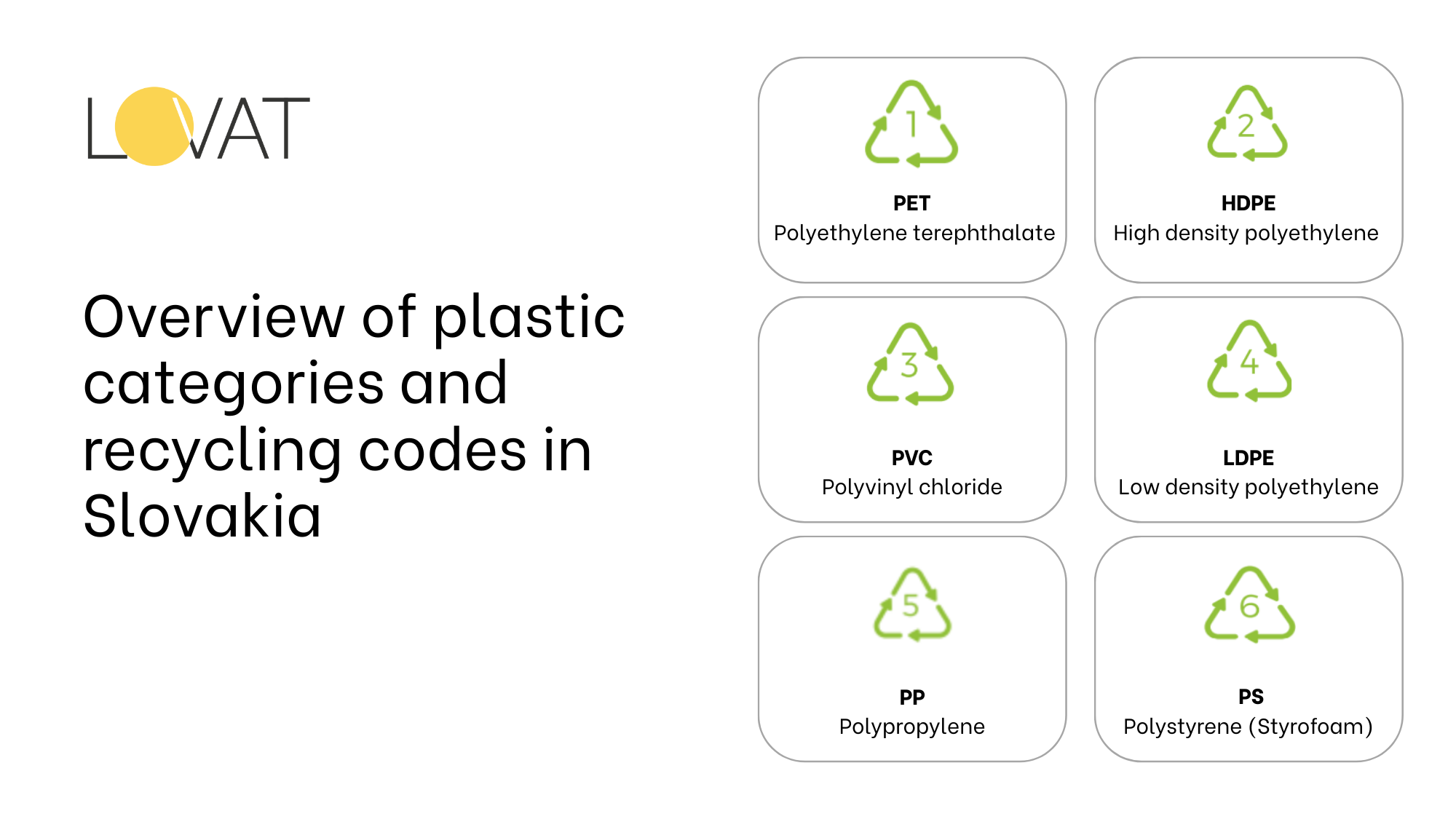
The plastic resin identification system uses recycling symbols on packaging with codes 1 through 7. These cover major plastic categories. Additional codes exist for specialty materials. Each number corresponds to a specific polymer type. These have distinct recycling characteristics and end-use applications. Understanding these codes helps consumers make informed decisions.
Polyethylene terephthalate has code 1 with abbreviation PET. This is rigid and unbreakable plastic. PET finds widespread use in:
- Beverage bottles for water, carbonated drinks, and fruit juice
- Edible oil bottles
- Food packaging containers
This makes it one of the most commonly recycled plastics globally.
Code 2 identifies high-density polyethylene, abbreviated HDPE. This is rigid plastic material. HDPE commonly appears in:
- Detergent bottles and shampoo containers
- Motor oil bottles
- Butter containers and yoghurt packaging
- Toys and household items
Its chemical resistance and durability suit products needing strong barrier properties.
| Plastic Type | Code | Abbreviation | Common Applications |
| Polyethylene terephthalate | 1 | PET | Beverage bottles, water bottles, juice bottles |
| High density polyethylene | 2 | HDPE | Detergent bottles, milk containers, toys |
| Polyvinyl chloride | 3 | PVC | Shampoo bottles, pipes, flooring, gaskets |
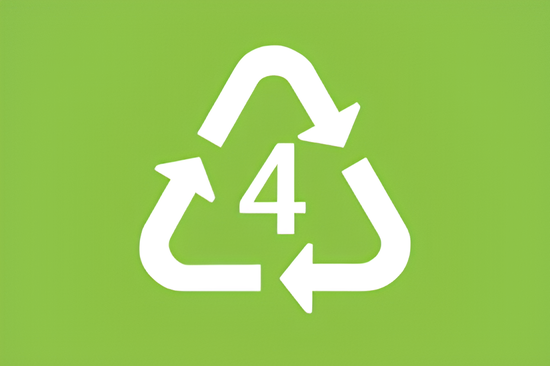
| Low density polyethylene | 4 | LDPE | Food packaging, plastic bags, films |
| Polypropylene | 5 | PP | Food containers, yoghurt, kitchen utensils |
| Polystyrene | 6 | PS | Disposable cups, CD packaging, insulation |
Polyvinyl chloride carries code 3 with abbreviation PVC. This versatile plastic produces:
- Detergent and shampoo bottles
- Cooking oil bottles
- Transparent packaging materials
- Gaskets, flooring, and sewer pipes
Low-density polyethylene receives code 4 and abbreviation LDPE. This material resists chemical reactions and high temperatures. This makes it ideal as film for food packaging.
Polypropylene has code 5 with abbreviation PP. It features high melting temperature. It’s the most suitable plastic for:
- Food packaging and medical products
- Kitchen utensils and food containers
- Yoghurt containers
Polystyrene appears as code 6, abbreviated PS. This material occurs as brittle translucent plastic or foam.
Code 7 encompasses specialty plastics and composite materials. Category 7 includes expanded polystyrene and extruded polystyrene. These are used for:
- Fragile product protection
- Thermoboxes and insulated containers
- Cups for hot drinks
The expanded category 7 includes specialty polymers. Acrylonitrile butadiene styrene, abbreviated ABS, is transparent plastic. It’s mainly used in consumer goods, construction, automotive applications, and three-dimensional printers. Polycarbonate appears with abbreviation PC in category 7. It features excellent strength and heat resistance.
Composite materials identification symbols
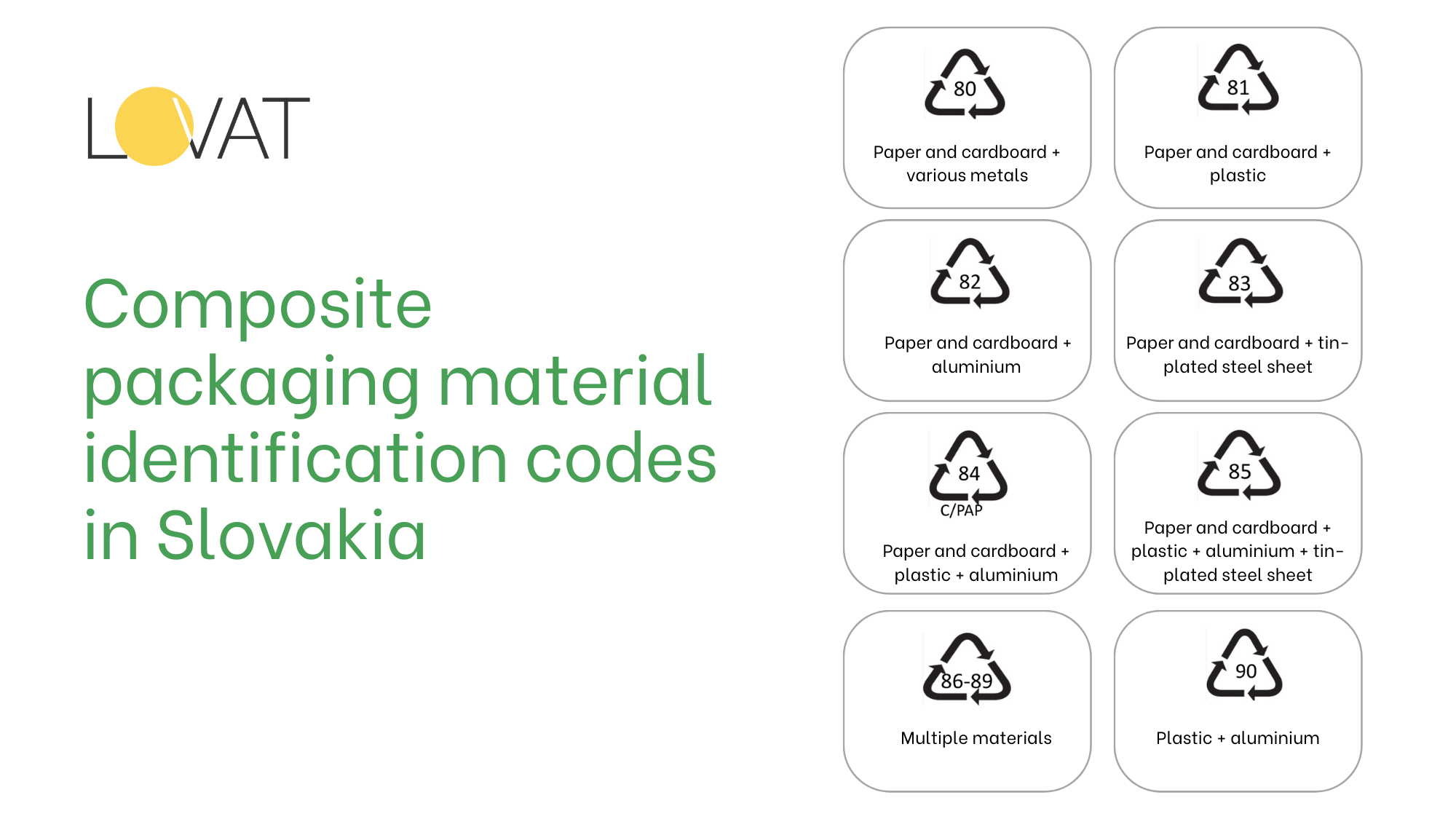
Composite packaging materials combine multiple material types. This achieves desired performance characteristics. The coding system for composites uses numbers 80 through 94. These identify various material combinations. These codes help recycling facilities determine if materials can be separated. Otherwise they’re handled as mixed waste.
Code 80 identifies composite packaging. The majority component is paper and cardboard, combined with metals like steel and aluminum. Code 81 represents paper and cardboard combined with plastic. Code 84 with additional marking C/PAP identifies beverage cartons. This composite based on cardboard includes packaging with several material layers. It’s intended for:
- Milk and juice packaging
- Tomato puree containers
- Cheese packaging
Code 90 identifies plastic combined with aluminum. Code 91 represents plastic combined with tin-plated steel sheet. Code 92 covers plastic combined with various metals.
Glass, metal, and paper packaging symbols
Glass packaging uses codes 70 through 79. These indicate different glass types and compositions. The fundamental glass categories distinguish between clear, green, brown, and other colored glass. This supports color-sorted glass recycling. It maintains quality in recycled glass production.
Code 70 with designation GL identifies clear glass. This is the most valuable recycled glass stream. Code 71 GL marks green glass, commonly used for wine bottles. Code 72 GL designates brown glass. It’s used extensively for beer bottles and light-sensitive products.
Metal packaging employs codes 40 through 49. These identify different metal types. Code 40 with designation FE identifies packaging made of iron. Iron content exceeds 95% of total packaging unit weight. Code 41 marked ALU designates aluminum packaging.
Paper and cardboard packaging uses codes 20 through 39 with designation PAP. Code 20 identifies corrugated cardboard. Code 21 marks smooth cardboard. Code 22 designates paper, including packaging with paper content exceeding 95%.
Producer responsibility and implementation in Slovakia
The Slovak approach to labeling packaging balances mandatory European Union requirements with voluntary national systems. Producer obligations under Act No. 79/2015 Coll. extend beyond registration, making them responsible for the post-consumer phase.
Material composition marking remains voluntary, creating strategic decisions for producers. While marking packaging with material codes isn’t legally required, producers choosing implementation must follow prescribed standards. According to Decree No. 373/2015 Coll., those marking packaging with material composition must label according to special regulations.
Graphic marks labels indicating material composition may appear directly on packaging, on labels, or in accompanying documents. Placement must consider package handling and normal use patterns, occupying positions undamaged by opening or routine handling.
The multilingual European Union market creates challenges as each member state maintains official languages. Packaging text must accommodate these when products enter that state’s market. Translation placement follows a hierarchical system, with translated information text positioned close below the marking to maintain visual proximity. These obligations reflect shared principles applied across the EU.
Environmental impact of recycling signs on packaging and used labeling equipment
The comprehensive marking and labeling system drives environmental protection through consumer awareness. Clear recycling signs on packaging enable proper household waste sorting, reducing contamination and improving rates. Member States must cut consumption of certain single-use plastics by 2026.
The labeling equipment market adapts with innovative printing, engraving, and embossing technologies. Manufacturers upgrade used labeling equipment and deploy new systems for compliant markings across materials, developing solutions that support packaging labeling requirements.
Consumer education boosts these efforts. Understanding rrecycling signs on packaging improves sorting accuracy. Clear marks labels help identify proper disposal methods, supporting recycling infrastructure and effective marking labeling packaging implementation.
The European Union regularly updates packaging directives as environmental science advances, addressing new materials and technologies. Digital marking technologies – QR codes and NFC tags – may supplement traditional graphic symbol formats, ensuring marking and labeling systems remain effective tools for environmental protection.
Key takeaways for Slovakia’s labeling equipment market
Packaging producers must navigate both EU regulations and Slovak national laws. Act No. 79/2015 Coll. forms the foundation of Slovak packaging regulation. Companies importing over 100 kg annually face registration, recycling program participation, and fee requirements.
Single-use plastic products require specific markings under EU Regulation 2020/2151. Technical specifications demand precise color codes, font sizes, and resolution standards. Markings must appear in Slovak language when products enter Slovakia’s market.
Material identification codes range from 1 to 7 for plastics. Codes 20 to 39 cover paper. Codes 40 to 49 identify metals. Codes 70 to 79 designate glass. Codes 80 to 94 mark composites. These recycling signs on packaging codes support sorting infrastructure.
Slovakia allows voluntary material composition marking. Producers choosing this must follow Decree No. 373/2015 Coll. standards. Strategic decisions about marking affect compliance and market positioning. The market offers cost-effective solutions for smaller producers. This helps companies meet marking and labeling requirements without major capital investment.