
The Complete 2026 Guide to Triman Labeling and EPR Compliance in France
The Complete 2026 Guide to Triman Labeling and EPR Compliance in France
Every product sold to French households tells a story — and since 2015, that story must include a visual signal about what happens at the end of its life. The Triman label France requirement is not optional. It is a legally binding obligation under Article L.541-9-3 of the French Environmental Code, enforced by the DGCCRF, and tied directly to the country’s extended producer responsibility framework.
This guide covers everything required for proper EPR regulations compliance: the legal foundation, who must comply, how to correctly apply the logo, what each sector’s deadlines look like, and what goes wrong when businesses cut corners.
What the Triman label is
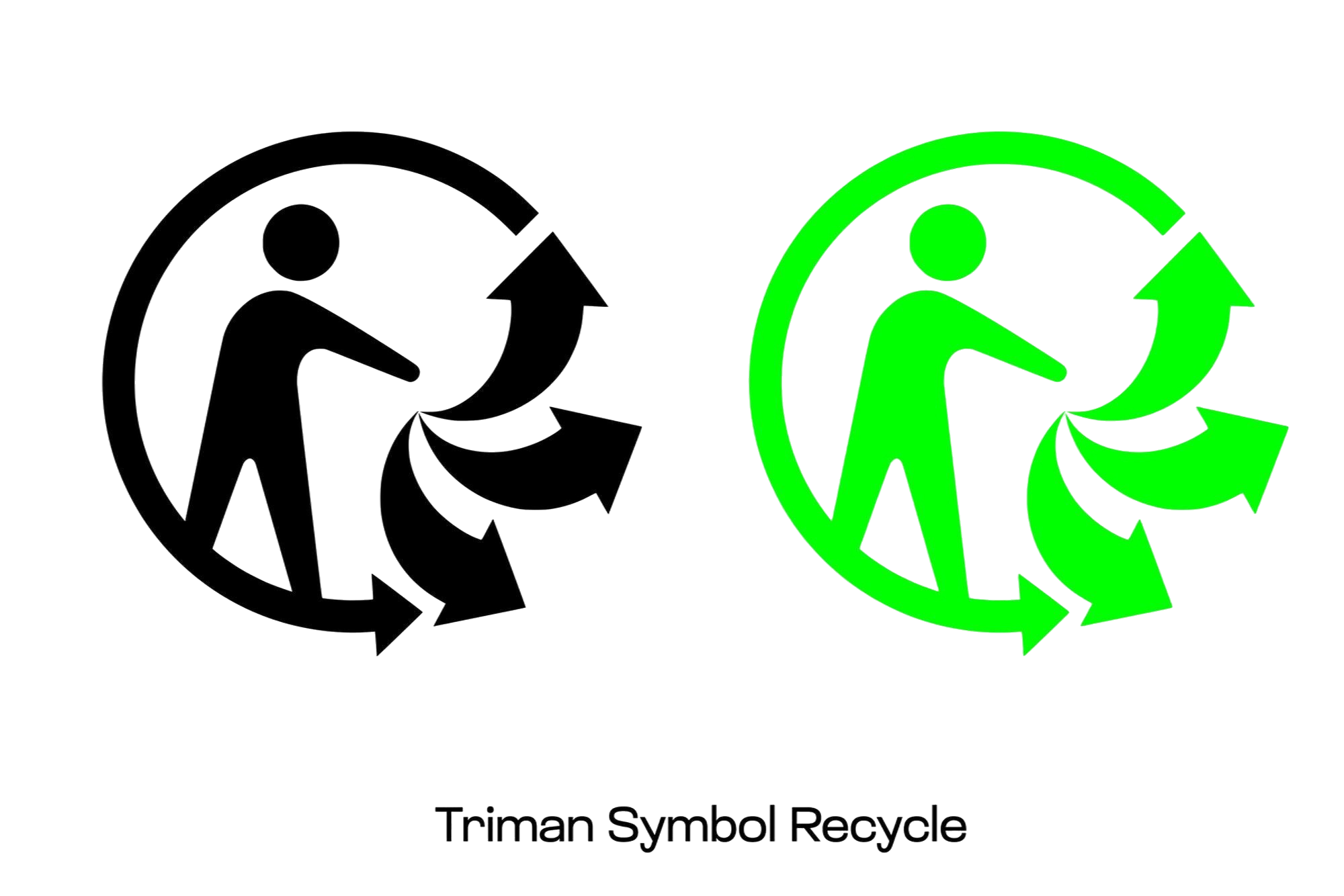
The Triman label is a standardized sorting signage system created to help French consumers dispose of products correctly. It does not certify recyclability. It does not mean a product is made from recycled materials. It simply tells the consumer that this item must be sorted separately and that rules exist for its disposal.
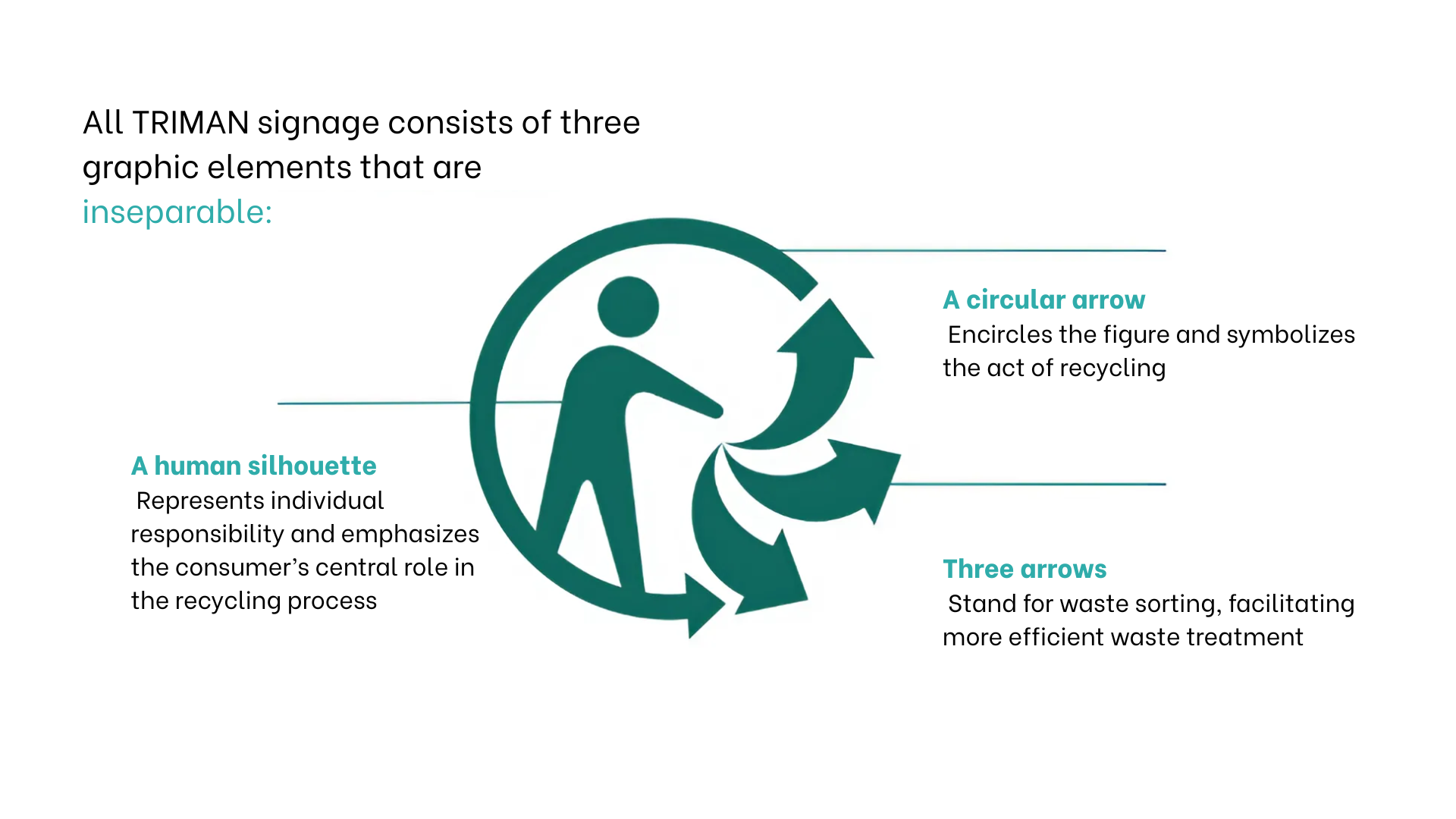
The logo itself consists of three inseparable graphic elements. A human silhouette represents individual consumer action. Three outward-pointing arrows symbolize sorting. A circular arrow surrounding the figure represents recycling. These three elements must always appear together as part of the label Triman — no element can be removed or repositioned.
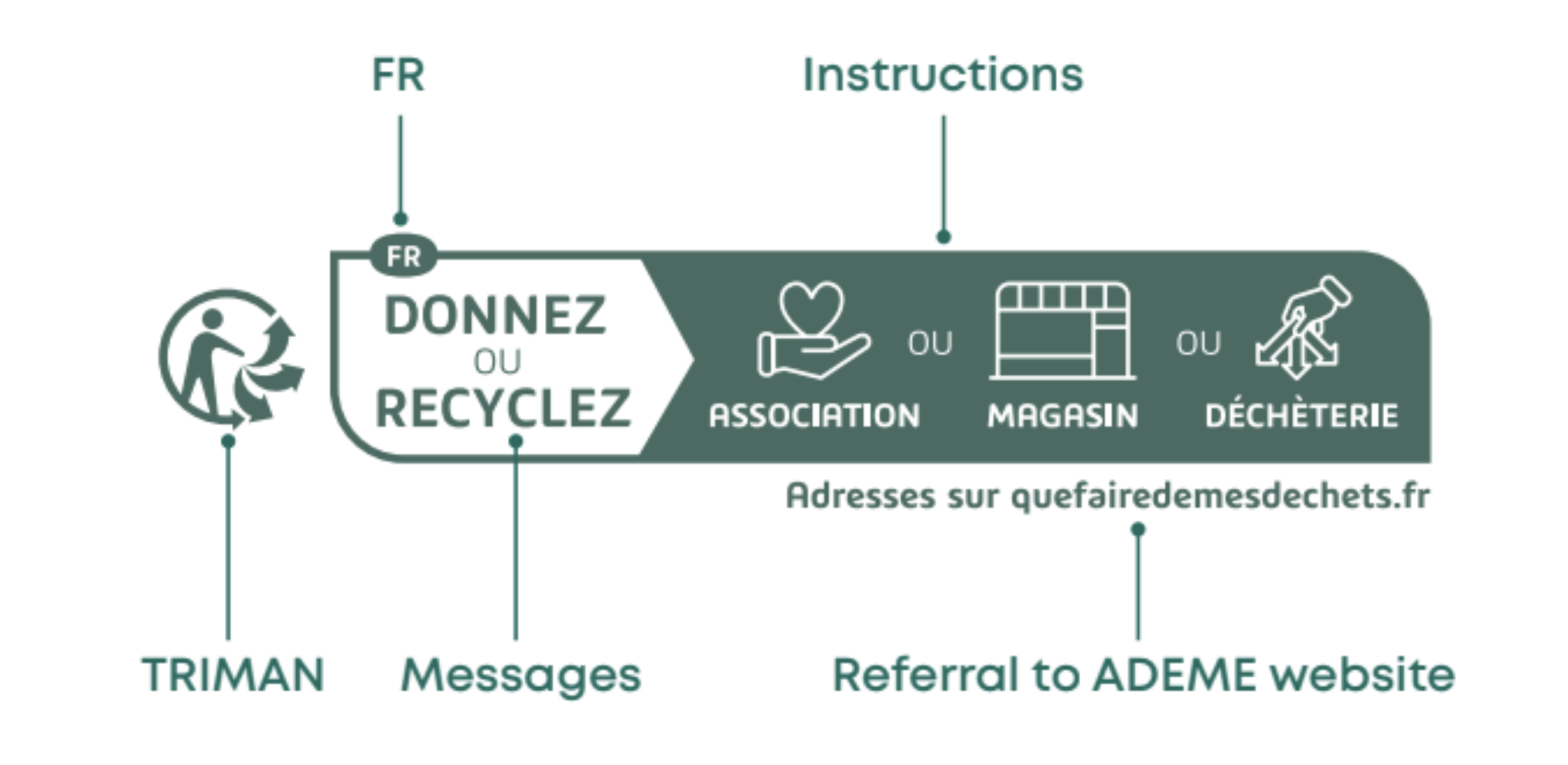
The signage must always include two things: the Triman logo symbols and sorting instructions explaining where or how the product should be disposed of. The instructions vary by product type and sector. They are not generic — they reflect the specific disposal routes available for that category and must appear together with the official Triman logo.
The French laws behind EPR compliance
Understanding the legal basis helps businesses approach this correctly. Several pieces of legislation govern EPR compliance France:
- Decree No. 2014-1577 of 23 December 2014 — established the original Triman signage as a common standard for recyclable products subject to sorting requirements
- Law No. 2020-105 of 10 February 2020 (AGEC Law) — significantly expanded EPR rules and modified implementation procedures for sorting signage
- Decree No. 2021-835 of 29 June 2021 — detailed consumer information requirements for products under extended producer responsibility
- Decree No. 2022-975 of 1 July 2022 — brought decorative textiles (carpets, curtains) into the furniture EPR stream
Article L.541-9-4 of the French Environmental Code sets out the penalty structure. The supervisory authority is the DGCCRF (Directorate General for Consumer Affairs, Competition, and Fraud Prevention). Inspectors may impose fines per non-compliant product. The stated maximum is €15,000 for a legal entity — though fines in practice depend on the situation and are assessed per product.
For the full text of Article L.541-9-3, see: legiFrance.gouv.fr
Who must comply under French EPR rules
EPR compliance obligations fall on any producer, importer, or distributor of own-brand products intended for household use, where those products are subject to extended producer responsibility under French law.
This includes businesses based outside France. An online retailer shipping products to French consumers must comply with EPR requirements, including the correct display of the Triman logo symbols and sorting instructions. If the third-party seller fails to apply sorting signage, the marketplace platform becomes responsible in their place.
The obligation does not apply to products sold exclusively for professional use — but only when the seller can verify this with certainty. If there is any possibility a product reaches a household consumer, signage is required.
The “FR” country code must appear on the signage. Each EU member state has its own sorting infrastructure and rules. The FR indicator prevents confusion for consumers in other French-speaking countries where different disposal routes apply.
The three graphic elements of the logo Triman — rules you cannot break
The logo Triman is governed by strict visual identity rules. These are not suggestions. The following are prohibited:
- Changing the color of the Triman symbol independently from the rest of the logo block
- Removing the Triman logo and using only the instruction panel
- Repositioning the Triman symbol relative to the label
- Resizing the Triman symbol disproportionately to the rest of the signage
- Changing the proportions of any element within the overall signage
The protected zone is defined relative to the size of the “FR” bubble. No text, rule, or image should appear within this zone. This keeps the label legible and legally valid.
Color versions and typography
Three color versions are available for the Triman logo France signage. Each serves a different context:
| Version | When to use |
| Full color (Pantone 562C / CMYK 85-35-60-25) | Preferred for packaging with adequate print capacity |
| Black monochrome (Pantone Black C) | Use for instruction manuals, quotes, and invoices |
| Reverse printing (white on dark background) | Required when signage sits on a colored background |
Download the official Triman logo files
Get the correct, approved Triman logo versions for your sector and ensure compliant use on your products and packaging.
Need help with Triman logo compliance? Contact us for support with correct logo placement, sector selection, and packaging review.
Standard and compact label Triman dimensions
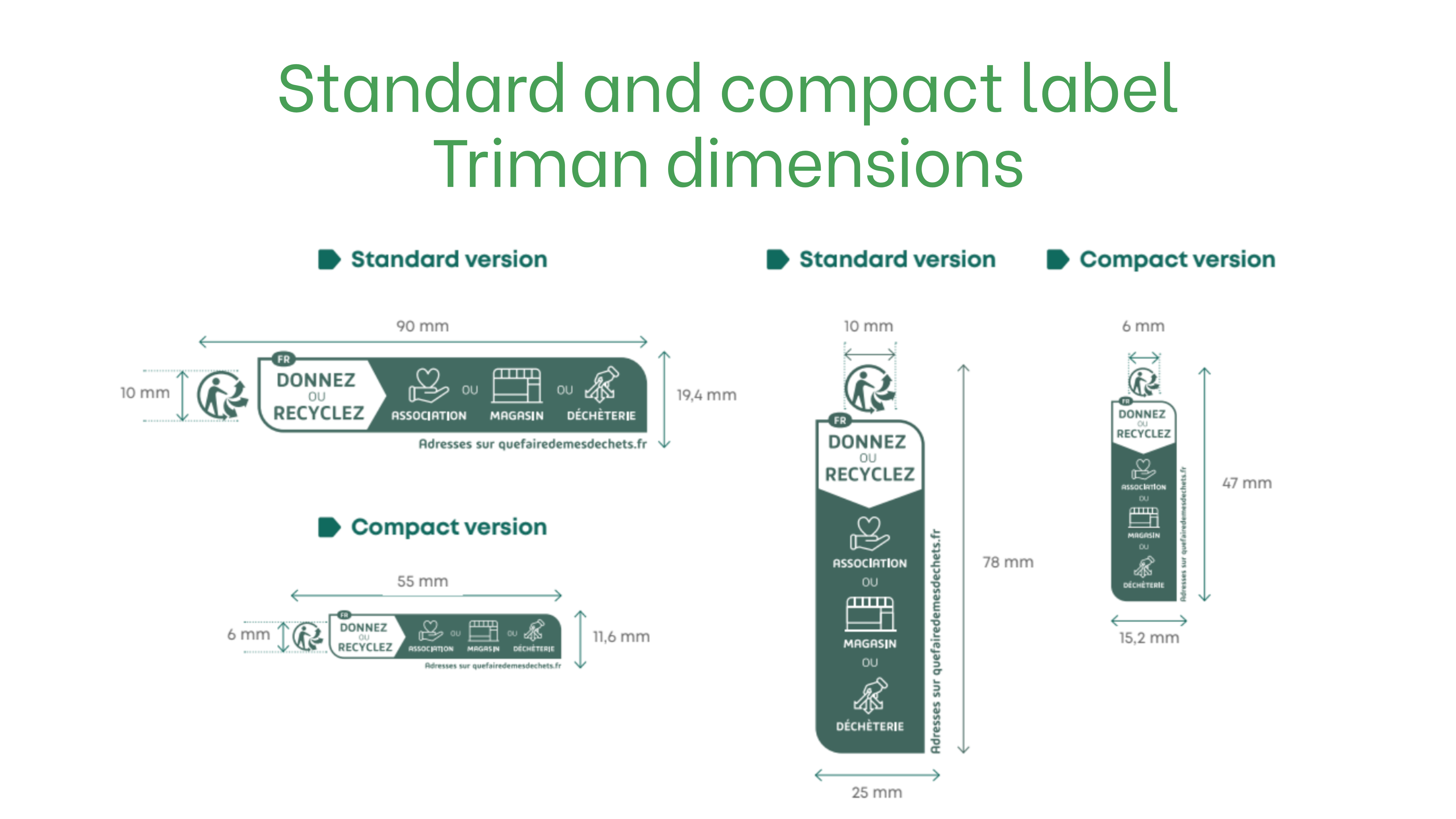
Two formats exist for the logo Triman 2026 signage, and the choice depends on available space.
Versions with three pictograms (furniture, bedding, decorative textiles)
| Format | Width | Height | Triman min height |
| Standard horizontal | 90 mm | 19.4 mm | 10 mm |
| Compact horizontal | 55 mm | 11.6 mm | 6 mm |
| Standard vertical | 25 mm | 78 mm | 10 mm |
| Compact vertical | 15.2 mm | 47 mm | 6 mm |
Versions with four pictograms (DIY, gardening, toys)
| Format | Width | Height | Triman min height |
| Standard horizontal | 94.2 mm | 19.4 mm | 10 mm |
| Compact horizontal | 58 mm | 11.6 mm | 6 mm |
| Standard vertical | 25 mm | 98 mm | 10 mm |
| Compact vertical | 15.2 mm | 66 mm | 6 mm |
The standard version is always the priority. The compact version is only acceptable when space genuinely does not allow the standard format. The compact version cannot be reduced further — 6 mm is the absolute minimum height for the Triman symbol as recommended by ADEME.
All dimensions are recommendations, not absolute legal requirements. However, the law states the logo must remain sufficiently visible. If it is too small to be legible, it fails its legal purpose regardless of dimensions.
When dematerialization is allowed based on size exceptions
One of the more practical questions businesses face concerns small products or packaging. The EPR packaging rules account for this with a tiered approach based on the surface area of the largest side:
- Over 20 cm²: Full logo and sorting instructions must appear physically on the product, packaging, or included documentation.
- Between 10 and 20 cm²: The Triman logo must still appear physically. However, the sorting instructions can be dematerialized — for example, via a URL or QR code.
- Under 10 cm²: Both the Triman logo and the sorting instructions can be fully dematerialized. Neither needs to appear directly on the product.
- For cylindrical or spherical products, these thresholds double: 10 cm² becomes 20 cm², and 20 cm² becomes 40 cm².
- An important point: dematerialization never replaces physical placement on packaging. If the product has packaging with adequate surface area, the logo must appear on the packaging regardless of the product’s own size.
EPR registration in France. We manage your EPR registration with the correct eco-organization — fast and compliant.
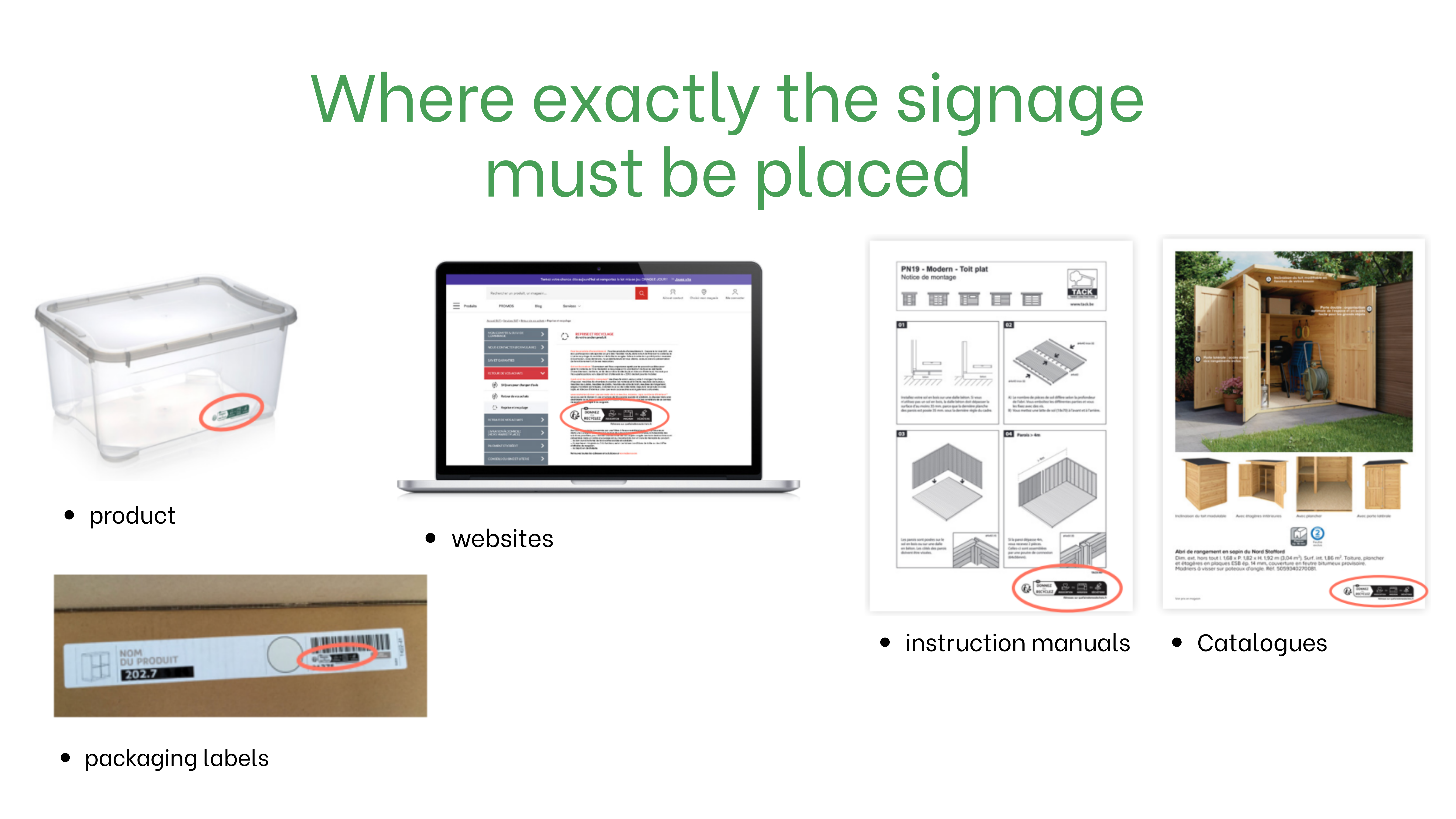
Where exactly the signage must be placed
Sorting in French regulation uses the phrase “au plus près du produit” — as close as possible to the product. This translates into three acceptable placement locations, in order of preference:
- Directly on the product itself (for example, via a sticker)
- On the product’s packaging
- In documentation provided with the product (instruction manual, assembly guide)
A website or product page does not count as a replacement for any of these three options. Online display can supplement compliance — but it cannot substitute for physical placement. This has been the rule since January 2022.
If different components of a product have different disposal routes, each component must be labeled separately. A sofa with a wooden frame and foam cushions, for instance, may require separate instructions for each material type.
 Sector-by-Sector implementation deadlines
Each sector covered by EPR regulations compliance has its own timeline. These are not unified — each went through a separate validation process with public authorities.
| Sector | Validation by Authorities | Affixing Deadline | Stock Disposal Deadline |
| Furniture and bedding | 15 December 2021 | 15 December 2022 | 15 June 2023 |
| Decorative textiles | 25 August 2023 | 25 August 2024 | No further extension |
| DIY and gardening products | 06 December 2022 | 06 December 2023 | 06 June 2024 |
| Toys | 06 December 2022 | 06 December 2023 | 06 June 2024 |
For furniture and bedding, the stock disposal exception applied only to products manufactured or imported before 15 December 2022 and transferred before 15 June 2023. Any product outside those conditions must carry full signage in line with logo Triman 2026 requirements.
By 2026, all these deadlines have passed. Any product currently on the French market in these categories must carry correct Triman logo signage. No transitional periods remain active.
Triman logo symbols for furniture and bedding signage versions
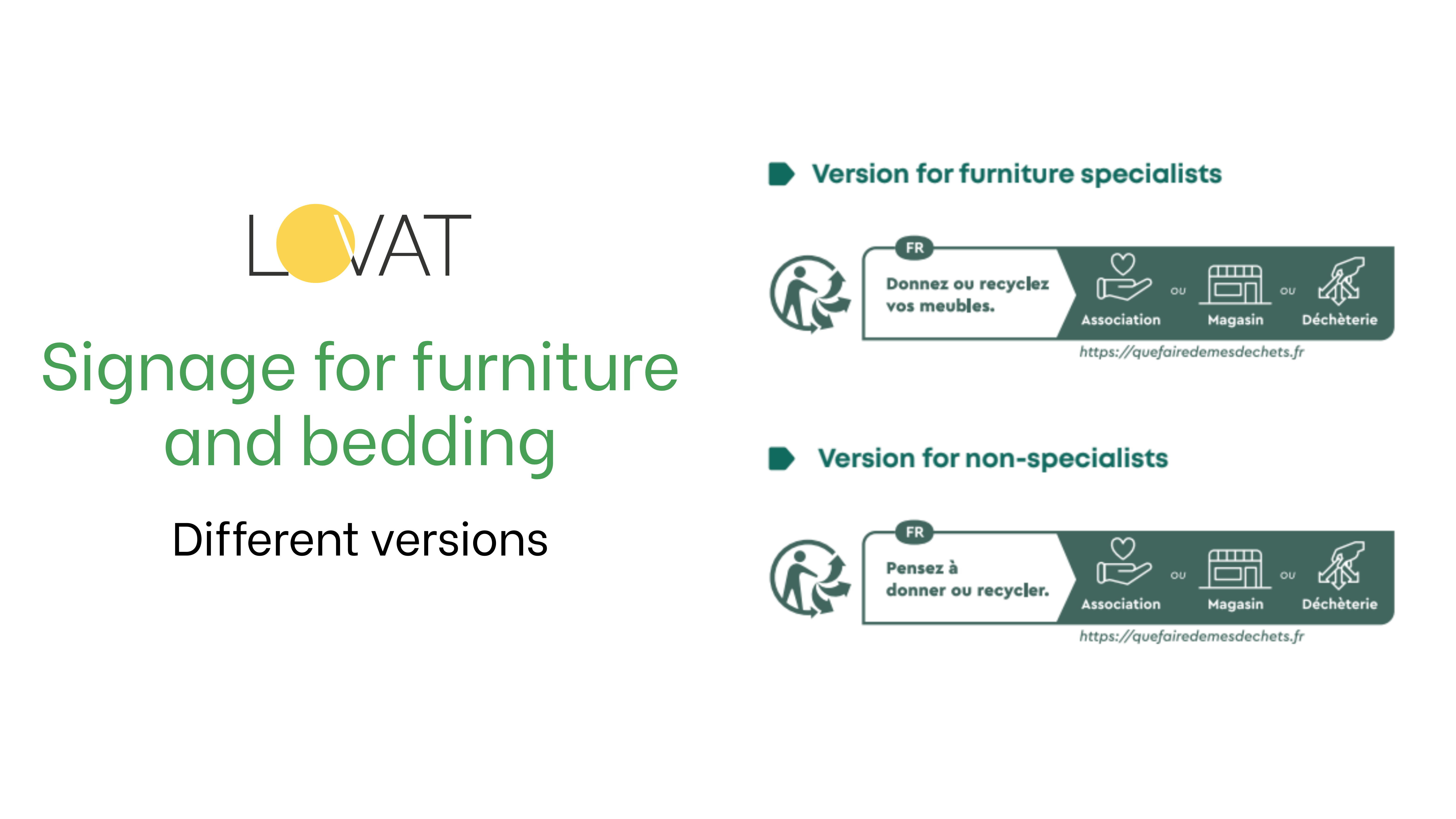
Two signage versions exist for the furniture sector under current EPR regulations compliance requirements, and marketers choose based on what they sell.
The furniture specialist version uses the message “Donnez ou recyclez vos meubles.” This version is designed for sellers who deal exclusively or primarily in furniture. The word “meubles” makes the message specific and immediately relevant to the consumer.
The general version uses the message “Pensez à donner ou recycler.” This applies to all other products in the category — bedding, storage, and accessories. Sellers of mattresses, for instance, should use this version rather than the furniture-specific one.
Both versions include three pictograms: donation to a social or charitable association, in-store recovery, and drop-off at a waste disposal center. Both are legally equivalent. The choice is left to the marketer’s discretion.
 Triman logo France versions for decorative textiles
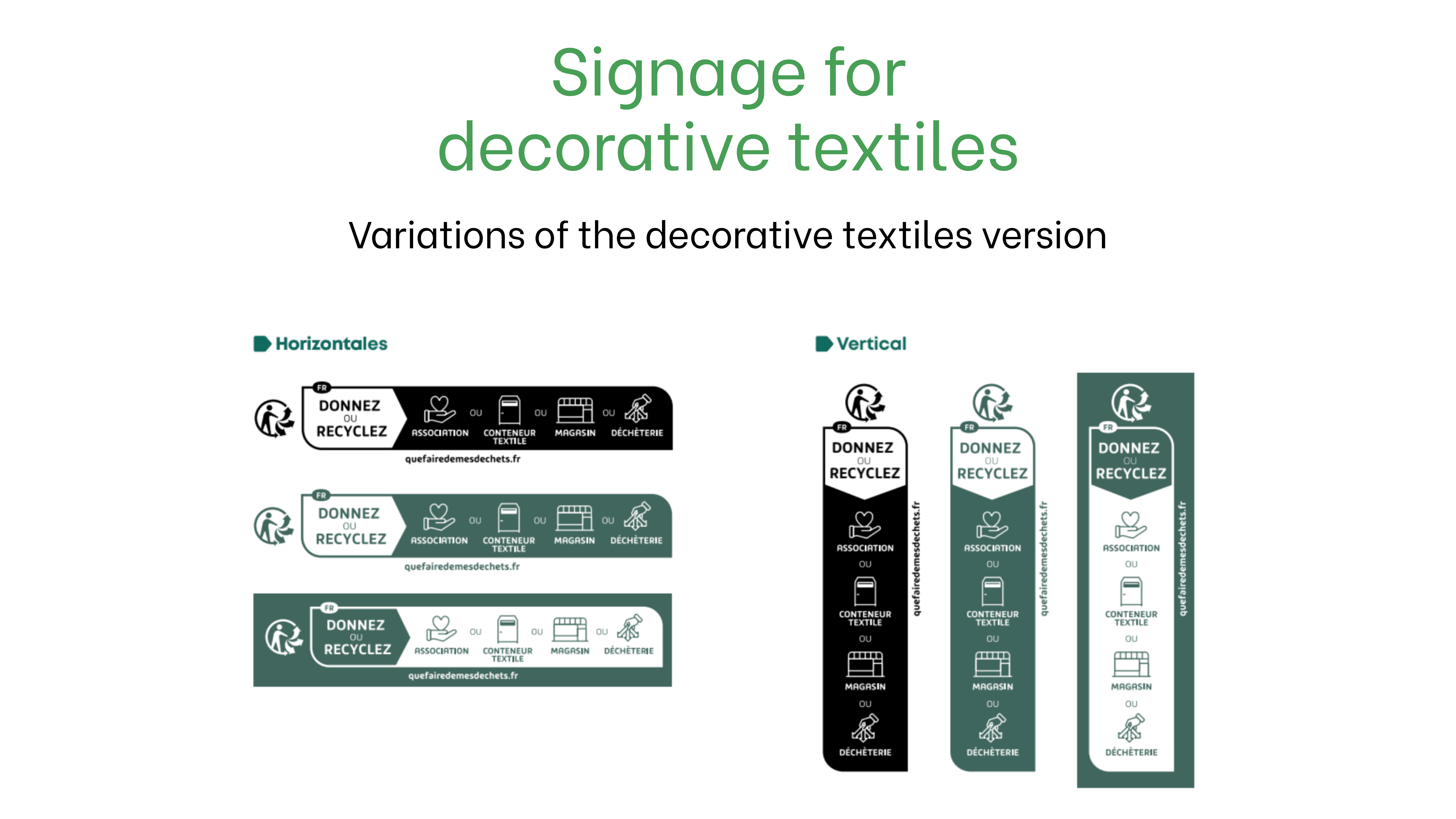
The decorative textiles sector, added through Decree No. 2022-975, requires label Triman placement on carpets, interior curtains, nets, and their accessories.
Two options exist:
- Version for curtains and nets — this is the only category that includes a fourth pictogram: the textile container. Curtains and nets can be collected alongside clothing in dedicated textile collection points. This version carries four pictograms: association, textile container, store, waste center.
- General version for decorative textiles — applies to carpets, rugs, and all other items in this category. This version carries three pictograms: association, store, waste center.
The textile container pictogram must not be used for carpets. Carpets are not accepted in clothing textile containers. Using the wrong version would mislead consumers about actual disposal routes.
 Signage versions for DIY, gardening products, and toys
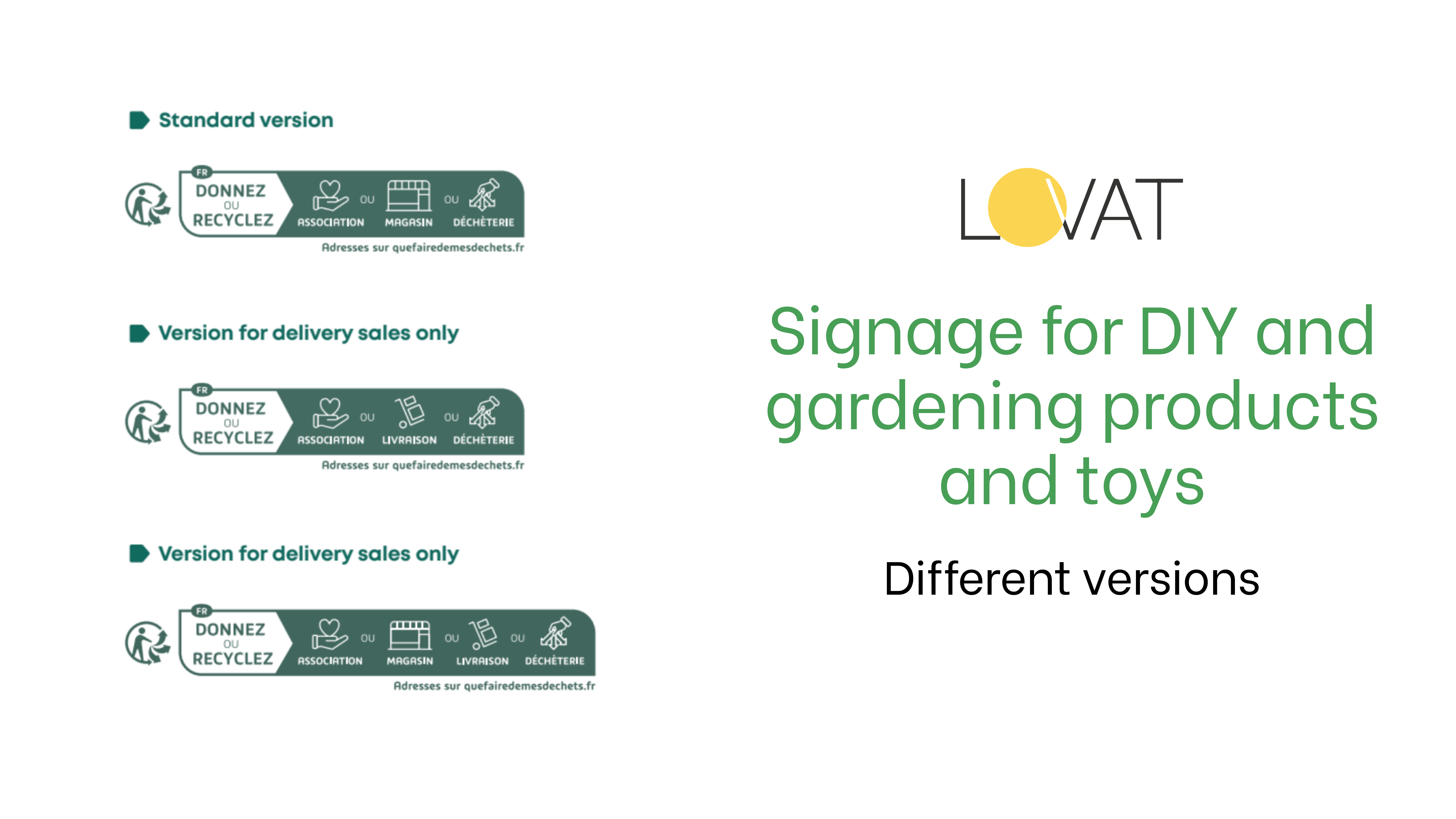
This sector was the last to receive validated signage, with the December 2022 authority approval. It introduced an additional complexity: some products are sold exclusively online and delivered, while others are sold in physical stores.
Three versions address this:
- Standard version (three pictograms): association, store, waste center. For products sold in physical retail.
- Delivery sales only version (three pictograms): association, home delivery recovery, waste center. For products sold exclusively through distance selling.
- Combined version (four pictograms): association, store, home delivery, waste center. For sellers operating both physical and online channels.
Since January 2023, distributors of DIY, gardening, and toy products — regardless of whether they are individuals or legal entities — are bound by the take-back obligation during both physical and distance selling.
How to implement the Triman logo in France
Implementing EPR compliance correctly requires a structured approach. Here is a practical sequence:
- Determine whether your product is in scope. Check whether your product category is covered by a French EPR stream.
- Identify your sector’s signage version. Each sector has specific approved versions. Do not mix versions across product types.
- Choose the right format. Assess the available surface area on your product or packaging. Use the standard format whenever possible. Move to compact only when necessary. Never go below minimum dimensions.
- Select the appropriate color version. Use full color as the default. Switch to monochrome for documents with printing constraints. Use the white-border reverse version when placing the label on any dark or colored background.
- Determine placement location. The product itself is ideal. The packaging is the standard fallback. Documentation is acceptable only when neither the product nor its packaging offers adequate space.
- Review the protected zone. Ensure no other graphic element appears within the protected area around the logo. Check this at actual print scale, not just on-screen.
- Apply the “FR” country code. Confirm the FR bubble is present and correctly positioned. This is mandatory for products sold specifically on the French market.
- Update all documentation and digital channels. While websites do not replace physical labeling, they should reflect accurate disposal information for consistency and consumer trust.
- Verify before placing new stock on market. Do not wait until inspections occur. Build internal checks into your production or packaging workflow before new product runs to ensure full compliance with logo Triman 2026.
Logo Triman 2026 placement examples
Understanding the rules abstractly is useful. Seeing them applied concretely is more useful.
Example 1 — A flat-pack bookshelf: The product is large and unpackaged for direct consumer assembly. The signage appears on the instruction manual included in the box. A compact black-monochrome version is used due to document printing constraints. This is compliant.
Example 2 — A set of interior curtains: Sold in a plastic packaging sleeve with a surface area of 35 cm² on the largest face. The full-color standard horizontal version of the curtains-and-nets signage (four pictograms) is printed directly on a label affixed to the packaging. This is compliant.
Example 3 — A children’s toy in a small box: The packaging has a largest face of 12 cm². The compact Triman logo appears on the packaging. Detailed sorting instructions are provided via a QR code on the same face, linking to a French-language disposal information page. This is compliant under the dematerialization exception.
Example 4 — An online-only garden tool set: Sold exclusively through distance selling. The four-pictogram combined version would be incorrect here — the seller does not operate physical stores. The correct choice is the delivery sales only version, with the home delivery pictogram replacing the store pictogram. This is compliant.
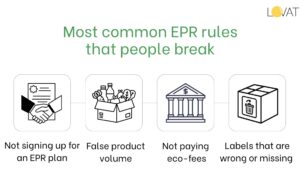
EPR compliance France common mistakes
Several patterns of non-compliance appear repeatedly. Knowing them in advance prevents costly relabeling or enforcement action.
Using only a website reference instead of physical labeling. This was acceptable before January 2022. It is not acceptable now under updated EPR rules. Physical placement is mandatory, with dematerialization permitted only within defined size thresholds.
Applying the wrong sector version. A seller offering both furniture and bedding uses the furniture specialist version on mattresses. The furniture specialist wording specifically references “meubles” — which does not encompass bedding. The general version should be used for mattresses to ensure correct use of the Triman logo in France.
Placing graphic elements inside the protected zone. Promotional text, certifications, or other logos placed too close to the Triman symbol reduce its legal validity. The protected area must remain clear.
Using a reconstructed or modified logo. Recreating the logo from scratch — even accurately — is not recommended, as font substitution and proportion errors are common.
Failing to update signage after sector expansion. The decorative textiles sector entered the EPR stream in 2023. Sellers of carpets and curtains who had not previously needed to comply suddenly had new obligations regarding the Triman logo France. Missing sector deadline updates is a common gap.
Relying on the stock disposal deadline as ongoing permission. Stock disposal periods are finite. After they expire, all products in that category — regardless of when they were manufactured — must carry compliant signage to be sold.
Compliance checklist for Triman label France requirements
Use this checklist before placing any new product on the French market:
- Product confirmed as falling within an active French EPR stream
- Correct sector version of signage identified (furniture specialist, general, curtains/nets, DIY, etc.)
- “FR” country code present on the signage
- Standard format used unless space genuinely requires compact
- Minimum Triman symbol height respected (10 mm standard, 6 mm compact)
- Color version appropriate to the background and medium
- Protected zone around logo clear of other graphic elements
- Signage placed on product, packaging, or included documentation
- If surface area between 10-20 cm²: Triman logo on product, instructions dematerialized
- If surface area under 10 cm²: full dematerialization documented and accessible
- If multiple components have different disposal routes: each component labeled separately
- Logo files sourced from official Ecomaison downloads, not recreated
- Sector implementation deadline confirmed as passed or upcoming under Triman logo France obligations
- Internal review process in place for future product launches
EPR reporting support. We handle EPR reporting, eco-fee declarations, and ongoing compliance management.
Marketplace obligations and international sellers
EPR compliance France extends to online marketplaces operating in France. The marketplace is treated as responsible in place of any third-party seller who fails to display required sorting signage.
This has practical consequences. A marketplace cannot simply rely on its sellers to manage compliance. It must either verify that sellers have complied or step in and apply the signage itself. Non-compliance by a seller does not exempt the platform.
For sellers based outside France, the requirement applies whenever products reach French household consumers. Triman logo in France obligations apply based on the market destination, not the seller’s country of establishment. This covers both physical exports and cross-border e-commerce.
Products imported from another EU member state may substitute an equivalent EU-recognized sorting signage in place of the Triman symbol, provided that equivalent signage informs consumers that sorting rules apply to the product. The WEEE crossed-out wheeled bin symbol is one accepted equivalent for electrical and electronic equipment.
EPR regulations compliance enforcement and penalties
The DGCCRF is the authority responsible for inspecting and enforcing EPR rules related to sorting signage. Inspectors can assess fines per individual product found to be non-compliant. The maximum administrative fine is €15,000 per legal entity per violation.
This figure is a ceiling, not a fixed amount. The actual fine depends on the severity and scale of the non-compliance, including improper display of the Triman logo in France. However, because fines apply per product rather than per company, a large inventory of incorrectly labeled items can generate significant cumulative exposure.
The cost of enforcement action typically exceeds the cost of compliance. Relabeling existing stock, recalling incorrectly labeled products, and managing regulatory correspondence all carry real operational cost. Early compliance is consistently the more economical path.
Sorting in French requirements and importance
The Triman logo symbols tell the consumer what to do, but the accompanying text and pictograms explain how. Sorting instructions are not decorative. They are the mechanism through which the label fulfills its legal purpose.
Instructions must reflect the actual disposal routes available for that product in France and comply with EPR packaging and product stream requirements. Businesses should not create their own instructions independently.
The order of options within the instructions follows a priority logic aligned with official sorting in French guidance. Donation to social and charitable associations appears first, promoting reuse. In-store or delivery recovery appears second, reflecting the distributor’s take-back obligation. Waste disposal center appears last, as the final option rather than the first resort.
Consumers looking for specific drop-off locations are directed to quefairedemesdechets.fr, an ADEME search engine that displays nearby collection points based on GPS data.
Practical notes on implementation in documents and digital channels
Physical placement is the core obligation. But businesses often need to display logo Triman signage in additional contexts — catalogues, quotes, invoices, and websites. These are permitted, with important distinctions.
For instruction manuals and assembly guides, the black monochrome version is recommended. Color printing adds cost to documents that are typically mass-produced in black and white, while still remaining compliant with EPR rules.
For quotes and invoices, the monochrome compact version is practical. The regulatory obligation does not technically require signage on these documents — but including it supports consumer awareness without additional burden.
For catalogues, the black monochrome version placed at the bottom of the relevant page satisfies the informational purpose. However, a catalogue does not replace the required placement on the product or its packaging.
For websites, signage can include the label Triman on product pages and in dedicated waste information sections. Ecomaison has committed to providing multi-sector text templates as the brand identity is rolled out. Until then, sector-specific example texts are available for furniture and bedding.
None of these additional placements substitute for physical labeling. They supplement it. This distinction is critical for businesses managing compliance across both physical and digital channels.
Triman compliance as operational standard
The Triman label France requirement is now a baseline condition for selling household products in France, including full compliance with EPR packaging obligations. By 2026, every sector with an EPR stream has passed its implementation deadline. There are no remaining transition periods to rely on.
For businesses already operating in France, the question is not whether to comply but whether current labeling is accurate for every product category, every signage version, and the correct presentation of sorting in French. For businesses entering the French market, compliance must be built into product development and packaging design before launch.
The regulatory framework is detailed, but it is also well-documented. The ADEME tool at quefairedemesdechets.fr supports consumer communication. The system is designed to function — it requires businesses to engage with it seriously.
Sorting signage done well does more than satisfy inspectors. It tells consumers clearly and consistently what to do. That consistency, across millions of products, is what makes France’s circular economy framework actually work.
Unsure if your Triman logo is compliant? We review your labeling and help you fix issues before inspections or fines occur. Contact us or book a demo.

Related articles