
E-Invoicing and PEPPOL Requirements for Global Businesses
E-Invoicing and PEPPOL Requirements for Global Businesses
Business invoicing has changed a lot recently. The old paper methods are quickly disappearing as governments around the world put e invoicing compliance rules in place. This change is about more than just new tech; it is changing how businesses share financial documents and report transactions to tax authorities.
Global businesses need to pay attention: Belgium requires structured PEPPOL e invoicing starting January 2026. Poland is next, with a phased rollout from February 2026. France begins in September 2026. Germany already requires businesses to receive e-invoices as of January 2025, and they must send them by 2027. The EU’s VAT in the Digital Age initiative will extend these rules to all member states by 2030.
For companies doing business around the world, it’s not easy when each country has its own rules, tech standards, and deadlines. Because every place does electronic invoicing regulations differently, it can be hard for businesses to find one solution that works everywhere. Some countries want invoices to go through their government systems. Others insist on certain formats or networks. All these rules keep changing fast.
This guide looks at key parts of the rules that affect global businesses today. We will check out PEPPOL, what’s needed in different places, how to set things up, and smart ways to stay in line with the rules as tax goes digital.
Understanding modern electronic invoicing regulations
Sending a PDF invoice by email is not the same as real electronic invoicing. Real digital invoices use structured data in a format machines can read, so tax people can process them automatically. This difference is the base of today’s rules around the globe.
EN 16931 is the European standard that sets out how electronic invoices should be structured in terms of data. It makes sure different systems can work together by laying out the key info and structure needed. Countries then use this as a base but add what they need to fit their own rules.
Around the world, there are three main ways rules are set up. The first, the post-audit model, lets companies send invoices without asking anyone first, but they need to keep good records in case they get checked later. Germany and the Netherlands do it this way. Next, the clearance model makes businesses send invoices to the government right away for approval before they’re official. Italy, Poland, and many countries in Latin America use this kind of system. Last, there’s the reporting model, where companies have to tell the tax people about their transactions within a certain time, but they don’t need to get permission beforehand.
Tax authorities use these systems for a few reasons. A main one is to lower the VAT gap. The European Commission thinks that if e-invoicing and real-time reporting were required, it could bring in between €135 billion and €177 billion a year that’s now lost. Also, these systems help fight fraud, make audits run better, and speed up how fast taxes are collected around the world.
These different systems can make things tricky for companies that work all over the world. For instance, if you’re doing business in Italy, you have to send your invoices through their Sistema di Interscambio platform. But if you also have operations in Belgium, you’ll need to use PEPPOL e invoicing networks by January 2026. And in France, any branches there will need to use platforms that have been certified, starting in September 2026. Every place has its own rules for how things should be done technically, including the formats to use and how to send everything in.
To stick to the rules, companies first need to know which model applies where they operate. This means figuring out where their legal setups are, where they do business with other companies, and what they need to do to follow the rules in each place.
The PEPPOL e invoicing network and its global expansion
PEPPOL, which stands for Pan-European Public Procurement Online, is managed by OpenPeppol, a non-profit group based in Belgium. This network lets organizations send procurement documents, like invoices, electronically in a format computers can read.
By March 2025, the PEPPOL network included over 1.4 million organizations across 98 countries. This quick growth shows that people see peppol e invoicing as a solid way to exchange electronic documents internationally. The network uses a system where certified Access Points link users to the larger system.
The PEPPOL network runs on a four-corner model. The first corner is the sender. The second is the PEPPOL access point provider. The third is the receiver’s access point. The last corner is the receiver. Sometimes, a fifth corner is included for government authorities when clearance is needed.
As of January 2026, Belgium is making PEPPOL mandatory, showing how popular it’s becoming for required systems. All VAT-registered businesses doing B2B must use the PEPPOL network, sending and receiving documents in the PEPPOL-BIS format. Paper and PDFs won’t cut it anymore for local transactions.
Other countries in Europe are doing the same thing. For example, Lithuania started requiring PEPPOL BIS Billing 3.0 for business-to-government deals back in April 2019. Ireland chose PEPPOL as the tech it supports for invoicing public organizations. The Nordic countries like Denmark, Norway, and Sweden need PEPPOL for government buying and are pushing businesses to use it too.
The network is growing outside of Europe, too. Singapore was the first non-European country to become a peppol access poin authority in May 2018. They used PEPPOL infrastructure to start their Nationwide E-Invoicing Initiative. Japan’s Digital Agency became an authority in September 2021. Australia, New Zealand, and Malaysia are creating PEPPOL-based systems to help with their digital changes.
PEPPOL ensures everything works together through its tech setup. The network uses PEPPOL-BIS specs, which are based on the European standard EN 16931. It also uses Universal Business Language (UBL) formats to structure documents. The PEPPOL International Invoice (PINT) standard, which was just created, makes invoice specs that work all over the world while still following EN 16931.
For global businesses, connecting to PEPPOL is a game changer. Companies can link up once through a certified access point and instantly start sending documents to anyone on the PEPPOL network around the world. This connect once, connect to all idea means you don’t need separate deals with each trading partner.
PEPPOL isn’t the only answer. Some countries, like France, Poland, and Italy, use other systems. If you work internationally, it’s important to know how peppol e invoicing fits in.
Certified PEPPOL Access Point services for secure sending and receiving of structured e-invoices in full compliance with PEPPOL requirements. Certified Peppol Access Point (PAP) Provider
Mandatory e invoicing requirements across key european markets
Europe is at the forefront of the global move toward mandatory e invoicing. Several countries have already put in place or announced B2B requirements with firm deadlines that companies must meet to keep doing business legally.
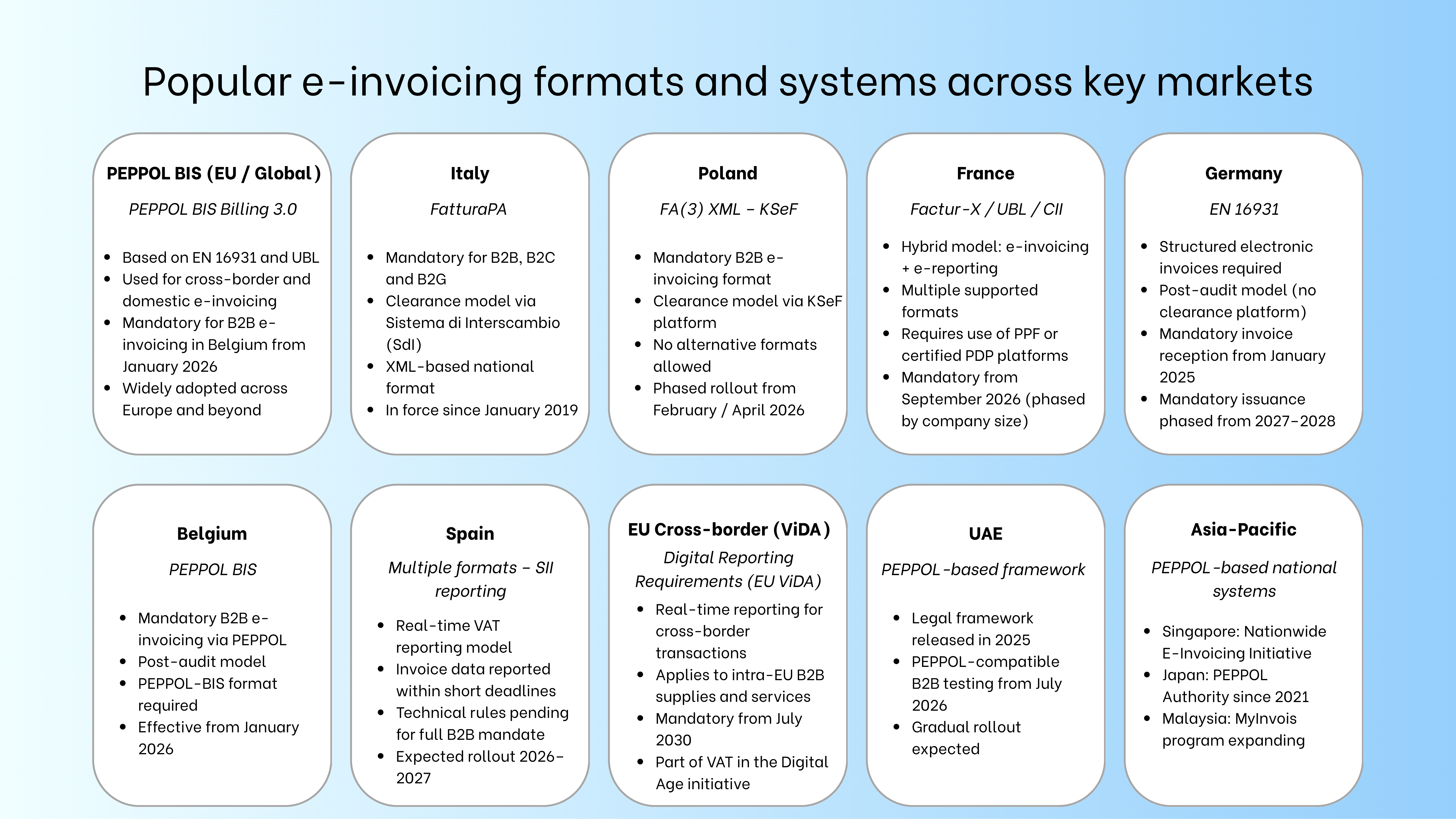
Starting January 1, 2026, businesses in Belgium that are registered for VAT must send and receive structured documents for business-to-business transactions. This has to be done through the PEPPOL network using the PEPPOL-BIS format. If companies are using other EDI systems, they can keep using them if both sides agree and the invoices follow EN 16931 standards.
Poland will roll out its KSeF clearance system in stages. Big taxpayers, those with turnover above PLN 200 million, need to be on board starting February 1, 2026. The rest of the VAT-registered businesses have to comply from April 1, 2026. The system uses a specific XML format, FA(3), and doesn’t allow other formats for B2B transactions.
Starting September 1, 2026, France will roll out its new system in stages. By this date, all businesses need to be able to get documents electronically. Big and mid-sized companies also have to issue e-invoices and do e-reporting. Small and micro-businesses get more time, until September 1, 2027. To use France’s system, you’ll need to register with the Portail Public de Facturation or go through a certified Partner Dematerialization Platform.
Starting January 1, 2025, Germany requires all businesses to be able to receive electronic invoices. These invoices must be in a structured format that meets the European EN 16931 standard. The requirement to send e-invoices is being rolled out in phases. Businesses with yearly revenue over €800,000 must issue e-invoices starting in January 2027. By January 2028, all companies will need to send invoices electronically.
Italy was the first in Europe to put e-invoicing for businesses in place, starting in January 2019. Their Sistema di Interscambio system handles all local invoices. The FatturaPA XML format is the only one accepted for B2B, B2C, and B2G transactions there.
After Spain puts out its tech rules, businesses will need to follow them. Companies that make over €8 million a year have a year to get on board once the rules are officially released. Smaller businesses get two years. A lot of people think these changes will roll out gradually during 2026 and 2027.
Outside Europe, many countries have their own systems. The UAE Ministry of Finance released rules in late 2025, and B2B testing with PEPPOL is set to start in July 2026. Malaysia changed its schedule but is still growing its MyInvois program.
For companies that work across the globe, keeping up with different rules means always staying informed. Deadlines can come up fast, and what’s needed from a technical point of view can change a lot from place to place. If you don’t follow the rules, you could be fined, not be able to get back VAT, or even have issues doing business legally.
A free tool to validate PEPPOL XML invoices against PEPPOL BIS and EN 16931 standards before submission. Free PEPPOL & XML Validator Tool
Real time VAT reporting and continuous transaction controls
Real time vat reporting is another development changing how taxes are handled worldwide. Though it’s related to electronic invoicing regulations, it places different demands on businesses that they need to understand on their own.
VAT reporting used to work in cycles. Companies would send in reports every month or quarter that showed their transactions. Then, tax people would do audits sometimes to check if everything was correct. This slow system let some scams happen and made governments lose money.
Continuous Transaction Controls really change how things work. With CTC setups, tax people get data about each transaction almost right away, so they can check and analyze it fast. Because of this change, governments see what’s happening with the economy like never before.
Spain’s Immediate Supply of Information system is a good example of how reporting can work. Companies in Spain that make over €6 million a year have to send their invoice info within four days of issuing the invoice. The system has worked well, with operating income up 9%, over 90% compliance, and more than 700 million invoices submitted.
Starting July 2030, the EU’s VAT in the Digital Age plan will require real time vat reporting for all cross-border deals across member states. The Digital Reporting Requirements mean that suppliers and buyers must send basic data on intra-community supplies, purchases, B2B services, and reverse charge transactions.
Dealing with different reporting rules can be tricky for global businesses. Deadlines change depending on where you are—Spain asks for data in four days, Hungary needs it within a day, and Romania wants it right away after a trial. Plus, each country wants different data.
To respond strategically, we need e invoicing software that can grow with us. It should manage all our reporting needs through a single system. If you’re running international operations, cloud platforms are key. They come with features, automatic updates to keep up with changing rules, and support for multiple countries.
Choosing appropriate e invoicing software solutions
Good e invoicing software is key to following different rules in many places. The right system makes creating, checking, sending, and saving invoices automatic, and it keeps up with changing laws.
Software needs to work with a lot of different formats and standards. EN 16931 is the standard in Europe. UBL and UN/CEFACT invoices are used a lot. Each country also has its own rules, like FatturaPA in Italy, FA(3) in Poland, Factur-X in France and Germany, and PEPPOL-BIS in Belgium.
How well a software fits into your current work setup can make or break it. Today’s platforms come with built-in ways to hook up to big ERP systems like SAP, Oracle, Microsoft Dynamics 365, and NetSuite. Also, RESTful APIs let you build custom links to your own systems. The point is to have data move smoothly from where it starts, through checks, and then on to where it needs to go, all without anyone having to do it by hand.
To prevent mistakes that cost money, software should check invoices using the rules of the specific country before sending them. It should make sure the math is right, all needed boxes are filled in with the proper info, and VAT numbers match the official records. Finding any problems beforehand keeps the invoice from being turned down or penalized.
For global businesses, having support that works across many countries is super important. Using one platform to handle rules in all the places you work is cheaper and easier than having different systems for each place. Also, you get a clear view of everything, keep things consistent, and get all your reports in one place, which is a plus.
When it comes to software, automatic updates separate the good stuff from the basic tools. Rules change all the time, so companies that sell software around the world have teams that keep an eye on those changes. They bring the validation rules up to date, tweak the format changes, and put in place any new requirements for getting everything hooked up right.
 A centralized e-invoicing engine that enables compliant invoice creation, validation, and delivery across multiple countries and formats from one platform. Lovat Software
Navigating e invoicing compliance across european markets
E invoicing Europe scene is one of the most active and complicated in the world. The EU’s ViDA plan, along with each country’s own rules, means global companies need to watch out and plan carefully.
The VAT in the Digital Age package, which was approved in March 2025, sets the stage for a full digital makeover across the EU. Starting in July 2030, Digital invoicing requirements will be a must for cross-border business transactions, and real-time reporting will be required. When it comes to passenger transport and short-term lodging, digital platforms will be in charge of collecting and passing on VAT. Also, the One-Stop-Shop rules have been improved to broaden the scope of simplified VAT registration.
ViDA gets rid of the old rule where buyers could refuse documents. Now, countries can require everyone to follow the rules without needing special permission from the VAT Directive. Countries that make these requirements are now working within the same ViDA system.
Even with the EU trying to get everyone on the same page, invoice formats are still all over the place. EN 16931 sets the semantic standards, but how countries actually put them into practice differs. For example, Italy requires FatturaPA, and Poland uses FA(3). On the other hand, France is okay with UBL, CII, and Factur-X, as long as they can be processed. Belgium has settled on PEPPOL-BIS.
Getting transmission infrastructure right adds another level of difficulty. PEPPOL is the standard in Belgium, Lithuania, and the Nordic countries. Poland needs a link to the KSeF platform. France lets you pick between the public PPF portal and approved private platforms. Italy runs the SdI clearance system, while Germany uses a more spread-out, post-audit setup.
Global businesses operating throughout e invoicing europe face significant coordination challenges. For example, a manufacturer might need one system for its operations in Belgium, another for its Polish branches, a third for its French businesses, and yet another for its Italian activities. Keeping everything working well in this complex environment calls for serious tech know-how.
To best approach this, use flexible platforms that can change based on the country’s needs through set up, not custom work. Picking e invoicing software that already works in many European areas makes putting it in place easier.
Global e invoicing trends and digital transformation
Europe is ahead in making mandatory e invoicing, but other continents are seeing changes too. Businesses that work internationally should keep up with these global e invoicing trends so they’re ready for any new rules in different markets.
Latin America started using clearance-based systems a while back. Mexico began with CFDI in 2004 and made it a must in 2014. Brazil runs several state-level systems that need real-time submissions before any business can take place. Chile, Peru, Argentina, Colombia, and others also have their own systems already in place.
The Middle East advances digital invoicing requirements through mandates.Saudi Arabia started its requirements in stages back in December 2021. The UAE released its legal rules in late 2025 and plans to start testing PEPPOL-compatible business-to-business transactions in July 2026. Egypt is also still growing its digital invoicing system.
Across Asia-Pacific, different markets are taking different paths. For example, Singapore’s country-wide plan, which used peppol access point starting in January 2019, shows that voluntary take-up can work if you have the incentives right. At the same time, Malaysia is tweaking its MyInvois program launch but is still dedicated to going digital.
Global e invoicing trends indicate continued expansion. Studies show that more countries are starting to ask for it. Also, the number of transactions done through e- systems is going up, and businesses are joining networks such as PEPPOL.
Growing globally can be hard but also rewarding for businesses. It’s tough to stay on top of new rules, set up tech that works everywhere, and keep following the rules. But, it also makes things run smoother, gets you paid quicker, cleans up your data, and helps you be better than your rivals if you get started first.
Implementation strategies for compliance
Getting e invoicing compliance right in different places means carefully planning how to meet legal rules, business needs, and budget limits.
To start, organizations should figure out what’s needed. They have to map out what they’re doing against both current and future rules. This means asking: Which countries have our businesses? Where are we selling to other businesses? What rules do we have to follow? When are things due? This review will point out all the requirements the company needs to fulfill.
After doing an assessment, prioritization should be next. Since Belgium’s January 2026 deadline has come and gone, companies that operate there have immediate needs. Poland’s February and April 2026 dates are coming up fast. France and Germany have longer timelines. The idea is to focus resources on what’s most pressing.
The choices you make when setting up your solution really decide how well you’ll do in the long run. Most groups think it’s easier to just buy e invoicing software that already works well instead of trying to make their own. It’s usually better to go with what’s already there because there are a lot of things to think about, like the rules in different countries, keeping everything up-to-date, and just generally taking care of the system.
When deciding how to build something, you have to choose between a centralized or decentralized way. Centralized means using one platform for everything, which makes things easy to see and keeps processes the same. Decentralized means using different solutions for each country, which gives you more flexibility but can make things harder to connect. Most businesses like centralized platforms that can be set up for each specific country.
We’re implementing in phases. First, we’ll test pilot programs in single countries or departments to make sure the solutions work. We’ll use what we learn from these pilots to inform the full implementation. This way, we lower risk and build our knowledge over time.
For digital invoicing to succeed, it must connect with what you already use – like ERP, order management, procurement, and accounts payable. When these connections are well-designed, data flows smoothly, which cuts down on manual work and mistakes.
Testing should check everything. Make sure the format is right, submissions work, errors are handled, and the system can handle a high volume. Use the separate test spaces from government platforms and network companies. Before going live, test everything from start to finish with your trading partners.
To get people to use new systems, train them well. Finance people must know the new processes. IT folks need the tech skills to help out. Suppliers and clients might need some direction, too. If training covers everyone involved, the project has a much better chance.
Digital invoicing requirements across European countries
| Country | Effective Date | Model Type | Primary Format | Network/Platform |
| Belgium | January 2026 | Post-audit | PEPPOL-BIS | PEPPOL |
| Poland | February/April 2026 | Clearance | FA(3) XML | KSeF Platform |
| France | September 2026 | Hybrid | UBL/CII/Factur-X | PPF/PDP |
| Germany | 2025-2028 phased | Post-audit | EN 16931 | Decentralized |
| Italy | January 2019 | Clearance | FatturaPA | SdI |
| Spain | TBD 2026-2027 | Reporting | Multiple | Centralized |
European markets are fragmented, as this comparison shows. If global businesses want to operate in Europe, they must understand and follow each area’s specific rules. Even with EU frameworks, technical requirements can still differ greatly.