
PPWR Requirements 2026 — EU Directive Packaging Law, EPR Registration and Full Compliance Guide
PPWR Requirements 2026 — EU Directive Packaging Law, EPR Registration and Full Compliance Guide
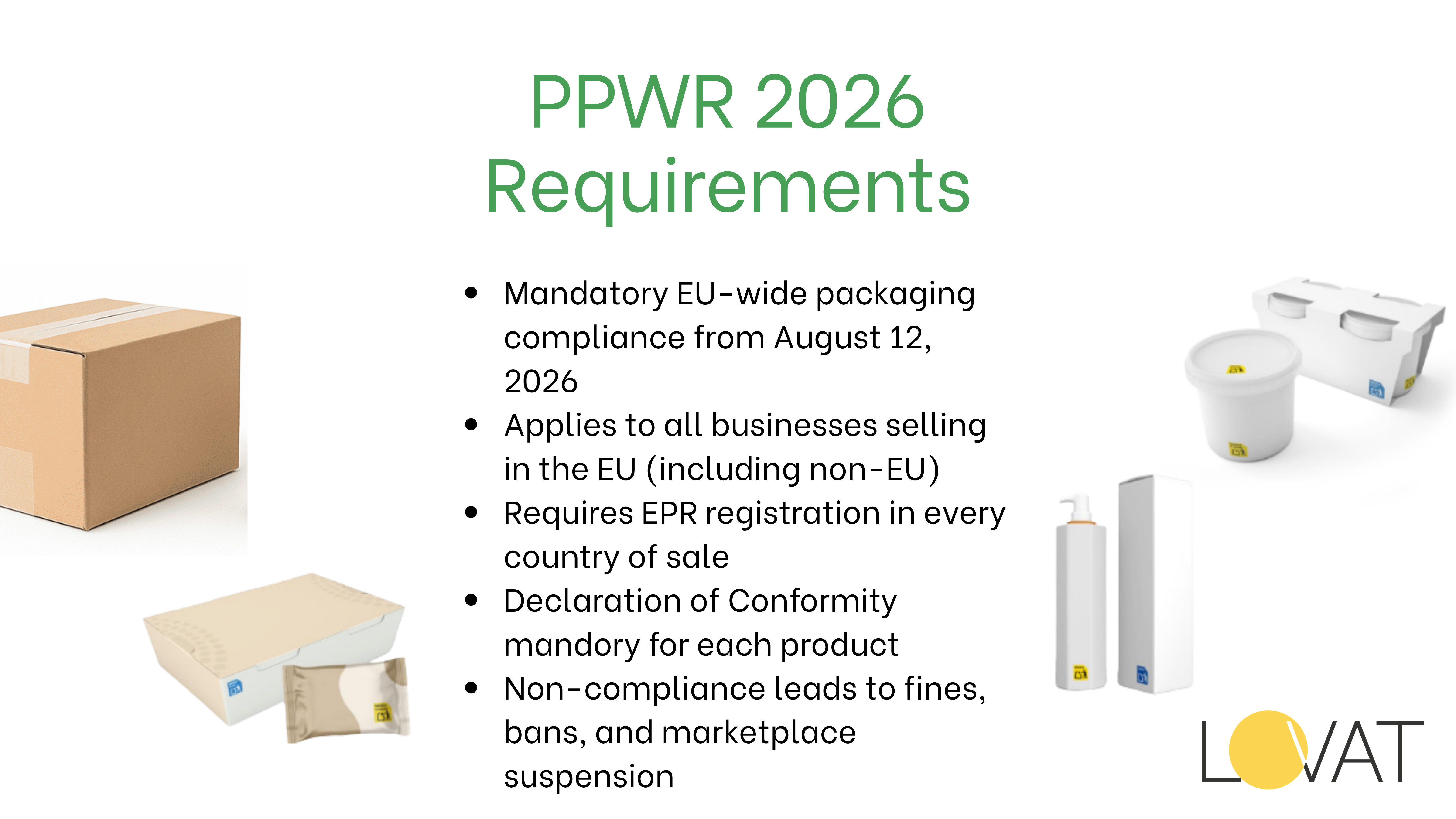
Every business that sells packaged goods in the EU has a tough legal deadline on August 12, 2026. If you don’t do it, you could get fined up to €200,000, have your products banned, or have your marketplace listings suspended. This can happen if you don’t register for EPR or if your product doesn’t have a valid declaration of conformity. The ppwr requirements affect all areas of procurement, law, finance, and operations at the same time. This guide lists all of the main duties, deadlines, and responsibilities, along with links to official sources and exact article numbers.
From EU Directive Packaging Waste and EU Directive 94 62 EC Compliance Requirements to One Unified Regulation
Directive 94/62/EC governed European packaging for three decades. Under the old eu directive packaging framework, each Member State wrote its own implementation: Germany built LUCID, France built CITEO, Italy built CONAI. A business active across three markets had to navigate three registration portals, three reporting formats, and three enforcement philosophies. The result was predictable — compliance looked different everywhere.
That time came to an end with Regulation (EU) 2025/40. It is a regulation, not a directive, and it was published in the Official Journal on January 22, 2025. It will go into effect on February 11, 2025. That legal difference is very important. Unlike the old EU directive on packaging waste, a regulation is directly applicable in all 27 Member States with no need for national transposition and no room for local variation. One text, one standard, and one baseline for enforcement.
The eu directive packaging waste rules gave each country a lot of freedom, such as sector exemptions, staggered rollouts, and localized interpretation. As new implementing acts go into effect, those accommodations are being phased out. It is not enough to just patch up any compliance architecture built on the eu directive packaging waste framework; it needs to be completely reassessed.
Meeting eu directive 94 62 ec compliance requirements shaped operations for three decades but enabled too much national divergence. Every system built around eu directive 94 62 ec compliance requirements — national carve-outs, phased timelines, local readings of the law — is being retired. One violation under the new regulation now creates exposure across all markets simultaneously, not just the country where the breach occurred.
Every European Company and Many Beyond Europe Must Follow PPWR
The regulation covers brand owners, manufacturers, importers, distributors, fillers, retailers, and online sellers. Every european company placing packaged goods on EU markets is included, but the scope reaches further. A business operating from Ukraine, Japan, or the United States carries identical obligations to a european company headquartered in Berlin.
Territorial location is irrelevant when it comes to scope. Whoever first makes products available on European markets becomes a “producer” under Article 45. That definition includes physical manufacturing, importing packaged goods from outside the EU, and certain distribution roles. A foreign brand selling direct-to-consumer across France, Spain, and Poland via its own website carries the same responsibilities as a european company manufacturing goods domestically.
Micro-enterprises, which have fewer than 10 employees and make less than €2 million a year, have less paperwork to do for some of their obligations. There is no such reduction for EPR registration. Every producer, no matter how big or small, has to sign up in the national register of every country where they sell goods.
As part of the registration process, businesses outside the EU must hire an Authorized Representative, which is a legal entity with a European address, to handle compliance duties. Product labels must have the representative’s contact information on them. Companies that are already following GPSR (General Product Safety Regulation, EU 2023/988) can usually give that representative more authority to cover the new duties, but they need to get written confirmation of the scope.
Article 45(4) assigns distinct responsibilities to online marketplaces. They must verify that sellers hold valid EPR registration in each country of sale. Amazon, Zalando, and eBay are already building these verification systems. A seller without proper registration faces immediate listing suspension — no warning, no grace period.

The Full PPWR Timeline from 2025 to 2040
The rule will be in effect for 15 years. Each phase adds new responsibilities on top of the ones from the previous phase. This is why full-arc awareness is important for making decisions about investments, supplier contracts, and IT infrastructure planning.
| Date | Obligation |
| Feb 11, 2025 | Regulation enters into force. The 18-month transition period begins. |
| Aug 12, 2026 | Core ppwr requirements become enforceable: Declaration of Conformity, PFAS ban, EPR registration, void space limits, own-container right, heavy metals cap. |
| Dec 31, 2026 | Commission publishes PCR content verification methodology. ECHA Substances of Concern report released. |
| Aug 2027 | Digital labelling mandatory — QR codes required on all product units under ppwr labelling requirements (Article 12). |
| Jan 1, 2028 | Design for Recycling criteria and recyclability grades A–E adopted per product category (Article 6). |
| Aug 2028 | Harmonised EU recycling pictograms replace all national symbols, including France’s Triman logo. |
| Jan 1, 2029 | Deposit and Return Systems operational across all Member States. Central EU EPR register replaces 27 national formats. |
| Jan 1, 2030 | Grade C minimum recyclability; PCR plastic targets; 40% reusable transport packaging; Annex V bans in food service; refill stations in large retail. |
| Jan 1, 2035 | Recyclability grades assessed against actual sorting infrastructure, not design alone. |
| Jan 1, 2038 | Grade D and E products banned from EU markets. |
| Jan 1, 2040 | Packaging waste down 15% vs. 2018 baseline. Final recycled content targets across all plastic categories. |
Declaration of Conformity Obligations and Who Produces It
From August 12, 2026, every distinct product type entering EU markets requires an EU declaration of conformity. This document confirms that the packaging meets all PPWR requirements covering design, substance, and recyclability. Responsibility depends on supply chain position.
Where an EU-based manufacturer supplies packaging, they issue the declaration of conformity. The brand’s job is to request it and retain it. Micro-enterprises are not exempt from this retention obligation. Waiting until July 2026 to request documentation is already too late — suppliers serving hundreds of clients will be backlogged for months before the deadline.
For self-manufactured or non-EU-sourced packaging, the declaration of conformity becomes the brand’s own obligation. The Annex VII conformity assessment must cover material composition per layer, weight per component, design rationale for recyclability, substance test results, and the basis for any claimed recyclability grade.
Retention runs five years for single-use products (from last unit sold) and ten years for reusable ones. Market surveillance authorities can request this documentation at any time. Failing to provide it is a standalone violation — independent of whether the packaging itself meets technical standards.
One detail most compliance summaries omit: pre-manufactured stock placed on EU markets after August 12, 2026, must fully comply. There is no grandfather clause for existing inventory.
PFAS Ban in Food-Contact Packaging Materials and Why Nine Months Lead Time Is Required
Per- and polyfluoroalkyl substances (PFAS) have been used in grease- and moisture-resistant food-contact materials for decades — pizza boxes, coffee cups, fast-food wrappers, popcorn bags, sandwich papers, baking trays. Article 5(5) of Regulation (EU) 2025/40 sets binding thresholds from August 12, 2026:
| Threshold Type | Limit |
| Individual PFAS compound | 25 ppb maximum |
| Total sum of all PFAS present | 250 ppb maximum |
These are analytical detection limits, not supplier declaration thresholds. Laboratory test results are required — a supplier declaration alone does not constitute compliance. A full PFAS panel typically takes two to six weeks to obtain.
The supply chain arithmetic is unforgiving. Most food businesses need four to nine months to switch to a compliant supplier, test the new material, update artwork, place a volume order, and clear non-compliant stock. A business beginning this process in May 2026 will still be selling non-compliant material in September 2026.
ECHA will publish a Substances of Concern report by December 31, 2026, which may trigger further restrictions beyond PFAS. Monitoring echa.europa.eu for updates is advisable.
Extended Producer Responsibility Europe EPR Registration Annual Reporting and EPR Reporting Requirements Explained
Extended producer responsibility Europe is the financial mechanism underlying the system. Whoever places products on EU markets pays for the collection, sorting, and recycling of that packaging after consumer use. Articles 44 and 45 lay out the legal structure.
Article 44 requires every Member State to maintain a national Producer Register. Article 45 defines producer obligations: register in every country of sale, pay annual fees based on material weight, and submit annual declarations. Extended producer responsibility Europe operates country by country — and that national architecture catches most businesses off guard.
The epr reporting requirements trap is straightforward: selling in seven countries means registering in seven countries separately, not once across a region. The central EU-level register replacing all 27 national systems is not scheduled until January 1, 2029.
Article 44(14) required the Commission’s implementing act establishing standardised epr reporting requirements formats by February 12, 2026. As of early 2026, that act remained unpublished. The correct approach is to register under current national systems now and update when the standardised format is confirmed.
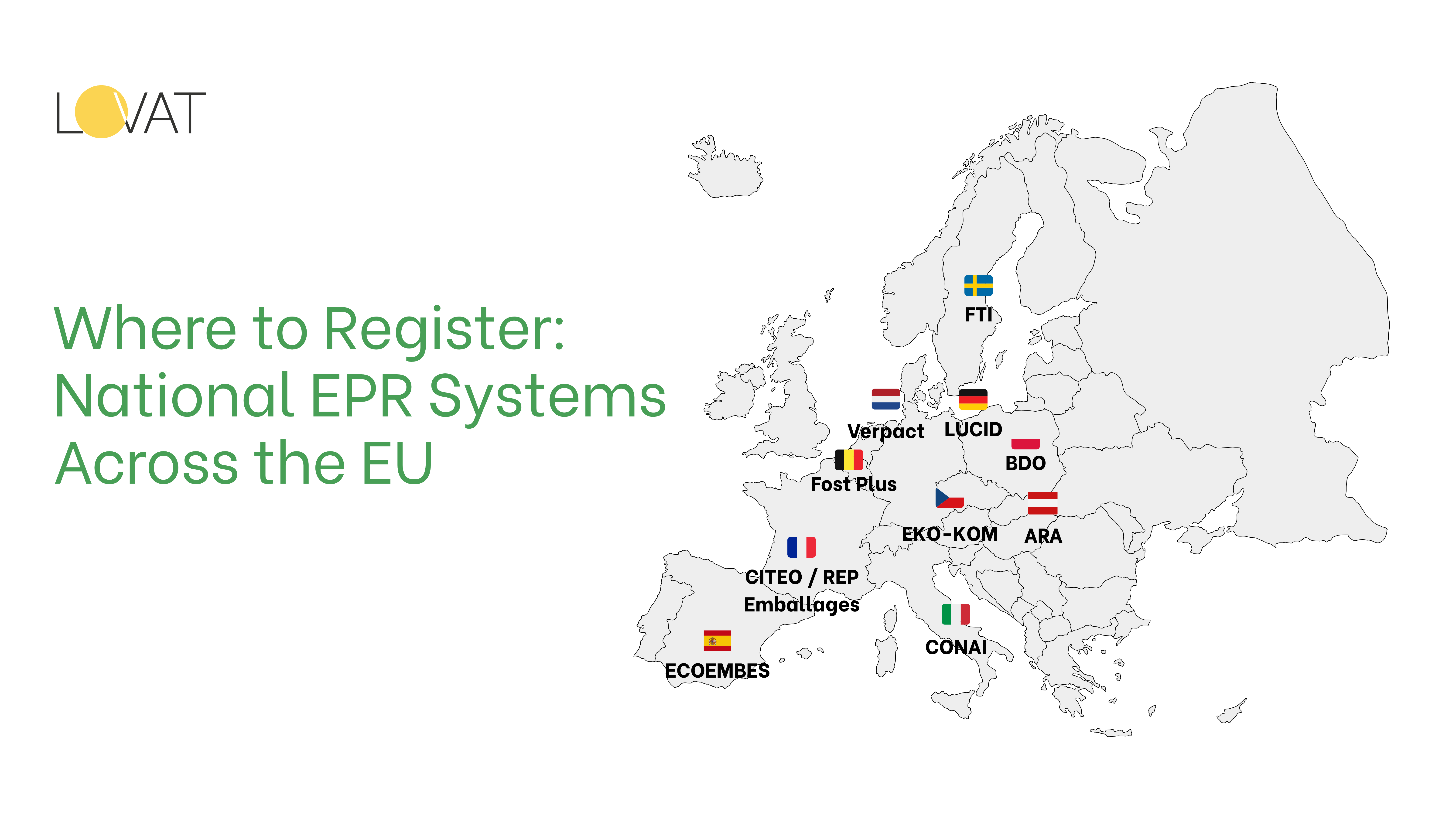
National EPR Registers in 10 Key Markets
| Country | Register | Key Detail |
| Germany | LUCID — lucid.verpackungsregister.org | Strictest enforcement; must register before first sale |
| France | CITEO / REP Emballages — citeo.com | Fee differentiation by recyclability already active |
| Spain | ECOEMBES — ecoembes.com | Spanish fiscal address or authorised representative required |
| Italy | CONAI — conai.org | Join CONAI, then the relevant material consortium |
| Netherlands | Verpact — verpact.nl | Fee by recyclability already in force |
| Poland | BDO — rejestr-bdo.mos.gov.pl | 5th-largest EU economy; fast-growing e-commerce |
| Austria | ARA — ara.at | Late registration carries significant fines |
| Belgium | Fost Plus — fostplus.be | Household products |
| Sweden | FTI — ftiab.se | — |
| Czech Republic | EKO-KOM — ekokom.cz | — |
How to Report Packaging Data in Annual EPR Declarations
Producers file once a year, typically in Q1 following the reporting period. Each declaration captures the total weight of all material types placed on the market in that country during the calendar year. When businesses report packaging data, they must break it down by polymer for plastics (PET, PE, PP, PS), paper and cardboard, glass, aluminium, steel, wood, and composite materials.
The need to report packaging data correctly requires calculating SKU weights, material layers, and sales countries independently. Germany’s figures cannot be applied to France’s declaration — each country requires a separate submission with its own totals. Forty SKUs across three material layers in five countries produces roughly 600 data points per reporting cycle. Spreadsheets work at small scale, but gaps accumulate between cycles and become visible during audit requests.
The packaging data sheet that supports each declaration must be traceable to specific products and material compositions. When authorities cross-reference a QR code record against an EPR declaration, both must match. A packaging data sheet maintained in one place — not rebuilt from supplier emails at year-end — is what makes that match reliable.
Under Article 45, fee modulation ties contribution rates directly to recyclability grades. Grade A products pay less than Grade C. France and the Netherlands already run mature fee-differentiation systems with rate gaps large enough to affect business cases materially. Redesigning packaging for better recyclability pays for itself through lower annual contributions, before any brand benefit is considered.
PPWR Labelling Requirements and What Every QR Code Must Contain from 2027
From August 2027, every product unit must carry a digital identifier — typically a QR code — linking to structured data. Article 12 defines the minimum content for ppwr labelling requirements:
| Required Field | Notes |
| Material composition per component | All layers, all materials |
| Recyclability grade | Published after Design for Recycling criteria are finalised |
| Consumer sorting instructions | Country-specific guidance where applicable |
| Substances of Concern above threshold | Where present |
| Producer registration number | Per country of sale |
The Commission will publish technical specifications for the ppwr labelling requirements by August 12, 2026, giving businesses the exact format before the 2027 obligation begins. The GS1 Digital Link format is suited for carriers — a single URL encoding GTIN, serial number, and all required data fields.
A well-structured digital label extends beyond legal minimums. It functions as a packaging data sheet — a machine-readable record of composition, weight, substance status, and recyclability grade, tied to a specific product via QR code. Retailers, recyclers, and market surveillance authorities can all access the same record simultaneously.
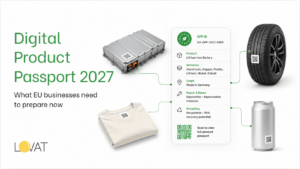
The overlap with the ESPR Digital Product Passport is significant. Both draw on the same underlying records: composition, layer weights, substance data, grade status. Building a compliant packaging data sheet for PPWR simultaneously lays the ESPR foundation — without rebuilding the data architecture twice.
Recyclability Grades A through E and Their Market Access Implications
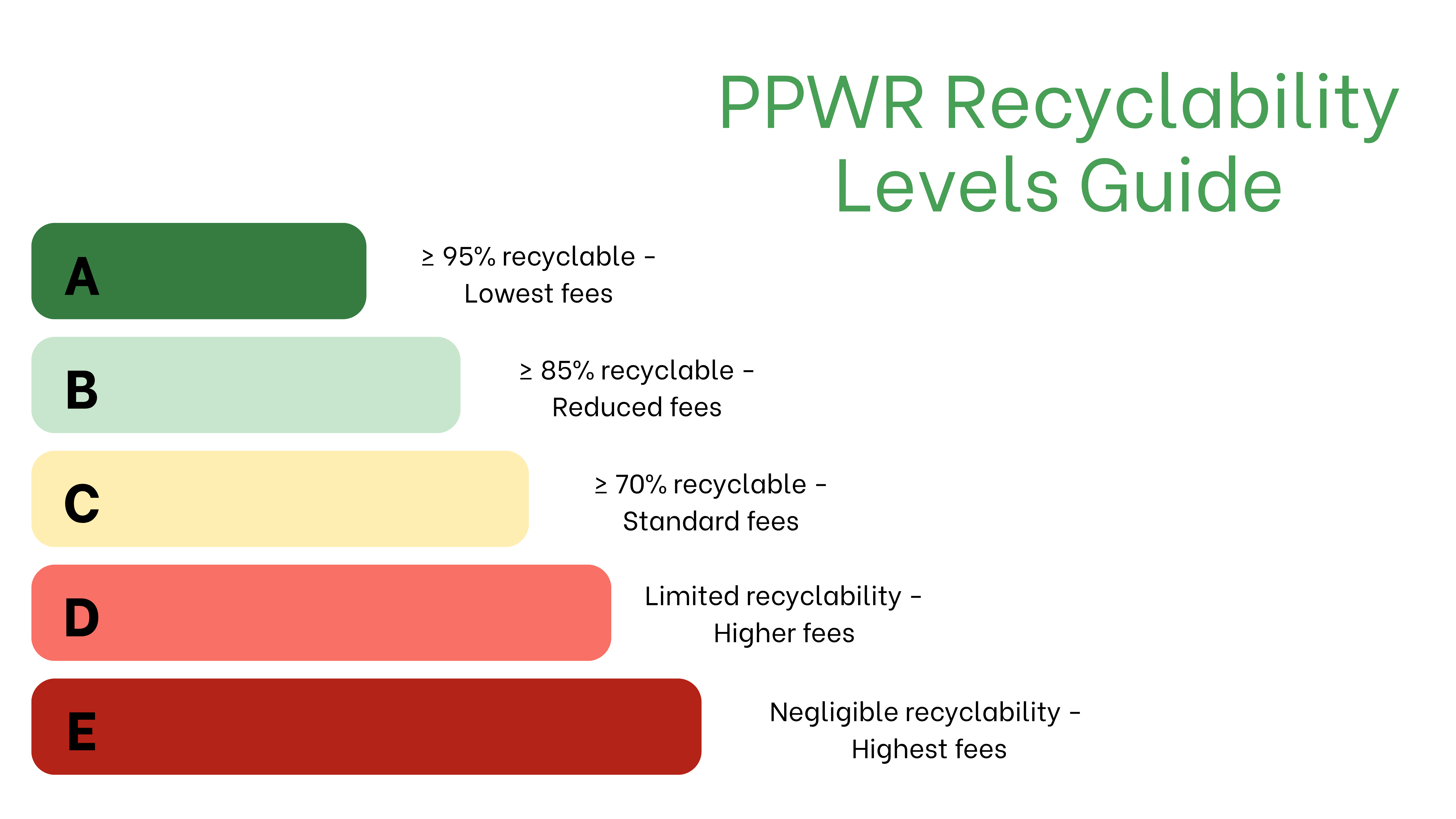
The A-to-E grading system progressively steers product design toward genuine recyclability. A product’s grade determines its EPR contribution rate and — from 2030 onward — whether it can remain on EU markets at all.
| Grade | Definition | Market Status |
| A | Recycled at high volume and quality across most Member States; all Design for Recycling criteria met | Permitted — lowest EPR fees |
| B | Recyclable across a majority of Member States with high-quality output | Permitted — reduced EPR fees |
| C | Recyclable with some design limitations — mandatory minimum from January 1, 2030 | Permitted — standard EPR fees |
| D | Limited practical recyclability | Permitted until January 1, 2038 |
| E | Negligible practical recyclability | Permitted until January 1, 2038 |
A PET tray wrapped tightly in PE film sleeve typically grades C or D. The sleeve is difficult to separate in sorting facilities and contaminates the PET output stream. Replace the sleeve with a paper band that peels away cleanly and the same tray moves to Grade A or B. The raw material cost difference is minimal. The EPR fee difference across 500,000 units per year is material.
From 2035, grades will reflect actual sorting infrastructure in each region, not product design criteria alone. A technically recyclable item without accessible collection and processing infrastructure in a given area will not qualify.
Recycled Content Targets for Plastics and 2030 Deadlines
Article 7 sets mandatory post-consumer recycled (PCR) content minimums for plastic packaging, phased by category. The Commission publishes the verification methodology by December 31, 2026.
| Category | PCR Minimum 2030 | PCR Minimum 2040 |
| PET beverage bottles (single-use) | 30% | 65% |
| Other single-use plastic sales items | 10% | 35% |
| Industrial and e-commerce plastic film | 35% | 65% |
| Contact-sensitive materials (pharma, medical) | Under assessment | TBD |
Food-grade recycled PET supply in Europe is already constrained — demand from the Single-Use Plastics Directive has tightened availability. Adding PPWR targets to an already stretched supply creates a structural shortage for businesses that wait. Companies securing long-term PCR polymer contracts in 2026 pay 2026 prices. Those waiting until 2029 will compete with every other brand running the same search simultaneously.
Bio-based plastics do not count toward PCR content targets under current rules. The Commission will evaluate whether bio-based substitution is permissible by approximately February 2028 — 36 months after the regulation entered into force. No compliance pathway through bio-based materials exists until that ruling is published.
Void Space Limits Reuse Targets and HORECA Obligations
Article 9 sets the void space rule. From August 12, 2026, empty space inside an e-commerce parcel cannot exceed 40% of total internal volume. Implementing acts will define the “technically unavoidable” exception — but if a smaller box fits the product, the exception is unlikely to apply. Right-sizing machines (custom-height corrugated cardboard systems) pay for themselves in under 12 months at mid-scale shipping volumes.
Article 23 establishes the own-container right. Takeaway food businesses must accept a customer’s clean personal container at the same price and with equivalent service quality. Deadline: August 12, 2026. Two practical requirements follow: POS system updates and staff training.
Article 26 sets reuse targets from January 1, 2030: at least 40% of transport packaging materials must be reusable; e-commerce businesses must offer reusable shipping as a checkout option alongside single-use; retail spaces above 400 m² must allocate at least 10% of floor area to refill stations.
Annex V single-use items banned from food service from January 1, 2030 include individual condiment sachets, coffee creamers, and sugar portions. Supplier qualification cycles run 12 to 18 months. Beginning supplier transition planning in 2026 avoids a real crunch in 2029.
Packaging Data Software and Packaging Data Sheet as the Foundation for Compliance Outcomes
All PPWR obligations — EPR registration, declaration of conformity production, grade assessment, epr reporting requirements, and digital labelling — converge on the same underlying problem: structured materials records. The only data that all obligations share is material type and weight per component, substance characteristics, and design rationale per product type. Companies that handle the regulation well use packaging data software that maintains this information centrally, updates as products change, and exports in the format each obligation requires.
The packaging data software approach means one record can simultaneously hold declaration of conformity files, EPR annual declarations, grade assessments, and QR code content. Businesses relying on separate spreadsheets, supplier PDFs, and order histories face a different reality — every compliance request requires finding and rebuilding the same records from scratch.
What matters is not necessarily a specific tool — it is a structured data model with a single source of truth. To report packaging data correctly across multiple countries and reporting cycles, businesses must ensure that what a QR code shows a consumer, what an EPR declaration shows a national authority, and what the packaging data sheet shows a market surveillance inspector are all identical. Those three records only match reliably when they come from one place.
Businesses that treat this as a data architecture problem — not a compliance paperwork problem — solve it once. Every subsequent regulatory deadline becomes an export task rather than a research project.
 Lovat handles your PPWR compliance end-to-end — EPR registration, reporting, and declarations across all EU markets. Get a fee quote or book a call with our team.
Penalties for Non-Compliance and Specific Figures
Article 52 requires Member States to set penalties that are effective, proportionate, and dissuasive. National draft legislation provides specific figures:
| Penalty Type | Detail |
| Fines | Germany’s draft Verpackungs-Durchführungsgesetz allows up to €200,000. France, Italy, and the Netherlands propose comparable maximums. Ten products without a declaration of conformity count as ten separate violations. |
| Sales prohibition | Market surveillance authorities can halt further market placement of non-compliant products, including stock already in circulation. |
| Mandatory recall | Authorities can order removal from all distribution channels. |
| Marketplace suspension | Missing registration number triggers immediate listing suspension under Article 45(4). Two peak-season weeks offline costs more than most regulatory fines for an EU marketplace business generating €2M annually. |
| Customs blockage | Goods arriving from outside Europe are held at the border when a declaration of conformity or registration number is absent. |
| Supplier contract clauses | Retailers and distributors renegotiating contracts in 2025–2026 are adding regulatory warranties. A supplier unable to produce a declaration of conformity on request risks losing the contract without regulatory involvement. |
Compliance Steps by Business Role
Brand Owner or EU Manufacturer
Map all product types (primary, secondary, transport) — material and weight per component per SKU.
EU-based suppliers: request Declarations of Conformity and file them. Self-manufactured or non-EU sourced: run Annex VII conformity assessment and assign ownership.
Food-contact materials: obtain PFAS lab results. Any result above 25 ppb per compound triggers immediate supplier transition.
E-commerce: calculate void space ratios and flag anything above 40%.
Register in national producer registers for every sales country.
Implement packaging data software centralising material type, weight, and recyclability rating per product — exportable for EPR declarations and digital label content.
Importer or Non-EU Brand
Complete steps 1 through 6 above, plus:
Appoint an Authorised Representative or confirm in writing that a GPSR representative’s mandate covers the new obligations.
Confirm declaration of conformity ownership for all non-EU manufactured products.
E-Commerce or Marketplace Seller
Complete steps 1 through 6 above, plus:
Have per-country registration numbers ready for marketplace verification portals — verification is rolling out now.
Evaluate reusable shipping suppliers for the 2030 checkout obligation. Lead times make 2026 the practical starting point.
Food Service and HORECA
Complete steps 1 through 6 above, plus:
Update POS systems and staff procedures for own-container acceptance before August 12, 2026.
Identify which Annex V single-use items are currently in use and begin supplier transition for the 2030 ban.

All Key Dates at a Glance
| Date | Obligation |
| Feb 11, 2025 | PPWR enters into force |
| Aug 12, 2026 | Declaration of Conformity required; PFAS ban; EPR registration; void space limit; own-container right |
| Dec 31, 2026 | PCR content methodology published; ECHA Substances of Concern report |
| Aug 2027 | ppwr labelling requirements active — QR codes on all product units |
| Jan 1, 2028 | Design for Recycling criteria and grades A–E published |
| Aug 2028 | Harmonised EU recycling pictograms on physical products |
| Jan 1, 2029 | Deposit and Return Systems across all Member States; central EU EPR register |
| Jan 1, 2030 | Grade C minimum; PCR targets; reuse targets; Annex V bans; refill station obligations |
| Jan 1, 2035 | Grades assessed against actual sorting infrastructure |
| Jan 1, 2038 | Grades D and E banned |
| Jan 1, 2040 | Final waste reduction and recycled content targets |
Don’t face PPWR alone. Lovat’s software automates EPR registration and reporting across the EU. Request a quote or talk to a specialist.