
EU VAT Number Validation for Businesses — A Complete B2B Guide
EU VAT Number Validation for Businesses — A Complete B2B Guide
Why EU VAT Number Validation Matters for B2B Businesses
You sell a €20,000 shipment of goods to a company in Germany. They hand over a VAT identifier. You zero-rate the invoice. Six months later, a tax inspector asks: “Did you check whether this was valid before skipping VAT?” If you can’t prove it — that zero-rating gets reversed. You owe the VAT. Plus interest. Maybe a penalty too.
That’s why EU VAT Number validation isn’t a formality. It’s a financial safeguard.
Every time your business applies reverse charge or zero-rated treatment on a cross-border B2B sale within the EU, you’re making a claim. The claim is that your counterparty is a legitimate, VAT-registered business in another member state. Authorities expect proof. And “they told me they were registered” won’t hold up during an inspection.
This trips up all kinds of businesses. Ecommerce wholesalers on Shopify selling to resellers across Europe. Amazon sellers fulfilling B2B orders through Seller Central. SaaS companies invoicing enterprise clients in France and Italy. Marketplace vendors handling mixed B2C and B2B orders without a reliable way to separate them.
Validating EU VAT numbers protects you from three specific risks. First: issuing an incorrect zero-rated invoice, which makes the unpaid VAT your problem. Second: failing an audit because you can’t produce evidence the check happened. Third: accidentally applying B2B treatment to a consumer transaction — a mistake that’s harder to unwind than most people realise.
How to Validate EU VAT Number Details
So how do you actually validate EU VAT number information before issuing an invoice? The process sounds simple. In practice, it has more moving parts than you’d expect.
You need a few things before you start. The client’s country code — two letters, like DE for Germany or FR for France. Watch out for Greece, though. They use EL, not GR. That trips up systems constantly. Then the VAT identification itself, stripped of spaces, dashes, or dots. DE123456789 works. DE 123-456.789 doesn’t.
Beyond the registration, you want the client’s legal name and address. Why? Because a valid VAT ID that belongs to a different legal entity than the one placing the order is still a problem. Auditors check for that.
Here’s a step-by-step approach that works:
- Get the client’s full VAT details including the country prefix
- Strip out any spaces, punctuation, or formatting errors
- Run it through VIES (the EU’s official validation system) or an automated compliance tool
- Compare the returned legal name and address against your records on file
- If there’s a mismatch, ask the client to clarify before invoicing
- Save the result — date, response, any reference code — and link it to the transaction
- Repeat the check periodically, not just at onboarding
One check at setup isn’t enough. Registrations get deactivated. Companies restructure. Something valid in January might not be valid in September. Best practice is to validate EU VAT numbers before each significant transaction, or on a monthly/quarterly schedule.
The quickest manual route is the European Commission’s VIES portal. But if you’re processing dozens or hundreds of B2B transactions a month, manual checks break down fast. That’s where automated tools earn their keep — they process in bulk, store results, and flag problems before an invoice goes out.
VIES VAT Check — How the System Actually Works
Most people assume VIES is a database. It’s not. A VIES VAT check is more like a search engine that pings national systems in real time.
When you enter a VAT registration on the VIES portal, the system doesn’t look it up in some central European registry. It sends a query to the national authority of whichever country issued it. Germany’s Bundeszentralamt für Steuern, France’s DGFiP, Italy’s Agenzia delle Entrate — each maintains its own records. VIES just connects to them.
This matters because the data returned depends entirely on the national system. Some countries — Germany, the Netherlands — return the company name and full address alongside the result. Others don’t. Spain confirms validity but won’t disclose the registered name. Poland provides the name but may skip the address. The VIES VAT check result you get for an Italian entry will look different from a Dutch one. Same system, different data.
VIES doesn’t create registrations. It doesn’t register businesses. It doesn’t activate anything for intra-community trade. All of that happens nationally. VIES only reports back what the national records tell it. If a national system is down for maintenance — and this happens more than you’d like — VIES returns “unavailable” for that country.
One detail that catches people off guard: a valid result in VIES means the entry is active for intra-EU transactions. Some member states issue a domestic registration first and require a separate activation step before it appears in VIES. Germany, Italy, and Spain all work this way. A brand-new client might give you a perfectly real registration that VIES calls invalid — not because it’s fake, but because the cross-border activation hasn’t gone through yet.
For high-volume businesses, the VIES web portal is painfully slow. One entry at a time, no batch processing, no automatic record keeping. Fine for a handful of clients. For an ecommerce business processing hundreds of B2B orders a week across six EU countries, it’s unworkable. Automated VIES VAT checks through an API or compliance platform solve that bottleneck.
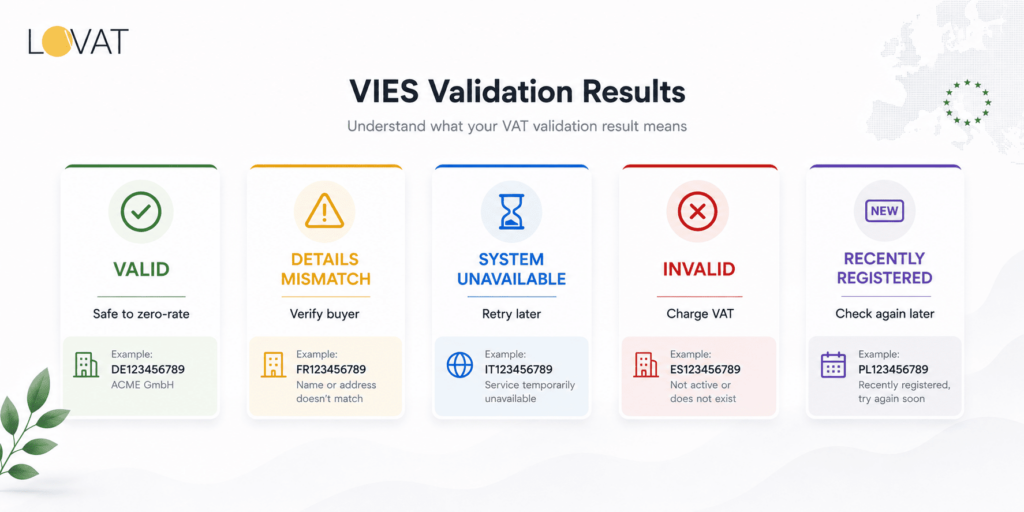
VIES Validation Results and What They Mean
The response you get from a VIES validation check isn’t always a clean “yes” or “no.” There’s nuance, and misreading the result costs money.
A “valid” result means the registration is active for intra-community transactions. Good. Save it, confirm the company details match, and proceed with your zero-rated invoice.
An “invalid” result is trickier than it sounds. It might mean the entry doesn’t exist. Or it was deactivated. Or — the frustrating one — it hasn’t been activated for cross-border trade yet. A German company that registered last week might have a legitimate ID that VIES won’t recognise for another few weeks. Treating every “invalid” response as a definitive rejection isn’t right either. You need to investigate.
“Service unavailable” means the national records for that country are offline. It happens regularly. France’s system goes down for maintenance. Italy’s takes a nap. The key point: unavailable does not mean invalid. Don’t treat it that way. Retry later, and document that you tried.
Then there’s the case where the entry comes back valid, but the company name or address doesn’t match what your client gave you. Red flag. Maybe they’re ordering under a trading name. Maybe the registration belongs to a parent company and the purchaser is a subsidiary. Maybe it’s the wrong entity entirely. Resolve this before issuing a zero-rated invoice.
VIES validation results require context. A valid entry with matching details is straightforward. Everything else demands a judgement call — and documentation of what you decided and why. Businesses that run frequent VIES validations should build a clear internal protocol for handling each type of outcome.
| Validation Result | What It Means | Risk Level | Recommended Action |
| Valid | Active for EU cross-border transactions | Low | Save result and confirm buyer details |
| Invalid | Not recognised for EU transactions | High | Request corrected details — do not zero-rate |
| National system unavailable | Country records cannot respond | Medium | Retry later and retain evidence of the failed check |
| Details do not match | May be valid but company info differs | High | Ask buyer to confirm legal name and registration |
| Recently registered | Not yet synchronised with VIES | Medium | Confirm with national authority or retry later |
| Domestic-only registration | Not enabled for intra-community trade | High | Apply domestic or non-B2B VAT treatment |
VAT Number Verification EU — Requirements for Cross-Border Sales
A valid VAT identifier is step one. But VAT number verification EU rules go further — especially for cross-border transactions.
For intra-community supplies of goods, the rules are strict. You need a valid buyer ID, proof that the goods physically moved from one EU country to another, and an invoice referencing the correct VAT treatment. Miss any of those three, and your zero-rating is at risk. Since the 2020 “Quick Fixes” regulation, you need at least two non-contradictory pieces of evidence proving transport happened. A signed CMR plus a bank statement. A carrier invoice plus a delivery confirmation. An invoice alone isn’t enough.
B2B services follow different rules. If your client is established in another EU country and you’re supplying consulting, advertising, or IT services — the reverse charge applies. The client accounts for the VAT. But you still need to verify their registration. Without verification, your basis for applying the reverse charge is shaky.
Digital services get their own treatment. For B2B digital supplies, the reverse charge generally applies when the purchaser is in a different EU country. For B2C digital sales, OSS kicks in. The dividing line between B2B and B2C depends on — you guessed it — VAT number verification EU evidence. No valid registration, no B2B treatment.
Marketplace transactions add another layer. If you’re selling B2B through Amazon or a similar platform, you need to capture and verify the purchaser’s VAT details before the platform remits payment. Some platforms handle this. Others leave it entirely to the seller.
Triangulation and chain transactions get complicated fast. Three parties, two or three countries, goods moving directly from supplier A to end buyer C while company B sits in the middle. Each party’s VAT status needs checking. One invalid entry in the chain and the whole VAT treatment collapses.
A real example: you’re a Dutch company selling industrial parts. A Polish distributor orders €80,000 of stock, provides their VAT registration. You verify through VIES — valid. You ship from Rotterdam to Wroclaw. You have a signed CMR, a carrier invoice, and a bank transfer from the Polish company. That’s a clean, defensible zero-rated supply. Remove any one of those elements and you’ve got an exposure.
VAT ID Verification Before Applying Zero-Rated VAT
A valid registration doesn’t automatically earn zero-rating. VAT ID verification is necessary, but it’s only one piece of the puzzle.
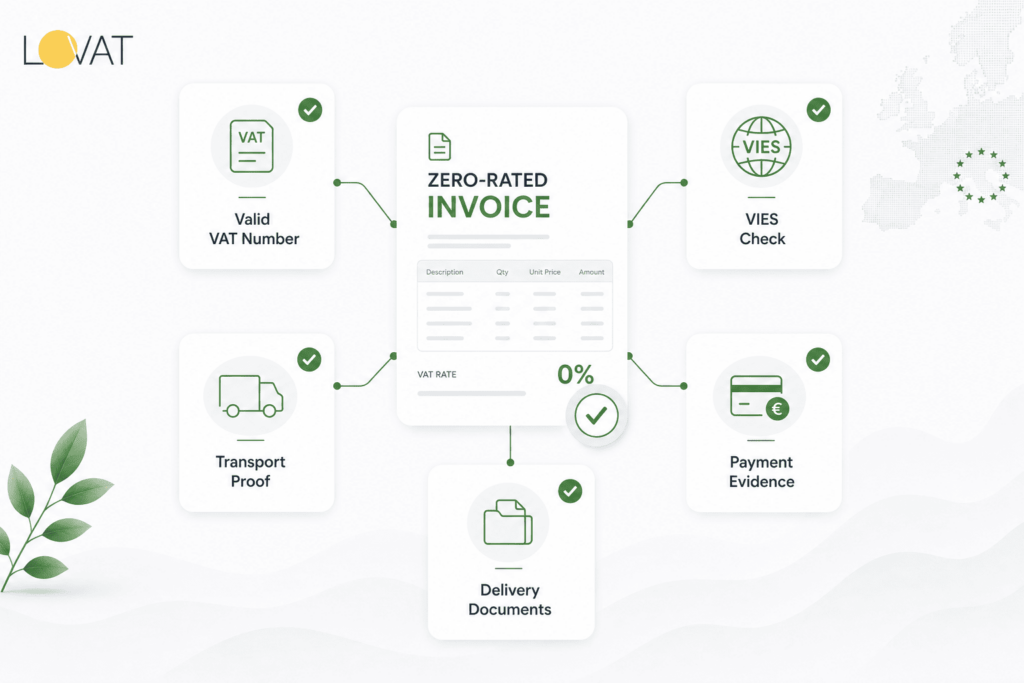
Authorities expect a package of evidence. The validation check confirms your counterparty’s status. But you also need to show that the transaction itself qualifies. That means keeping:
- The invoice with correct details and VAT treatment references
- Proof of transport — signed CMR, carrier invoices, tracking confirmation, delivery receipts
- Order records — the purchase order, email chain, or contract
- VIES check result with the date, response, and any reference
- A timestamp showing when the check happened relative to the transaction
- Delivery address matching the registration or a documented alternative
- Payment evidence linking the funds to the specific order
Errors creep in when the VAT registration belongs to a different legal entity. A German holding company gives you its ID, but the actual purchaser is a subsidiary with its own registration. That mismatch might not surface until an auditor asks why entity A’s details appear on entity B’s order.
Another common trap: the client provides a domestic-only VAT registration. It’s real. Valid in their country. But it hasn’t been activated for intra-community trade, so VIES doesn’t recognise it. If you zero-rate anyway because “it looked right,” the liability is yours.
Verifying VAT IDs before invoicing is the last line of defence. Once a zero-rated invoice goes out, unwinding it — reissuing with VAT, chasing the buyer for the amount — is messy, slow, and often unsuccessful. Better to catch the problem before the invoice leaves your system.
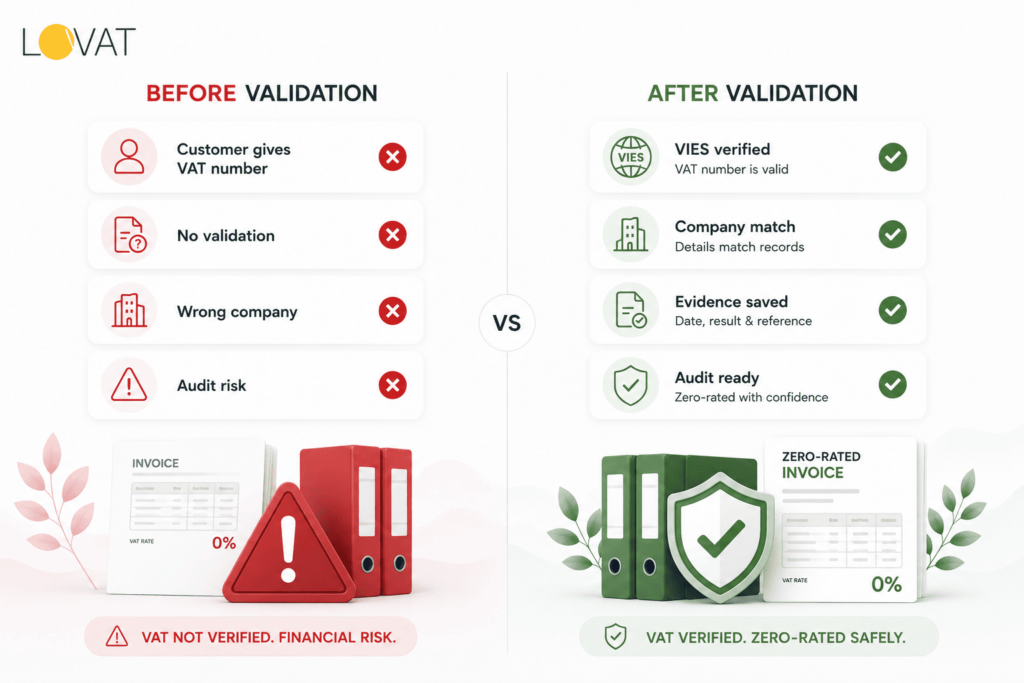
Common EU VAT Number Validation Errors
Most validation failures aren’t caused by fraud. They’re caused by sloppy process. Here are the mistakes that come up again and again — every one of them preventable.
- Checking after the invoice is already out. This defeats the purpose. Validation is meant to confirm B2B status before you apply zero-rating. Doing it retroactively doesn’t protect you if the entry turns out to be invalid.
- Stripping the country prefix. Someone enters 123456789 instead of DE123456789. VIES needs the country code. Without it, the check fails or returns a result for the wrong country.
- Formatting errors. Spaces, dashes, dots — none of these belong in a VAT identifier. But people copy-paste from invoices, emails, business cards. “FR 12 345 678 901” won’t work. “FR12345678901” will.
- Wrong legal entity. The client gives you the registration of their parent company, a trading subsidiary, or a different branch. The ID itself might be perfectly valid. But if it doesn’t belong to the entity actually buying from you, the zero-rating won’t hold up.
- No evidence saved. You ran the check. Great. Can you prove it six months from now? If the answer involves digging through browser history, the answer is no.
- Treating VIES downtime as a rejection. A national system goes offline, VIES returns “unavailable,” and someone on your team marks the account as unverified. That’s not what happened. The check couldn’t be completed. Retry it.
- Reverse charge without verification. Applying reverse charge because the counterparty said they’re a business — without actually running a validate EU VAT number check — is a mistake auditors specifically hunt for.
- Reusing old results. A check from 2023 doesn’t cover a transaction in 2026. Registrations change. Companies deregister. You need recent validation for recent transactions.
Signs that your EU VAT number validation process is unreliable:
- You can’t locate the VIES result for a specific invoice from three months ago
- Different team members follow different procedures
- Nobody knows whether recently onboarded buyers have been validated
- VIES failures get ignored rather than followed up
- B2B and B2C orders use the same invoicing workflow without a verification gate
Businesses that need to verify client VAT details before issuing an invoice can use Lovat to validate VAT records and reduce the risk of incorrect zero-rated B2B transactions.
Assistance Services for VAT Number Checks
At some point, manual checks stop scaling. That’s when assistance services become less of a nice-to-have and more of a necessity.
If you’re a small B2B operation processing five cross-border invoices a month, you can handle VIES checks yourself. Log into the portal, enter each entry, save a screenshot, move on. But what happens when you’re doing 500 invoices a month across eight EU countries? What about selling through Amazon, Shopify, and your own webshop simultaneously — each with its own B2B buyer base?
That’s where professional assistance services earn their place. Automated tools can process hundreds of VAT registrations in batch. They store results directly against buyer records or transaction IDs. They flag mismatches between the VIES response and your data on file. They schedule revalidation at whatever interval you choose — monthly, quarterly, before each invoice.
High-volume ecommerce is the obvious use case. But it’s not the only one. Businesses managing registrations across multiple EU countries need systematic checks to keep their own IDs active and visible in VIES. Companies issuing credit notes after a failed validation need a workflow connecting the check to the invoice adjustment. And anyone facing an audit needs organised, retrievable records — not a folder of screenshots labelled “VIES check Jan 2024.”
One thing to be clear about: automated assistance doesn’t replace your responsibility. You still make judgement calls when results are ambiguous. You still resolve mismatches. The automation handles the repetitive, high-volume part — mechanical checking, storing, flagging. The decisions stay with you.
How Lovat Supports EU VAT Number Validation
Managing VAT checks across borders, platforms, and hundreds of buyer records is exactly the kind of problem Lovat was built to solve.
Lovat connects to your sales channels — Amazon, Shopify, eBay, and others — and pulls B2B transaction data into a centralised system. Instead of logging into VIES manually for each client, Lovat automates the process. Registrations get checked. Results get stored. Mismatches get flagged. All without someone on your team copy-pasting into a web form one at a time.
What makes the difference for ecommerce businesses is how validation ties into everything else. Lovat doesn’t just check an entry and forget about it. The result links to the specific buyer, invoice, and transaction. When an auditor asks “did you verify this buyer’s VAT status before zero-rating invoice #4782?” — the answer is right there. Date, time, VIES response, matching details. That’s EU VAT number validation done properly.
The platform identifies when buyer details don’t match VIES records — a wrong legal name, a mismatched address, a domestic-only registration. It flags these before the invoice goes out, not after. For businesses selling in six or seven EU countries, that early warning prevents a lot of downstream pain.
Lovat also handles the broader compliance picture. VAT return preparation across 100+ countries, DAC7 reporting, e-invoicing, and threshold monitoring all run through the same system. So your VAT checks aren’t isolated in one tool while filings live in another. Everything connects.
For high-volume sellers, the reporting alone is worth it. Centralised validation history, audit-ready exports, and automated revalidation schedules replace the spreadsheet-and-screenshot approach that most businesses start with and quickly outgrow.
If your business sells goods or services across EU borders and needs a reliable VAT compliance process, Lovat can help you automate VAT number checks, organise transaction records, and manage cross-border reporting.
| Area | Manual Verification | Automated Verification |
| Speed | Each entry checked individually | Multiple entries processed automatically |
| Evidence retention | Screenshots or files saved manually | Results linked to transaction records |
| Error risk | Higher risk of typing and filing errors | Lower risk with automatic data transfer |
| High-volume sales | Difficult to scale | Built for marketplaces and ecommerce |
| Repeat validation | Staff must remember when to recheck | Rechecks scheduled or triggered automatically |
| Reporting | Records spread across folders and systems | Validation history centralised |