

Global EPR Evolution — How Canada, Australia, USA and China Are Shaping the Next Wave of Reform
Global EPR Evolution — How Canada, Australia, USA and China Are Shaping the Next Wave of Reform
The concept of extended producer responsibility (EPR) has evolved dramatically from a theoretical environmental principle to a harsh reality of compliance that dictates market access for businesses around the world. As 2025 approaches, we are seeing a synchronized tightening of waste management laws, with governments no longer asking for voluntary management but demanding financial and operational responsibility for the entire product life cycle. Insights from regions deeply engaged in regulatory transformation, such as packaging Europe, illustrate how rapidly EPR systems are advancing and setting new global expectations for compliance. The global EPR framework is rapidly maturing, going beyond simple waste recycling targets to include complex requirements for eco-design, digital traceability, and mandatory recycled content. This article examines the different but converging regulatory paths of four major economies – Canada, Australia, India, and China – and provides practical guidance for manufacturers operating in this complex space.
EPR global policies reshaping compliance for the packaging company and other producers
The traditional linear economic model of “take, make, and dispose” is being dismantled by aggressive legislative reforms that place the burden of waste management squarely on producers.While Europe historically led this charge, the center of gravity for innovation in environmental policy is expanding to include major economies in the Asia-Pacific and North American regions. Manufacturers and importers must now navigate a fractured landscape where EPR global strategies require hyper-local adaptation to succeed.
Governments are increasingly utilizing EPR as a fiscal tool to fund modern recycling infrastructure and as a policy lever to force upstream design changes in packaging and electronics. For the packaging company, this shift means navigating a far more proactive regulatory landscape where product composition, recyclability, and data accuracy directly influence compliance costs. The era of passive compliance is over, replaced by a dynamic environment where data reporting, fee modulation, and third-party auditing are standard operational requirements.
Packaging EPR driving compliance change across the United States
The United States represents one of the most rapidly evolving yet structurally fragmented EPR landscapes worldwide. Although no federal packaging law exists, state legislatures are increasingly driving momentum behind EPR in USA, reshaping recycling financing and product-design expectations. As more jurisdictions adopt producer-funded models, businesses operating across the country are finding packaging USA compliance far more complex, with different timelines, definitions, and performance standards. This creates a patchwork framework where EPR USA obligations depend heavily on the specific rules of each state.
To understand the regulatory direction of EPR in USA, it is essential to look at the states that have already implemented or are actively developing mandatory systems. Below is a breakdown of key state actions shaping the future of packaging USA regulations and accelerating the broader shift toward EPR USA nationwide:
Key U.S. States leading EPR reform
California (SB 54 – 2022)
- Considered the most ambitious EPR in USA law.
- Requires a 25% reduction in single-use packaging by 2032.
- Enforces strict recyclability criteria and bans non-recyclable formats.
- Introduces eco-modulated fees and mandatory Producer Responsibility Organizations (PROs).
- Expected to influence national packaging USA standards due to the state’s market size.
Colorado (HB 1355 – 2022)
- Establishes a fully producer-funded recycling system.
- Aims for statewide access to curbside recycling services by 2035.
- Fee structures based on environmental impact align Colorado closely with European-style EPR USA models.
Oregon (SB 582 – 2021)
- Requires producers to join state-approved PROs.
- Introduces strict reporting obligations and recyclability labeling rules.
- Expands the list of covered materials beyond traditional packaging, strengthening the scope of packaging USA compliance.
Maine (LD 1541 – 2021)
- The first U.S. state to adopt mandatory packaging EPR.
- Producers must cover municipal recycling costs and report annual packaging volumes.
- Maine maintains strong enforcement mechanisms, forming a foundational blueprint for EPR in USA expansion.
Washington State
- Actively considering multiple EPR proposals.
- Draft bills emphasize refillable packaging incentives, higher PCR (post-consumer recycled) content, and eco-modulated fees.
- Likely one of the next states to formalize EPR USA legislation.
New York
- A draft Packaging Reduction & Recycling Infrastructure Act is under debate.
- Proposes significant packaging reduction mandates and strict recyclability standards.
- If passed, New York would become a major driver of innovation in packaging USA design and compliance.
Maryland
- Conducting studies and stakeholder consultations to build a roadmap toward statewide EPR in USA adoption.
- Early signs suggest alignment with models already implemented in Maine and Oregon.
- Trends Likely to Shape the Future of EPR in the U.S.
- Movement toward harmonized reporting standards to reduce administrative burdens for companies operating nationally.
- Expansion of EPR beyond packaging to include electronics, batteries, carpets, mattresses, and textiles.
- Digital tracking systems, similar to those used internationally, expected to appear in future EPR USA legislation.
- Stricter eco-design mandates, requiring companies to redesign packaging for recyclability and incorporate higher levels of post-consumer resin.
- Rising compliance costs, as producer-funded systems replace municipal funding across multiple states.
 We provide EPR registration services to help producers register with local authorities and ensure compliance with extended producer responsibility requirements across applicable markets. Learn more
Why packaging USA and other EPR categories matter for businesses
For brands selling into the U.S., packaging USA rules are no longer a peripheral consideration – they directly influence product design, supply chains, cost structures, and market access. Companies must build scalable compliance systems that accommodate multiple state laws while preparing for an eventual federal push toward broader EPR USA harmonization.
EPR Canada entering a new phase of producer responsibility
Canada presents a unique case study where significant constitutional authority for waste management rests with provinces, yet a cohesive national strategy is emerging through synchronized implementation dates. The year 2025 marks a critical turning point as several major provinces simultaneously transition from municipal-funded recycling to full producer-led models. As policymakers refine the overarching framework for EPR Canada, the country is positioning itself as a leading example of how decentralized governance can still deliver harmonized producer responsibility standards. This shift effectively transfers hundreds of millions of dollars in waste management costs from taxpayers directly to brand owners and first importers.
Canada EPR and key provincial developments
- Ontario: The province enters the final phase of its transition to full producer responsibility, with the Blue Box program completely shifting to producer operational control by December 31, 2025.
- Alberta: The implementation of a comprehensive EPR framework for single-use products, packaging, and printed paper officially accelerates, establishing a “polluter-pay” system that aligns with British Columbia’s established model.
- Nova Scotia: New packaging EPR regulations go live in late 2025, mandating that producers finance the full net cost of curbside recycling programs.
- Federal Action: The Federal Plastics Registry requires its first detailed reports in September 2025, compelling companies to track plastic resins from import to end-of-life.
For businesses operating in EPR Canada jurisdictions, the challenge lies in data management across these varying provincial timelines. While the definitions of “producer” are becoming more harmonized, the reporting portals and specific fee structures often remain distinct. Companies must ensure their Canada EPR strategies account for these subtle administrative differences to avoid penalties.
As the Canada EPR ecosystem expands, policymakers are increasingly prioritizing national interoperability to reduce administrative burdens for producers operating in multiple provinces. Efforts are underway to align material definitions, performance targets, and auditing standards across jurisdictions, creating a more predictable compliance environment. At the same time, Canada is exploring the introduction of modulated fees that reward eco-design – such as lightweighting, increased recyclability, and the use of post-consumer resin – mirroring European-style incentives. These emerging harmonization measures suggest that Canada EPR will continue evolving toward a more unified system, even as provincial governments retain substantial control over implementation details. For producers, this means that long-term compliance planning will require both cross-provincial coordination and the flexibility to adapt to regional nuances as regulations mature.
 We provide EPR reporting services to help you prepare, submit, and manage compliant extended producer responsibility reports across applicable markets. Learn more
EPR in Australia entering a new era of mandatory compliance
Australia has historically relied on a co-regulatory model centered around the Australian Packaging Covenant Organisation (APCO), which blended voluntary targets with statutory safety nets. However, recognizing that voluntary measures were insufficient to meet the 2025 National Packaging Targets, the regulatory mood has hardened significantly. As countries align their frameworks with broader EPR global trends, Australia is no exception, reflecting a shift toward more accountable and enforceable compliance systems. This evolution is increasingly discussed under the lens of EPR Australia, as policymakers signal a transition to stricter, outcome-driven obligations for producers. The federal government, in concert with state environment ministers, is moving toward strict mandates that penalize inaction and free-riding.
The 2025 National Packaging Targets remain the “north star” for compliance, demanding that 100% of packaging be reusable, recyclable, or compostable.Furthermore, there is a specific mandate to phase out problematic single-use plastics, which has triggered a cascade of state-level bans on items like polystyrene and plastic cutlery.The state of New South Wales has taken aggressive steps by passing legislation that allows for unilateral state-based EPR Australia schemes if national progress stalls.
EPR Australia compliance requirements:
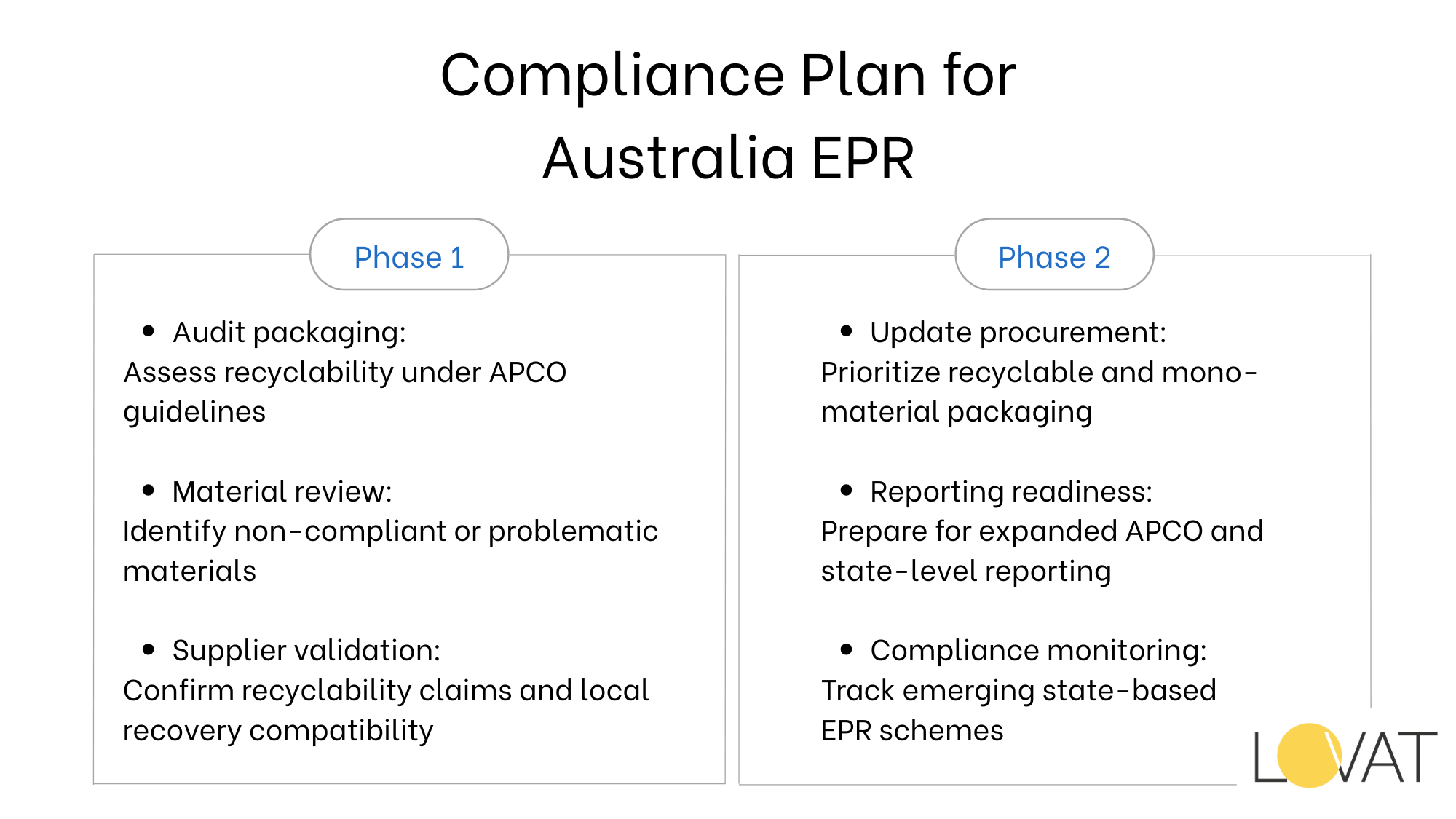
- Demonstrating evidence-based recyclability for all packaging formats placed on the market.
- Eliminating materials incompatible with local recycling systems, such as certain multi-layer plastics.
- Adhering to design-for-recovery principles, including clear material labeling and simplified packaging structures.
- Preparing for expanded reporting duties, including granular data on packaging composition and recovery outcomes.
- Aligning with emerging state-specific schemes, which may impose stricter requirements than national frameworks.
This regulatory pivot means that EPR in Australia is transforming into a system with sharper teeth, where design standards are no longer suggestions but prerequisites for market entry. Brand owners must now demonstrate not just intent but actual evidence of recoverability for their packaging formats. Consequently, Australia EPR compliance now requires deep engagement with supply chains to eliminate materials that disrupt local recycling streams.
Australia EPR expansion
Beyond packaging, EPR in Australia is gradually expanding into new product categories, reflecting a broader policy ambition to align with global best practices. The federal government has already outlined intentions to strengthen schemes for electronics, tyres, and photovoltaic systems, with consultations underway to introduce mandatory e-waste recovery targets and stricter reporting obligations. As Australia EPR frameworks mature, producers can expect more uniform national standards that reduce the historical fragmentation between states, alongside increased use of digital tracking tools to verify recycling outcomes. These developments signal a future in which EPR is not confined to packaging alone, but becomes a core regulatory mechanism governing product stewardship across multiple sectors of the Australian economy.
 We provide EPR Authorised Representative services, acting as your local compliance contact and ensuring full adherence to EPR regulations across applicable markets. Learn more
India EPR compliance essentials
India has established itself as a global pioneer by implementing one of the most technologically advanced and data-centric EPR frameworks in the world. The Plastic Waste Management (Amendment) Rules, which have seen significant updates leading into 2025, introduce a rigorous digital backbone to compliance. As international observers increasingly reference EPR India as a benchmark for scalable, data-driven regulation, the country’s model is shaping expectations far beyond its borders. The focus here is on preventing leakage and ensuring that the recycling claims made by producers are backed by verifiable data.
A defining feature of EPR India regulations is the centralized online portal developed by the Central Pollution Control Board (CPCB), which tracks producer obligations in real-time. This system mandates the generation and exchange of EPR credits, creating a market-based mechanism where companies that exceed their recycling targets can sell surplus credits to those who fall short.
Key components of the EPR in India
- Digital Tracking: From July 2025, mandatory QR codes on plastic packaging will enable traceability from the manufacturing plant to the recycling facility. This requirement reflects how EPR in India is increasingly built around real-time data systems that ensure transparency at every stage of the waste value chain.
- Recycled Content Mandates: Rigid packaging (Category I) faces strict requirements to include minimum percentages of recycled plastic, increasing annually.
- Credit Trading: EPR companies in India – including recyclers and waste processors – must be registered to generate the credits that brands need to purchase for compliance.
- Liability: Importers and brand owners are held equally responsible, closing loopholes that previously allowed foreign entities to bypass local EPR regulations India.
For international brands, doing business here means integrating local digital systems into their global compliance workflows. The complexity of EPR in India demands a robust on-the-ground presence or partnership with specialized Producer Responsibility Organizations (PROs) that understand the nuances of the CPCB portal.
Why EPR regulations India matter for businesses
The rapid evolution of EPR regulations India means that companies can no longer rely on generic, multi-country compliance strategies. Instead, they must adapt to India’s uniquely digital and enforcement-heavy system, where real-time data accuracy determines market access. For businesses, this shift creates both operational pressure and strategic opportunity: those able to meet the strict requirements of EPR regulations India gain a competitive edge in one of the world’s fastest-growing consumer markets, while those who fall behind risk penalties, supply-chain disruptions, and potential product delisting.
China EPR compliance requirements
China’s approach to EPR is inextricably the industrial policy of a manufacturing superpower, focusing on resource security as much as environmental protection. Following the “National Sword” policy that banned waste imports, China has turned inward to build a domestic recycling engine. The EPR China framework is characterized by its integration into the broader “Zero-Waste City” pilot programs and the promotion of green supply chains.The year 2025 serves as an enforcement inflection point where voluntary pilots in sectors like electronics and packaging are transitioning into mandatory national standards.Recent policies strictly limit “excessive packaging” for commodities like food and cosmetics, setting technical standards for void space and layer counts.Violations of these standards can result in products being pulled from physical and digital shelves.
For China EPR compliance, the government utilizes the sheer size of its market to force upstream design changes. Brands are expected to design for disassembly and material purity, facilitating easier recycling within China’s domestic infrastructure.The regulatory pressure is applied equally to domestic giants and foreign multinationals, making eco-design a non-negotiable aspect of selling to Chinese consumers.
As China EPR systems expand, policymakers are increasingly linking producer responsibility with national digital governance initiatives, including mandatory product-level QR codes that track materials from production to end-of-life. This digital integration allows regulators to verify recycling performance in real time and identify non-compliant actors with unprecedented precision. Under the evolving EPR China model, sectors such as automotive batteries, photovoltaics, and home appliances are gradually being incorporated into formalized stewardship schemes, reflecting China’s broader strategy to secure critical materials like lithium, cobalt, and rare metals. As a result, China EPR requirements are becoming a central component of China’s industrial planning, incentivizing companies to redesign products for closed-loop manufacturing and ensuring that valuable resources remain within the domestic economy.
Why EPR China matters for businesses
For companies operating in or exporting to China, the tightening requirements under EPR China mean that compliance can no longer be treated as an afterthought. The shift toward mandatory digital reporting, design-for-recycling rules, and sector-specific obligations directly affects product development, supply-chain planning, and market access. Businesses that adapt early to EPR China standards gain operational stability and a competitive advantage, while those that fall behind risk enforcement actions, product removals, and barriers to entering the world’s largest consumer market.
Comparing the giants a regulatory overview
To understand the distinct obligations across these four jurisdictions, it is helpful to visualize their core regulatory levers and enforcement mechanisms side-by-side.
Comparative EPR frameworks
| Feature | Canada | Australia | India | China |
| Primary Model | Full Producer Responsibility (Provincial) | Co-regulatory / Federal Mandates | Digital Credit Trading & Mandates | State-Controlled & Green Supply Chain |
| Key 2025 Driver | Transition of Blue Box/curbside to producers | 2025 National Packaging Targets | Mandatory Recycled Content & QR Codes | Excessive Packaging Limits |
| Funding Mechanism | 100% Producer Funded (PROs) | Membership Fees & State Levies | Market-based EPR Credit Purchase | Producer Fees & Subsidy Removal |
| Enforcement | Provincial Authorities (e.g., RPRA) | APCO & State EPA | CPCB & Digital Portal Audits | Market Regulation & Penalties |
Packaging Europe and global expectations for companies
In this rigorous regulatory environment, the packaging company – whether a manufacturer or a supplier – acts as the critical linchpin between legislative intent and brand compliance. Suppliers are no longer just vendors of boxes and bottles; they must now act as compliance consultants who provide detailed material data sheets and lifecycle assessments.
A robust packaging EPR strategy involves selecting materials that are compatible with the specific recycling technologies available in the target market. For instance, a multi-layered pouch might be compliant in a jurisdiction with advanced chemical recycling but penalized heavily in a region relying on mechanical sorting. Packaging converters are increasingly innovating with mono-materials and digital watermarks to ensure their clients can meet the strict reporting requirements of nations like India and Canada.
Interconnected regulatory trends worldwide
While this article focuses on non-European nations, it is impossible to ignore the gravitational pull of packaging Europe regulations on the rest of the world. The EU’s Packaging and Packaging Waste Regulation (PPWR) effectively sets a global gold standard that other nations observe and often emulate. Developments in packaging USA also show how closely major markets track EU rules, with American brands increasingly adapting their packaging strategies to stay aligned with emerging global expectations. When a multinational corporation redesigns a bottle to meet EU tethered cap requirements or recycled content quotas, that design often rolls out globally to save manufacturing costs.
Similarly, trends in packaging USA legislation- particularly at the state level in California and Oregon – are beginning to mirror the Canadian model of full producer responsibility.This creates a feedback loop where regulatory innovations in one region, such as India’s plastic credit trading or Canada’s modulated fees, inspire policy adjustments in Europe and North America.
Actionable compliance strategies for manufacturers
Navigating this fragmented landscape requires a proactive approach that moves compliance from the legal department to the design studio. Manufacturers must treat EPR regulations as dynamic variables in their product development process rather than static post-market hurdles.
Strategic steps for global compliance:
- Data Centralization: aggregate all packaging weight and material data into a single “source of truth” system that can output reports for different national formats.
- Local Partners: Engage with accredited PROs in Canada and EPR companies in India to navigate local bureaucratic nuances and avoid common filing errors.
- Design for Harmonization: Create packaging specifications that meet the strictest common denominator (often the EU or Australia 2025 targets) to simplify global inventory.
- Financial Forecasting: Model the projected EPR fees for 2026 and 2027, as fee modulation (charging more for hard-to-recycle materials) will significantly impact margins.
Future outlook for 2026 and beyond
As we look toward 2026, the global EPR landscape will likely shift from establishing frameworks to aggressive enforcement and harmonization. We expect to see global EPR systems becoming more interconnected, with potential future agreements on data standards that allow for easier cross-border reporting. Recent developments under EPR regulations India also highlight how rapidly digital compliance models are becoming the new norm for global policymakers. The next wave of global EPR’s evolution will likely include a stronger focus on chemical safety in recycled materials and the inclusion of new product categories like textiles and furniture. The digitization of waste – pioneered by India – will likely become a standard expectation in Canada and Australia, providing regulators with the transparency needed to fine non-compliant actors.We provide EPR Authorised Representative services, acting as your local compliance contact and ensuring full adherence to EPR regulations across applicable markets.
Conclusion
The concept of extended producer responsibility (EPR) has evolved dramatically from a theoretical environmental principle to a harsh reality of compliance that dictates market access for businesses around the world. As 2025 approaches, we are seeing a synchronized tightening of waste management laws, with governments no longer asking for voluntary management but demanding financial and operational responsibility for the entire product life cycle. For the packaging company, these shifts underscore the urgency of aligning product design, reporting systems, and supply-chain practices with new compliance expectations. The global EPR framework is rapidly maturing, going beyond simple waste recycling targets to include complex requirements for eco-design, digital traceability, and mandatory recycled content. This article examines the different but converging regulatory paths of four major economies – Canada, Australia, India, and China – and provides practical guidance for manufacturers operating in this complex space.