
Global EPR Trends for 2026
Global EPR Trends for 2026
Planning for global EPR compliance across markets in 2026
If you sell in many regions, centralize definitions early as EPR compliance depends on a stable SKU list, weights, and material logic. When those definitions change weekly, reporting becomes a moving target.
Treat global EPR compliance’s scope as a living map. Update it on purpose, not by accident. A short monthly review prevents last minute panic.
How global legislation for food packaging materials is changing in 2026
Many companies still keep packaging data in scattered files.Global legislation for food packaging materials requires one clean source of truth. The same bottle should not have two different weights in two systems.
Watch the language in new texts and guidance. global legislation for food packaging material definitions can be narrow. Small wording changes can shift a product from out of scope to in scope.
Why EPR reporting requirements will move to data controls in 2026
Build a reporting package that your finance team understands. EPR reporting requirements work best when you define what is final, what is estimated, and who signs off. A two-step approval reduces corrections later.
Expect more checkpoints, not fewer. EPR reporting requirement changes often arrive through platform updates and scheme rules. Keep screenshots, submission receipts, and version notes in one folder structure.
Where global sustainability regulations connect with EPR in 2026
Many businesses will notice convergence. Global sustainability regulations increasingly influence packaging design, recycled content plans, and labeling positions. This creates pressure to align compliance and sustainability teams.
If you run separate projects, you will duplicate work. global sustainability regulations can pull the same product data as EPR filings. Align one dataset and use it across functions.
Be careful with assumptions and marketing language. Global sustainability regulation enforcement often focuses on evidence. A claim without proof can create risk across multiple regimes.
How producer responsibility laws will expand beyond packaging in 2026
The model keeps spreading across product categories. Producer Responsibility laws now touch more than packaging in many markets. Companies need one consistent method that can scale to batteries, textiles, electronics, and other flows.
A common mistake is to build a process for one category only. Producer Responsibility laws are easier when the same governance model applies to every stream. You change the data fields, not the entire workflow.
Read scope triggers like a contract. producer responsibility law language can define “producer” in a way that surprises online sellers. Clarify the trigger before you register.
What to expect from EPR regulations in 2026
The trend is more standardization and more digital structure. EPR regulations often add new categories, new portals, and stronger checks. That is why teams should plan for system work, not only legal work.
Compliance becomes safer when you build controls early. EPR regulations reward firms that maintain clean master data. Errors usually come from rushed mapping and missing evidence.
Treat updates as operational changes. EPR regulation shifts can change reporting fields and fee logic. Add monitoring to your weekly routine, not only quarterly.
How EPR rules are changing day to day execution in 2026
Operational clarity is becoming a competitive advantage. EPR rules are no longer “background policy,” they actively shape listings, import flows, and marketplace requirements. When sellers miss steps, products can be delayed.
Create a single internal glossary for your team. EPR rules often use local terms that differ from country to country. A glossary avoids confusion and reduces rework.
Track changes in one place. EPR rule updates can arrive through scheme notes and portal messages. Assign one owner to log changes and inform stakeholders.
What EPR law trends mean for cross border sellers in 2026
The legal logic is consistent, but the triggers vary. EPR law can define producer roles differently across countries and even regions. Cross border sellers need a clear decision tree.
Do not rely on assumptions from one market. EPR law enforcement can be strict where platforms require proof. When proof is missing, listings can be impacted quickly.
Document your reasoning and keep it accessible. EPR law’s practical defense is a clean audit trail. If you can explain your method, you reduce risk.
How EPR packaging regulations will affect marketplaces in 2026
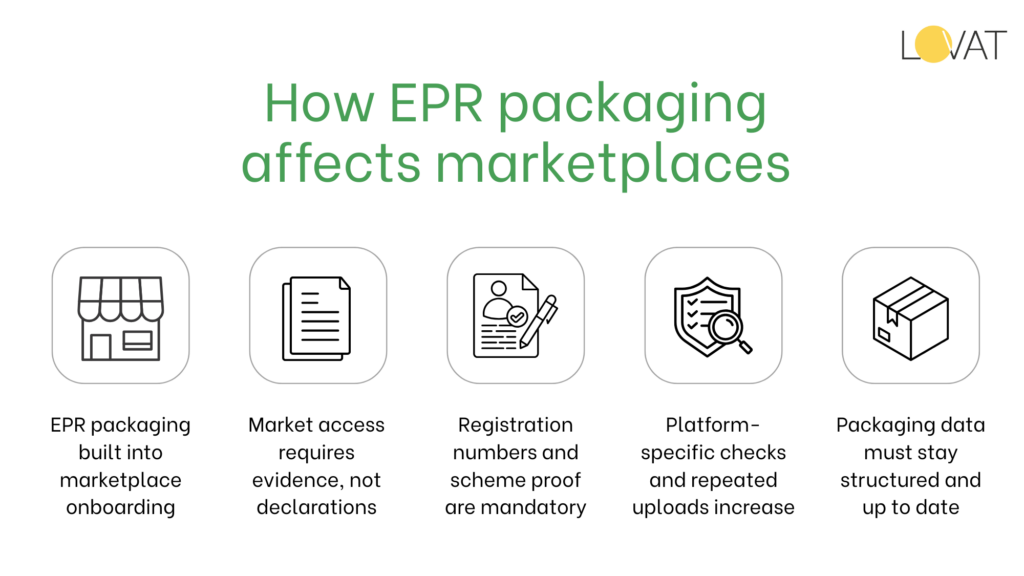
Marketplaces want evidence, not promises. EPR Packaging regulations increasingly sit inside platform onboarding and seller verification flows. This creates a new gate for market access.
Plan for platform specific checks. EPR packaging regulations often require registration numbers and scheme membership proof. Keep these records ready for repeated uploads.
Treat packaging as a data product. EPR packaging regulation requirements can change reporting formats. If you maintain structured data, updates are manageable.
Why EPR laws will focus on proof in 2026
Enforcement is moving from intent to evidence. EPR laws in many regions are designed to verify who registered, who reported, and who paid. That pushes companies towards stronger internal controls.
The biggest exposure is inconsistent information. EPR laws work against teams that submit different data to different places. Align your numbers across finance, logistics, and compliance.
Keep a compliance archive by market. EPR laws’ audits often ask for submissions, invoices, and calculation notes. Build the archive as you go, not after the fact.
How EPR packaging law can reshape scope and fees in 2026
What to watch in extended producer responsibility act proposals for 2026
Why Extended Producer Responsibility EPR regulations are adding eco design signals in 2026
How Extended Producer Responsibility laws will broaden product streams in 2026
What EPR plastic controls will look like in 2026
Build a material map that your team trusts as EPR plastic reporting becomes safer when weights and polymer types are consistent. If you cannot explain your data, you cannot defend it.
Watch how plastics are grouped and labeled. These categories can shift over time. Plan for updates by keeping your mapping rules documented.
How EPR compliance workflows should look for 2026 audits
Keep your workflow simple and repeatable as compliance execution usually needs data prep, review, and submission. Each stage should have one owner and one deadline.
Treat your archive like an asset and strongest proof. Store registrations, reports, receipts, and calculation notes in a structured folder.
A practical internal control set for 2026
- Assign one owner per market and per stream
- Lock SKU lists with version control
- Confirm weights and composition with supplier evidence
- Run a pre filing review with finance sign off
- Store receipts and portal confirmations immediately
How EPR for plastic waste will drive reporting depth in 2026
The reporting expectation is rising. EPR for Plastic waste often requires better visibility into material flows and packaging composition. Teams need data that can be traced back to products.
Start with what you can verify. EPR for plastic waste reporting becomes safer when you use a consistent method and record the source. A controlled estimate is better than an uncontrolled guess.
Plan for more checks and more questions. EPR for plastic waste’s direction is towards validation. If you prepare documentation early, you reduce last minute friction.
Why EPR packaging will move towards modulated fees in 2026
Fee logic is becoming more nuanced. EPR packaging can include signals that reward better design and penalize harder to recycle materials. This creates a link between design and compliance cost.
Do not treat this as only a financial issue. EPR packaging strategy belongs with product and sourcing teams too. When materials change, fees and reporting can change.
Make your decisions measurable for the best defense using consistent data. If your team can measure packaging accurately, you can plan costs and avoid surprises.
What EPR for packaging data you should prepare for 2026 filings
Comparative table on what changes most in 2026 by region focus
| Region focus | What typically increases | What teams should prepare |
| EU style systems | Verification and structured reporting | Strong dataset and archive discipline |
| North American style systems | New scopes and expanding streams | Monitoring, role clarity, readiness packs |
| Asia Pacific growth markets | Faster policy rollout and localization | Local triggers, language checks, portal readiness |
When EPR consulting services help most in 2026
A practical EPR registration process for new markets in 2026
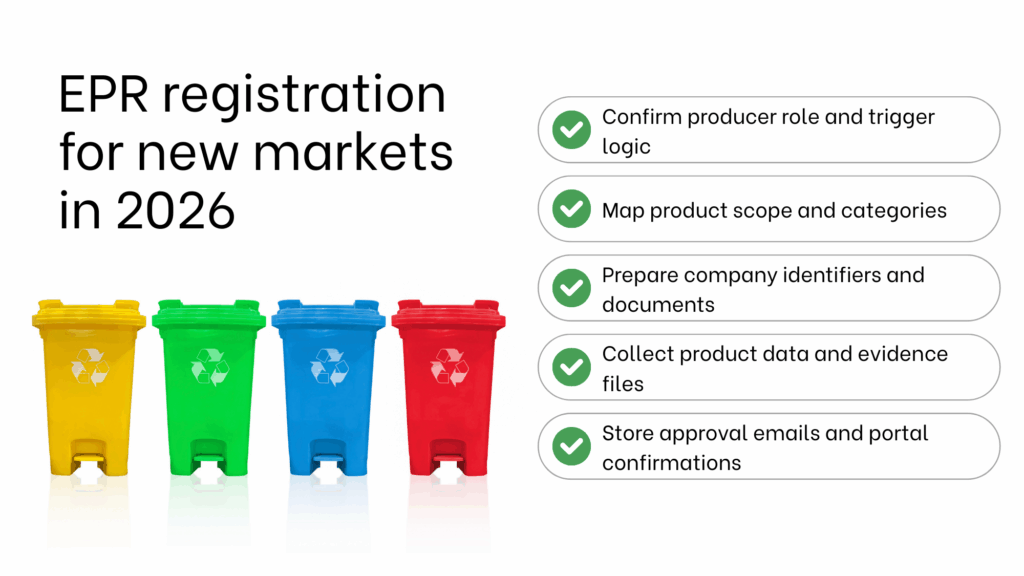
Registration pack checklist
- Confirm producer role and trigger logic
- Map product scope and categories
- Prepare company identifiers and documents
- Collect product data and evidence files
- Store approval emails and portal confirmations
- Send a Fee Quote to LOVAT
How EPR registration online is changing the workflow in 2026
Comparative table on internal ownership that prevents delays in 2026
| Internal role | What they usually own | What they must deliver |
| Compliance | Scope map and filings calendar | Submissions, receipts, evidence archive |
| Finance | Fee budgeting and approvals | Sign off and payment tracking |
| Product and sourcing | Specs and composition evidence | Bills of materials and supplier proof |
Global EPR Trends for 2026 execution roadmap for teams that sell cross border
Practical next steps
- Build one SKU master list with locked versions
- Create one reporting calendar per market and stream
- Define approvals for data, finance, and legal review
- Store every submission receipt in one archive
- Review changes monthly and update the scope map