

Packaging EPR expansion — USA active regulations in 2026
Packaging EPR expansion — USA active regulations in 2026
EPR USA Packaging in 2026
In US packaging, the main difference between 2025 and 2026 is urgency. Some states are still building their frameworks, but others are already collecting registration data and lining up fee schedules. That turns “we’ll sort it later” into late nights with spreadsheets.
A practical way to think about us packaging compliance is to treat it like indirect tax. You need a product list, a place of supply concept, a party responsible, and evidence. And you need it before the deadline is two weeks away.
Later in this guide, we will come back to US packaging’s internal ownership question, because that is where most programmes fail in real life.
At a glance for 2026
- The number of programmes for packaging and paper remains limited, but the operational burden is rising fast.
- Washington EPR sets a clear 2026 entering date for producers. Registration sequence for organisations is also planned.
- Colorado EPR moves into fee payments from January 2026, after earlier registration and reporting steps.
- Maine’s EPR timeline points registration for producers for 2025 including data reporting due in 2026.
EPR laws in USA by state in 2026
When people ask for EPR laws by state, they usually want a simple answer: “Which state do already have active packaging EPR laws right now?” As of 2026, the commonly cited set are seven states with enacted packaging and paper EPR frameworks: Oregon, California, Maine, Washington, Minnesota, Maryland, and Colorado,
But EPR laws by state are not equal in timing. Oregon is moving through programme implementation from mid 2025, while Washington’s statute puts major producer membership obligations in 2026, and Maryland’s plan deadline sits later.
If you are building an internal tracker, treat this as your point of start, then add product scope, who is the “producer” for your business model, and which reporting date applies to which state. That beats guessing.
Active programme states
- California
- Colorado
- Maine
- Minnesota
- Maryland
- Oregon
- Washington
Active packaging EPR laws and 2026 pressure points
| State | Law status | 2026 pressure point for producers |
| California | Active | Rulemaking and EPR reporting reporting prep remain central in 2026 as the system matures |
| Colorado | Active | Fee payments begun on January 2026, with plan implementation dates also in 2026 |
| Maine | Active | Producer to proceed for data registration and reporting in 2025 and dates to be highlighted in 2026 |
| Minnesota | Active | Early build phase continues, with agency and PRO set up work spanning 2025–2026 |
| Maryland | Active | Framework is in place; plan submission deadline is later, but 2026 is for groundwork |
| Oregon | Active | Programme plan to be approved and implementation begins from July 2025, so 2026 is operational |
| Washington | Active | Producers have to appoint, register, and join by set dates in 2026 |
EPR regulations you should expect in real operations
Teams often talk about EPR regulations as if they are one set of rules. They are not. They are a mix of state law, agency guidance, and PRO programme rules that decide what you must report, when you must pay, and what happens if you do not.
The uncomfortable part is that your compliance position can be “right” under the statute and still “not accepted” by a PRO if your material mapping is weak. That is where the work is in 2026.
A common EPR regulation pattern is that the producer definition is designed to pick one responsible party for each item, even when the supply chain is messy. If you do not decide internally who owns what, the state programme will decide for you.
What usually changes first
- EPR Registration mechanics and who can file on behalf of whom
- The exact data fields for reporting (materials, weights, exemptions)
- Fee signals for “harder to manage” materials
Packaging EPR and how the model works in the US
Packaging EPR is a rule where producers finance (and sometimes manage) the collection, sorting, and end of life handling of packaging and paper products in a state system, often through a producer organisation.
The key practical detail is that packaging EPR programmes do not care about your organisational chart. They care about who is the defined “producer” and whether that entity is registered and paying.
Once you accept that, your work becomes plain: decide if you are in scope, map your packaging, file on time, and keep evidence. Packaging EPR programmes are paperwork heavy because they are funding mechanisms first.
Typical flow in a packaging programme
- Law sets scope and producer definition
- Producer joins a PRO or runs an individual plan where allowed
- Producer reports packaging placed on the market, by material type
- Fees are calculated and paid
- Audits and enforcement come later, but they do come
- Send a Fee Quote to Lovat and make it easier and faster
EPR systems USA and the role of producer organisations
When people say EPR systems USA , they usually mean “Who runs this, and who do we talk to?”
In many states, the operational vehicle is a Producer Responsibility Organisation that collects producer fees and files plans, while the agency oversees the programme and enforces the law.
EPR systems USA can allow one or more organisations depending on the statute. Washington’s bill report, for example, discusses early plan periods and limits on multiple registrations in that phase.
If your team keeps saying “we are waiting for the final rules”, this is where to push back. You can build the data model and producer mapping now, because those rarely change in ways that save time. An EPR system USA rollout rewards early groundwork.
Who normally needs to be involved internally
- Legal for producer definition decisions
- Finance for accrual and payment logic
- Procurement for packaging specifications
- Operations for SKU and market mapping
EPR packaging regulations and what counts as covered material
A lot of risk comes from misunderstanding EPR packaging law scope.
Most state frameworks cover packaging and paper products sold into the state, and they often include certain single use food service items. They also include exclusions, and those exclusions can be narrower than people expect.
An EPR packaging law usually defines “producer” with a hierarchy: brand owner, licence holder, importer, distributor, or a party assigned responsibility by contract. That means contracts matter.
If you work with multiple brand structures, EPR packaging laws can put responsibility in different places depending on who owns the trademark and who is the importer of record. That is not a theory problem. It is a “who pays the invoice” problem.
The scope is
- Primary packaging for consumer products
- Secondary packaging used to sell or group units
- Shipping materials, depending on state definitions
- Paper products included by statute in some states
EPR packaging regulations and reporting that does not fall apart
The day to day burden sits in EPR packaging regulations rather than in the headline law.
Reporting tends to require packaging weights by material category, time period, and sometimes recyclability attributes. If your data is scattered across suppliers and co packers, you will feel that pain first.
A second pressure point is evidence. EPR packaging regulations often assume you can explain where a number came from, even if the PRO is not asking for full audit support on day one. You should still store your assumptions, BOM versions, and supplier declarations.
If your finance team asks “how sure are we”, that is a sign you need stronger controls. An EPR packaging regulation mindset is closer to tax and customs than to marketing claims.
Common reporting fields to prepare in 2026
- SKU or product family ID
- State market placement logic
- Packaging component type and material
- Weight per component and unit of measure
- Exemption flags and supporting notes
- Get a fee quote after filling our form
Packaging regulations beyond EPR
Do not treat packaging regulations as if they start and end with EPR.
Even inside one state, you may be dealing with recycled content rules, labelling requirements, restricted substances, and claims rules, alongside EPR. Washington’s bill report, for example, references related recycled content requirements in state policy history.
Packaging regulations also shape commercial reality. A design choice that reduces EPR fees might increase claims risk if your marketing language gets ahead of what the material can actually do. That gets messy fast.
When you hear “packaging regulation” from a colleague, ask which layer they mean: statute, agency rule, PRO rule, or contract. They are not interchangeable, and 2026 is when those differences show up in deadlines.
Quick check for internal reviews
- Are product claims and compliance data aligned
- Are procurement specs aligned with what you report
- Is there a clear owner for programme filings
Recyclable packaging and what EPR actually rewards
A lot of teams assume recyclable packaging is always “good” in EPR. In practice, programmes reward what is recyclable in the real collection and sorting system, not what looks recyclable in a design meeting.
Recyclable packaging choices also have an evidence problem. You may need to show why you classified a component as recyclable, and what standard or collection list you used. Washington’s 2026 work on statewide collection lists shows why this matters.
If you want to reduce fees and reduce future disputes, you need a repeatable classification method and a place to store it. Recyclable packaging’s “goodness” needs a paper trail in 2026.
Practical design checks that avoid later arguments
- Avoid material mixes that cannot be separated in normal systems
- Avoid components that contaminate fibre streams
- Document why you chose a classification
- Keep supplier declarations in one place
Paper packaging and why fibre still needs attention
Many teams relax when they hear paper packaging, because fibre recycling is familiar.
But fibre still brings scope questions, coatings, additives, and product types that may be treated differently by state lists and programme rules. And if you sell national SKUs, it only takes one state programme to force better granularity.
Paper packaging also sits right in the “who is the producer” question. If you are not the brand owner, you may still become responsible based on the hierarchy. So you need clarity with your partners.
For many companies, paper packaging’s biggest issue is not whether it is recyclable. It is whether the weight data is accurate enough to price fees without nasty surprises.
Where paper often causes reporting errors
- Missing secondary paper components
- Misclassified coated fibre
- Wrong unit weights for boxes and inserts
- Supplier data that is out of date
Packaging supplier data and contract habits
If you do not have the upstream data, your packaging supplier becomes your compliance dependency.
A packaging supplier can usually provide material specs and weights, but only if you ask for it in a structured way. If you ask ad hoc, you get ad hoc answers. That is not sustainable once you have multiple state filings.
Your second problem is version control. Suppliers change materials. Your reporting period may not match the date you last updated the BOM. That is where your numbers drift, and drift becomes a payment issue.
You can reduce risk by changing how you work with packaging suppliers. Put reporting fields into the packaging spec workflow, not into last minute emails.
Contract clauses that are boring but useful
- Supplier must provide weight and material breakdown per component
- Supplier must notify of material changes before production
- Supplier must keep declarations for a set period
- Supplier must support reasonable audit requests
Packaging solutions for seven different state programmes
By 2026, “we will handle it manually” stops being a plan. You need packaging solutions that work across states and business units.
A packaging solutions approach starts with one shared data model, then maps each state’s categories onto that model. That gives you consistent internal numbers even when the external filing templates differ.
Packaging solutions also include process design. You need a monthly close style routine for packaging data, not an annual panic. Otherwise your first real deadline will find your gaps.
When you review packaging solution options internally, watch out for “one person owns it” thinking. The compliance work crosses teams. Packaging solution ownership needs a clear RACI.
Manual vs Structured approach
| Topic | Manual approach | Structured approach |
| Component weights | Pulled from emails and PDFs | Stored in a controlled dataset |
| State mapping | Rebuilt each filing | Reused mapping rules per state |
| Evidence | Hard to reconstruct later | Stored with sources and dates |
| Continuity | Falls apart when staff change | Process survives staff change |
Packaging software that supports reporting and evidence
People often buy tools too late. By the time you need packaging software, the first registration cycle has already started.
Packaging software should do three simple things well: store packaging component data, track which SKUs are sold where, and export what the programme wants without manual rekeying. Anything beyond that is optional.
A second requirement is evidence handling. You may need to show how you calculated weights, which BOM version you used, and why you used a classification. Packaging software’s value is that it keeps that material linked to the numbers.
If you are still early, start with a clean dataset and a clear filing calendar. Packaging software is a tool, not a strategy.
Minimum feature checklist
- Import BOM and supplier declarations
- Store units, conversions, and packaging hierarchy
- State market placement rules
- Audit log for changes
- Exports aligned to programme categories
Packaging for small business and the awkward trade offs
A lot of founders hear “EPR” and assume it is only for large firms. packaging for small business is now part of the conversation, even when de minimis exemptions exist.
Some programmes exclude very small volumes or certain entity types, but you still need to prove you qualify. If you grow, you can fall out of an exemption quickly, and the catch up work is painful.
Packaging for small business also brings reseller and marketplace confusion. If you sell through platforms, you still need to know who is treated as the “producer” in each state definition. That can be you, the brand owner, the importer, or another party.
The practical advice is simple: decide if you are a small business in the way the statute means, not in the way your team talks about it. Packaging for small businesses is a compliance category, not a vibe.
Fast triage steps
- List the states you sell into
- Identify who owns the brand on pack
- Check if you import goods yourself
- Estimate annual packaging volumes
- Store the basis for any exemption position
USA packaging companies and producer responsibility ownership
For USA packaging companies, the hard part is governance, not the recycling theory.
You need one accountable owner for each filing, even if several teams provide data. If nobody owns the result, everybody owns the mess. Washington’s producer definition hierarchy and registration dates make this concrete.
Us packaging companies also need to decide whether compliance sits with legal, finance, sustainability, or operations. In practice, finance owns payments, legal owns interpretation, and operations owns data. If you pretend it can live in one place, it will fail.
If you are a US packaging company with multiple brands, your biggest risk is double counting and missed counting. Both happen when brands keep separate BOMs and nobody reconciles.
A workable internal split
- Legal: producer definition decisions and contract wording
- Operations: SKU list, sales states, packaging BOM
- Procurement: supplier declarations and material changes
- Finance: fee accruals, payments, evidence retention
Product packaging companies realities
If you are one of the product packaging companies or you rely on co packers, clarify roles early.
A product packaging company might manufacture the physical item, but the “producer” role in many statutes attaches to brand ownership, licensing, import status, or contractual assignment. That means the operational reality and the legal definition can differ.
The fix is not complicated. Put producer responsibility language into your manufacturing and distribution agreements, and make sure it matches how you actually operate. That avoids two parties assuming the other one is filing.
If you are reviewing a co manufacturing set up, treat this as a risk review. Product packaging company relationships can be clean, but only if responsibilities are written down and followed.
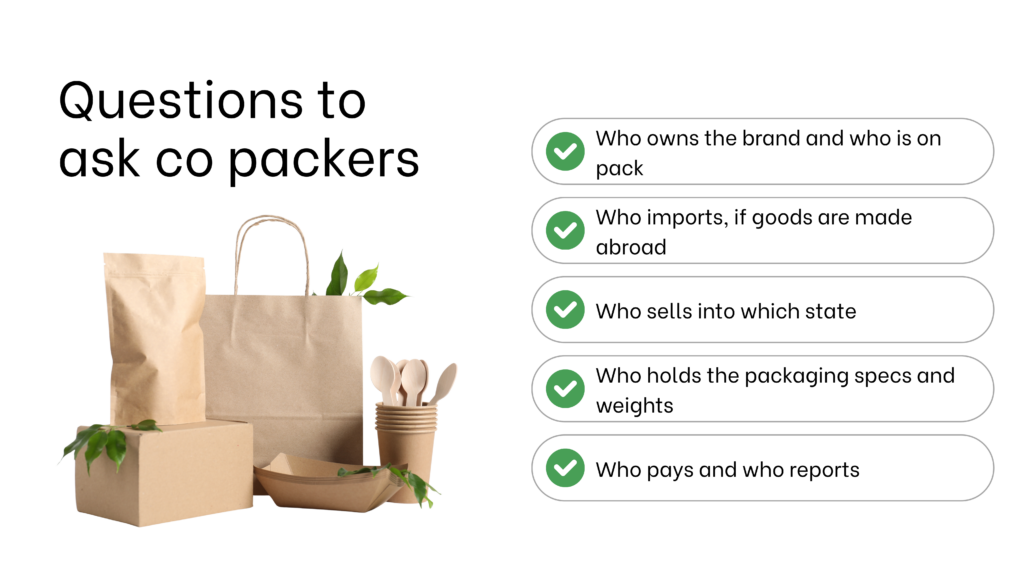
Questions to ask co packers
- Who owns the brand and who is on pack
- Who imports, if goods are made abroad
- Who sells into which state
- Who holds the packaging specs and weights
- Who pays and who reports
American packaging budgets and what to put into the forecast
People like to talk about sustainability targets. In 2026, American packaging compliance is also a finance topic.
You need to budget for three buckets: internal labour, external support, and programme fees. The fees can be unpredictable early on, so conservative accruals are a sane approach.
American packaging fee exposure is also sensitive to design choices. If your packaging mix changes, your fees can change. That is a reason to connect procurement and finance workflows, not a reason to ignore the numbers.
If you want fewer surprises, treat American packaging’s reporting dataset as a controlled financial input. Once it is controlled, it becomes forecastable.
Budget line items people forget
- External validation of weight and material assumptions
- Internal time to update BOM data
- Legal review of producer assignment clauses
- Fees for late corrections and refilings
- System work to connect sales data to reporting periods
EPR laws and the 2026 checklist you can actually use
You will hear “we will deal with it when it is enforced”. That is a bad plan with EPR laws, because enforcement usually follows reporting. If you cannot report, you cannot comply.
EPR laws also tend to put sale restrictions in place for non compliance. Colorado’s public programme description is explicit that producers not in compliance may not sell covered materials in the state after the set date.
An EPR law approach that works is dull. Build the register, map the producer, build the dataset, meet the dates, keep evidence. That is it.
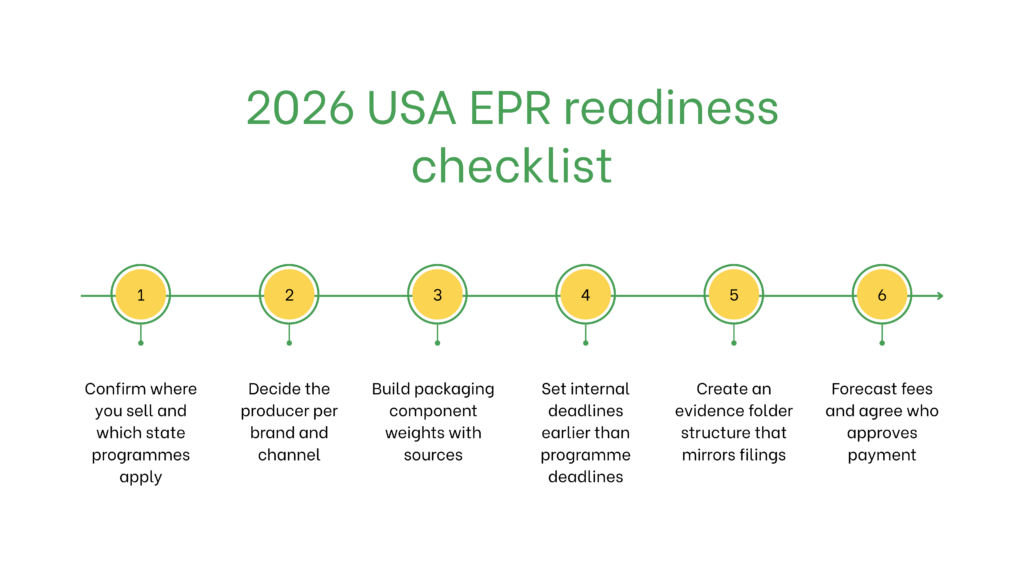
2026 USA EPR readiness checklist
- Confirm where you sell and which state programmes apply
- Decide the producer per brand and channel
- Build packaging component weights with sources
- Set internal deadlines earlier than programme deadlines
- Create an evidence folder structure that mirrors filings
- Forecast fees and agree who approves payment
2026 state notes you should not miss
This section is short on purpose. It highlights 2026 timing pressure points that are easy to overlook.
- Washington sets clear milestones: producers appoint a PRO by 1 January 2026, register by 1 March 2026, and must be a member by 1 July 2026.
- Colorado moves into dues: fee payments begin 1 January 2026, and the public programme outline also points to implementation by June 2026.
- Oregon’s DEQ approved the programme plan for implementation beginning 1 July 2025, so 2026 is a “running programme” year.
- Maine timelines discussed publicly point to a 2026 registration and 2025 data reporting expectation, with state contracting steps also shown in 2026.
- Maryland’s law requires producer plans by 1 July 2028, so 2026 is for preparation and rulemaking engagement, not for waiting.