

Belgium E-invoice
Provinces
General
Provinces
General
About
General
About
General
General
General
Regulated under the EU Directive 2014/55/EU and the Peppol framework. Mandatory for public procurement and encouraged for private sector transactions.
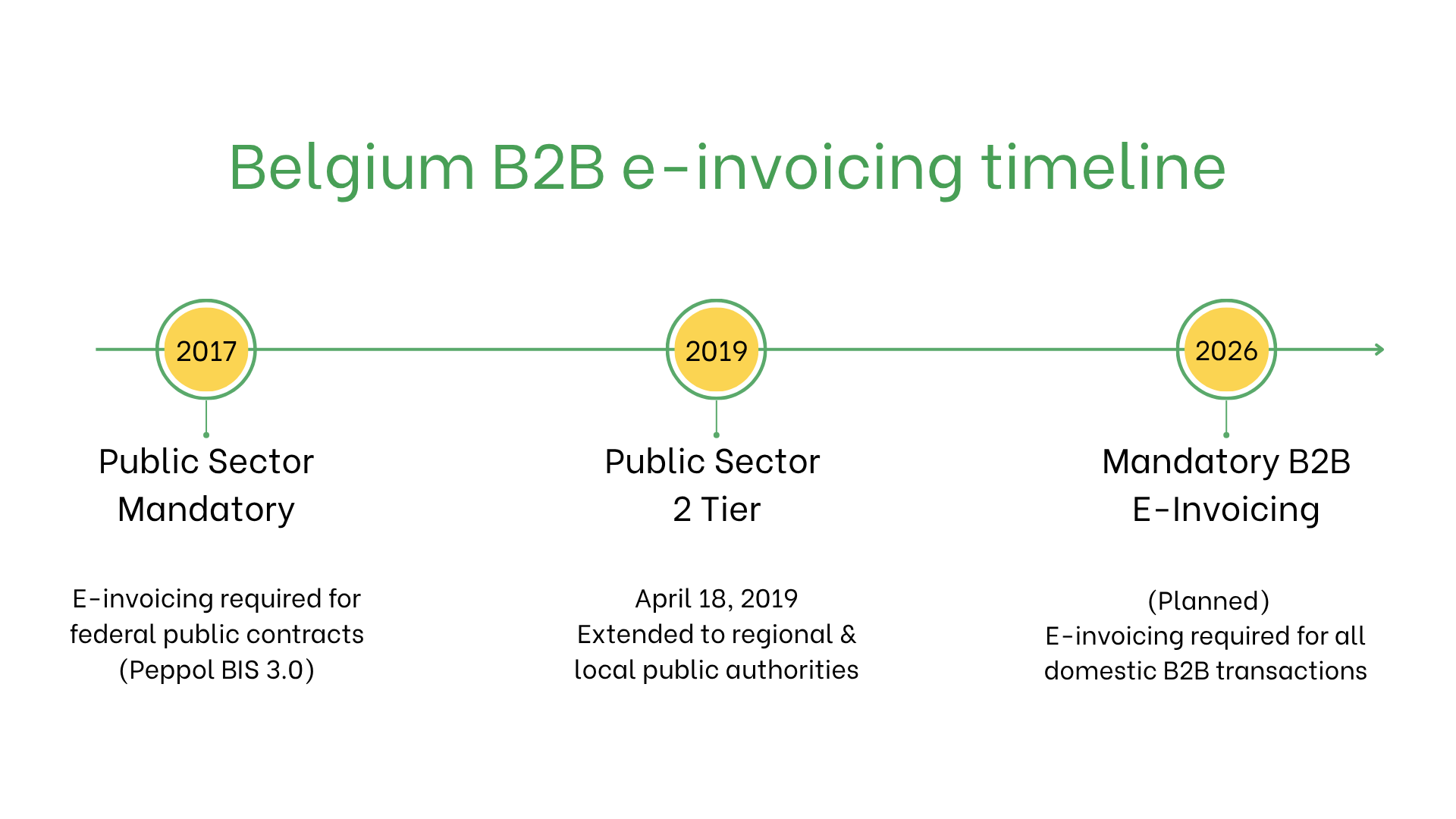 Belgium is progressively adopting mandatory electronic invoicing (e-invoicing) in line with EU and national legislation. Here's how the transition is unfolding:
Implementation of mandatory e-invoicing in Belgium
Belgium is progressively adopting mandatory electronic invoicing (e-invoicing) in line with EU and national legislation. Here's how the transition is unfolding:
- January 1, 2017: E-invoicing became mandatory for suppliers to federal public entities. All invoices must comply with the Peppol BIS Billing 3.0 format.
- April 18, 2019: To comply with EU Directive 2014/55/EU, the e-invoicing mandate was extended to regional and local public administrations.
- January 1, 2026: Belgium will implement mandatory B2B e-invoicing for all businesses registered for VAT. All domestic B2B transactions will require structured e-invoices compliant with the EN 16931 standard, typically via the Peppol network. The use of unstructured formats (such as PDFs or paper invoices) will no longer be permitted for B2B transactions.
Who needs e-invoices in Belgium?
E-invoicing in Belgium is required for:- Public Sector Suppliers: Federal, regional, and local suppliers.
- Private Sector B2B: Planned for 2024.
- Exporters: Required for cross-border VAT reporting within the EU.
- Non-Resident Businesses: Applies to transactions with Belgian public entities if VAT-registered.
E-Invoicing vs. E-Billing
| Aspect | E-Invoicing | E-Billing |
| Purpose | Compliance with Belgian and EU regulations | Informal or internal transactions |
| Validation | Real-time via Peppol network | Not validated |
| Format | Structured (Peppol BIS Billing 3.0) | Flexible, non-regulated formats |
| Archiving | Mandatory for seven years | Optional |
Key features of Belgium’s e-invoicing system
Belgium’s e-invoicing system involves:- Submission: Via the Peppol network using BIS Billing 3.0.
- Validation: Ensures compliance with tax regulations and mandatory fields.
- Archiving: E-invoices must be stored for 7 years as per Belgian tax laws.
E-Invoicing dataset
- Buyer/Seller IDs: VAT IDs.
- Invoice Details: Number, issue date, payment terms.
- Goods and Services: Descriptions, quantities, prices, and VAT details.
- Taxes: Applicable VAT rates and amounts.
- Transaction Info: Total amount, currency, payment method.
- Delivery Info: Date and location.
E-Invoicing across transaction types
B2B Transactions :- Belgium is planning to mandate e-invoicing for B2B transactions by 2024.
- E-invoices improve efficiency, VAT compliance, and reduce errors in cross-border transactions.
- E-invoicing is not mandatory for B2C transactions but is encouraged for better transparency and internal process optimization.
- Mandatory for all suppliers to public entities at federal, regional, and local levels.
- E-invoices must be submitted via the Peppol network and comply with BIS Billing 3.0 standards.
Penalties for non-compliance
- Invoice Rejections: Delayed payments.
- Fines: For failure to meet procurement requirements.
- Legal Risks: Audits and reputational damage for repeated violations.
Subscribe to the newsletter
No spam, only interesting news