
Gestione globale della conformità EPR
Gestione globale della conformità EPR
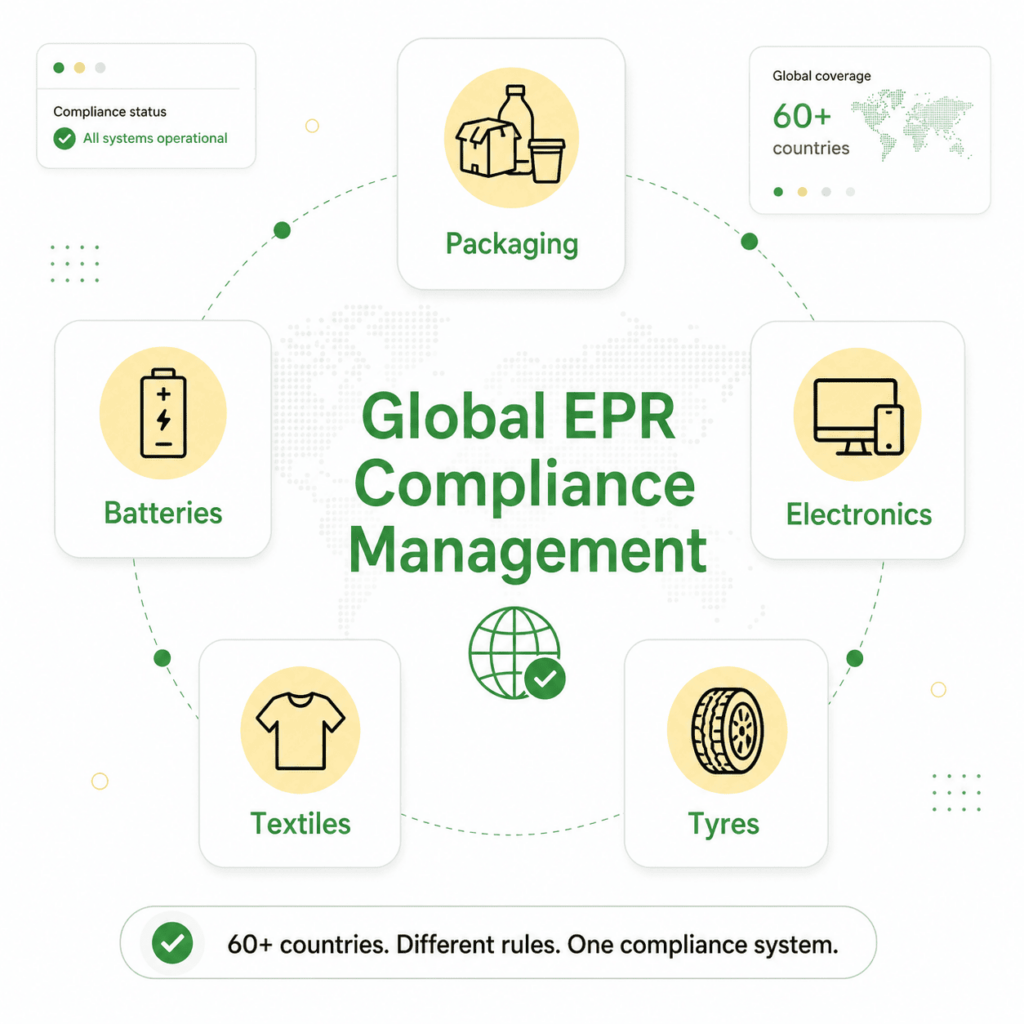
A German e-commerce retailer selling packaging into France, Spain, and Poland faces three separate producer registration deadlines in the same quarter — and missing just one of them cost a comparable business €28,000 in fines in 2023. That kind of exposure is no longer rare. Extended Producer Responsibility legislation has spread to over 60 countries, and the pace is accelerating. EPR obligations now cover packaging, electronics, batteries, textiles, and tyres across markets that each write their own rules, set their own thresholds, and enforce on their own schedules.
Most mid-sized importers and brand owners know EPR exists. The gap is operational: how do you track weight data across ten product lines, reconcile it against country-specific exemption thresholds, file the right returns in the right formats, and still have time to run the business? International compliance across this many jurisdictions is genuinely hard, and the consequences of getting it wrong — deregistration, import bans, public naming — are escalating.
What follows covers the practical side: what obligations look like across major markets, where reporting breaks down, how software has changed the equation, and what separates businesses with clean compliance records from those accumulating fines.
What It Actually Means to Manage EPR Obligations Across Markets
To manage EPR across multiple markets is not a single task — it is a rolling portfolio of tasks with no natural finish line. Registration in one country does not transfer to another. A compliance certificate from Germany’s Lucid system tells France’s ADEME nothing. Every jurisdiction runs its own producer register, its own fee schedule, and its own audit rights.
Six distinct workstreams keep that portfolio moving:
- Producer registration — filing entity details, product categories, and annual tonnage estimates with each national authority, often before the first product ships
- Data collection — capturing weight per SKU, per material type, per shipment, at a granularity standard ERP systems were not designed to produce
- Fee calculation — applying country-specific eco-contribution rates to reported tonnage, with rates that shift annually and vary by material (plastic film, rigid plastic, and cardboard carry different rates in France’s REP Emballages)
- Return filing — submitting periodic reports to PROs (Producer Responsibility Organisations) on each country’s own schedule: quarterly in some markets, annually in others
- Auditing and record retention — keeping source data available for inspection, typically three to five years depending on jurisdiction
- Change monitoring — tracking legislative updates, threshold changes, and new product category expansions across every active market
Businesses that run these workstreams as a standing operational function stay ahead. Those that treat EPR as a one-off project find out they were wrong when a penalty notice lands. International trade compliance tools can systematise several of these areas, but the data discipline underneath has to come from the business itself.
Packaging Reporting Requirements Vary More Than Most Businesses Expect
Packaging reporting is where most EPR programmes start — and where most errors cluster. Importers tend to assume one set of rules applies across markets. It does not. France, Germany, Spain, and Poland all have packaging EPR, but who bears the obligation and how tonnage gets reported differ in ways that catch people off-guard.
Take a concrete example: a UK brand selling bottled supplements into both Germany and France. In Germany, whoever first places the packaged product on the German market holds the obligation — so the UK brand, not the German distributor, registers in Lucid and pays eco-contributions to a German PRO. The same logic applies to REP Emballages in France, but the material categories there are more granular: glass sits in a different rate bracket from plastic, which sits in a different bracket from composite materials. Feeding identical weight figures into both systems produces two different fee calculations.
| Country | Reporting Frequency | Obligation Holder | Correction Window |
| Germany | Annual (quarterly updates for large producers) | First placer on market | 12 months; late filing penalty up to €200,000 |
| France | Annual (data year = calendar year) | Brand owner / importer | 6 months post-deadline; penalties up to €1,500/day |
| Spain | Annual | Producer or authorised representative | 3 months; fines €6,000–€60,000 |
| Poland | Annual + quarterly advance payments | Producer or importer | 30 days; fees plus surcharges at 150% |
| Netherlands | Annual | Brand owner | 60 days; administrative fine up to €900,000 |
A business filing five countries in the same cycle cannot keep five manual spreadsheets straight — the data source, material categorisation logic, and filing format all need to be locked down at the point of capture, not patched together the week before the deadline.
Packaging reports with incorrect material splits are one of the most common audit triggers across European PROs. Reclassification, re-filing, and potential penalties typically cost three to five times what it would have taken to capture the data correctly the first time.
EPR Global Landscape — Key Schemes and How They Differ
North America, Asia-Pacific, and the EU each built their producer responsibility frameworks from different legal starting points. A company that successfully navigated Germany’s VerpackG can still walk into serious problems in Canada or Japan if it assumes the structural logic transfers. It does not.
EU — The Most Mature Regulatory Environment
EPR frameworks across EU member states are shaped by the Packaging and Packaging Waste Directive and its 2024 revision (PPWR), but transposition at national level produces real divergence. France’s REP system covers eleven product categories beyond packaging. Germany’s VerpackG operates through a private-sector PRO marketplace where producers pick their scheme operator. The Netherlands enforces EPR obligations through its own inspectorate, with financial penalties that have caught several international brands by surprise.
Stricter reuse targets and digital product passport requirements will deepen EPR data obligations through 2027–2029. What companies need to file will expand, not contract.
Extended Producer Responsibility Schemes Beyond Europe
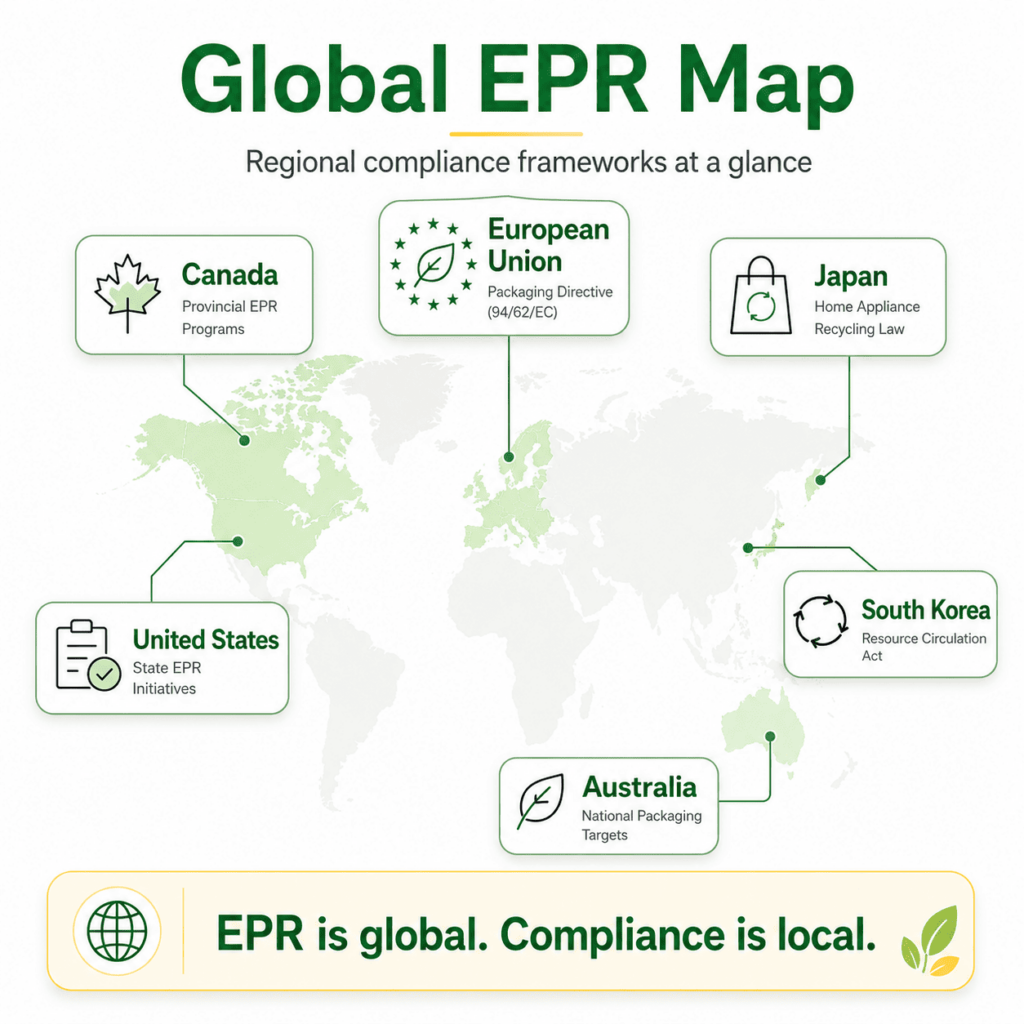
- Canada — British Columbia and Ontario have mandatory packaging EPR. National harmonisation is underway, with full coverage expected by 2030.
- United States — Maine, Oregon, Colorado, and California have enacted packaging EPR laws. No federal framework exists yet, but over a dozen states have active bills.
- Japan — The Containers and Packaging Recycling Act requires producers to contract with the Japan Containers and Packaging Recycling Association (JCPRA).
- South Korea — Mandatory packaging EPR has operated since 2003, with progressively tighter targets.
- Australia — Voluntary schemes still dominate, but state-level mandatory obligations are expanding under the National Packaging Targets framework.
Each of these markets carries its own PRO structure, registration calendar, and enforcement culture. EU experience does not translate across the Pacific.
| Region | Legal Basis | PRO Structure | Primary Enforcement Body |
| European Union | National laws under EU Directive | Mixed public/private PROs per country | National environmental agencies |
| Canada (BC/ON) | Provincial regulation | Regulated industry-funded organisations | Provincial ministries |
| United States | State statutes | Producer-run stewardship organisations | State environmental departments |
| Japan | National statute (CPRA) | Single national PRO (JCPRA) | Ministry of Environment |
| South Korea | National statute | Compliance guarantee system | Korea Environment Corporation |
Choosing a Platform for Global EPR Compliance Management
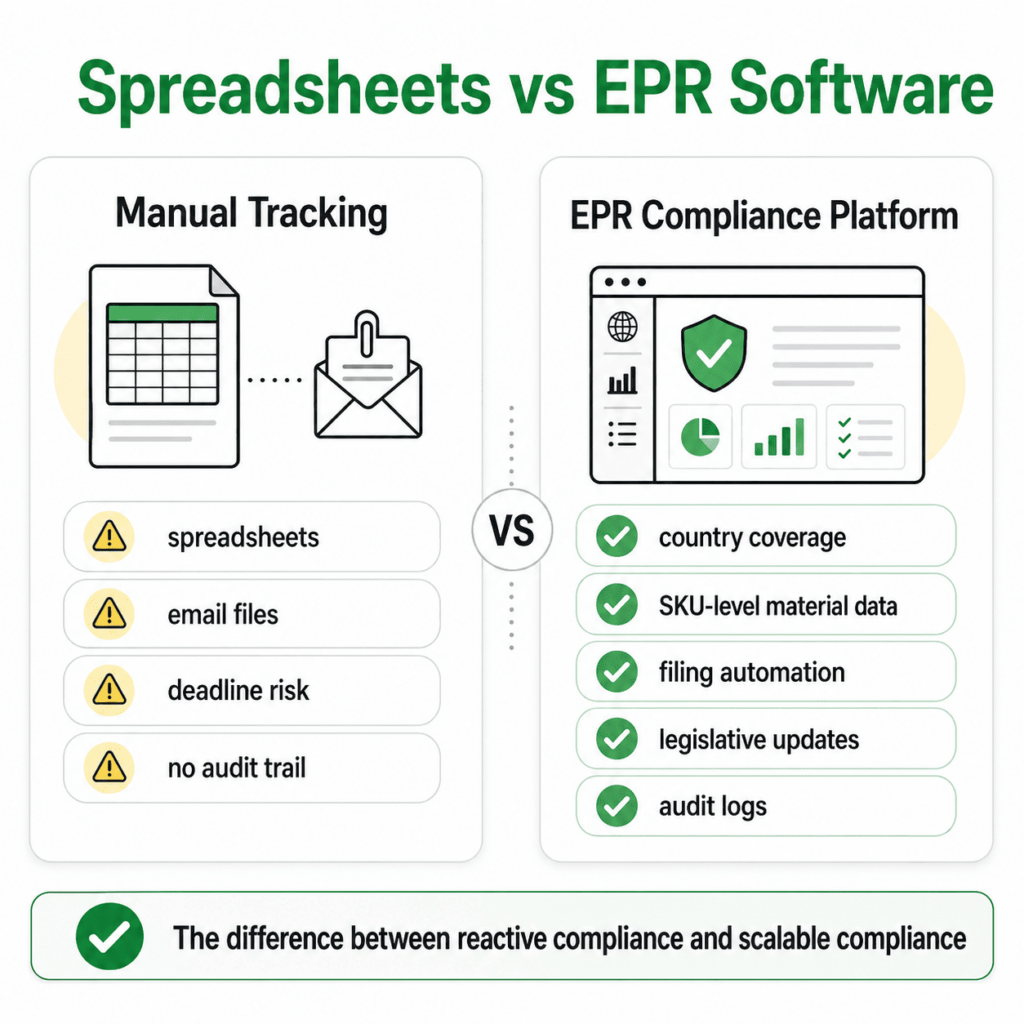
Before 2020, most businesses ran global EPR compliance management on spreadsheets topped up by consultants phoning in country updates. Since then, a real software market has formed — and the platforms in it are not equally capable. The gap between a purpose-built EPR tool and a generic compliance suite with an EPR tab bolted on is large enough to matter when an audit hits.
Here is what to test before you sign:
| Criterion | What to Look For | Red Flag |
| Country coverage | Active coverage of all current and near-term markets, with named PRO integrations | Vague ‘global coverage’ claim with no country list |
| Data model | Weight-based material tracking at SKU or product level, not just invoice level | Aggregation at company level only |
| Filing automation | Direct or semi-direct submission to PROs, not just report generation | PDF exports you still have to upload manually |
| Legislative updates | Named team or process for monitoring regulatory changes | ‘We update when regulations change’ with no SLA |
| Audit trail | Immutable log of submitted data with timestamps and version history | No audit log, or one users can edit |
International trade compliance software that covers EPR as a primary use case — not as a customs module’s footnote — performs better on country depth and PRO connectivity. Platforms built around tariff classification and customs clearance typically know EPR at a surface level, which becomes obvious the first time you need to file a corrected return in Poland.
Management reporting within these platforms also varies significantly. Some build executive dashboards that consolidate EPR exposure across all markets into a single view; others generate country-by-country output that someone on your team has to stitch together. For multi-country operations, the consolidated view feeds directly into monthly accruals — which makes it a finance requirement, not a compliance nicety.
Steps to Build an International EPR Programme from Scratch
Four to twelve weeks per country — that’s the realistic window to go from zero to filed, depending on how clean your product data is and how straightforward the national registration process turns out to be. Here is the sequence that works across most packaging EPR jurisdictions:
- Identify obligation triggers — confirm whether your business clears the registration threshold in the target market; thresholds vary by annual turnover, tonnage placed, or product category
- Appoint an authorised representative if required — non-EU businesses entering EU markets need a locally registered representative in each member state; this is not optional
- Complete producer registration — file with the national competent authority or PRO; plan for two to four weeks and potential notarisation requirements
- Map product weights by material — pull weight-per-SKU data from product specs and classify by local material taxonomy; Germany’s VerpackG and France’s REP Emballages use different category structures
- Calculate initial fee estimate — apply current eco-contribution rates to estimated annual tonnage and get an EPR cost line into the budget
- Select a PRO or compliance scheme — in markets with multiple PROs (Germany, UK), the choice affects fee rates, tooling, and support quality
- File the first return — submit within the required window on the prescribed form
- Set up ongoing data feeds — connect sales or logistics data to your reporting system so future returns run on live figures, not manual extracts
Managing EPR obligations as an international business service means running this sequence simultaneously for every market you enter. The data architecture in step 4 either works across all of them or creates rework in every one. Get that layer right early — it carries everything above it.
Management Reporting and the Role of International Trade Compliance Software
Your compliance manager and your CFO need completely different things from the same EPR data. The compliance team wants country-level granularity: what was filed, under which PRO, at which rate, and what comes due next month. The CFO wants one number — total EPR liability across every market, tracked against budget, with a variance explanation if it moved.
Management reporting that serves both audiences is where most EPR platforms fall short. Compliance-specialist tools produce excellent country-level detail. Ask them for a one-page group-level summary and you get a blank stare, or a pile of PDFs to reconcile yourself.
Platforms that handle this well treat EPR data as a liability item, not just a filing obligation. They hold tonnage figures, apply live fee rates per country, and produce an accrual number that drops straight into the monthly close. When France announces revised rates in October — as it typically does — the system reprices the forecast without anyone having to remember to update a spreadsheet.
International trade compliance software with this dual-audience architecture also handles retroactive corrections cleanly. A client ships 40 tonnes of packaging to Germany in Q1, then discovers in Q3 that 8 tonnes were miscategorised as cardboard rather than composite. That correction ripples across multiple countries simultaneously — composite rates are higher in several markets — and needs to surface in management accounts, not just in the German PRO portal.
| Report Type | Primary Audience | Update Frequency | Key Metric |
| Country compliance status | Compliance manager | Real-time / per filing | Registration status, next deadline, filed vs. due |
| Material tonnage by market | Compliance + data team | Monthly | Kg per material category per country |
| EPR cost accrual | Finance / CFO | Monthly | Total liability, YTD spend, budget variance |
| Audit readiness summary | Legal / General Counsel | Quarterly | Document completeness, open items, penalty exposure |
Building Long-Term International Compliance Without Accumulating Risk
Ask any compliance consultant which clients give them the most remediation work and the answer is consistent: businesses that sorted out EPR once, declared victory, and never looked at it again. Three years later, one market has a lapsed registration, another has outdated material categories, and a third has a PRO contract that auto-renewed on terms that no longer fit the business. None of those individually wrecks the company. Together they add up to real financial exposure — and in several jurisdictions, they provide the basis for a sales ban.
The fix is structural, not heroic. Treating international compliance as a standing function — not a project that concludes — is what keeps this from compounding. Four things need to run continuously:
- A regulatory calendar covering every market’s filing deadlines, fee rate update dates, and legislative review cycles — kept current quarterly at minimum
- A data owner accountable for weight and material accuracy across all product lines, with clear handoffs when specs change
- A PRO relationship manager maintaining active contact with each PRO, watching PRO financial health (they do occasionally fail), and handling contract renewals
- A technology layer — purpose-built EPR software or an international compliance platform’s EPR module, with a documented connection to the ERP or order management system
Globally operating EPR programs keep expanding in scope. The PPWR tightens reuse targets from 2030. Asian markets are writing packaging EPR legislation now. Canada’s national scheme completes its rollout this decade. Companies with scalable EPR infrastructure absorb each of those changes in a few configuration updates. Companies still on spreadsheets when the deadlines land face a full rebuild under time pressure — which is exactly when expensive mistakes happen.
FAQ
Does a non-EU business need to register for EPR in each EU country separately?
Yes. There is no EU-wide EPR registration. Each member state runs its own producer register. A UK brand selling packaging into France, Germany, and Spain must register in all three — and in most cases will need a local authorised representative in each, given the lack of an EU establishment.
What is the typical penalty for missing an EPR filing deadline in Germany?
Under VerpackG, unregistered producers face fines up to €200,000 and a sales ban. Late filings by registered producers carry lower penalties, but the Zentrale Stelle Verpackungsregister monitors actively and has issued enforcement notices to online marketplaces as well as individual brands.
Can EPR compliance for packaging be managed with a standard ERP system?
Not cleanly. Standard ERP systems record transaction data; they rarely hold weight-by-material data at SKU level in the format EPR requires. Most businesses need a dedicated EPR platform or an integration layer between their ERP and a compliance tool. The structural gap is the material taxonomy — ERPs track items, not packaging composition.
How often do EPR fee rates change?
Annually in most EU markets. France and Germany both publish revised rates in Q4 for the following year. Spain and Poland have changed rates more frequently during legislative transitions. Treating this as a once-a-year check is fine in stable years; in transition years it is not.
Is EPR only about packaging?
No. Packaging is the most widespread category, but electronics (WEEE), batteries, tyres, textiles, and certain medical devices carry EPR obligations in multiple markets. The EU’s WEEE Directive has been running since 2003. Battery EPR rules tightened substantially under the EU Batteries Regulation of 2023. Any business selling across these categories needs a product-by-product review, not just a packaging check.