
Understanding EPR Fee Regulations in Europe for 2026
Understanding EPR Fee Regulations in Europe for 2026
How to EPR Register and Meet Your Legal Obligations
If you want to follow European packaging rules, you need to understand how the EPR fee structure works for your company. As environmental laws get stricter in member states, producers need to know how extended producer responsibility (EPR) systems work and what they mean for their finances. This complete guide talks about EPR registration fees, requirements that are different in each country, and helpful advice for keeping compliance costs down in 2026.
If you are planning to register for EPR in one or multiple European countries, you can submit a registration request through our platform. Our team will review your data and help you complete the process correctly from the start.
Understanding EPR for Packaging Material Requirements
EPR for packaging is the most common type of producer responsibility that affects e-commerce and retail businesses. This duty includes all materials used to hold, protect, or display goods, such as cardboard boxes and plastic bubble wrap. Producers have to report the weights of their packaging by type of material and pay the right fees.
For EPR for packaging compliance, the most common material categories are paper and cardboard, different types of plastic, glass, metals like aluminum and steel, wood, and composite materials. The fees for each category are different because of the difficulty of recycling and the costs of the infrastructure. To figure out the right fees, businesses need to weigh and sort each part of the packaging correctly.
To use EPR for packaging systems, you need to keep detailed records of your suppliers, the materials you buy, and the packaging you buy every month. At first, many companies have trouble collecting data, especially when they use different types of packaging from different vendors. Setting up systematic tracking processes early on stops problems with compliance and mistakes in calculating fees later on.
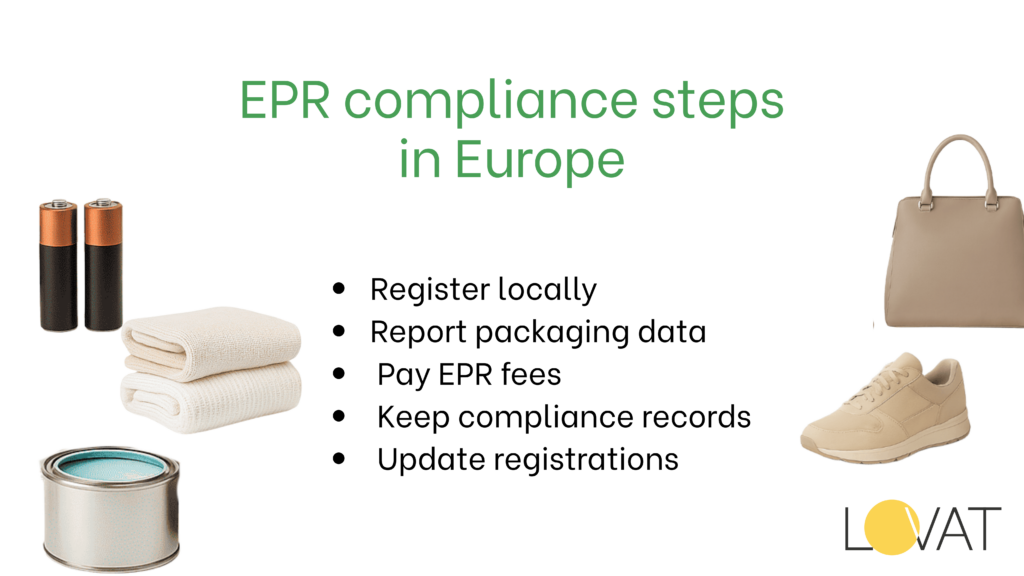
- Before putting products on the market, register your company’s information with the national EPR authorities.
- Report the number of packages you send out every month or every three months, along with a detailed breakdown of the materials used.
- Make a deal with a waste management scheme or producer responsibility organization that has been approved.
- Pay fees based on the types of packaging and the amount of material put on the market
- Keep records that show you are following the rules in case the government wants to check.
Breaking Down the EPR Fee Structure Across Europe
If businesses know how the EPR fee is figured out, they can make better budgets. Most countries charge by the kilogram for packaging, but the price varies depending on the material. Plastics that are light usually cost more per kilogram than glass or paper, which are heavier. The reason for this is that they are bad for the environment and hard to recycle.
There are a lot of things that can change how much EPR fees you have to pay. It’s very important that materials can be recycled. Packaging made from materials that can be easily recycled often costs less. Some countries use eco-modulation, which means they change fees based on design choices that make it easier or harder to recycle. Packages that have recycled materials in them may also pay less.
You can find out how much you owe in EPR fees by multiplying the weight of your packaging by the rates that apply to each type of material in each country. Small changes to the design or materials used in packaging can have a big effect on yearly costs, especially for sellers who sell a lot of items. Checking the specifications for your packaging on a regular basis makes sure you don’t pay too much or too little.
| Material Type | Average Fee Range (per kg) | Recycling Complexity |
| Paper & Cardboard | €0.02 — €0.15 | Low |
| Plastic (PET, PE) | €0.30 — €0.80 | Medium |
| Glass | €0.01 — €0.05 | Low |
| Aluminum | €0.15 — €0.40 | Medium |
To better understand how EPR fees are calculated and how obligations differ by country, we recommend reviewing our detailed EPR compliance guide.
Germany Extended Producer Responsibility EPR Compliance Guide
The Packaging Act (VerpackG) sets up the Germany extended producer responsibility (EPR) system, which requires businesses to register twice. First, businesses need to sign up for the LUCID Packaging Register, which is a public database run by the Central Agency Packaging Register. Second, they need to hire at least one licensed dual system that will pick up and recycle packaging waste in person.
Germany extended producer responsibility (EPR) obligations apply to anyone first placing packaging on the German market. This includes manufacturers, importers, and online sellers who send goods to German customers. The dual-system approach makes compliance schemes compete with each other, which could lead to better rates than systems that only have one provider in other countries.
To follow Germany’s extended producer responsibility (EPR), you need to send data to your chosen dual system every month and to LUCID every three months. The fees for dual systems depend on the type of material and the weight of the load. If you don’t follow the rules, you could face big fines, be kicked out of the marketplace, and be publicly listed as non-compliant, which would hurt your business’s reputation a lot.
Navigating EPR Registration Fee Costs and Administrative Expenses
The EPR registration fee is the first step in setting up your compliance account with national authorities or producer responsibility organizations. Some countries charge nothing for these one-time or yearly fees, while others charge hundreds of euros. The costs of registering are very different from country to country. Some countries don’t charge anything for basic registration and only make money from packaging tonnage fees.
In addition to the basic EPR registration fee, many countries also require annual membership fees for producer responsibility organizations. These recurring fees help pay for the systems that run the business, report on its activities, and collect trash. Even if you don’t sell a lot of packaging, you might still have to pay membership fees, which means that even small sellers have to pay compliance costs.
Paying EPR registration fees in more than one country adds to the administrative burden. Each jurisdiction has its own payment systems, currencies, and billing schedules. Companies that do business across Europe often hire compliance service providers to handle payments and reporting for them. This adds service fees but cuts down on the amount of work they have to do themselves.
Comparing EPR Registration Fees Across 15 European Countries
When comparing EPR registration fees in different European markets, there are big differences between the West and the East. Countries in the Nordic region and the Benelux region usually have higher fees because they have better waste management systems. Central and Eastern European countries often have lower compliance costs, but the rules for reporting and enforcement are still just as strict.
The full table below shows the differences in EPR registration fees and packaging costs in 15 major European markets. This information helps companies plan for the costs of following the rules when they move into new areas. The fees are based on current rates and expected increases, and they are estimates for 2026.
| Country | Registration Fee | Average Packaging Fee (per kg) | Estimated Annual Cost* |
| Germany | €0 (LUCID) | €0.15 — €0.60 | €300 — €1,200 |
| France | €0 — €150 | €0.08 — €0.45 | €250 — €900 |
| Italy | €100 — €200 | €0.10 — €0.50 | €400 — €1,100 |
| Spain | €0 — €100 | €0.12 — €0.48 | €350 — €950 |
| Poland | €50 — €150 | €0.05 — €0.35 | €200 — €700 |
| Netherlands | €0 | €0.18 — €0.65 | €450 — €1,300 |
| Belgium | €125 — €250 | €0.20 — €0.70 | €500 — €1,400 |
| Austria | €0 — €100 | €0.14 — €0.55 | €350 — €1,000 |
| Czech Republic | €30 — €80 | €0.06 — €0.30 | €180 — €600 |
| Hungary | €0 (EPF system) | €0.08 — €0.40 | €200 — €800 |
| Portugal | €50 — €120 | €0.09 — €0.42 | €280 — €850 |
| Romania | €25 — €75 | €0.04 — €0.28 | €150 — €550 |
| Sweden | €0 | €0.16 — €0.58 | €400 — €1,150 |
| Denmark | €0 | €0.22 — €0.75 | €550 — €1,500 |
| Slovakia | €40 — €100 | €0.07 — €0.33 | €220 — €650 |
* Estimated annual cost assumes small to medium business placing 2-5 tons of mixed packaging materials on the market. Actual costs vary based on packaging volume, material composition, and chosen compliance scheme.
EPR Extended Producer Responsibility EU Regional Cost Analysis
Looking at the costs of EPR extended producer responsibility EU in different areas can help you come up with strategies for expanding your business. Germany, France, and the Netherlands are examples of Western European markets that have a lot of customers but also higher compliance costs. Eastern European countries offer chances for growth at lower EPR costs, but the sizes of the markets and the buying power are different.
Denmark and Sweden, which are in the Nordic region, charge high prices because they have the best recycling systems in the world and want to protect the environment. The EPR Extended Producer Responsibility EU directive lets countries make these kinds of changes while still following the main rules. Even though they cost more, these markets have rich customers and a lot of e-commerce.
Businesses can better manage operations in multiple countries by understanding the EPR extended producer responsibility EU framework. This regulatory framework helps keep the market stable while still allowing for differences in how things are done in different areas. Companies can learn a lot by looking at how the EU’s extended producer responsibility systems are different in different places.
Poland and the Czech Republic are examples of central European markets that find a good balance between low prices and the benefits of being a member of the EU. Their Extended Producer Responsibility (EPR) systems keep strict compliance while charging less than their Western neighbors. This position makes them appealing to companies that want to test the waters in Europe before moving on to more expensive markets.
EPR Fee Hungary System and Environmental Product Charges
The EPR Fee Hungary operates through the Environmental Product Fee (EPF) system, which differs structurally from Western European models. Rather than contracting with private compliance schemes, Hungarian producers either pay fees directly to the National Tax and Customs Administration (NAV) or join product stewardship organizations that assume fee obligations.
Calculating the EPR Fee Hungary requires understanding the EPF rate schedule, which applies to packaging, paper products, electronics, batteries, and other materials. Packaging fees vary by material weight, with producers reporting quarterly to NAV. The system allows fee exemptions when joining approved stewardship organizations that meet collection and recycling quotas.
Businesses entering the Hungarian market must familiarize themselves with epr fee Hungary requirements before launching sales. Working with local stewardship organizations helps navigate NAV reporting requirements and Hungarian language documentation. While generally more affordable than Western European markets, Hungary maintains strict enforcement with penalties for non-compliance.
The dual-option structure of Hungary EPR fee systems provides flexibility for different business models. Companies can choose direct payment or organization membership based on their operational preferences. This Hungarian EPR fee approach differs from mandatory compliance scheme models in countries like France or Germany.
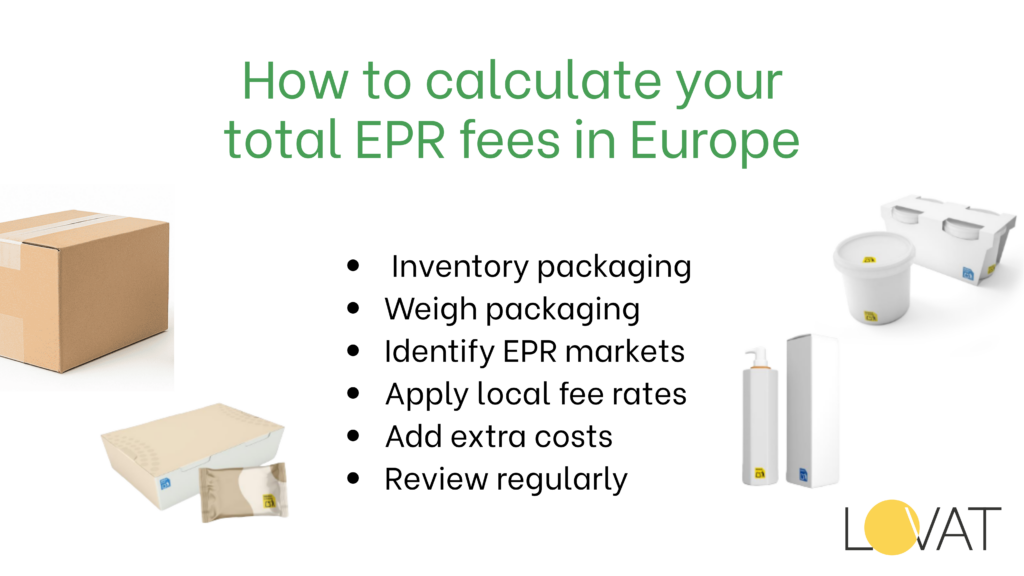
How to Calculate Total EPR Fees Europe for Your Business
The Environmental Product Fee (EPF) system is how Hungary’s EPR fee works. This system is different from those in Western Europe. Instead of working with private compliance schemes, Hungarian producers either pay fees directly to the National Tax and Customs Administration (NAV) or join product stewardship organizations that take on the fee responsibilities.
To figure out the EPR fee in Hungary, you need to know the EPF rate schedule, which covers packaging, paper goods, electronics, batteries, and other materials. The cost of packaging depends on the weight of the material, and producers report to NAV every three months. When you join an approved stewardship organization that meets collection and recycling quotas, the system lets you skip the fees.
Before starting to sell in Hungary, businesses must learn about the EPR fee Hungary requirements. Working with local stewardship groups makes it easier to understand NAV reporting rules and documents written in Hungarian. Hungary’s markets are generally cheaper than those in Western Europe, but the country strictly enforces its rules and punishes those who don’t follow them.
The Hungary EPR fee systems have two options, which makes them flexible for different types of businesses. Businesses can choose between direct payment and membership in the organization based on how they like to do things. This Hungarian EPR fee system is different from the mandatory compliance schemes used in France and Germany.
- Make a list of all the packaging parts for products sold in European markets
- Weigh each part and put it into groups based on the exact type of material it is made of.
- Conduct a research of markets where the goods are sold for your EPR obligations
- Use the fee rates for each country based on the weight of the material.
- Add the costs of registering, joining, and using compliance services.
- Check the calculations every three months, as the number of items and packaging requirements change.
Common Mistakes When Managing Producer Responsibility Costs
Many businesses don’t realize how complicated EPR registration fees are because they think that one registration covers all EU countries. This basic misunderstanding leads to gaps in compliance. Each country has its own rules for registration, payment, and reporting. Companies must register separately in each market where they sell, even if they are members of the EU.
Another common mistake is putting packaging materials in the wrong category. Sometimes, companies group composite materials into single-material types or wrongly label plastic grades. These mistakes lead to underpayment of fees, which can result in fines during government audits. Taking the time to correctly classify materials now will save you money later on.
Errors in timing can also cause problems. Sometimes, companies wait until after sales have started to start registration, which means they are not in compliance from the start. Most countries require businesses to register before they can sell goods. Also, when companies change packaging suppliers or reformulate products with different materials, they sometimes forget to update their registrations, which can change the weights and fees they report.
What to expect for European Producer Responsibility
Europe is still in the midst of a fast-paced development on Extended Producer Responsibility (EPR). Starting in 2026 and beyond, we can expect more harmonization as the EU encourages consistency while still allowing each member state to choose how to implement things. Digital reporting platforms are quickly becoming the norm as more and more countries switch to electronic data submission and registration. Even though there will be some problems during the transition periods, compliance should become easier as a result of this modernization.
There will probably be more fee changes, which is good news for packaging that lasts. Products that have recyclable materials or packaging that is easy to recycle may be cheaper. On the other hand, products that have packaging that is hard to recycle will cost more. This movement fits with the goals of the European Union’s circular economy. To stay ahead of the competition, you need to look at package design from an EPR cost point of view on a regular basis.
| Emerging Trend | Impact on Businesses |
| Digital registration platforms | Streamlined reporting with learning curve |
| Expanded fee modulation | Rewards for sustainable packaging choices |
| Cross-border data sharing | Simplified multi-country compliance |
| Stricter enforcement | Higher penalties for non-compliance |
Practical Steps for Your Compliance Process
You will need to be very organized to keep track of your EPR registration duties in different countries. Put all the papers you need in one easy-to-find place. This includes letters from the government, registration certificates, receipts for fees, and quarterly reports. Choose someone to be the boss and make sure that they are always in charge of EPR compliance, even if staff members leave.
Keep in mind, EPR for packaging compliance on your own or if you need to hire experts to help you. Companies that sell in only one or two marketplaces and have simple packaging might be able to manage themselves – it is not so complicated to waste a few hours and days. But compliance service providers are helpful for businesses that sell in more than one European country. It will help you to keep all things up to date and never miss a deadline.
Managing EPR obligations across multiple countries can be time-consuming. If you want to see how registrations, fee tracking, and reporting can be handled in one system, you can explore a demo of our compliance platform.
Taking Control of Your Extended Producer Responsibilities
You can protect your business from fines and show that you care about the environment by knowing and keeping track of your EPR fee duties in all European markets. By keeping accurate records of packaging data, following the rules for each country, and setting up systematic compliance practices, you can set yourself up for long-term success.
As the circular economy grows in European markets, producer accountability systems will become more important. Companies that take care of these things ahead of time will do well when they enter the European market. If you want to grow your business into Europe or any other area, you should make compliance a key part of your business process instead of an afterthought. This will help you run your business more efficiently and manage risks better.
Are you having trouble understanding the rules for the European EPR? Lovat helps businesses meet compliance requirements in many places by providing quick, reliable, and customized solutions.