
EPR Enforcement and Penalties in 2026
EPR Enforcement and Penalties in 2026
Understanding EPR penalties across European Markets
It is so complicated to know all the new rules and regulations, but, unfortunately, we have to be always up to date with it. Remember when it was only discussions if EPR will be even implemented – see what do we have know. Europe is in full scale of tightening the nuts and USA EPR is already a common topic on Lovat – The EPR penalty structure varies dramatically between member states.
Now you want to know what how tough is it becoming now and what are the fees & penalties to be avoided. Companies face significant EPR penalties when registration obligations are ignored – be careful.
Authorities define extended producer responsibility as financial and operational accountability for product end-of-life management.
Extended Producer Responsibility (EPR) is no longer just a regulatory concept — it has become a strictly enforced compliance framework across major jurisdictions. In 2026, governments are shifting from policy-building and advising and closing the eyes to active enforcement, increasing both the frequency of inspections and the severity of penalties.
Companies who thought it would be just on the words and no any actions will be done by the government were incorrect. Now all the companies are facing the tasks and risks to financial and operational sides of the business. For example,France applies EPR penalties starting at €7,500 per violation with daily accumulation.
In this article you will find out about how EPR enforcement mechanisms works and find recommendations of how to avoid the violations and maintain market expansion.
What is EPR Enforcement in practice
Let’s start from the most important – how the EPR Enforcement really works in real life, not on the paper.
Who is checking EPR compliance? Regulator.
Regulator is a government authority or authorized organization that monitors and enforces compliance with EPR regulations.
Organization observing if producers meets the following :
- Registered in the EPR System
- Sent declarations
- Paid eco-tax
- Performed utilisation requirements
In many countries regulators can be the one who cooperates with customs and tax authorities to identify who are non-compliant.The EU Waste Framework Directive helps define extended producer responsibility minimum requirements.
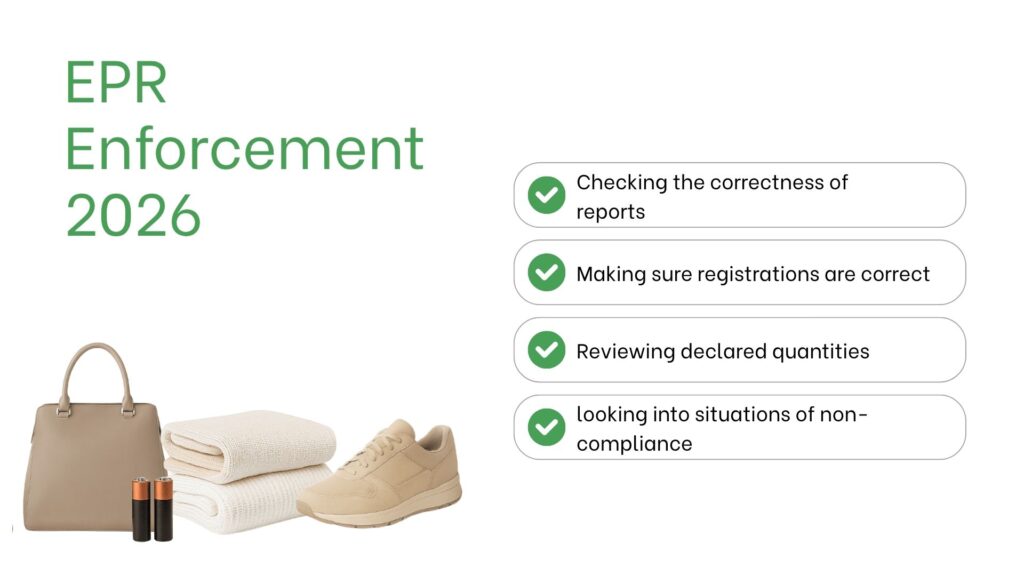
Meanwhile, EPR enforcement refers to how regulators ensure that producers comply with their legal obligations regarding the lifecycle of products, especially waste management.
EPR enforcement includes the following actions by regulators:
- Monitoring reporting accuracy
- Verifying registration with national schemes
- Auditing declared volumes and recycling contributions
- Investigating non-compliance cases
Authorities are increasingly using digital tracking systems and cross-border data exchange, which makes it harder to underreport or avoid obligations.
How EPR regulations penalties escalate for Non-Compliance
Like in all the laws and regulations, the violations are clearly stated and explained. And we already know that it never works that all violations are treated equally. Regulators divide them in main groups of administrative errors and deliberate non-compliance.The EPR regulations penalties framework distinguishes between administrative errors and willful violations
Administrative errors are usually a human error mistakes or the one’s that occur due to incorrect processes or simply “I didn’t know” .
Examples include:
- Submitting reports with incorrect data
- Missing reporting deadlines
- Minor calculation errors in declared volumes
- Incorrect classification of products
Deliberate non-compliance refers to intentional actions where a company knowingly avoids its EPR obligations.
Examples include:
- Not registering in the EPR system at all
- Intentionally underreporting product volumes
- Avoiding payment of eco-fees
- Providing false or misleading information
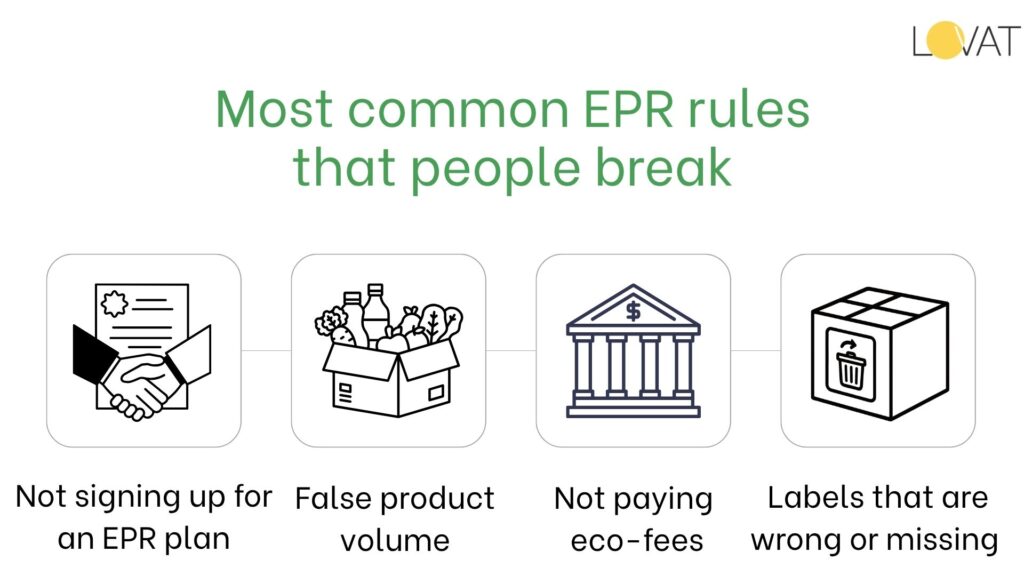
Statistics shows that the most common violations include:
- Failure to register with an EPR scheme
- Incorrect or incomplete reporting
- Underreporting product volumes
- Non-payment of eco-fees
- Mislabeling or lack of required markings
Each of these breaches can trigger enforcement actions depending on severity and intent
EPR Penalties in 2026 –what has changed
Let come to the main thing: EPR Penalties . They are becoming more structured and significantly stricter in 2026. Many of the jurisdictions are aligning penalties as a environmental impact and try to gain economic benefit from non-compliance. For example, Germany enforces EPR regulations penalties through the Federal Environment Agency which is a high level of authority.
Important to know : In most of the countries the measures follow the same penalty flow: first is money fee, then goes prohibition to place the product on the market, prohibitions for export and reputational damage. In some jurisdictions, this is already explicitly stated and actively implemented, while in others, the focus is still stronger on registration, EPR compliance reporting, and public transparency. For more guides follow to our Guides
Typical enforcement measures include:
- Administrative fines (often scaled by turnover)
- Daily penalties for ongoing violations
- Product sales bans
- Import restrictions
- Criminal liability in severe cases
In some regions, regulators also publish public violation registers, increasing reputational risks for companies.For example,France mandates quarterly EPR compliance reporting through the ADEME portal.
| Country | Money fines | Ban for selling goods | Import-related risk | Reputational risk |
| Germany | Incorrect or incomplete registration fines can reach up to 100,000 EUR | Yes | High | Hight |
| United Kingdom | Unlimited under Environment Act civil sanctions – producers remain liable for outstanding fees as well. | Possible for improper registration/reporting failures | Medium to High | High |
| France | Exact sanction depends on the breach and scheme | Possible through loss of compliance status | Medium to high | Medium to high. |
| USA (Oregon) | Up to $25,000 per day | A daily penalty structure can make continued non-compliance commercially unsustainable | Medium. | Medium. |
Regional differences in enforcement approaches
EPR enforcement is not uniform globally, and understanding regional differences is critical. Regulators define environmental compliance through measurable criteria documented in national legislation and start audit. The EPR audit process typically begins with document requests including registration certificates and tonnage reports
European Union
The EU continues to lead in strict enforcement. Authorities actively coordinate across member states, focusing on:
- Cross-border compliance
- Marketplace responsibility (including online sellers)
- Harmonized reporting standards
United States
EPR is expanding at the state level, with enforcement varying by jurisdiction. Some states prioritize:
- Electronics and packaging waste
- Producer registration and fee compliance
Asia-Pacific
Countries in this region are rapidly strengthening enforcement frameworks, particularly in:
- Plastic packaging regulations
- Import compliance checks
- Mandatory recycling targets
Companies should prepare for the EPR audit process by maintaining organized compliance files
Role of regulators in EPR Enforcement
Lets return to basics to clearly understand why do we need Regulator. The process regulator plays a central role in ensuring compliance and proper reporting. Don’t forget that The EPR compliance report must include documentation proving fee payment to authorized schemes Authorities can’t just say what to do – they have to check if it is possible to make and if business are really make it.
What they are going to do :
- To check If business producer registered for EPR
- To conduct audits and inspections
- To issue penalties and enforcement notices
- To coordinate with customs and tax authorities
This integrated approach increases the likelihood of detecting violations early.
How companies can reduce EPR Compliance risks
Answer you were looking for: how to be compliant for EPR and avoid risk. Our recommendation to businesses is to make a focus on the strategy the reactive fixes when process regulator enforcement is going after you.
Use our EPR software to see how organized your declarations can be!
Steps we recommend to avoid EPR Fines:
- Ensure accurate data collection across all markets
- Perform regular internal audits of reporting processes
- Monitor regulatory updates in each jurisdiction by subscribing to our newsletter
- Work with compliance partners or consultants
- Fill proper EPR Compliance report (The EPR compliance report must include documentation proving fee payment to authorized schemes)
Companies that treat EPR as part of core risk management are better positioned to avoid enforcement actions.The definition of environmental compliance standards evolves annually as process regulator recycling targets increase.
The Future of EPR Enforcement
Now we need to look ahead and to know who will be. Not only imagine and guess. Since 2026, enforcement will become more automated. Governments are investing in reporting systems , anomaly detection and integrations with customs and VAT data. But keep in mind that National laws define the extended producer responsibility scope differently across jurisdictions.
Conclusion
EPR enforcement in 2026 represents a clear vision of what to expect next.
Regulators are increasing pressure on producers, and penalties are information which you can’t simply forget due to regular EPR Audit.
Understanding EPR audit procedures enables proactive preparation rather than reactive scrambling. International – trade businesses already implementing strategies to protect the revenue and reputational risks. The regulatory processing timeline varies from two weeks to six months depending on violation severity.
FAQ for EPR enforcement and penalties in 2026
What does EPR enforcement mean
- EPR enforcement is the way that regulators make sure that producers follow the rules for extended producer responsibility. This includes checking the correctness of reports, making sure registrations are correct, reviewing declared quantities, and looking into situations of non-compliance.
Who makes sure that EPR is followed
- A regulator, which is a government agency or authorized group that makes sure that businesses follow EPR rules, checks for EPR compliance.
What are the most common EPR rules that people break
- The most prevalent violations are:
- Not signing up for an EPR plan
- Reporting that is wrong or not complete
- Not reporting enough product volumes
- Not paying eco-fees
- Labels that are wrong or missing on products
What is the difference between making mistakes on purpose and making mistakes by accident?
Most of the time, administrative errors are mistakes that weren’t meant to happen, such putting the wrong information in reports or missing deadlines.
Deliberate non-compliance is when someone purposefully doing incorrect