
Common EU VAT Mistakes Online Businesses Should Avoid
Common EU VAT Mistakes Online Businesses Should Avoid
A German online retailer selling digital subscriptions spotted an oddity in their Q3 2023 filing — a €47,000 discrepancy between reported revenue and actual remittances across six EU member states. The shop had applied domestic German rates to cross-border B2C sales for 18 months. By the time the accountant caught it, the Bundeszentralamt für Steuern had flagged the account. Interest accrued. Penalties stacked.
That scenario plays out more often than most operators expect. VAT-related slip-ups of this kind sit quietly inside spreadsheets for quarters. Nobody notices until a tax authority does — and by then, the cost of discovery usually exceeds the original shortfall.
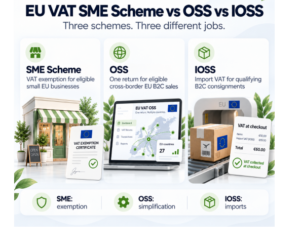
The landscape shifted fast. The OSS scheme, launched in July 2021, collapsed individual member-state registration thresholds into a single EU-wide €10,000 limit. Then came DAC7 in January 2023, adding mandatory reporting obligations for marketplace platforms. In 2026, enforcement appetite across France, Germany, and the Netherlands has visibly increased: the Dutch Belastingdienst issued over 3,400 notices to cross-border digital sellers in 2025 alone.

Operators who have historically reported these errors voluntarily tend to face far softer outcomes than those discovered through audit. Voluntary disclosure requires knowing what to look for — and most owners don’t until it’s too late.
This guide covers the specific failure points: overlooked thresholds, classification slip-ups, filing cadences nobody reads until a government letter arrives. Concrete examples. Actual numbers. Patterns that trip up otherwise careful retailers.
Why VAT Mistakes Are Getting More Expensive in 2026
The math changed when the EU tightened enforcement coordination across member states. Pre-2021, a seller could operate across Germany, France, and Spain without registering in each country — and many did, quietly. The OSS scheme made that unsustainable, but it also made non-compliance far more visible to authorities simultaneously.
Filing errors that once flew under the radar now surface in cross-border data exchanges. Under DAC7 and the earlier DAC6 directive, tax authorities in all 27 member states share transaction data automatically. A discrepancy spotted in Poland can trigger a review in Sweden within the same quarter. The system is more interconnected than most sellers realize.
The financial cost of not avoiding VAT penalties across the EU has also changed substantially. Several jurisdictions updated their penalty frameworks in 2024–2025:
- Late filing penalties now start immediately in Austria and Portugal — no grace period at all
- Interest on underpayments sits at 7–10% annually across most member states, compounding monthly
- Repeat filing errors can trigger mandatory quarterly audit cycles in Germany under § 21 UStG
Incorrect classification of digital versus physical goods costs an average of €2,300 in administrative correction fees per jurisdiction (European Commission estimate, 2024) - Missing OSS registrations expose sellers to back-registration demands in each member state separately — multiply that cost by your actual number of destination countries
- Marketplace liability rules mean platforms like Amazon EU or Etsy can now withhold remittances from sellers with outstanding obligations
- Currency conversion errors compound over time and prove notoriously difficult to recalculate retroactively
The enforcement gap is closing. Tax authorities are better resourced, better connected, and working from better data than in 2020. Compliance gaps that EU-facing retailers tolerated a few years ago now routinely trigger detection and flagging.
Most Common Online Business VAT Errors We See
VAT mistakes cluster around four failure points: wrong rates, wrong place of supply, wrong entity classification, and wrong filing cadence. Most aren’t exotic misunderstandings — they’re process gaps that developed slowly, unnoticed.
Sellers making mistakes on their VAT returns usually fall into a recognizable pattern: they built their billing setup once, sometime around 2019 or 2020, and never revisited it as rules changed around them. We see this regularly across hundreds of EU-facing shops.
The table below covers the most frequently seen online business VAT errors, how often they appear in correction workflows, and what they typically cost to address:
| Error Type | Frequency Among Flagged Filings | Avg. Cost to Correct |
| Wrong rate applied | 41% | €800–€2,400 |
| Incorrect place of supply | 27% | €1,200–€5,000 |
| Missing OSS registration | 14% | €2,000–€8,000 per country |
| B2B vs. B2C misclassification | 10% | €600–€3,000 |
| Digital goods misclassified as physical | 5% | €900–€2,800 |
| Incorrect currency conversion | 3% | €200–€600 |
The tax missteps specific to digital services deserve a separate callout — they appear in nearly 35% of e-commerce correction cases processed each year. Subscription platforms, SaaS tools, and downloadable content providers consistently underestimate how granular EU rules get for electronically supplied services.
Mistake on VAT Return — What Triggers It and How to Spot
The most common mistake on VAT return rarely looks dramatic from the outside. It’s usually a cell in a spreadsheet pulling from the wrong column, or an automation rule that was correct in 2022 and became incorrect by 2024. The triggers are mundane. The financial exposure isn’t.
Three conditions make filings particularly error-prone:
- Manual data aggregation — pulling figures from multiple sales channels by hand introduces transposition errors. A single-digit slip on a €12,000 line becomes a €12,000 liability overnight.
- Rate table staleness — EU member states adjust standard and reduced rates independently. Estonia raised its standard rate from 20% to 22% in January 2024. Shops that didn’t update their billing engine filed at the wrong rate for months without realizing.
- Multi-currency handling — the applicable exchange rate for this obligation is the ECB rate on the tax point date, not the rate your payment processor applied at settlement.
VAT Return Mistake — High-Risk Scenarios That Generate It
A vat return mistake most often surfaces in one of three specific situations. The first: a seller transitions from domestic-only to EU-wide sales. OSS registration happens, but the old billing logic doesn’t get disabled — creating double-counting in some periods. Second: a platform migration (moving from Shopify to WooCommerce, say) resets tax configuration to system defaults. Third: the business crosses the €10,000 EU threshold mid-year and doesn’t retroactively recalculate invoices already issued at domestic rates.

The Irish Revenue Commissioners published guidance in 2024 noting that 40% of OSS correction submissions processed that year involved threshold-crossing errors. Not exotic fraud. Just math applied at the wrong moment.
Digital Services VAT Mistakes Specific to Online Businesses
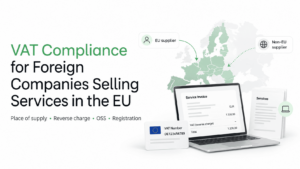
Digital services VAT mistakes hit harder than most operators expect, and they’re not always obvious inside standard accounting software. EU Directive 2006/112/EC defines electronically supplied services broadly: streaming content, cloud software access, downloadable templates, online courses, subscription newsletters. Each category carries its own place-of-supply logic and its failure pattern.
Here’s where it gets tricky. A customer in Lyon buys access to your SaaS platform. She’s a private individual — B2C. The sale is taxable in France at the current rate of 20%. But if she uses a business ID registered in Paris for her freelance consultancy, the transaction flips: it becomes B2B, reverse charge applies, and the French government collects nothing from you directly. Getting this classification wrong generates compounding tax liabilities across every transaction of the same type — and those add up fast.
The table below compares the main digital service categories, the common misstep, and which EU countries have been most active in flagging discrepancies:
| Service Category | Common Error | Most Active Enforcement Countries |
| SaaS / cloud software | B2B vs. B2C misclassification | Germany, France, Netherlands |
| Streaming / digital content | Wrong rate on reduced-rate content | France, Italy, Spain |
| Downloadable files | Physical vs. digital classification | Sweden, Poland, Austria |
| Online courses / e-learning | Exemption claimed incorrectly | Ireland, Denmark, Belgium |
| Subscription newsletters | Mixed supply classification | Netherlands, Germany |
The rate variation alone is significant. Hungary applies 27% to digital services. Luxembourg sits at 17%. If your checkout applies the wrong country’s rate, the error scales with every transaction. A €50/month subscription sold to 500 French customers at the wrong rate generates a €30,000+ annual discrepancy before any penalties attach. Scale that across three or four markets and the exposure becomes very real very quickly.
Reporting VAT Errors — When, How, and to Whom
Reporting VAT errors is not optional once a discrepancy is discovered — but timing and method matter enormously. There’s a meaningful difference between voluntary disclosure and a correction made under investigation. Tax authorities across the EU distinguish between them explicitly, and the penalty outcomes reflect that gap clearly.
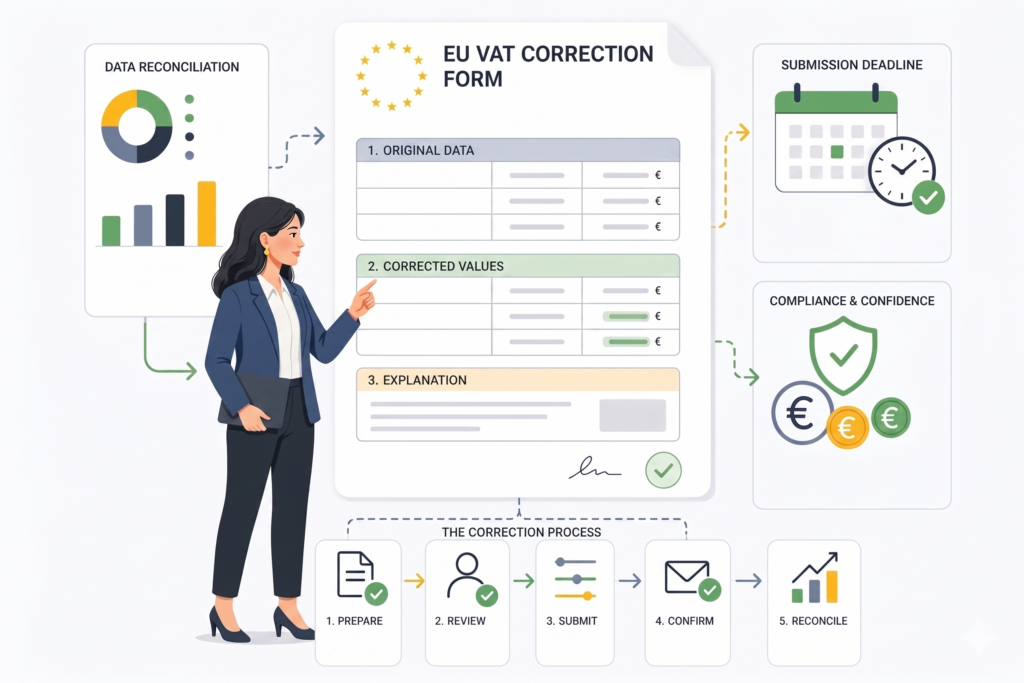
The general framework in most EU jurisdictions follows this sequence:
- Identify the error — determine the period affected, the amount in question, and the root cause. Document everything before contacting any authority.
- Check the materiality threshold — discrepancies below a certain value (typically €10,000 in Germany, €2,000 in Ireland) can often be corrected on the next regular return without formal notification.
- Determine the jurisdiction — errors in OSS filings are corrected through your member state of identification (MSI), not the destination country.
- File a corrected return — through your OSS portal or the local authority’s online system, referencing the original period and the nature of the change.
- Calculate interest due — even voluntary corrections attract interest from the original due date. Budget for this before filing.
- Prepare supporting documentation — invoices, transaction logs, rate tables active at the time. Authorities regularly request evidence when a corrected submission arrives.
- Confirm receipt — get written acknowledgment. For OSS corrections, this comes automatically via the portal dashboard.
The key distinction: proactive error correction places you in the voluntary disclosure category. Waiting until the authority makes contact moves you into assessed underpayment territory — where penalties typically start at 10–25% of the outstanding amount.
Correcting VAT Errors Without Triggering a Full Audit
Correcting VAT errors cleanly requires a specific sequence — skip a step and the correction itself can raise flags. This is one of the few compliance areas where a brief consultation with a tax specialist is genuinely worth the cost, even for smaller retailers. The fee for one hour of advice is almost always less than the penalty surcharge on a mishandled correction.
A return’s mistaken entries become significantly easier to address when the seller maintains detailed transaction logs. No logs means the tax authority relies entirely on summary figures — not a comfortable position during any kind of review. Start there before doing anything else.
| Factor | Proactive Correction | Reactive Correction |
| Penalty rate | 0–5% (or none for minor errors) | 10–25% of underpayment |
| Interest | Standard statutory rate | Standard + possible surcharge |
| Audit risk | Low | High — triggers further scrutiny |
| Processing time | 4–8 weeks | 3–6 months |
| Relationship with authority | Preserved | Under scrutiny |
| Documentation required | Standard | Extensive |
Multi-period corrections require extra care. The OSS portal allows amendments only up to 3 years back. Beyond that window, individual country filings may be required — and each jurisdiction has its own procedures, deadlines, and required documentation formats. The Dutch Belastingdienst, for instance, requires a formal letter of correction for any adjustment exceeding €1,000 per period; the German Finanzamt accepts digital submissions but requires supporting PDFs per transaction line.
The merchants who handle this well tend to do one consistent thing: they set a quarterly internal review date. Not after a problem surfaces. As routine practice. Catching a slip-up 6 weeks after it happens is dramatically cheaper than catching it 18 months later.
How to Avoid VAT Penalties in the EU — A Systematic Approach
Knowing how to avoid VAT penalties in the EU starts with accepting one reality: the EU compliance environment is not static. Rates change. Thresholds change. Directives get amended. A setup correct in January 2024 may carry genuine gaps by January 2026. Build your compliance process around that assumption, not the optimistic one.

These failures are almost always preventable with the right internal processes. Here’s what operators who rarely end up in correction workflows do differently:
- Rate monitoring — subscribe to official gazettes in your top five customer countries. Rate changes are always published; they’re just easy to miss.
- Annual system audits — have your billing or ERP team verify configuration every January and after any platform upgrade.
- OSS threshold tracking — monitor cross-border EU sales against the €10,000 limit in real time, not at year-end.
- Business ID validation — automate VIES lookups for every B2B transaction to prevent entity classification errors.
- Dedicated filing calendar — OSS returns are due monthly or quarterly. Missing a deadline is an avoidable cost.
- Multi-country rate tables in checkout — not defaults from your payment processor; they are custom-configured for your actual customer base.
- Audit trail policy — retain all transaction-level data for at least 10 years (legally required in Germany, France, and Italy).
- Annual external review — even one hour with a specialist in EU digital commerce catches what internal teams routinely miss.
Avoiding VAT penalties across the EU isn’t about being clever. It’s about being systematic. The sellers who rarely face penalties aren’t smarter — they’re more consistent.
Closing Notes and Action Checklist
The pattern across every correction case we track is similar: the error was small, it was structural, and it ran quietly for too long. By the time it surfaced — through internal audit or an official notice — the correction of those errors became significantly more expensive than prevention would have been.
Online businesses’ VAT-related errors rarely stem from ignorance. They stem from outdated configurations, missed updates, and the assumption that if something worked last year, it works this year. That assumption breaks more often than operators expect.
If you’ve been operating in the EU without a formal annual review of your tax configuration, this is the moment. A practical starting checklist:
- Confirm your OSS registration status and MSI country.
Verify the rates applied in your checkout match current rates in your top customer countries. - Run a VIES check on your last 50 B2B customers — confirm all business IDs are still valid.
- Pull your last four quarterly OSS returns and compare declared amounts against payment processor reports.
- Check your most recent filing period for any multi-currency transactions — confirm the ECB exchange rate was applied.
Identify any cross-border sales prior to OSS registration — these may require country-level back-filings. - Document your current rate table configuration and timestamp it for your records.
Schedule the next internal review date before closing this browser tab.
FAQ
How long do I have to correct a mistake on a return before it becomes a formal liability?
- In most EU jurisdictions, 3–4 years from the original filing deadline. After that window closes, the period locks. Act before the authority opens an inquiry — that event shifts the entire framework.
What separates a filing error from deliberate misstatement in the eyes of EU authorities?
- Consistent errors in the same direction—especially when combined with missing documentation—can tip an assessment toward a deliberate misstatement. Document your intent; don’t assume it’s obvious.
Are digital services VAT missteps treated differently from physical goods errors?
- Yes. These missteps attract closer scrutiny because place-of-supply rules are more complex and error amounts scale quickly. France and Germany both operate specialist units for reviewing compliance in digital commerce.
Can I correct an OSS return myself, or do I need a tax advisor?
- Minor corrections — single-period, below materiality thresholds — are typically straightforward through the portal. If corrections span multiple periods or exceed €5,000 in total adjustment, professional guidance changes the risk calculus significantly.
What most commonly triggers a tax audit for an online retailer?
- Late or missing filings, significant discrepancies between declared revenue and marketplace data reported via DAC7, sudden changes in declared amounts between periods, and returns that diverge substantially from sector averages for comparable businesses.