
Shopify and WooCommerce VAT Setup Guide for EU Sales
Shopify and WooCommerce VAT Setup Guide for EU Sales
Selling across European borders used to feel like a simple win: list products, ship them out, watch orders arrive from Berlin, Madrid, and Amsterdam. In 2026, the picture looks different. A single misconfigured tax setting in a Shopify or WooCommerce shop can mean wrong percentages, customs holds in France, or a letter from German authorities you really do not want.
The rules shaping eu sales today are stricter, more interconnected, and far less forgiving than two years ago. The €10,000 cross-border threshold, One Stop Shop, the upcoming removal of the €150 customs duty exemption from 1 July 2026, and the slow rollout of taxation in the Digital Age have turned compliance into something you cannot wing. Yet most operators still rely on default platform settings or an adviser they spoke to once in 2022.
This vat guide fixes that. We walk through the steps to set things up correctly in both major e-commerce platforms — covering Union OSS, IOSS, Non-Union OSS, B2B reverse charge, and the marketplace rules. If you run a shopify eu vat setup or a WooCommerce site with European customers, the next sections give a complete playbook: where to click, which extensions to choose, when local enrolment is unavoidable, and how to keep filings clean as rules evolve through 2027 and beyond.
Why This VAT Guide Matters for EU Cross-Border Sellers
The cost of getting this wrong has climbed sharply over three years. Authorities across the bloc share data through the Central Electronic System of Payment information (CESOP), so a discrepancy between payment processor reports and One Stop Shop returns no longer disappears quietly. German, Dutch, and French audit teams have all expanded their e-commerce divisions. Fines range from a few hundred euros to a percentage of unpaid duties plus interest.
Two regulatory shifts make 2026 a particularly bad year to ignore tax setup. The €150 customs duty exemption disappears from 1 July 2026, folding every imported parcel into duties. the Digital Age reform package (ViDA) brings platform-economy obligations from 2028, single registration extensions in 2028, and full digital reporting plus mandatory e-invoicing for cross-border B2B by July 2030.
Sellers who treat the present vat guide as a starting checklist avoid the most expensive mistakes — those which come not from misunderstanding a rule, but from never noticing it applied. Most errors share a pattern: they happen quietly, show up six months later, and require lawyers to undo.
Five common compliance failures we see in shops managing eu sales:
- Charging a flat home-jurisdiction rate to all European customers after crossing €10,000, instead of switching to destination percentages through the simplified scheme.
- Holding stock in a second European jurisdiction without a local sign-up there, on the assumption that the simplified scheme covers warehouse activity (it does not).
- Relying entirely on the marketplace deemed supplier rule, when the underlying B2B leg still requires the seller to be tax-registered in the country of dispatch.
- Skipping VIES validation and applying reverse charge to numbers which turn out to be invalid, leaving the retailer liable.
- Ignoring the ten-year record-keeping rule—penalties reach 5% of duty owed per Member State if records are lost.
Above all, the operational discipline matters more than the choice of tooling. Audit findings rarely come from misunderstood law. They come from drift: someone joined the team, opened a new fulfillment hub in Slovakia, ran promotional campaigns into Poland, and nobody updated the underlying setup. The numbers themselves did not lie — they reflected what the system was told. Six months later, an authority asks why deliveries to Bratislava show home-rate charges instead of Slovak ones, and there is no good answer. Building a quarterly habit beats reacting to letters.
That habit involves three distinct activities. Reconciliation: pull all order data from the period, group by destination, and sanity-check the totals against what was filed. Rate review: Confirm that any percentage updated mid-quarter has been picked up correctly. Coverage check: walk through the live channels (own site, Amazon, eBay, Etsy, wholesale invoicing) and confirm each has the right collection mechanism behind it. None of this takes long once a routine exists. Without routine, every quarter becomes an emergency.
EU VAT Fundamentals Every Shopify EU VAT Seller Needs to Know
Before touching any setting, build a clean mental model. European taxation rests on three principles which make every extension option easier to interpret. First, destination-based taxation: above the cross-border threshold, the applicable rate is that of the buyer’s location, not where the business sits. A sale to Hungary carries 27%; the same product sold to Luxembourg carries 17%.
Second, the threshold for intra-EU distance selling is €10,000. Until combined cross-border B2C sales hit that figure within a calendar year, you can charge home percentages. The moment you cross it — even mid-quarter — you must switch to destination rates and have an OSS sign-up in place. Neither platform enforces this trigger automatically.
Third, physical presence creates separate obligations. Inventory in a Polish fulfilment centre means a Polish tax number, regardless of volume. The simplified scheme covers cross-border reporting only; it never replaces local filings where stock sits. This single misunderstanding causes more shopify eu vat problems than any other configuration error we see.
For a properly configured shop handling Shopify’s European tax obligations, these three rules translate into a filing map: one home-jurisdiction tax number, one cross-border filing for B2C, plus one local number per inventory location. Add IOSS on low-value imports from outside the bloc; add Non-Union OSS on digital services as a non-EU business. Every other configuration choice follows from this map.
OSS, IOSS and Non-Union OSS Compared
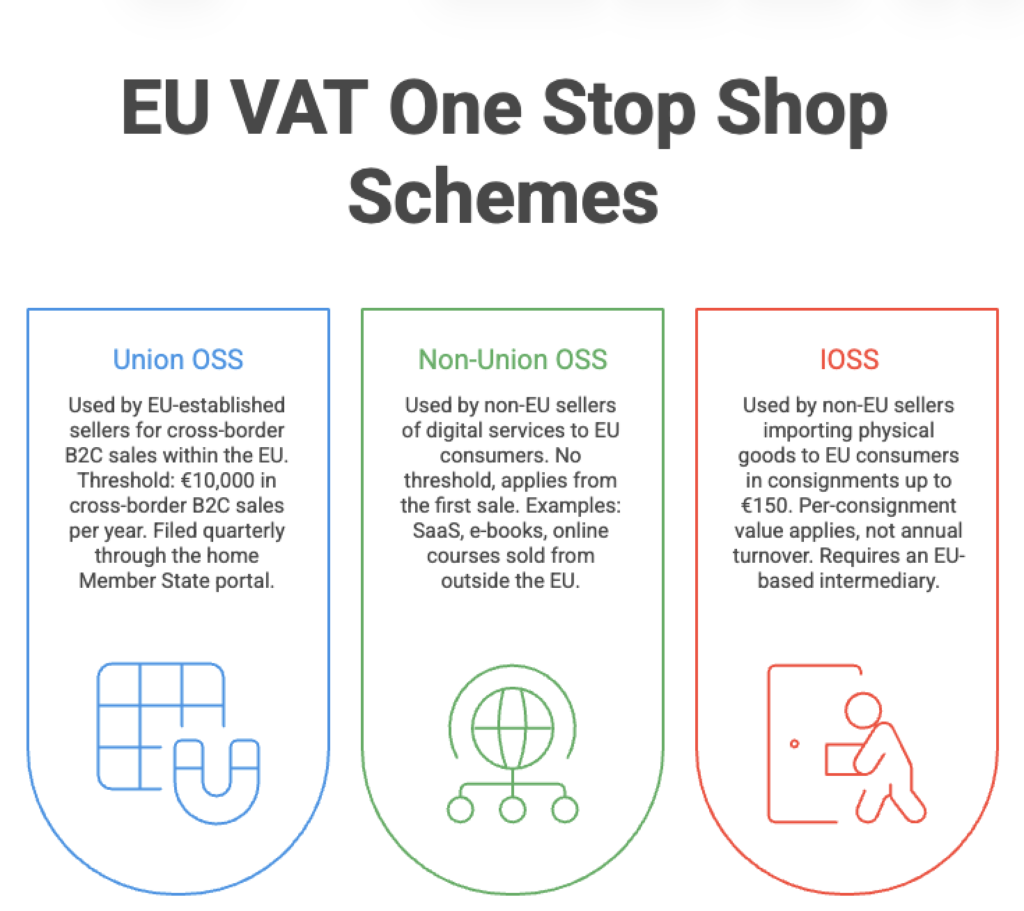
The three One Stop Shop schemes look similar but cover different transaction flows. Mixing them up leads to unfilable returns and customs holds.
| Scheme | Who uses it | What it covers | Threshold |
| Union OSS | EU-established businesses | B2C cross-border goods + electronic services within the bloc | €10,000 in cross-border B2C sales per year |
| Non-Union OSS | Non-EU digital service providers | B2C electronically supplied services to European consumers | First sale (no threshold) |
| IOSS | Non-European merchants importing goods | B2C imports of consignments up to €150 | Per-consignment value, not annual turnover |
| Local sign-up | Anyone holding stock or significant presence | Domestic sales, B2B reverse charge, intra-Community movements | Stock storage, fulfilment centre, physical presence |
IOSS is optional but commercially essential — without it, customers pay duty to the courier on delivery, killing conversion. Non-Union OSS often surprises non-EU SaaS and e-book providers who assumed digital goods were exempt. Local sign-up is unavoidable using FBA, 3PL, or in-jurisdiction fulfilment. You can run multiple schemes simultaneously, but Shopify forbids combining Union OSS and IOSS in one shop having both EU and non-EU fulfilment locations.
Shopify OSS VAT Setup Walkthrough
Once registrations are in place, the Shopify side takes under thirty minutes. The platform supports the simplified scheme natively — but only with Shopify Tax or Basic Tax. Manual rates lock you out and force every percentage change by hand.
Before opening admin, confirm three things: a valid number in your home Member State, an active OSS filing through that Member State’s portal (BZSt in Germany, FTA in France), and the calendar date your coverage begins.
A correctly executed Shopify OSS VAT flow places merchants on a clean quarterly rhythm and removes the need for separate filings in 26 other Member States. It does not remove obligations where stock is stored — Shopify’s interface gives no warning here.
Step-by-Step Configuration in Shopify Admin
Sequence matters. Skipping shipping zones is the most common reason the EU tax region fails to appear:
- Confirm tax service. Open Settings → Taxes and duties; verify Shopify Tax or Basic Tax is active.
- Create an European shipping zone. Settings → Shipping and delivery, add all 27 Member States, save. The European Union region appears in tax settings only after this.
- Open EU tax region. Settings → Taxes and duties → European Union under Regional settings.
- Activate cross-border collection. Click Collect VAT, select the home Member State, enter the number.
- Select One-Stop Shop type so destination percentages apply automatically to every cross-border B2C order.
- Add local numbers via Collect in another location — one entry per stock jurisdiction.
- Assign product tax categories, especially for reduced-rate goods like books, food, children’s clothing.
- Run a test order with a billing address in another Member State and confirm the standard percentage applies.
The test step is most often skipped and most regretted. Five minutes against three or four destinations catches almost every misconfiguration.
Common Shopify OSS VAT Mistakes
Even a clean Shopify OSS VAT configuration breaks when business reality drifts. The damaging mistakes are not setup errors but drift errors:
- Adding an EU fulfillment center without a local sign-up. The cross-border scheme does not cover where stock physically sits.
- Mixing EU and non-EU fulfillment locations in one shop. Shopify forbids running Union OSS and IOSS together in this case; the destination-side scheme takes precedence.
- Leaving product categories unassigned. Shopify defaults to the standard percentage—children’s books at 20% instead of 5.5% in France is a refund situation, costly at scale.
- Forgetting Northern Ireland’s dual status. Goods can use the Union scheme; UK rules apply to services and Great Britain shipments.
- Failing to update numbers after filing changes. A lapsed number stops compliant invoice generation; the gap usually surfaces during an audit.
Operators who avoid these traps revisit Shopify’s OSS VAT setup every quarter, ideally a week before each return. Fifteen minutes against the live filing map catches almost every drift error.
EU VAT for WooCommerce Foundation Setup
Where Shopify hides the tax engine behind a clean UI, WooCommerce gives raw plumbing. Full control over rates, classes, rounding, and display logic — which is why B2B-heavy businesses prefer it. The trade-off: almost nothing is configured out of the box, and OSS-compliant cross-border behaviour requires either an extension or maintenance discipline most operators lack.
Setting up eu vat for woocommerce correctly starts in WooCommerce → Settings → Tax. The first decision: whether percentages are calculated by shipping address, billing address, or shop base. Destination-based taxation requires Customer shipping address — anything else charges the home rate to every European customer regardless of location.
WooCommerce ships with three default classes: Standard, Reduced, Zero. Merchants selling digital goods alongside physical products should add a fourth class — usually Digital Goods — because EU law treats digital sales differently. Add it under Additional tax classes, save, and a new tab appears where its percentages can be entered separately.
Two configuration choices matter most. Enable Round tax at subtotal level so multi-item orders avoid fractional rounding errors. Leave Display tax totals as a single total — it reads cleaner on B2C invoices and matches what most ERP integrations expect.
Importing 27 EU VAT Rates via CSV
Hand-entering 27 percentages is slow and error-prone. WooCommerce supports a CSV import format which loads every Member State figure in one upload. Most extensions provide ready-made files updated to current values. The native import lives at WooCommerce → Settings → Tax → Standard rates → Import CSV.
The CSV expects seven columns: country code, state code, postcode, city, percentage, name, priority. A typical German row: DE,,,,19.0000,VAT,1 and shipping enabled and compound disabled. Save as CSV with UTF-8 encoding and upload.
Several percentage changes hit the bloc in 2026 and 2027:
| Country | Change | Effective date |
| Slovakia | Standard rate adjustment | 1 January 2026 |
| Finland | Reduced rate restructuring | 1 January 2026 |
| Lithuania | Reduced rate updates |
1 January 2026
|
| Netherlands | Cultural and accommodation rate changes | 1 January 2026 |
| Germany | Sector-specific reduced rate review | Ongoing 2026 |
| Spain | VERI*FACTU invoice tracking mandate | 1 January 2027 |
A practical handling rule when managing eu vat for woocommerce rates: download a fresh CSV every January and July, diff against active values, import before the change date. Ten minutes twice a year prevents the most common audit finding — applying a percentage retired six months earlier.
One detail catches people repeatedly: CSV import overwrites only rows in the same class. With a Digital Goods class holding its own set, the Standard rates import will not touch it, and vice versa. Check both tabs after every import.
WooCommerce VAT EU Plugins Compared
A bare WooCommerce shop handles percentages well enough but stops short of full OSS compliance. No built-in VIES validation, no automatic reverse charge, no quarterly export, no IOSS integration. Each gap has at least one mature extension solution in 2026.
Choosing a woocommerce vat eu plugin comes down to five practical criteria. Real-time VIES validation is non-negotiable in B2B; without it, you cannot prove reverse charge was applied correctly. Quarterly OSS export saves hours each filing period. IOSS support matters only for imports under €150 from outside the bloc. Block-checkout compatibility is essential since the Store API is the default in WooCommerce 9 and later. Reverse charge automation determines whether B2B exemptions apply themselves or require manual intervention.
| Plugin | VIES validation | OSS reports | IOSS support | B2B reverse charge | Block checkout | Best for |
| YITH WooCommerce EU VAT, OSS & IOSS | Real-time | CSV export by quarter | Yes | Manual toggle | Full | All-in-one mixed B2B/B2C |
| EU VAT for WooCommerce (WPFactory) | Real-time + offline | No native export | No | Configurable | Full | B2B-heavy with fine control |
| EU VAT Guard | Optional VIES | No | No | Automatic | Full | Budget B2B with automation |
| European VAT Validator | Real-time | Scheme-aware logic | No | Automatic | Full | Scheme-focused B2B layer |
| WooCommerce EU VAT & B2B (Vanquish) | Real-time | No | No | Automatic | Partial | Country-specific fields like Codice Fiscale |
Three patterns: operators picking a single all-in-one solution typically choose YITH, since it bundles quarterly reporting with B2B handling and IOSS. Operators using separate invoicing tools prefer WPFactory or EU VAT Guard, which focus purely on validation and reverse charge. Merchants selling into Italy or Spain need at least one extension covering Codice Fiscale, SDI/PEC, NIF/CIF alongside the standard number.
One warning applies across the table. VIES occasionally times out during peak hours when the European Commission’s service is under load. Most extensions either block checkout or apply tax in those cases. Decide policy before going live — blocking protects against invalid reverse charges but costs conversion; falling through preserves the sale but requires manual refunds when validation later confirms.
Operators who configured the underlying woocommerce eu VAT structure correctly turn this into near-invisible checkout work. Wrong tools, or two extensions fighting over the same field, produce silent failures. Test the full B2B flow end to end on staging before deploying.
WooCommerce EU VAT & B2B Configuration for Reverse Charge
B2B sales between EU Member States operate on reverse charge. A registered business in one country buying from a registered seller in another receives an invoice at 0%; the buyer self-accounts in their jurisdiction. Simple in writing — in practice, four conditions must be true at checkout, and any extension handling woocommerce eu vat & b2b flows must verify all four before applying the exemption.
The four conditions: a number passing VIES validation in real time, not just a format check; the buyer’s enrolment country differs from the seller’s base; shipping is not local pickup (which changes place-of-supply rules); billing and shipping countries both match the validated number’s country, preventing the most common reverse charge fraud.
A correctly configured woocommerce eu vat & b2b checkout handles all four invisibly. The buyer enters a number, the extension pings VIES, the percentage drops to 0%, the invoice is generated with the legally required wording — typically “Reverse charge — Article 138 of Council Directive 2006/112/EC”. When VIES is unreachable, the tool either blocks checkout or falls through to charged duties depending on policy.
Country-specific fields complicate the standard B2B flow in three Member States. Italy requires Codice Fiscale plus SDI or PEC code. Spain requires NIF, NIE, or CIF depending on buyer type. France increasingly enforces SIREN/SIRET capture. Vanquish’s WooCommerce EU VAT & B2B and YITH’s bundle handle these natively; lighter solutions do not.
Block Checkout vs Classic Checkout Compatibility
Version 9 made the block checkout the default in new shops. The block checkout uses the Store API rather than legacy AJAX, so extensions built only for classic checkout need explicit block support. All five tools listed earlier now support block checkout to some degree.
Two compatibility issues recur. Field positioning in block checkout cannot use the same hooks as classic — extensions expose dedicated filters (e.g. alg_wc_eu_vat_field_position_block_checkout). Country-change events fire differently, which historically caused recalculations to lag behind buyer selection. Both are resolved in current releases; older versions should be updated before relying on block checkout in any B2B flow.
A short pre-launch checklist saves hours of debugging:
- Test a B2B order with a valid German number from a French billing address
- Test an invalid number to confirm fall-through behaviour matches policy
- Test VIES-down using debug mode or a temporary endpoint block
- Verify the invoice contains the reverse charge legal reference
- Confirm order export includes the number and validation timestamp
How to Register for VAT in the EU as an E-commerce Seller
Platform configuration only works once underlying registrations exist. Most operators reach into extension settings before deciding how to register for vat in their specific situation, then reconfigure when paperwork comes back different. The right sequence: filings first, platform configuration second.
Three factors determine the right path: where the business is established, where stock physically sits, and what type of supply (goods, digital services, B2B, B2C). Two businesses with identical catalogues need entirely different filing footprints depending on Berlin vs Toronto base, or single warehouse vs Amazon FBA across five Member States.
If Your Business Is in the EU
EU-established businesses have the simplest path. The starting point: a tax registration in the home Member State — Germany, France, Italy, Poland — wherever the business is established. This is unavoidable, triggered when domestic turnover crosses the local threshold or earlier voluntarily.
Once the home number is active, OSS sign-up is filed through the same national portal: BZSt for Germany, Agenzia delle Entrate for Italy, Agence des impôts for France. The simplified scheme is voluntary below €10,000 in cross-border B2C turnover, effectively mandatory above. Application takes 2–4 weeks in most jurisdictions and costs nothing.
Documents typically requested during EU OSS sign-up:
- National tax identification number and home certificate
- Company registration document or trade register extract
- Bank account details (IBAN + BIC)
- Shop URL and a description of products or services sold
- Expected annual cross-border turnover by Member State
- Authorised signatory identification
If Your Business Is Outside the EU
Non-European operators face a longer and more expensive path. UK businesses post-Brexit are treated identically to US, Canadian, or Australian operators — Brexit removed UK access to Union OSS, so UK shops selling physical goods into the bloc need IOSS or local sign-ups.
IOSS sign-up must go through an intermediary established in the EU, since non-EU businesses cannot file directly. The intermediary becomes jointly liable, which is why fees range from €1,500 to €5,000 per year on top of consultant costs. Local sign-up in a stock jurisdiction — Germany with Amazon FBA, say — runs to similar fees and 6–12 weeks depending on processing backlog.
Common scenarios with typical timelines and indicative costs:
| Scenario | What to register | Typical timeline | Indicative cost |
| EU merchant, B2C cross-border above €10K | Union OSS via home Member State | 2–4 weeks | Free |
| EU merchant, stock in another Member State | Local sign-up + Union OSS | 4–8 weeks | €0–€500 |
| Non-EU merchant, imports up to €150 | IOSS via EU intermediary | 2–6 weeks | €1,500+/year |
| Non-EU merchant, EU warehouse | Local sign-up + Union OSS combination | 6–12 weeks | €1,000+/jurisdiction |
| Non-EU digital services to EU | Non-Union OSS | 2–4 weeks | Free |
If you are still working out how to register for vat under your specific stock and shipment pattern, the safe sequence is: map every jurisdiction where stock sits, every region where customers buy, every type of supply, then check each row against the scenarios above before filing anything. Reversing the order — filing first, mapping second — is how merchants end up with overlapping registrations they cannot easily unwind.
Online Marketplace VAT Rules and Their Impact on Your Store
Selling through Amazon, eBay, Etsy, or similar platforms changes the picture. The online marketplace vat rules introduced by the bloc in July 2021 created the deemed supplier model — under which the platform itself becomes responsible for collecting and remitting tax on certain transactions, even though the retailer still owns the goods.
Two transaction types trigger the deemed supplier rule. First, sales of goods within the bloc by non-resident businesses where the marketplace facilitates the deal. Second, distance sales of imported consignments not exceeding €150, regardless of merchant establishment. The marketplace charges the customer and pays the relevant authority; the underlying sale from merchant to marketplace is treated as a zero-rated B2B supply.

The most damaging misunderstanding: many believe marketplace collection removes their own registration obligations. It does not. A non-EU merchant storing goods in a German Amazon hub still needs a German tax number, even though Amazon collects on the B2C leg. The deemed B2B supply from merchant to marketplace is itself a taxable event under place-of-supply rules, occurring where goods sit at the moment of sale. Issuing the zero-rated invoice requires registration.
Practical implications when running both a marketplace presence and an independent Shopify or WooCommerce site:
- Marketplace sales are excluded from the OSS return — the platform files them
- Off-platform sales through your own site remain your full responsibility
Stock jurisdictions trigger local sign-up regardless of channel - Invoice and record-keeping obligations sit with the retailer for both channels
- The 10-year retention rule applies to marketplace-collected sales too
ViDA reforms extend the deemed supplier model significantly from 2028, with short-term accommodation rentals and passenger transport platforms joining voluntarily from July 2028 and mandatorily from January 2030. For physical goods merchants, the immediate change is the €150 customs duty exemption removal from 1 July 2026, folding every imported parcel into the duties system regardless of value.
A useful mental model: the online marketplace VAT rules redistribute liability for some transactions but never reduce the total compliance surface of a multi-channel operator. Anyone selling on Amazon and through their own Shopify site needs a filing footprint covering both channels, with clear separation between marketplace-collected amounts and scheme-reported amounts. Mixing them on one return is a frequent audit finding.
Practical Tips for Ongoing EU Sales Compliance
Compliance is not a project ending at go-live. Operators who treat initial setup as final get caught out by rate changes, threshold drift, and new ViDA requirements. Operators who manage eu sales smoothly across years share a small set of operational habits which turn compliance into background work instead of recurring panic.
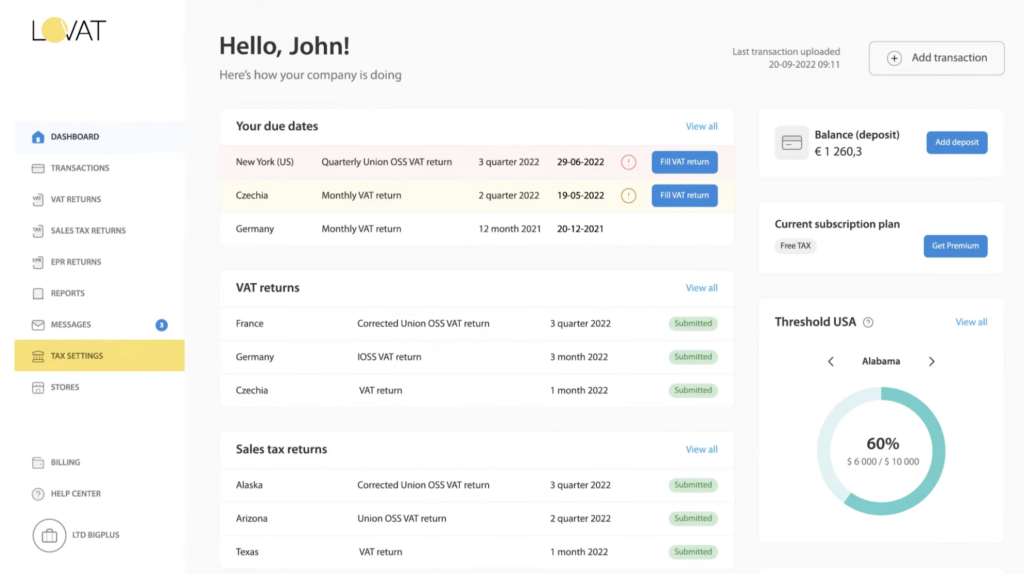
The quarterly rhythm anchors everything. Union returns are filed every quarter, deadlines on the last day of the month following — 30 April, 31 July, 31 October, 31 January. A return filed late even by one day flags non-compliance, which can escalate to scheme exclusion if it repeats. Most accounting software supports OSS export formats directly, and a direct Shopify integration with Lappa automatically pulls sales data through once the connection is set up, removing the manual export step from the cycle.
Six habits separating compliant operators from those who drift:
- Diff the rate file every January and July. Download fresh CSV from the extension or adviser, compare against active values before any change date.
- Re-validate stored B2B numbers quarterly. VIES is a point-in-time check; identifiers valid at order time can become invalid later.
- Reconcile marketplace amounts separately from scheme amounts. Monthly reconciliation splits sales by channel and confirms the right party collected.
- Hold every invoice and proof-of-location record for 10 years. Includes IP addresses, billing addresses, timestamps. Lost records: penalties up to 5% of unpaid duty per Member State.
- Watch country-specific mandates. Spain’s VERI*FACTU arrives 2027; France’s e-invoicing mandate continues phased rollout; ViDA digital reporting hits July 2030.
- Schedule a 30-minute platform review every quarter. A short check of settings, extension versions, shipping zones catches most drift errors before they show up in a return.
Two specific 2026–2027 changes deserve advance preparation. The €150 customs exemption removal from 1 July 2026 means every non-European-bound parcel faces customs duties on top of any indirect levy. Spain’s VERI*FACTU invoice standard, mandatory from 1 January 2027, requires invoicing software communicating with Spanish authorities in near real time — a software upgrade if you invoice Spanish customers regularly.
Choosing Between Shopify and WooCommerce for EU Compliance
The platform decision shapes the rest of the setup. Neither is universally better — each suits a different profile, and switching purely due to tax reasons is rarely worth the migration cost. The honest comparison: setup speed, B2B depth, total cost of compliance over time.
| Factor | Shopify | WooCommerce |
| Initial scheme setup time | Under 30 minutes once filings are in place | 1–3 hours including extension selection and configuration |
| Built-in OSS support | Yes, via Shopify Tax or Basic Tax | No — requires extension |
| VIES B2B validation | Available via Shopify B2B + apps | Extension-based, broader choice |
| Country-specific fields | Limited — usually requires app | Native support across multiple options |
| Reduced rate handling | Categories assigned per product | Classes with per-class percentage tables |
| Ongoing maintenance | Regulatory updates push automatically | Manual extension updates required |
| Total annual platform + tooling cost | Higher base, lower add-on | Lower base, extension licences add up |
Shopify is the cleaner choice for high-volume B2C operators selling standard goods across many Member States. Updates push automatically, the cross-border flow is one screen, and the post-launch operational burden is minimal. Merchants doing five to seven figures of monthly cross-border B2C revenue rarely regret being on the hosted route due to tax reasons.
WooCommerce is the cleaner choice in B2B-heavy operators, those selling into Italy or Spain needing country-specific identifier needs, merchants with unusual product mixes spanning multiple classes, or operators needing fine control over invoice formatting and rate logic. The extension layer is the source of both flexibility and ongoing maintenance — a fair trade if you need the flexibility, a poor trade if not.
One practical detail: operators selling on Amazon or eBay alongside their own site usually find the platform decision matters less than expected, since marketplace collection lives outside both Shopify and WooCommerce regardless. The platform choice mainly drives off-platform direct sales — often a smaller share of total volume than people think.
Closing Notes and Action Checklist
Getting this right in 2026 is not a single decision. It is a sequence: confirm establishment country, map stock locations, decide which scheme each transaction flow falls under, file the filings, then configure the platform. Reversing the order is the most common cause of expensive cleanup work eighteen months later.
Action checklist when starting fresh, regardless of platform:
- Map every Member State where stock sits, every region where customers buy, and every type of supply (physical goods, digital services, B2B, B2C)
- Decide the filing footprint based on the map: home filing, cross-border scheme, IOSS where applicable, plus local numbers triggered by stock
- File the filings and wait until confirmed before configuring platform settings
Configure Shopify OSS VAT or your chosen woocommerce vat eu plugin layer in line with the filing map - Run end-to-end test orders from billing addresses in at least four Member States before going live
- Build the quarterly rhythm into the operations calendar — reconciliation, return preparation, filing, archiving
- Schedule a January and July rate-file refresh to catch percentage changes before they hit live orders
The online marketplace VAT rules and ViDA reforms together mean the European compliance landscape will keep moving through 2027, 2028, and 2030. Operations built on a clean filing map and a maintainable platform configuration absorb those changes as small adjustments. Those built on workarounds and assumptions absorb them as crises. The difference is almost entirely upfront work — which this vat guide is designed to make routine.
FAQ
Do I need OSS if I sell less than €10,000 cross-border per year?
– No, the simplified scheme is optional below the threshold. You can charge home percentages and report through the domestic return. Many operators join voluntarily anyway — invoicing stays consistent and there is no mid-year scramble if you cross unexpectedly.
Does IOSS cover B2B sales?
-No. IOSS covers only B2C imports of consignments up to €150. B2B imports follow standard rules — the buyer typically acts as importer of record and reclaims via their own return.
What happens if a customer enters an invalid VIES number?
-Behaviour depends on extension or platform settings. Most shops either block the order until valid input is entered or fall through to charged duty as a B2C sale. Never apply reverse charge to a number which has not passed VIES — liability sits with the retailer.
Can I use OSS and IOSS in the same Shopify store?
-Not when the shop has fulfilment locations both inside and outside the bloc. Shopify forces a single scheme, and the destination-side filing takes precedence — meaning IOSS-eligible imports are not handled correctly. Operators in this situation usually split into two shops or use a third-party app to route fulfilment.
Does marketplace tax collection remove all my obligations?
-No. Marketplaces collect on the B2C leg of certain transactions, but the underlying B2B supply from merchant to platform still requires registration in the country where stock sits. The marketplace’s role reduces the compliance surface — it does not eliminate it.