
Digital Product Passport (DPP) Requirements in the EU 2027 and Required Data for Compliance
Digital Product Passport (DPP) Requirements in the EU 2027 and Required Data for Compliance
A factory in Porto is scanning barcodes today. That barcode feeds a record that does not exist yet. The record is coming fast. Brussels calls it the DPP. It turns supply chain data into a legal duty. Batteries face this duty first, from February 2027. Textiles, tyres and aluminium follow later that year.
This guide walks through the whole framework step by step. It covers the legal basis first. Then it covers the EU rollout. It also covers the exact fields each group must carry. A final section lists the paperwork firms need, before any deadline lands.
What A DPP Means For EU Businesses
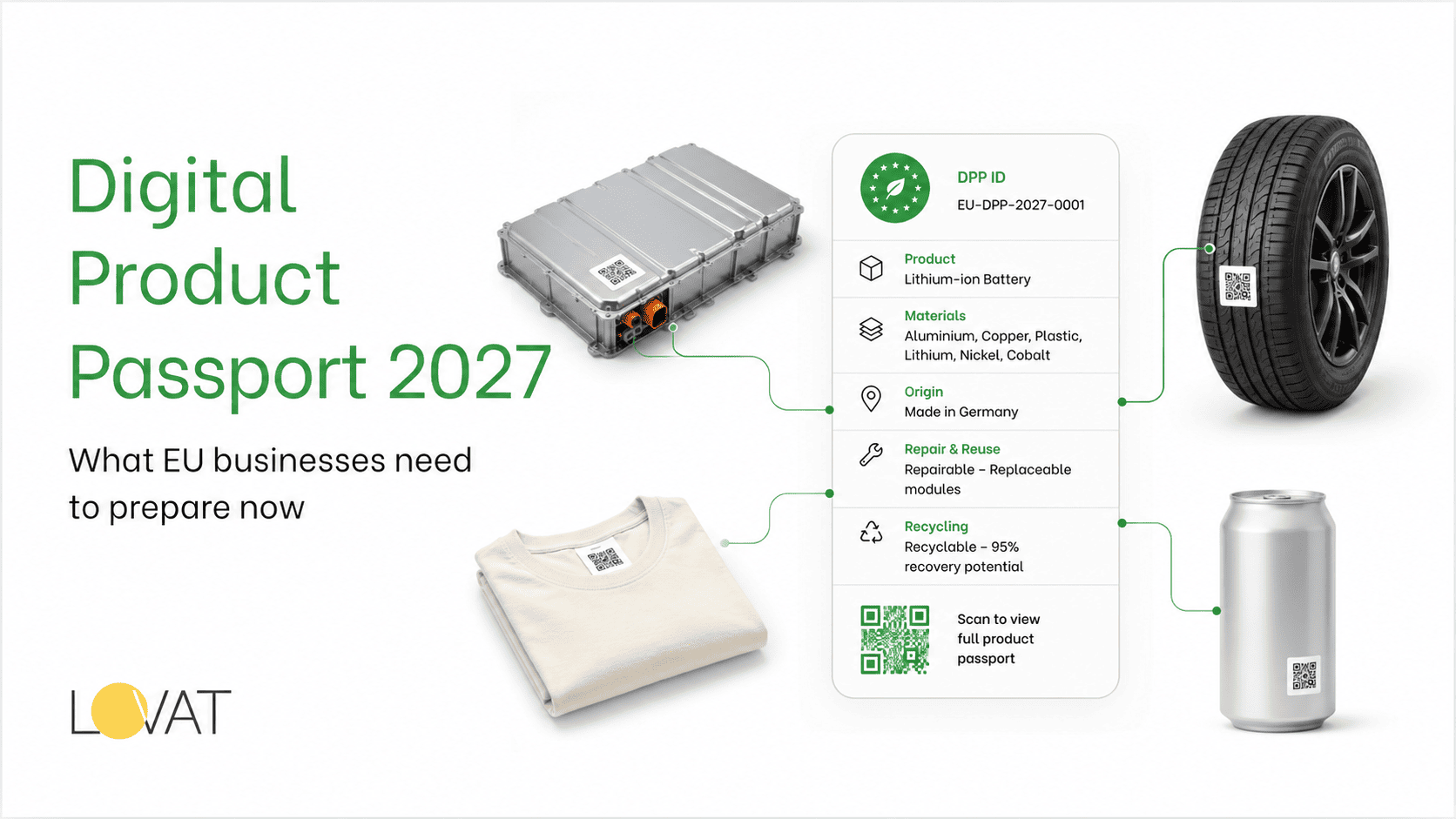
The Ecodesign Regulation is known as ESPR. Regulation (EU) 2024/1781 entered into force on 18 July 2024. It gives the European Commission power over supply chain data. A DPP is not one single document. It works instead as a linked electronic container. That container holds sustainability, material and lifecycle information. A QR code or similar carrier connects it to the physical unit.
Before ESPR, sustainability claims stayed largely voluntary. A brand could publish a claim without much proof. That gap closes once a delegated act applies. Buyers, repairers, recyclers and regulators then reach one verified file.
A short list of shifts follows from this one framework.
- Supply chain data becomes a market access condition, not a brand extra
- One unique registration identifier follows each registered item
- Access rights differ by user, from consumer to customs officer
- Non-EU manufacturers carry the identical duty as EU-based ones
Digital Product Passport European Commission Timeline For 2026 And 2027
The digital product passport European Commission page lists every confirmed date. That page counts as the safest primary source available today. The DPP Registry framework was set up in July 2026. Six DPP standards were confirmed at the same time.
Battery records arrive first, from 18 February 2027. Construction goods follow in Q2 2027. Textiles, aluminium and tyres land later, across Q3 and Q4 2027. Furniture follows in 2028. Mattresses and recycled content rules follow in 2029.
The table below sets that sequence out clearly.
| Sector | Indicative date | Legal instrument |
| Batteries (EV, industrial, LMT) | 18 February 2027 | Battery Regulation (EU) 2023/1542 |
| Iron and steel | Q4 2026 | ESPR delegated act |
| Construction goods | Q2 2027 | CPR |
| Textiles, aluminium, tyres | Q3-Q4 2027 | ESPR delegated acts |
| Furniture | 2028 | ESPR delegated act |
| Mattresses, recycled content | 2029 | ESPR delegated acts |
Digital product passport european commission guidance gets updated several times a year. Firms should treat that source as primary, above any third-party summary. Every delegated act also carries a transition period once adopted. That period runs at least eighteen months, under the Commission’s own rule.
Which Goods Need A DPP From 2027
Scope grows sector by sector, not all at once. Battery Regulation Article 77 names the first group precisely. It covers industrial batteries above 2 kWh capacity. It also covers every electric vehicle battery placed on the market.
Textiles, tyres and aluminium join through separate ESPR delegated acts. Adoption for that group sits across Q3 and Q4 2027.
- Batteries — mandatory from 18 February 2027
- Iron and steel — expected Q4 2026
- Construction goods — expected Q2 2027
- Textiles and apparel — expected Q4 2027
- Aluminium and tyres — expected Q3-Q4 2027
- Furniture — expected 2028
- Mattresses — expected 2029
Additional sectors can join through future ESPR Working Plan revisions. A firm selling several lines should track more than one page.
Digital Product Passport For Textiles And Apparel Rules
A digital product passport for textiles covers fibre and origin data. The Commission adopted its Working Plan for these rules in April 2025. That plan names textile apparel as a priority group. EU textile firms number roughly 194,000 across the bloc. Combined turnover across the sector reaches €166 billion a year. Apparel alone makes up the largest textile subgroup by weight.
The digital product passport for textiles builds on existing rules. Fibre composition data already follows the Textile Labelling Regulation. That existing dataset feeds directly into the future record.
Digital product passports for textiles are expected around Q4 2027. That date depends on formal adoption of the sector act. Origin data, repair guidance and disposal steps join fibre data too. All of it sits inside that same file.
Digital Product Passport Fashion Brands Must Prepare For Now
Digital product passport fashion rules will not wait for a finished act. Supplier contracts, fibre records and factory data take months to gather. Every digital product passport fashion brand should start collecting that data now. Waiting until Q4 2027 leaves almost no working runway.
Fashion digital product passports are expected to trace a garment’s full journey. That journey runs from raw fibre through to end-of-life. Repair, resale and recycling data will likely sit inside that record.
Selling apparel into the EU and unsure where your fibre data stands? Talk to our EPR team about mapping your textile supply chain. We can help before the Q4 2027 deadline lands.
Required Data Inside Every DPP
Exact fields differ by sector, since each act sets its own list. Still, several categories already recur across published guidance. The Commission and the Joint Research Centre outlined one shared structure. That structure applies, with local variation, across most future sectors.
- Identification details, model number and manufacturer name
- Material and fibre composition, including hazardous substance content
- Origin and manufacturing location information
- Repair, maintenance and spare parts guidance
- Reuse, resale, disassembly and recycling instructions
- End-of-life disposal routes and take-back schemes
- Conformity assessment and compliance documentation for authorities
Textile specific fields will likely add fibre-level traceability on top. Battery specific fields already add carbon footprint and durability figures. Each sector page on the Commission site lists its own confirmed additions.
Data Carriers And Formats Explained
A carrier is the physical link between a unit and its file. Three formats dominate current guidance from the Commission.
- QR codes, printed on labels, packaging or hang tags
- RFID tags, embedded inside a garment or a component
- Barcodes, used mainly as a fallback for older systems
QR codes remain the most common choice across early sectors. They cost little to print. Any smartphone camera can scan one instantly. RFID tags suit items scanned in bulk. Warehouse pallets are a typical example. A barcode alone rarely carries enough depth for full compliance today.
Whichever format a firm picks, the carrier must stay readable. It needs to survive the whole life of the unit. A faded label or a damaged tag can break that link entirely. Firms should test carrier durability under real shipping conditions. A design mockup alone will not reveal much. Months in transit reveal far more than any office test.
Who Can Access A DPP Once It Is Live
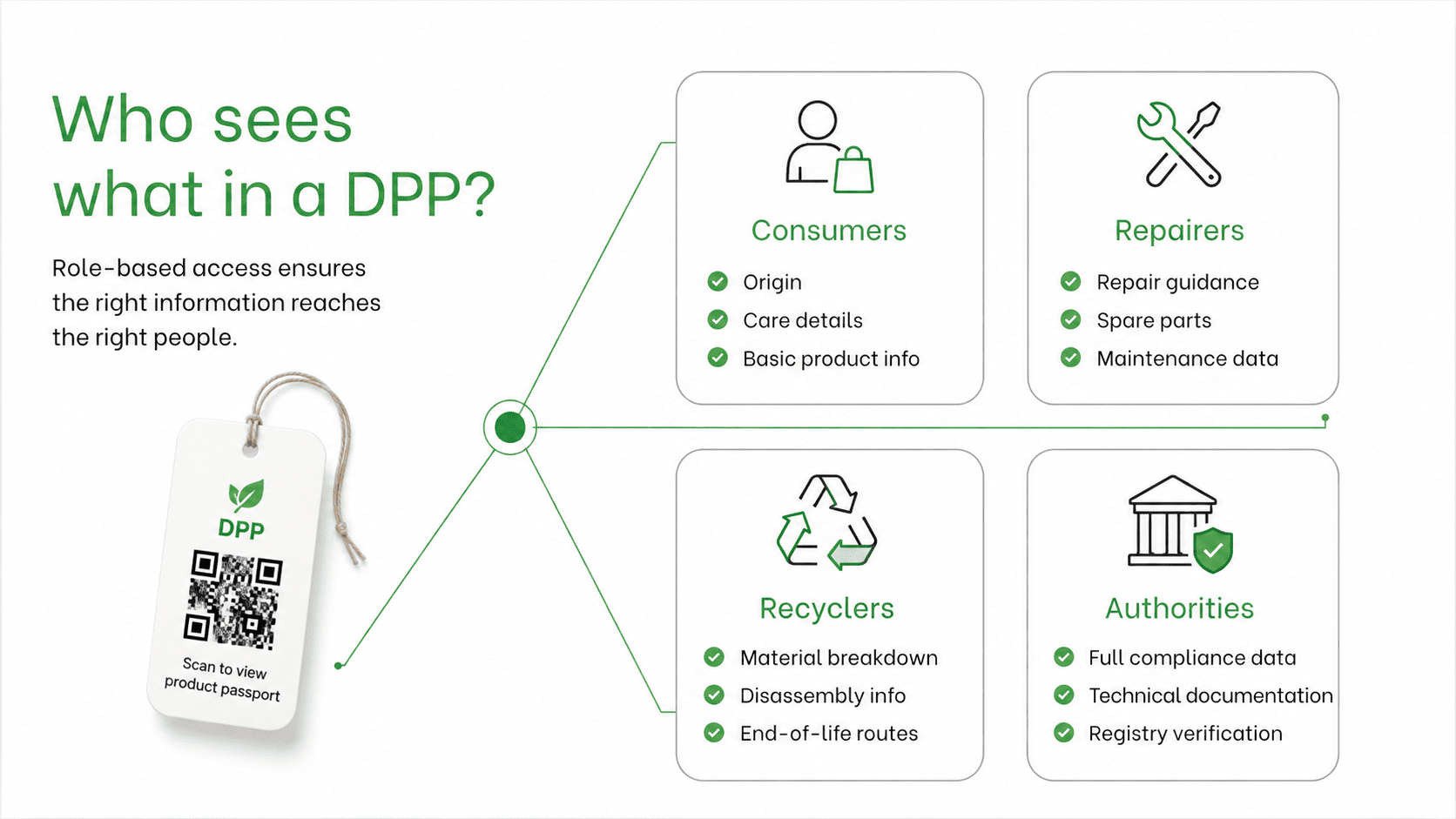
Not every reader sees the same slice of data. Access rights change depending on who is asking. The Commission’s own framework names four broad groups.
- Economic operators, who create and hold the underlying file
- Consumers, who scan a carrier before or after a purchase
- Repairers and recyclers, who need lifecycle and material data
- Public authorities, who verify compliance and run market checks
A shopper scanning a garment tag sees basic origin and care details. A recycler scanning that same tag instead sees material breakdown data. Customs officers and market surveillance bodies get the fullest view of all. A repair technician might see spare parts data only. That technician rarely needs full supplier or pricing terms. Layered access also lowers the risk of a data leak. It keeps sensitive terms away from rival firms.
The DPP Digital Product Passport Registry And How It Works
The DPP digital product passport registry sits at the centre. It anchors the whole system. Article 13 of ESPR required that registry by 19 July 2026. The Commission met that deadline. The registry went live on 20 July 2026.
A DPP digital product passport gets one unique registration identifier per unit. Imported items get checked against that identifier at customs. EU-made items must register before reaching the market.
DPP digital product passports never sit fully inside one central database. The architecture stays decentralised by design. Economic operators or approved service providers hold the full file. The registry itself stores only identifiers and required metadata.
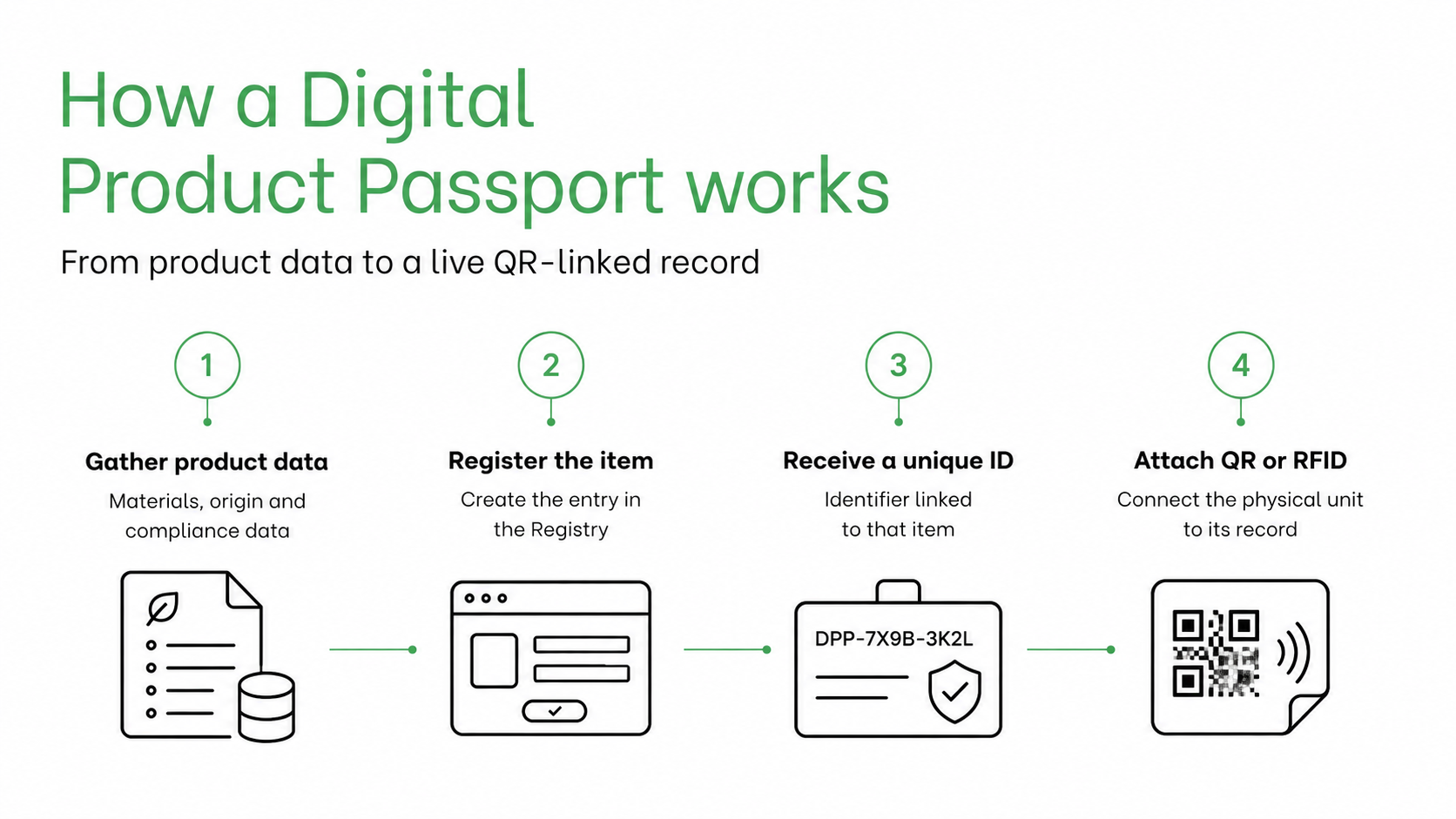
- Gather the required fields under the applicable act
- Create and register the entry in the Registry
- Receive a Unique Registration Identifier tied to that item
- Attach a carrier, such as a QR code, to the unit
Digital Product Passport Software Explained
Manual spreadsheets rarely survive contact with thousands of live SKUs. That gap is exactly why digital product passport software now exists. It has become its own market. Good digital product passport software pulls data straight from existing systems.
Software for digital product passports should support several categories at once. It should also manage the carrier automatically, per SKU, without manual rework. A weak setup tends to fail once volumes climb. A few hundred live lines is often enough to break it.
Digital Product Passport Solutions For EU Compliance
Many vendors now sell digital product passport solutions for exactly this reason. Choosing digital product passport solutions early avoids a scramble later. A strong digital product passport solution should flag missing data early.
| Factor | Manual, in-house build | A dedicated solution |
| Data sourcing | Manual supplier emails and files | Automated system integration |
| Carrier setup | Built separately, per line | Generated automatically per SKU |
| Registry submission | Manual entry into the Registry | API based bulk registration |
| Update speed after sourcing changes | Slow, prone to gaps | Near real time |
| Audit readiness | Scattered records across teams | Centralised, exportable trail |
Producer And Importer Duties Under The New Rules
The duty follows the item into the EU market. It makes no difference where the manufacturer sits. A firm outside the Union carries the identical duty.
- Identify which lines fall under an adopted delegated act
- Gather the required fields before the transition period ends
- Register each item in the Registry with a valid identifier
- Attach a compliant carrier to the item or its packaging
- Keep conformity documentation ready for market surveillance requests
Distributors and online marketplaces carry a lighter, but real, duty. They must confirm a valid entry exists before listing an item.
Proof And Paperwork Companies Must Keep
A claim needs proof sitting behind it, not just a stated figure. Authorities can request that proof at any point after launch.
- Maintain a technical file behind every registered item
- Keep supplier declarations covering material and origin claims
- Retain conformity assessment records for the required period
- Log batch numbers or serial numbers against each entry
- Track which delegated act version applied at registration
None of this paperwork needs to exist only for one audit day. Fold it into standard production records instead.
Penalties And Enforcement Once The Rules Apply
ESPR sets the framework, but enforcement sits with each Member State. National authorities choose their own penalty scales within that framework. Fines, sales bans and forced recalls are all realistic outcomes.
Customs checks happen at the point of import first. A missing entry can stop a shipment from clearing the border. Market surveillance bodies then run checks once goods reach shelves. They can request full technical files at short notice.
Firms trading across several EU countries should expect uneven enforcement pace. Some Member States are expected to move faster than others. That gap should narrow over time. Still, treat every national deadline as binding. Waiting for the slowest country to act is a risky bet. A single strict inspector at one border can halt a whole shipment.
A Pre Launch Checklist Before The 2027 Deadlines
A short internal review, run well before 2027, catches most gaps early. Finding a gap in-house always costs less. A regulator finding it first costs more. A short two week audit often suffices for a small catalogue. Larger portfolios may need a full quarter to finish properly.
- List every line falling near an upcoming delegated act
- Confirm which fields that act is expected to require
- Audit current supplier data against those expected fields
- Test registration inside the Registry sandbox environment
- Choose a carrier format for each SKU
- Assign internal ownership for monitoring future delegated acts
Firms that finish this sweep now usually face a straightforward rollout. Firms that wait until 2027 often face a rushed, costly scramble.