
Common VAT Deregistration Mistakes Businesses Should Avoid
Common VAT Deregistration Mistakes Businesses Should Avoid
That story plays out across sectors every year. Companies tend to treat vat cancellation as paperwork to handle later. It isn’t. It comes with firm deadlines, real financial consequences, and a process that punishes delay. This guide walks through the most common deregistration errors, why they keep happening, and how a company can avoid each one.
What VAT Cancellation Really Means for a Company
Cancelling a registration number ends your legal duty to charge tax on sales. It also ends your right to reclaim tax on most purchases. That trade-off surprises many owners who only think about the paperwork side.
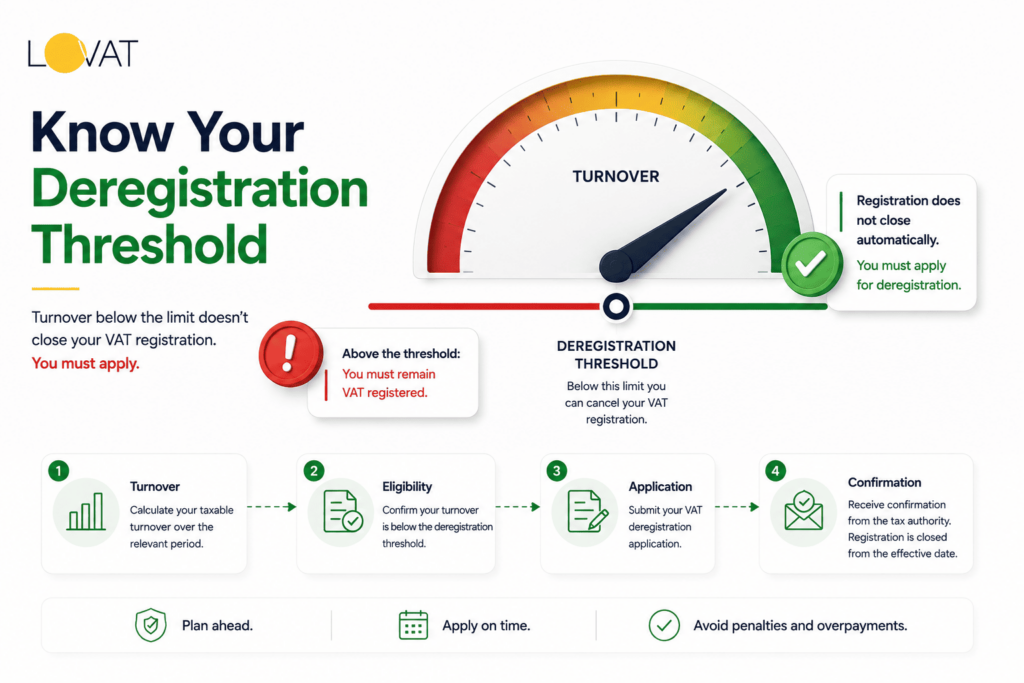
vat cancellation is not automatic once turnover drops. An application has to go in. Nothing changes on its own, and continuing to charge tax after eligibility ends creates its own set of problems.
Many owners assume the process finishes the day the form goes in. It does not. Tax offices can take weeks to confirm the change, and duties continue until that confirmation lands.
Not sure whether your company should deregister for VAT? Get a tailored fee quote and see what support you need to handle the process correctly.
Common VAT Deregistration Mistakes That Cost Money
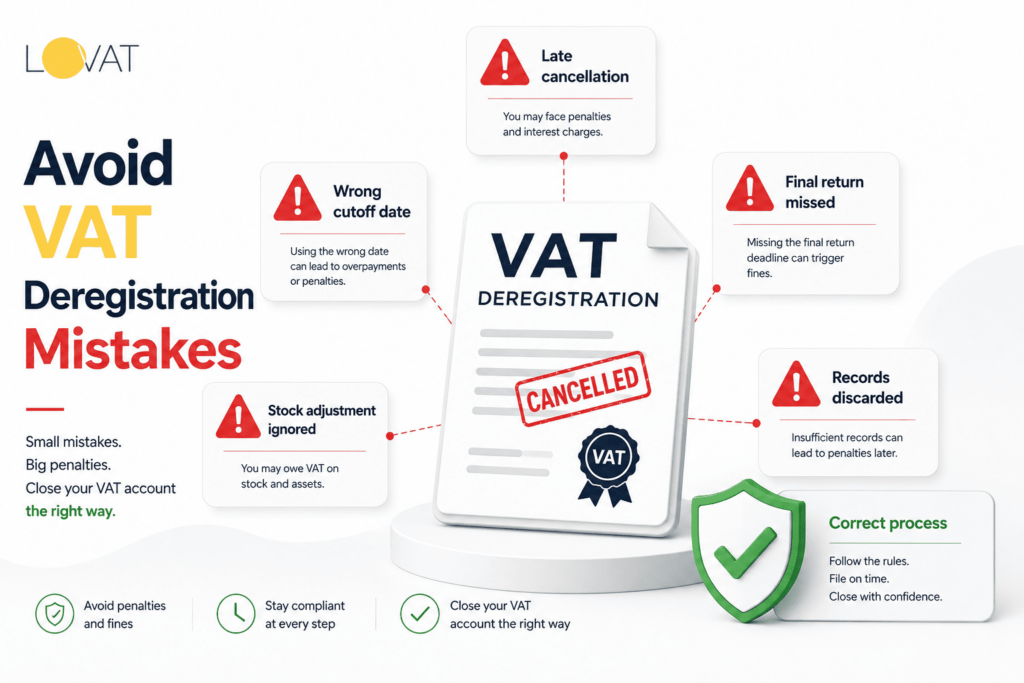
Some VAT deregistration mistakes appear again and again across small and mid-sized companies. Spotting them early saves both time and penalties.
Here are the slip-ups we see most often:
- Waiting too long after turnover drops below the limit
- Continuing to invoice with tax after the cutoff date
- Forgetting to file a final return within the required window
- Ignoring stock and asset adjustments owed back to the tax office
- Assuming closure is optional rather than a legal requirement
Each of these VAT deregistration mistakes shares a common root: owners treat the exit as a low-priority task. It rarely is. Tax offices apply the same enforcement energy to closing a number as they do to opening one.
A related issue involves recordkeeping. Deregistration mistakes with VAT often trace back to invoices, credit notes, or adjustments logged incorrectly in the weeks before the cutoff date.
Confusion around the threshold for VAT deregistration accounts for a large share of the errors on this list. Owners rarely check the figure until a strong sales month forces the question.
If you need help reviewing your VAT position, deadlines, or deregistration obligations, request a personalised quote from our VAT specialists. – Book a Demo
Do vs Don’t During the Wind-Down
| Do | Don’t |
| Apply as soon as eligibility ends | Wait for a reminder from the tax office |
| Keep records for the required retention period | Discard invoices once the account closes |
| Adjust stock and asset values owed | Assume no adjustment is needed |
| Confirm the effective date in writing | Rely on verbal assurance alone |
Getting the VAT Deregistration Threshold Wrong
The vat deregistration threshold trips up more companies than any other single figure in this process. It is not the same number as the registration limit, and confusing the two leads directly to filing errors.
Most tax offices set the exit figure lower than the entry one. That gap exists on purpose. It gives owners near the line room to plan rather than reacting to a single strong month.
Seasonal businesses face a particular trap here. A busy quarter can push turnover above the vat deregistration threshold temporarily, then drop again the following quarter. Reading twelve months of trading data, not one strong month, gives a far more reliable picture.
Threshold Comparison Across Common Jurisdictions
| Country | Registration limit | Deregistration limit |
| United Kingdom | £90,000 | £88,000 |
| Ireland (goods) | €80,000 | €75,000 |
| Ireland (services) | €40,000 | €37,500 |
| Germany | €25,000 | €22,000 |
Figures shift periodically, so always confirm current numbers with the relevant tax office before acting on them.
How to Deregister VAT Number Without Delays
Getting ready to deregister vat number records means gathering documentation before submitting anything. Rushing the application usually causes more delay than it saves.
Here’s the order that actually works:
- Confirm the exact date turnover fell below the limit
- Gather the last twelve months of returns for reference
- Check for any pending refunds or outstanding payments
- Notify your accountant or bookkeeper before submitting
- Submit the application through the correct online portal
Get the timing wrong here and the whole thing drags out. VAT number deregistration usually takes a few weeks once it’s filed correctly. During that window, the registration stays active and every existing duty still applies. Nothing pauses just because a form is sitting in a queue.
A common slip happens here, too. Some owners stop charging tax the day they hit submit, weeks before the confirmation email ever shows up. That gap creates a mismatch between invoices and a still-active registration, and tax offices notice it quickly.
Filing Your Final VAT Return on Time
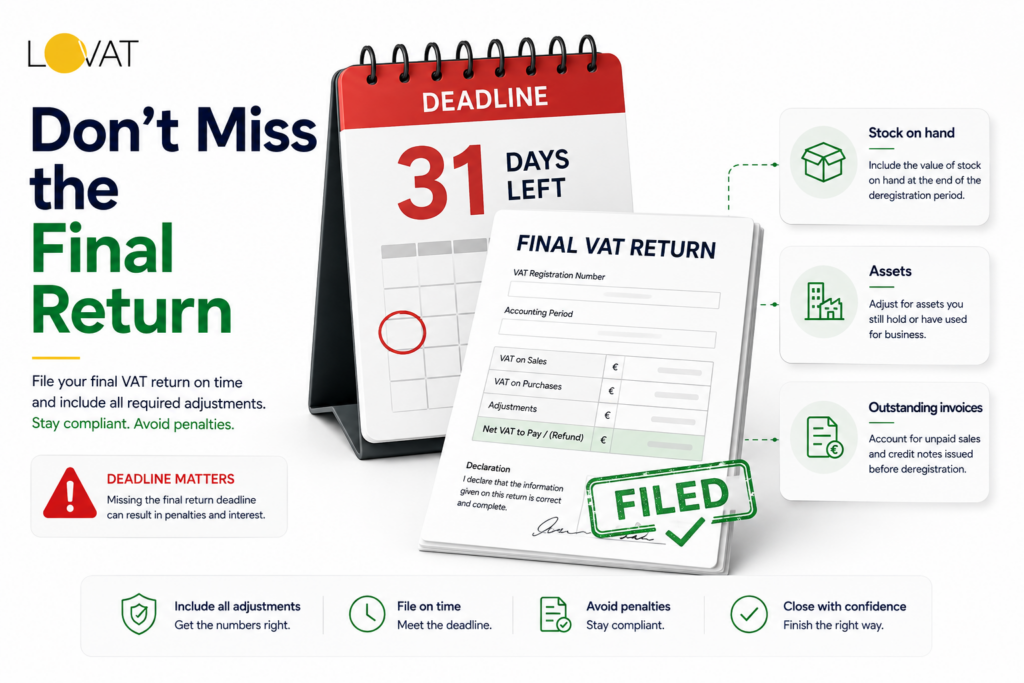
The final vat return carries different rules than a routine quarterly filing. Missing this distinction is one of the costliest errors on this entire list.
This return must cover the full period up to the closure date. It also needs to account for stock and assets still held at that point, since tax may be owed on their value.
Owners frequently underestimate the deadline attached to a last VAT return. Many tax offices allow less time than a standard filing period, sometimes as little as one month from the closure date.
Three items belong on every checklist before submitting this filing:
- Value of business assets and stock still on hand
- Any tax due on assets over a set value limit
- Outstanding invoices issued before the cutoff date
Choosing the Right Time to Cancel VAT Registration
Deciding when to cancel vat registration matters as much as deciding whether to do it at all. Timing affects cash flow, supplier relationships, and how smoothly the transition runs.
Some owners rush to cancel VAT registration the moment turnover dips, without checking whether the dip is temporary. Others delay for months out of habit, long after the numbers clearly justify acting.
A short pause for review works better than either extreme. Look at trading trends over a full year. Check upcoming contracts that might push revenue back above the line. Only then submit the request.
Cancelling VAT registration voluntarily, before it becomes mandatory, can also be a strategic choice. Companies expecting a permanent drop in turnover sometimes prefer to close things out early rather than wait for a forced deadline.
Steps to Close VAT Account Cleanly
Deciding to close vat account records is only the first step. What comes next decides whether invoices and suppliers stay in sync, or whether you spend the next quarter untangling confused paperwork.
A clean closure generally follows this order:
- Submit the cancellation application with the correct effective date
- File the final return within the required window
- Settle any tax owed on stock, assets, or outstanding invoices
- Update invoicing systems to remove the old number
- Retain records for the legally required period, often six years
Some owners skip that last step. Retention rules do not end when the registration does. Tax offices can still request records years after the number closes.
Closing your VAT account also means telling suppliers and customers who rely on that number for their own compliance. A quiet, unannounced closure tends to generate confused invoices on both sides for months afterward.
Before vs. After Deregistration
| Aspect | Before deregistration | After deregistration |
| Tax on sales | Charged and collected | No longer charged |
| Tax on purchases | Reclaimable | Not reclaimable |
| Filing duty | Regular periodic returns | One final return only |
| Record retention | Ongoing | Required for several more years |
Why the Pattern Keeps Repeating
Most errors in this process trace back to the same root cause: owners treat the exit as an afterthought rather than a formal task with its own deadlines.
People juggling daily operations rarely have a dedicated system for tracking the limit. By the time someone notices turnover has dropped, months may have already passed since eligibility changed.
A second pattern involves outsourcing gaps. Bookkeepers handle day-to-day filings but are not always told to flag closure eligibility. That gap in communication accounts for a large share of late applications. Owners who deregister vat number records without a paper trail often end up resubmitting within days.
Skipping the final vat return entirely is one of the fastest ways to trigger a penalty notice. Some owners close vat account records without checking retention rules first, and that oversight tends to surface again months later, usually in a letter nobody wanted.
Building a simple quarterly check, comparing rolling turnover against the current limit, closes most of that gap without adding much overhead. Cancelling your VAT early, rather than waiting for a compliance letter, keeps the whole wind-down predictable.
Take the uncertainty out of VAT deregistration
Whether you’re closing a VAT registration in one country or managing VAT obligations across multiple markets, Lovat can help you understand what needs to happen next.
Get expert help:
See the platform: Book a Demo