
VAT Refund in Europe 2026 and How to Claim VAT Paid in Another EU Country
VAT Refund in Europe 2026 and How to Claim VAT Paid in Another EU Country
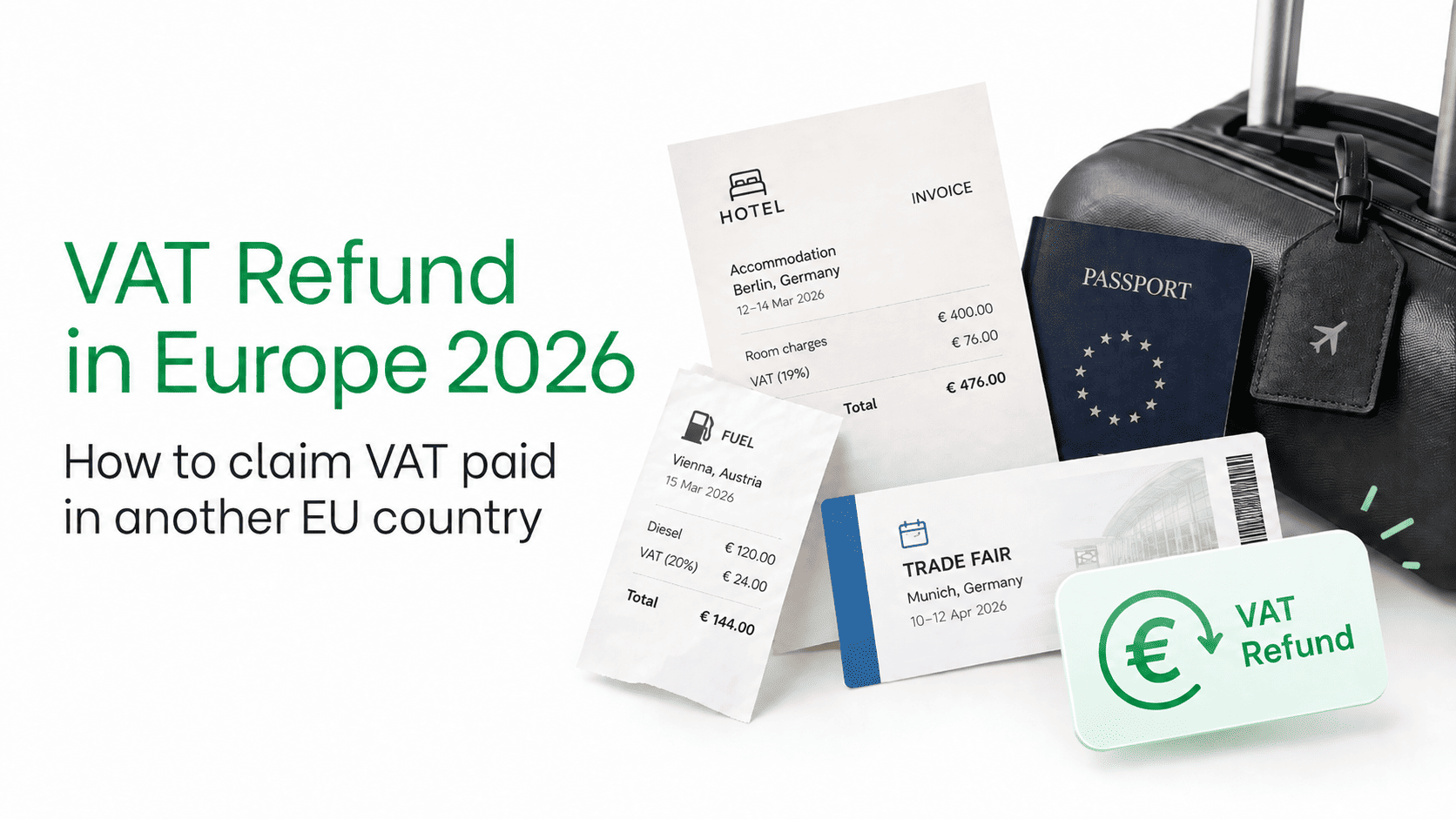
A hotel invoice from a Cologne trade fair last October, a Spanish fuel receipt, a Paris conference ticket. Each one still holds tax that a company can recover, and the window for 2025 costs closes on 30 September 2026. A Europe VAT refund is not a single procedure, though. Firms established inside the Union, firms based outside it and private travellers follow different rules, portals and deadlines. This guide separates the three routes and shows, with worked numbers, what to file, where and by when.
How a Europe VAT Refund Works in 2026
EU law splits repayments by who paid the tax and why. Mixing up the routes is the quickest way to lose money, because each one has its own legal basis and its own gatekeeper.
| Route | Who uses it | Legal basis | Where to file | Deadline |
| EU company claim | Company established in one member state, charged in another where it makes no local sales | Directive 2008/9/EC | Online portal of the home administration | 30 September of the following year |
| Non-EU company claim | Company established outside the Union | 13th Directive 86/560/EEC | Authority in the charging state | Set nationally, often 30 June or 30 September |
| Tourist tax-free shopping | Traveller living outside the Union | Articles 146 and 147 of Directive 2006/112/EC | Retailer or operator after customs validation | Export by the end of the third month after purchase |
| Local return | Seller registered in that state | National law | Periodic return | Each return period |
A European VAT refund application sent through the wrong channel is rejected, not redirected. A company registered in Spain, for example, deducts those costs in its Spanish return and cannot use the cross-border portal for the same costs.
VAT Refund Europe Rate by Country in 2026
There is no single VAT refund Europe rate. For a company, the amount returned equals the deductible amount shown on the invoice, which depends on the standard or reduced rate of the state that charged it. For a traveller, the payout starts from the same figure but shrinks once the operator takes its handling fee.
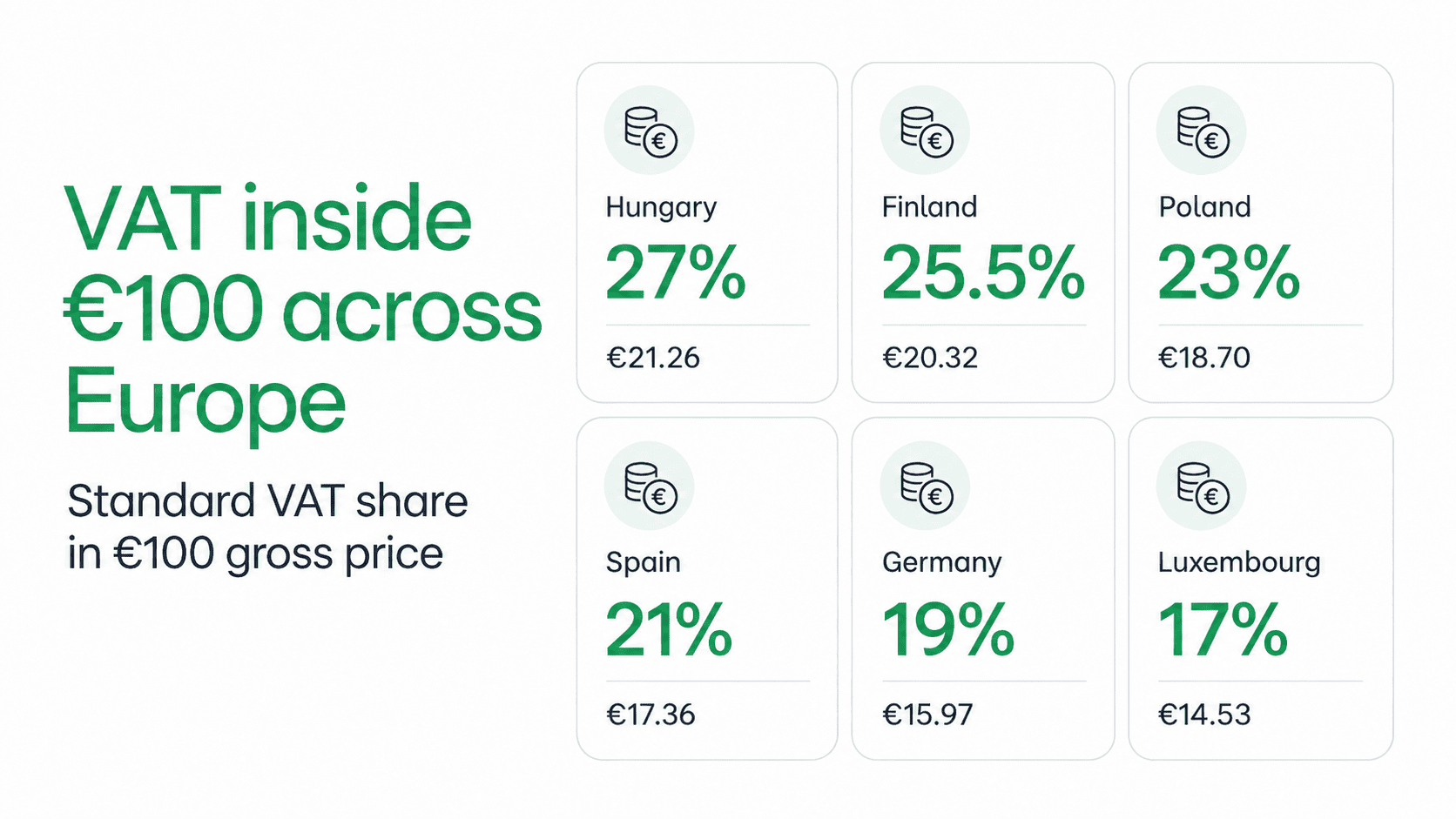
Consumer prices are gross, so the useful figure is its share inside the gross price: rate ÷ (100 + rate). The table shows how much sits inside €100 paid at the standard rate.
| Country | Standard rate 2026 | Share inside €100 gross |
| Hungary | 27% | €21.26 |
| Finland | 25.5% | €20.32 |
| Denmark, Sweden | 25% | €20.00 |
| Estonia | 24% | €19.35 |
| Poland | 23% | €18.70 |
| Italy | 22% | €18.03 |
| Spain, Netherlands, Romania | 21% | €17.36 |
| France, Austria | 20% | €16.67 |
| Germany | 19% | €15.97 |
| Luxembourg | 17% | €14.53 |
Recent increases explain several rows. Estonia moved from 22% to 24% in July 2025, Romania went from 19% to 21% in August 2025, and Finland now charges 25.5%.
Reduced rates matter even more for travel costs. Germany brought restaurant meals back to 7% on 1 January 2026, the Netherlands raised accommodation from 9% to 21% on the same date, and Belgium moved hotel stays from 6% to 12% from 1 March 2026. Anyone estimating a VAT refund Europe rate for a travel budget should use the rate valid on the invoice date.
Tourists should read the table as a ceiling. The VAT refund rate in Europe that a traveller actually receives is lower, because operators keep part of the amount, and cash at an airport counter usually costs more than a card payout.
Need the exact rate for a product before invoicing a cross-border customer? Check it in our free rate calculator or open the country pages in our country guides.
How EU Businesses Claim a VAT Refund From Another Member State
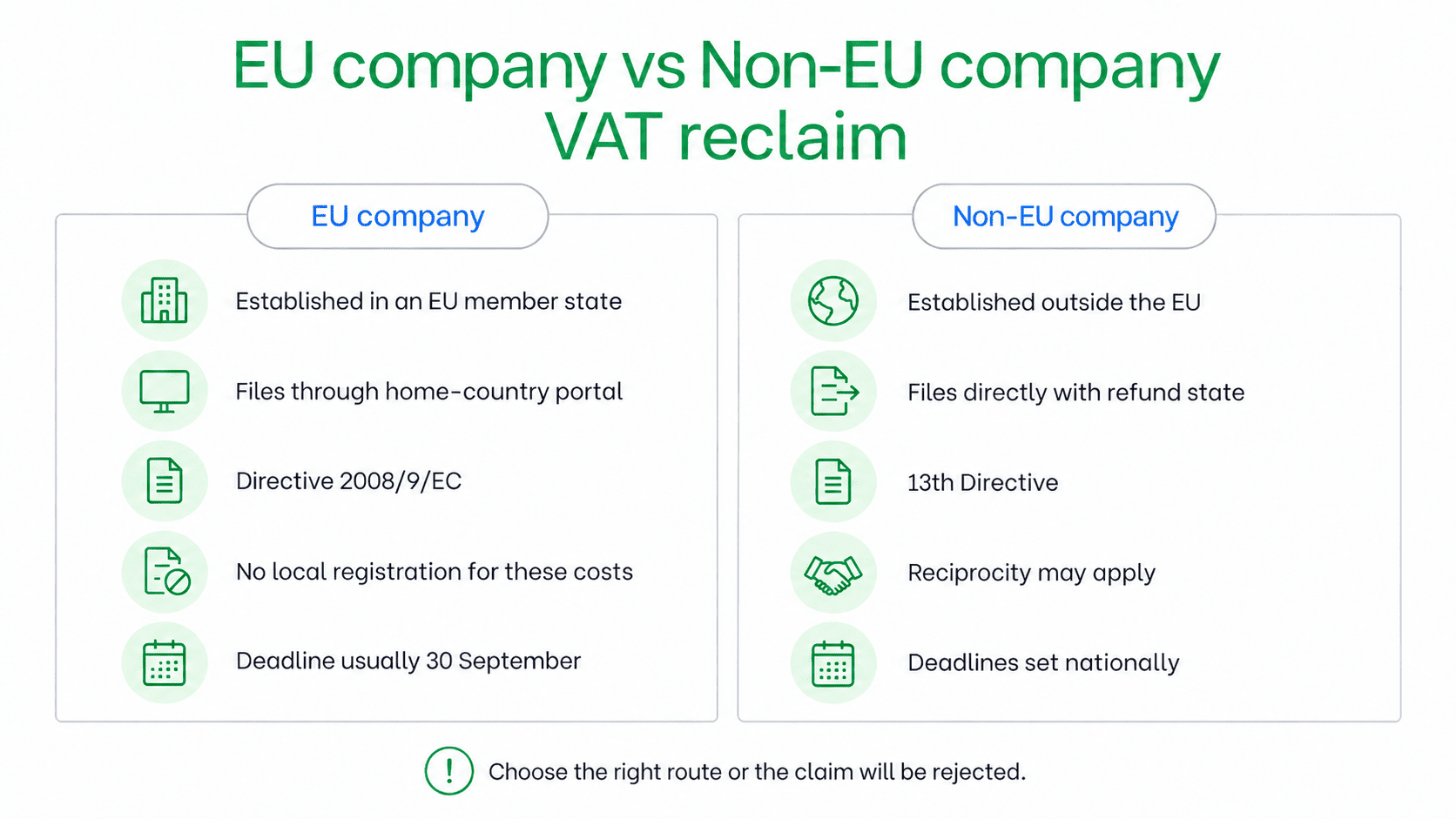
A company established in one member state can claim a VAT refund from another under Directive 2008/9/EC. The condition is that during the period it had no seat or fixed establishment there and supplied nothing locally, apart from certain exempt transport services and sales where the customer self-accounts. The application is filed online with the home administration, which forwards it abroad.
The country of refund applies its own deduction rules, not the claimant’s. Some member states refuse whole categories such as restaurant costs, entertainment, cars or fuel. In practice the filing runs in six steps:
- Collect invoices and import documents for the period, grouped by country of purchase
- Log in to the cross-border portal of your home administration
- File a separate application for each member state
- Code every expense with one of the ten EU expenditure codes, from fuel and accommodation to admissions to fairs, plus sub-codes where required
- Upload copies where asked, usually for invoices with a taxable amount of €1,000 or more, or €250 for fuel
- Keep the electronic receipt and answer any request for additional information within one month
Timelines are fixed by the directive. The country of refund has four months from receipt to decide. A request for more information extends that period, but the decision cannot come later than eight months after the application arrived. Payment is due within ten working days, and late payment can earn interest. Companies that claim a VAT refund every year often file quarterly, so cash returns sooner.
Claiming a VAT refund this way needs no local registration. That is the main advantage and also the limit: once the company starts selling goods or services in that state, the portal route closes for it.
Selling goods in another member state rather than just buying services there? A cross-border claim will not cover that activity. Our local registration service sets up the numbers you need so deductions run through regular returns.
VAT Reclaim Deadlines and Minimum Amounts for 2026
Every VAT reclaim under Directive 2008/9/EC must reach the home administration before 30 September of the year after the period it covers. For costs invoiced during 2025, the last day is Wednesday, 30 September 2026. Late applications are not accepted.
The directive also fixes the size and length of each claim:
- A period covers at least three months and at most one calendar year, with shorter periods allowed only for the final months of a year
- The minimum amount is €400, or €50 for a full calendar year or its last months
- Copies can be requested for invoices with a taxable amount of €1,000 or more, or €250 for fuel
- A decision is due within four months, or eight months at most after a request for more information
- Payment follows within ten working days of the decision period
The practical calendar for a company filing a VAT reclaim this year is short. Quarterly claims for 2026 costs can go in as each quarter closes, the full-year 2025 claim must be in by 30 September 2026, and any 2025 invoice left out of it cannot be recovered through this procedure afterwards.
Many finance teams treat VAT reclaims as a year-end clean-up task. That habit is expensive, because a missing hotel invoice found in October is simply lost.
How Businesses Outside the EU Reclaim VAT
Companies from the US, UK, Switzerland or any other third country reclaim VAT under the 13th Directive (86/560/EEC). The application goes straight to the authorities of the member state where the cost arose, and some countries only pay when the claimant’s home country offers similar treatment to their own firms. The European Commission’s own example is a Swiss company charged Belgian tax on a hotel bill during a conference in Belgium.
Deadlines are set nationally. The directive lets states require claims within six months of the end of the calendar year, so 30 June is common, while several have aligned with the 30 September date used for EU claimants. Always confirm the date on the national administration’s website. A typical file includes:
- Original invoices or import documents, or certified copies where accepted
- A certificate of status from the home authority confirming taxable activity
- A power of attorney if an adviser files on your behalf
- Details of a local fiscal representative where one is mandatory
UK firms joined this group after Brexit. A British exporter that wants to reclaim VAT on a Dutch warehouse audit or a Milan trade fair now files with the Dutch or Italian authorities, not with HMRC.
Reclaiming VAT from outside the Union is usually slower and more paper-driven than the EU portal. Before collecting invoices, check that the state accepts claimants from your country at all, since without reciprocity registration may be the only way to recover the money.
Claiming a VAT Tax Refund After Leaving Europe as a Tourist
Tax-free shopping is a separate system for private individuals who live outside the Union and take goods home in their personal luggage. The sale is treated as an exempt export, so the shop, or an operator working for it, repays the amount once customs confirms the goods left in time. The process has four steps:
- Ask for a tax-free form at the till and show your passport
- Keep the goods unused and packed, together with receipts and forms
- Validate the form at the last exit point from the Union, at a customs desk or kiosk, before checking in luggage
- Send the validated form to the retailer or operator, or collect the money at an airport counter
A VAT tax refund after leaving Europe depends entirely on that validation. A traveller who arrives home without a customs stamp or electronic approval leaves the retailer with no proof of export, so the money stays with the shop. In France, the form must be validated before the end of the third month after the month of purchase, and travellers leaving through another member state must get the customs visa there and post the original back to the French seller.
Eligibility rules differ by country. French customs rules limit the scheme to travellers aged 16 or over who live outside the Union and stay less than six months. Money from a VAT tax refund after leaving Europe usually arrives by card or bank transfer several weeks after the trip. Minimum spends also vary:
| Country | Minimum spend, gross | Export validation |
| France | Above €100 per shop and day | PABLO kiosks |
| Germany | From €50.01 | Customs stamp on the export certificate |
| Italy | Above €70 since 1 February 2024 | OTELLO 2.0 digital visa |
| Spain | No minimum | DIVA electronic validation |
VAT tax refunds after leaving Europe never cover services, so hotel nights, restaurant meals and car hire stay taxed. UK residents have qualified since Brexit, because they now count as living outside the Union.
When You Cannot Claim VAT Back and Why Claims Get Rejected
Not every invoice lets a company claim VAT back, even when the expense is fully deductible at home. The most common reasons for rejection are:
- An amount charged by mistake, for example on a B2B service that should have fallen under the reverse charge, which needs a corrected invoice from the supplier
- An invoice issued to the wrong legal entity or missing the supplier’s registration number
- Expense categories the member state blocks, such as entertainment or passenger cars
- A wrong or missing expenditure code
- Taxable sales made in that state during the period, which require registration instead
- A missed deadline or an amount below the minimum
Firms with partly exempt activities, such as banks, insurers or healthcare groups, can claim VAT back only in proportion to their deduction right at home. The country of refund applies that home ratio to the eligible amount.
Claiming VAT back on stock is also a warning sign. If goods bought in another member state were then sold there, the company made local supplies and must register instead of filing a claim.
Cross Border Operations That Need a Different Route
Many cross-border transactions never create anything to recover. When a German supplier sells a service to a French company, the French customer self-accounts under the reverse charge, so nothing is paid in Germany and nothing needs to come back. Intra-EU sales of goods between registered traders work the same way: exempt in the state of dispatch, taxed on acquisition at destination.
Online sellers using the One Stop Shop face a different trap. The OSS return only declares sales, so amounts paid on purchases in other member states cannot be deducted there. It has to be recovered through the Directive 2008/9/EC procedure, or through a local return where the seller is registered for other reasons, such as stock held in a warehouse.
Import charges follow the same logic. A trader registered in the state of import deducts it in the local return, while an importer without registration there may use the portal route, provided no local sales were made.
Filing OSS returns while holding registrations in several markets? Our OSS IOSS registration service and compliance platform keep multi-country filings on one schedule, so deductions do not slip between returns.
Practical Examples From Trade Fairs to Airport Kiosks
Polish manufacturer at a German trade fair
In October 2025, four employees of a Polish manufacturer attend a fair in Cologne. The company pays €1,200 net for exhibition passes at 19% (€228), €2,400 net for hotel rooms at 7% (€168) and €900 net for car hire at 19% (€171). It files one application for Germany through the Polish portal before 30 September 2026 and asks for €567. Because the passes and hotel invoices exceed €1,000 in taxable amount, Germany may request copies. Filed this week, the claim should be decided by around the end of January 2027.
US software company at an Amsterdam conference
In March 2026, a US sales team spends €1,500 net on Amsterdam accommodation, now at 21% (€315), and €2,500 net on conference tickets at 21% (€525). The company files directly with the Dutch administration under the 13th Directive for €840, after checking the Dutch deadline for 2026 costs and the documents required from third-country claimants.
Canadian tourist shopping in Paris
A Canadian visitor buys a coat for €1,200 at a 20% rate, so the price contains €200. She flies Paris to Frankfurt to Toronto, which makes Frankfurt her last exit point from the Union. German customs validate the form there, she posts it to the Paris shop, and the money reaches her card weeks later, minus the operator’s fee.
| Example | Route | Amount at stake | Filed with |
| Polish manufacturer | Directive 2008/9/EC | €567 | Polish portal, forwarded to Germany |
| US software company | 13th Directive | €840 | Dutch administration |
| Canadian tourist | Tax-free export | Up to €200 | Retailer after customs validation |
What ViDA Changes for Cross Border Claims
The ViDA package, adopted by the Council in March 2025, does not rewrite the Europe VAT refund procedure itself. Its effect is indirect. From 1 July 2028, wider OSS coverage and extended reverse charge rules mean fewer firms will need local numbers, which makes the portal route more important for pure cost items. From 1 July 2030, e-invoicing and near real-time digital reporting become the norm for intra-EU B2B trade, so invoice data will increasingly be matched against claims automatically.
For finance teams, structured and correct invoices will matter more than ever. A claim built on invoices that fail validation will be easier for authorities to reject.
Preparing for mandatory e-invoicing across several markets? Our Global E-Invoicing Software issues compliant invoices market by market, and you can book a free consultation to map your position before the next deadline.