
Lappa Newsletter – September 2026
Lappa Newsletter – September 2026
Product update
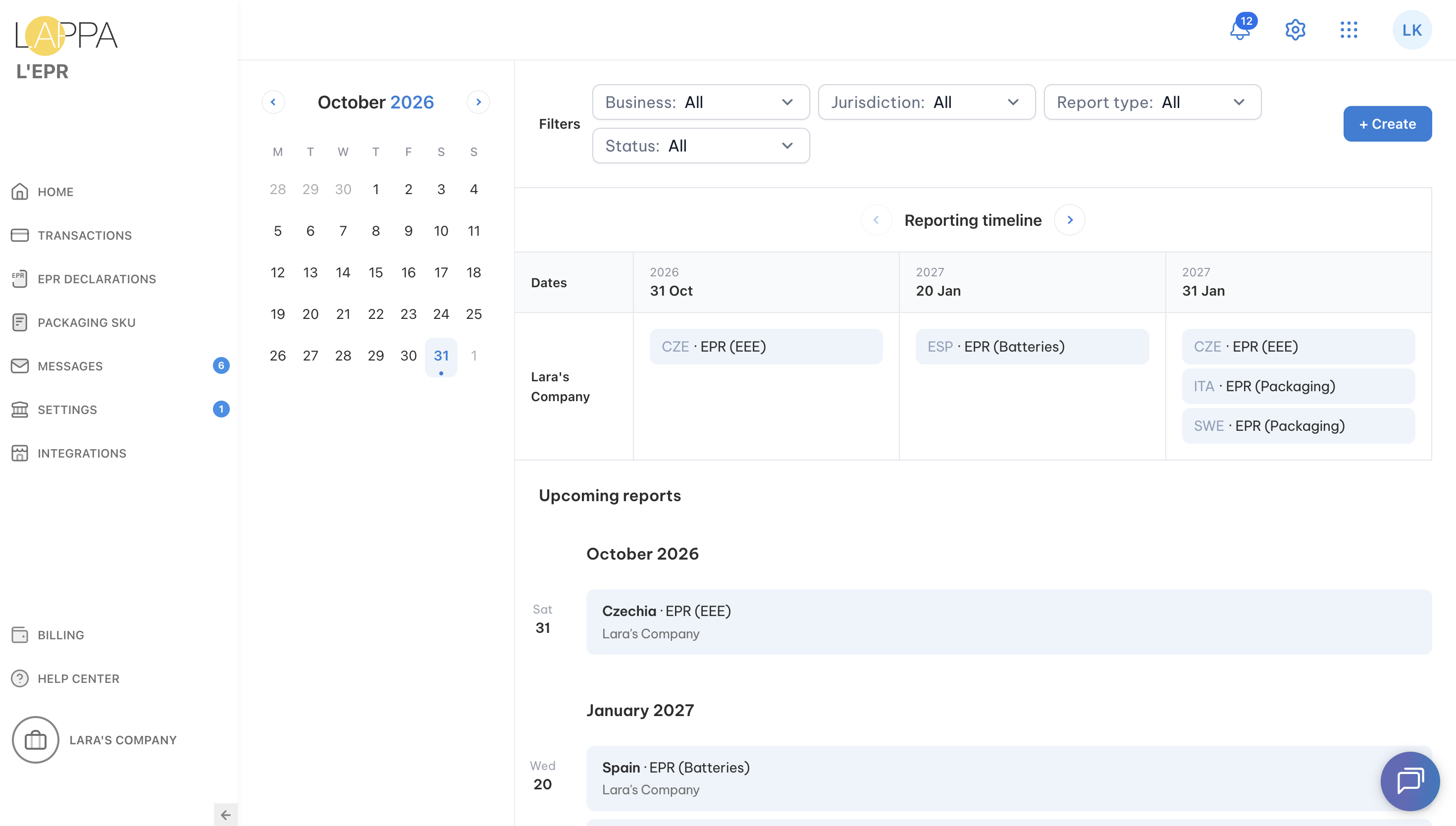
Reporting Calendar redesign
The calendar now gives you a single timeline view across every jurisdiction and report type you’re tracking, with upcoming filings sorted by date so nothing gets missed. See what’s new
Shopify integration for EPR now in pilot
A direct Shopify integration is being piloted to pull packaging data straight into your EPR reporting workflow. Want in on the pilot? Get in touch.
EPR & PPWR Fee Calculator
Get an early read on your packaging, WEEE, or battery obligation before registering in a new market.
Manage all your PPWR labelling requirements in one place
Recyclability pictograms, the Declaration of Conformity, batch and traceability marking, and the rollout of digital data carriers — all mapped against your SKUs and every deadline running through 2040.
EPR news
UK large producers: January-June 2026 packaging data is due by 1 October 2026
Large producers registered under the UK’s packaging Extended Producer Responsibility scheme (pEPR) have until 1 October 2026 to submit their January-June 2026 packaging figures. What sets this round apart is the first-ever requirement to include Self-Managed Organisation Waste (SMO) data — relevant for any business collecting and recycling its own packaging outside the standard council system, such as a retailer running an in-store take-back scheme for food-grade plastic trays. The same 1 October date also applies to anyone wanting to register closed-loop packaging for the 2027 scheme year, which comes with its own separate registration fee. Since 2026/27 base fees are set to be confirmed shortly after this filing window closes, how accurately businesses categorise and weigh their packaging now will shape what they’re actually charged. Read more
France’s new fast-fashion levy hits Shein, Temu and AliExpress from 1 September 2026
France’s textile EPR scheme now carries a per-item environmental surcharge for ultra-fast fashion products, collected through the eco-organisation Refashion. The 2026 scale starts small — €0.25 to €0.50 on basics such as underwear and socks — then climbs to €2 for a T-shirt, €9 for jeans, and €12 for a jacket, capped at half the item’s pre-tax price. That scale isn’t fixed: it’s due to rise sharply, potentially approaching €20 per item by 2030. Two criteria decide whether a product counts as “ultra-fast fashion” — how many new styles a brand pushes out and how the cost of repairing a garment compares with what it originally sold for — a design meant to catch high-turnover, low-durability retailers rather than mainstream fashion chains. The same legislation bans ultra-fast fashion advertising in France, social media and influencer promotion included. Any business selling apparel into the French market, regardless of size, should check whether its catalogue falls under this scoring system now, since the surcharge sits on top of the textile EPR fees most sellers already pay. Learn more about EPR in France
Italy’s CONAI raises plastic packaging contributions from 1 October 2026
CONAI, Italy’s packaging consortium, is lifting its Environmental Contribution (CAC) rates for plastic across nearly every recyclability band starting 1 October 2026, following a joint review with the COREPLA consortium. The lowest band, covering the easiest-to-recycle plastics (A1.1), goes from €40 to €51 per tonne, while the top band for hard-to-recycle plastics (C) climbs from €790 to €922 per tonne — with the sharpest jumps landing on materials facing the weakest recycling markets. CONAI points to rising collection and sorting costs and soft demand for certain recyclates as the drivers, alongside the goal of keeping Italy’s plastic packaging recycling rate at 50% or above. Anyone placing plastic packaging on the Italian market should confirm which CAC band each SKU sits in ahead of October, since that classification is what determines the contribution owed. Read more
A practical guide to PPWR packaging labelling requirements
Our latest guide walks through exactly what belongs on packaging and by when: traceability data from 2026, harmonised sorting pictograms from 2028, and reusable packaging labels with QR codes from 2029 — alongside a full explanation of the Declaration of Conformity and a field-by-field look at what a compliant label actually contains. With PPWR labelling rolling out over several years, mapping each deadline against your current SKU range now saves a scramble later. Read more
Lappa keeps EPR straightforward — registration, reporting, and staying clear of fines, handled in one place. Get a Fee Quote | Book a Demo
E-invoicing news
France adds e-reporting to its e-invoicing mandate from 1 September 2026
France’s e-reporting obligation takes effect on the same date as e-invoicing — 1 September 2026 — for large companies and ETIs. Its job is to catch what structured B2B e-invoicing doesn’t: B2C sales, cross-border B2B transactions with other EU countries, and cash-basis payment data. This data flows through the same approved-platform system used for e-invoicing, via a dedicated channel commonly called Flow 10. Miss a submission or send it late and the fine runs €250 per instance, capped at €15,000 a year — a separate penalty track from anything tied to e-invoicing itself. Businesses lining up their e-invoicing platform should confirm it also handles e-reporting, since both obligations share the same start date for large and mid-sized companies. Learn more
Greece’s e-invoicing mandate reaches every remaining business from 1 October 2026
Phase 1 of Greece’s B2B e-invoicing rollout — large companies with gross revenue above €1 million based on 2023 figures — went live on 2 March 2026. From 1 October 2026, every other Greek business joins, with a gradual adjustment period running until 31 December 2026 during which older invoicing methods can still run in parallel. Invoices route through the myDATA platform, get checked against the EN 16931 standard, and receive a MARK identifier once accepted; anything that fails validation comes back with an error code. Businesses can comply either through a certified provider or AADE’s free tools, Timologio and the myDATA app. The penalties for skipping the mandate are steep — 50% of the VAT due on VAT-bearing transactions, and €500 to €1,000 per tax audit for non-VAT ones — while switching early can unlock enhanced depreciation and deduction benefits on e-invoicing costs.
We’re here to support you through every stage of compliance. Questions or need a hand? Get in touch with our team.