
EPR Germany: Step-by-Step Process, Costs & Deadlines
EPR Germany: Step-by-Step Process, Costs & Deadlines
The country operates one of the most structured and strictly enforced Extended Producer Responsibility Germany frameworks in the European Union. In Germany, any business that sells batteries, electrical equipment, or packaged goods must register with the right national authority, pay into a dual or approved take-back system, and send in yearly volume reports.There are severe consequences for noncompliance, and the procedure is mandatory. This article outlines the precise tasks that producers must complete, the associated costs, and the dates of important deadlines.
The term “EPR Germany” refers to three legal systems working in parallel.The Verpackungsgesetz (VerpackG) covers packaging, the ElektroG covers electrical and electronic equipment, and the Batteriegesetz (BattG) covers batteries. A company that sells a battery-powered kitchen appliance in branded packaging must follow all three laws at the same time. A workable compliance strategy starts with understanding the overlap.
Companies that want to sell goods in Germany must first get a valid EPR registration number from the right authority. This identifier is a core element of the compliance framework. Retailers, marketplaces, and customs authorities use it to confirm a company meets its obligations. Sales must stop until the process is completed if there isn’t a valid number.
 Ready to register for EPR in Germany? Skip the paperwork headaches — Lovat handles your EPR registration across all categories, so you can start selling without compliance risks. Get registered today or book a free consultation with our EPR specialists.
What Extended Producer Responsibility Germany requires
Idea of “Extended Producer Responsibility Germany” means that the companies that first sold a product are responsible for paying for its collection and recycling when it is no longer useful.Rather than leaving waste management to municipal budgets, the law requires obligated companies to fund take-back infrastructure directly. This model has driven Germany’s packaging recovery rate above 70 percent and its battery collection rate consistently above EU targets.
EPR Germany law applies to any legal or natural person that, for the first time on a commercial basis, makes, imports, or buys goods from another EU member state and sells them in Germany. The definition is meant to be broad. The VerpackG applies to both a small e-commerce business that sends ten packages a week to German customers and a large consumer goods brand that sells to many countries. There are volume thresholds that trigger certain duties, but there is no threshold below which you don’t have to register.
The Zentrale Stelle Verpackungsregister (ZSVR) is in charge of packaging, and the Stiftung EAR is in charge of batteries and electrical equipment in Germany. Both agencies keep public records, do audits, and share information about enforcement with state-level consumer protection agencies. The EPREL and WEEE Forum networks also share information about people who don’t follow the rules across EU member states.
What a registration number means and why it is non-negotiable
In the EPR context, a registration number is a unique alphanumeric code assigned by the competent authority to each entity. The ZSVR gives it out through the LUCID portal for packaging. Stiftung EAR issues identifiers for electronics and assigns a separate registration number for batteries.
The identifier performs several important functions. It confirms that the company has declared the categories of goods it intends to sell. It connects the company with the contracted take-back operator and confirms the required financial contribution. It activates the company’s entry in the public register. Retailers, fulfillment centers, and online platforms must verify this identifier before accepting new suppliers.
Online marketplaces now check registration numbers automatically when a product is listed. If platforms in Germany under §7a VerpackG and §23 ElektroG knowingly let unregistered producers sell, they are responsible. Because of this, they have added automated compliance checks to their onboarding processes. If a seller can’t give a valid registration number, their product listing will be blocked before it ever gets to a customer.
Registration numbers are category-specific. A company holding a valid LUCID registration number for packaging is not automatically compliant for electronics. Each category requires a separate entry, contracts, and reporting cycles. Companies expanding their portfolio must reassess EPR obligations whenever a new item category is introduced.
EPR registration Germany process explained
The EPR registration Germany process for packaging is managed entirely through the LUCID online portal, operated by the ZSVR. The portal is available in German and English. The procedure is free and usually takes less than an hour when company information is prepared in advance.
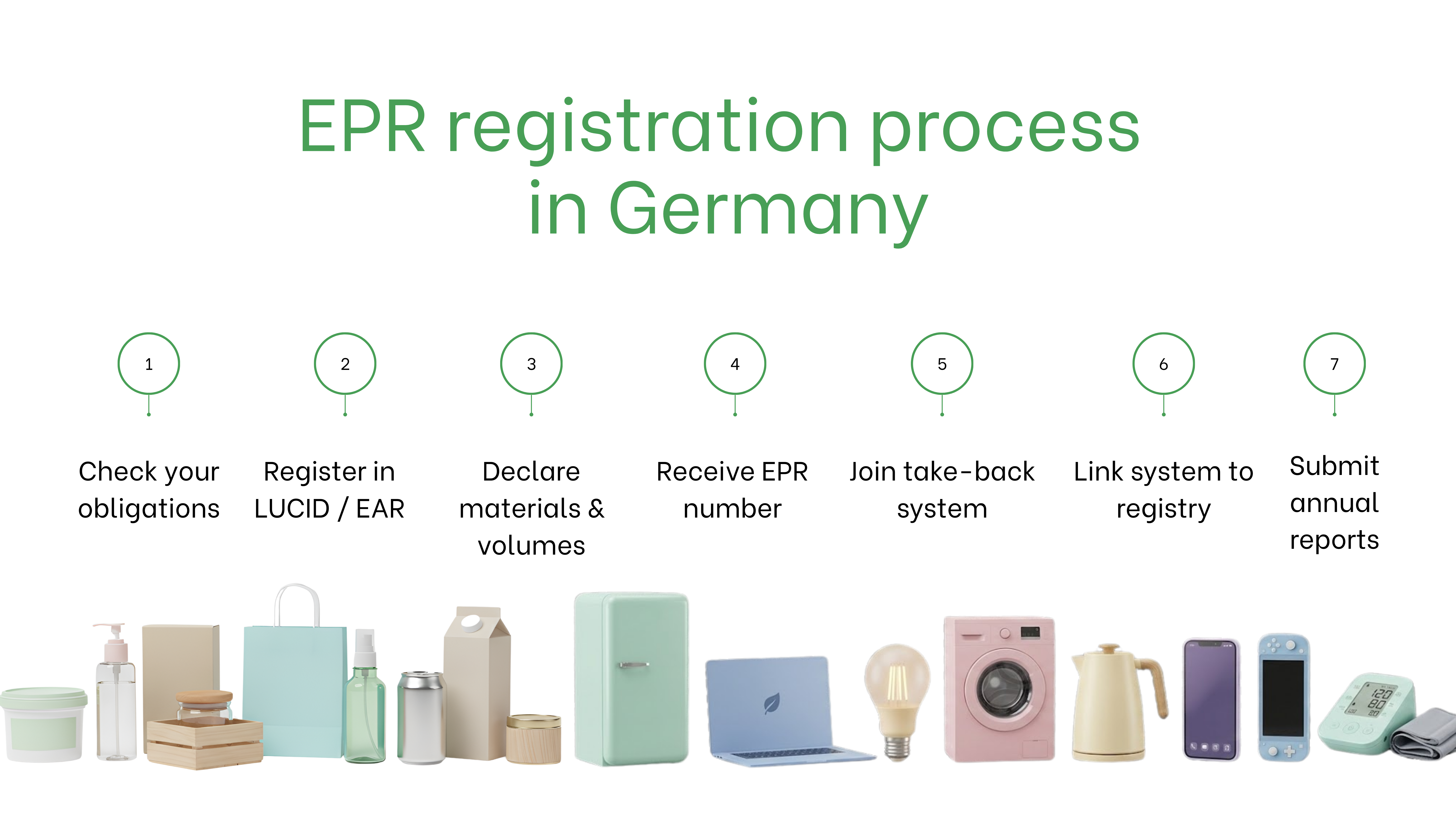
Here is the step-by-step sequence every producer must follow:
- Think about what you have to do. Find out if your packaging is “systempflichtig,” which means it has to be part of a dual system. This includes all consumer-facing materials, like e-commerce outer packaging, product packaging, and service packaging like carrier bags.
- Create a LUCID account at lucid.verpackungsregister.org. Enter your company’s legal name, registered address, VAT number, and the name of a responsible contact person.
- Declare your material categories. Specify the material types (glass, paper, plastic, composite, metal) and estimated annual weights you plan to place on the market.
- Receive your registered EPR number. ZSVR processes applications automatically. In most cases, the LUCID number appears in the public database within minutes.
- Contract with a licensed dual system. Germany has several licensed systems approved by the ZSVR. A participation contract must be signed before packaging can be placed on the market. The contract specifies your annual tonnage commitment and the resulting fee.
- Link your dual-system contract to your LUCID profile. ZSVR requires confirmation of system participation. Without this linkage, the process remains incomplete and the goods cannot be considered compliant.
- Submit annual volume reports. By 15 May each year, declare the actual packaging volumes you placed on the market in the previous calendar year. The figure must match the data the dual system reports independently to ZSVR.
Foreign producers without a German legal entity can complete EPR registration Germany directly. There is no law that says you have to hire a representative for packaging, but many sellers outside the EU choose to use a compliance service to help them with the process. Companies from all over the world can sign up for the LUCID portal.
EPR registration fees for producers
Understanding EPR registration fees is straightforward. Registration itself is free everywhere. You pay to participate in take-back systems.
| Category | Registration | Annual Cost | Authority |
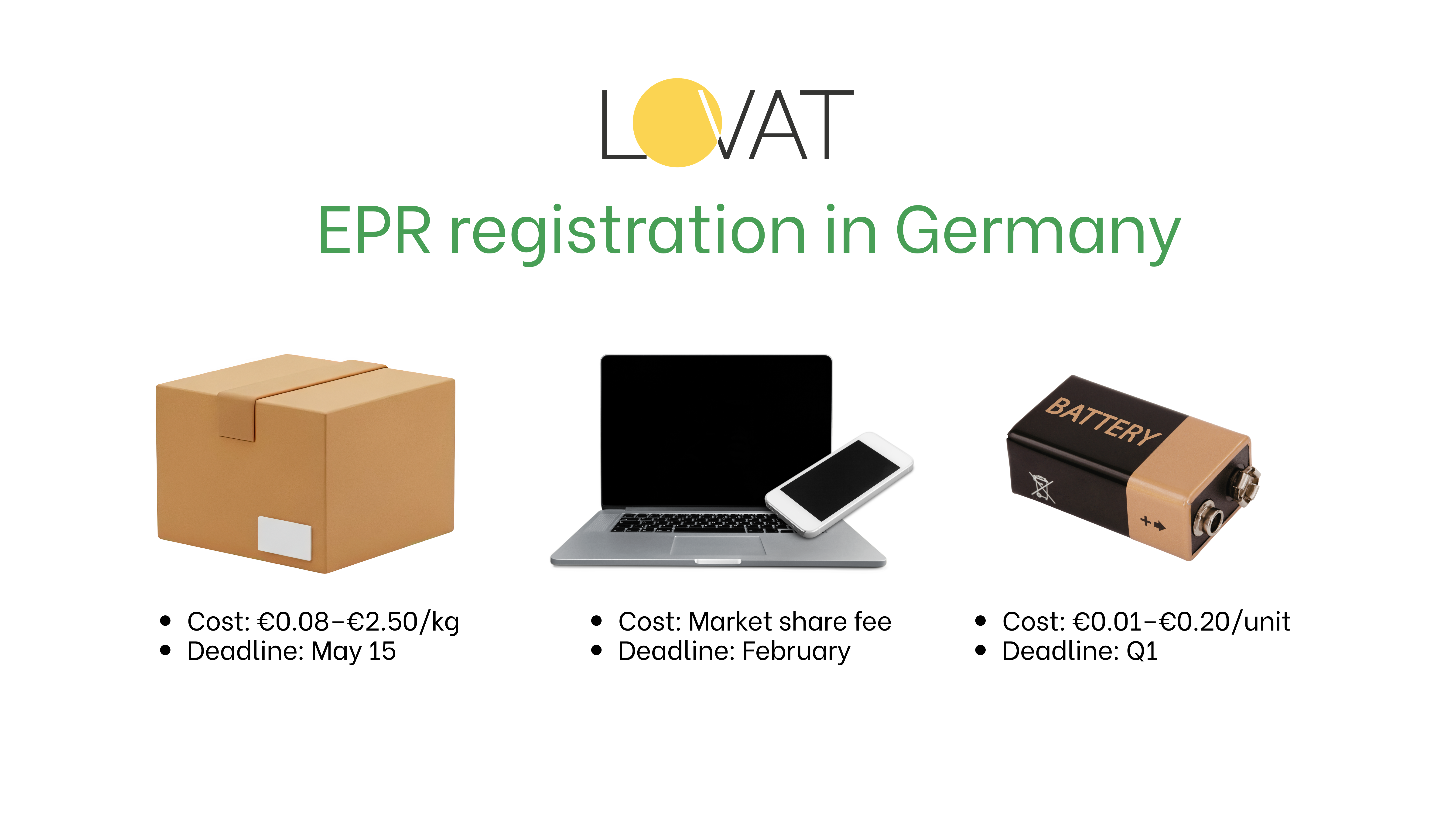
| Packaging (VerpackG) | Free | €0.08–€2.50/kg by material | ZSVR |
| Electronics (ElektroG) | Free | Based on market share per category | Stiftung EAR |
| Batteries (BattG) | Free | ~€0.01–€0.20/unit by chemistry | Stiftung EAR |
Packaging: dual system sets the rate, not ZSVR. Plastic costs more than paper. 200 kg/year = roughly €80–300; high-volume manufacturers pay tens of thousands. EPR registration fees for packaging vary significantly depending on which licensed dual system you choose.
Electronics: Stiftung EAR bills by market share. Bigger share, bigger infrastructure contribution.
Batteries: lithium-ion costs more than alkaline. The EPR registration fees for batteries depend on chemistry — under-declare volumes and you pay a retroactive surcharge at year-end.
EPR registration and reporting timeline and key deadlines
Most companies enter the market correctly. Risks accumulate later — during the EPR registration and reporting cycle. Registration happens once. Reporting is annual, sometimes quarterly. A missed deadline triggers automatic deregistration. Sales stop until the producer meets obligations.
Packaging
Before first sale — submit a volume forecast to ZSVR. Registered companies repeat this every year. The actual report for the previous year is due May 15. Your data must match the dual system’s report. Discrepancies trigger a review process. Expect recalculations or penalty fees.
Electronics
Deadlines for EPR registrations and reporting fall in February. Report total weight of goods placed on the German market. Break data down by categories from Annex I of ElektroG. High-volume producers file quarterly declarations year-round. Stiftung EAR cross-checks these against treatment facility data.
Batteries
Annual reports are due in Q1. Stiftung EAR receives sales data and collection rate figures. Germany’s collection targets rank among the EU’s highest. If rates drop below the legal threshold, all producers pay more next period.
Practical reminder
Compliance in Germany requires a dual-system contract before the first sale. Retroactive contracts are not accepted. Many producers learn this only after a warning letter. Follow this order: register in LUCID first, sign the dual-system contract second, then start selling.
Don’t let reporting deadlines catch you off guard. Lovat automates your annual EPR volume declarations for packaging, electronics, and batteries — and submits them to the right authorities on time. Explore EPR reporting
How to get your EPR registration number for electronics and batteries
The EAR portal at stiftung-ear.de is where you can submit your application for electrical and electronic devices. First, producers need to put their goods into one of the ten groups listed in Annex I of the ElektroG. The category you choose will determine the collection infrastructure that your registration fees go toward and the number of items you need to return. Your application will be looked over by Stiftung EAR, which will then give you your EPR registration number for electronics. This usually takes between five and fifteen business days.
Foreign companies that don’t have a business in Germany must hire an authorized representative (Bevollmächtigter) who is based in Germany. This representative assumes joint legal liability for compliance in Germany under the ElektroG. The EAR public register lists the producer, plus the representative’s name and contact details. Choosing a representative is not just an administrative step; it is a real legal appointment that needs to be done with care.
The process of registering batteries is similar. You fill out an application on the EAR portal that lists the battery chemistries you sell and how many you think you’ll sell each year. Stiftung EAR gives you a battery registration number and lets you know which approved take-back systems are available for your type of chemistry. Battery take-back is different from packaging because only a few authorized system operators are in charge of it and their collection infrastructure covers all of Germany.
In Germany, electronics companies have to do more than just register and pay fees. Manufacturers must put the crossed-out wheelie bin symbol and the year of manufacture on their products, tell customers how to get rid of them properly, and make sure that their products are easy to take apart. Market surveillance authorities can enforce these design-related rules, but they are often ignored.
Common mistakes in EPR Germany and how to avoid them
Selling without a valid EPR registration number is the most common violation. Registration must be active before day one of sales. Warning letters arrive fast — legal costs typically exceed what registration would have cost.EPR Germany enforcement is strict and competitors report each other actively.
Stale dual-system contracts. Growing companies forget to update tonnage declarations. VerpackG requires a mid-year amendment when actual volumes diverge from the forecast. ZSVR recovers underpayments retroactively.
Material misclassification. Classify by primary functional material, not heaviest by weight. Labeling a composite pack as “paper” cuts your fee — and triggers corrections on audit. Check ZSVR’s classification guidance before your first declaration.
Wrong ElektroG category. Categories follow device function, not product name. A smart home hub may land in “monitoring and control equipment,” not “IT and telecommunications.” Wrong category = wrong fees, wrong collection infrastructure.
Not updating after expanding. New packaging type, electronics category, or battery chemistry — update LUCID or EAR before the first sale in that category.
Compliance in Germany for cross-border and online sellers
Achieving full compliance in Germany is particularly nuanced for cross-border e-commerce operators. The VerpackG’s ‘first placement’ rule means that the obligation attaches to the entity that ships the packaged product to a German address, not to a German distributor or logistics partner. An online seller based in France shipping directly to German consumers must register with the ZSVR in exactly the same way as a German manufacturer.
Marketplaces in Germany have a secondary enforcement duty under §7a VerpackG and §23 ElektroG. Before letting product listings go live, they need to make sure that all third-party sellers on their platform have valid registration numbers. If a platform doesn’t do this check, it can be held responsible for the sellers who don’t follow the rules. This gives marketplaces a strong reason to strictly enforce compliance in Germany. Sellers say that documentation checks have become much stricter in the past few years.
For sellers who have to deal with EPR obligations in more than one EU market, the paperwork can add up quickly. Germany requires separate national registration for each category; there is no EU-wide registration. Each member state has its own rules, deadlines, and fees. Services like Lovat help producers keep track of their EPR registration and reporting data in one place, figure out their obligations by jurisdiction, and send their declarations to the right authorities on time. It’s much more efficient to automate volume tracking from the start of market entry than to recreate historical data for retroactive filings.
Official resources for EPR Germany compliance
AllEPR Germany processes run through official government portals. No middleman required to register — though compliance services help with multi-country tracking and deadline management.
Before you start, bookmark these:
- LUCID (packaging): lucid.verpackungsregister.org — registration, volume declarations, public register search. Anyone can look up a producer’s status by name or EPR registration number.
- Stiftung EAR (electronics, batteries): stiftung-ear.de — classification guides for all ten ElektroG categories, registration forms for local and foreign producers, public producer list.
- Laws: gesetze-im-internet.de — full texts of VerpackG, ElektroG, and BattG, updated with every amendment.
- Comparison of EU frameworks: ec.europa.eu shows EPR rules side by side for all member states. This is helpful if you sell in more than one country.
- Clarifications on binding classification: the Umweltbundesamt (UBA) is the federal agency in charge of both ZSVR and Stiftung EAR. If your product sits in a grey area, UBA issues binding rulings on disputed EPR Germany classification questions. Useful for unusual packaging constructions or new device categories.