
VAT Audit Checklist for Ecommerce Businesses
VAT Audit Checklist for Ecommerce Businesses
What a VAT Audit Means for Ecommerce Businesses
Nobody wakes up hoping for a letter from the tax office. Yet that’s exactly how a VAT audit starts for most ecommerce sellers — an envelope (or increasingly, an email) telling you a revenue authority wants to look at your books.
What are they checking? Whether the VAT you reported, collected, and paid actually matches reality. Your invoices, your returns, your bank activity, your marketplace data — all of it gets scrutinised. And if the numbers don’t line up, things get expensive fast.
Five or six years ago, an online seller could fly under the radar pretty easily. That era is over. EU authorities now pull transaction records straight from Amazon, eBay, Shopify payments, even Stripe. They have your numbers before you file. A mismatch — even €200 on a quarterly return — can flag your account in an automated system. No human involved.
The real problem? Most ecommerce businesses stumble into cross-border VAT obligations without understanding what they’ve signed up for. You launch on Amazon DE, Amazon FR, Amazon IT. Amazon moves your stock into fulfilment centres in Poland and the Czech Republic. Congratulations: you now owe VAT in five countries. Nobody told you. The marketplace certainly didn’t send a warning.
Two types of VAT audit exist, and the difference matters. Desk audits happen remotely — an official pulls up your returns, requests supporting documents, and runs the numbers from their office. That’s the common one for ecommerce. Field audits are the other kind. An auditor shows up physically. They walk through your warehouse, sit down with your finance person, leaf through printed records. These are rarer for online-only businesses but they do happen, typically after a desk audit raises red flags nobody could explain away.
And then there’s DAC7. Since January 2023, every digital platform in the EU must report seller income annually. Earned over €2,000 or completed 30+ transactions? Your data goes to the government. Automatically. Authorities now match these platform reports against what you declared on your VAT returns. The system flags discrepancies without a single bureaucrat lifting a finger. That’s why being audited went from “unlikely” to “pretty likely” for marketplace sellers in the space of two years.
VAT Audit Procedure — How It Works Step by Step
The vat audit procedure looks roughly the same whether you’re dealing with the Bundeszentralamt für Steuern in Germany or HMRC in the UK. Details change. The structure doesn’t.
- Stage 1 — You get the letter. It names the periods being examined, usually two to three fiscal years. It sets a deadline for documents. In Germany it’s called a Prüfungsanordnung. HMRC uses a VAT Notice 700/56. The letter also tells you who your assigned auditor is. Keep that name handy — you’ll be dealing with them for a while.
- Stage 2 — The document request arrives. And it’s long. They want your VAT returns. Sales invoices. Purchase invoices. Bank statements. Marketplace settlement reports. If you sell cross-border, add proof of export, intra-community supply paperwork, and evidence you charged the right VAT rate in each country. Now try pulling all of that from Amazon Seller Central, Xero, your bank portal, and maybe a Shopify export. For three years. That’s the part that breaks people.
- Stage 3 — They go through it. The auditor compares your filed returns against what Amazon or eBay reported. They check your OSS declarations against platform volumes. Selling digital products? They’ll want to see that you applied place-of-supply rules properly. Did a customer in Spain get charged Spanish VAT, not your home rate? They’ll verify.
- Stage 4 — The questions. Written, formal, specific. “Explain the discrepancy in Q3 2024 between your declared turnover and the settlement report from Amazon.de.” “Provide documentation for this zero-rated supply.” Good answers shorten everything. Vague ones drag the audit procedure out by months.
- Stage 5 — Draft findings land. The auditor tells you what they found. Underpaid amounts, overclaimed input VAT, sloppy documentation. You get a window to push back, supply extra evidence, or argue your side. Use it.
- Stage 6 — Final assessment. This is the bill. Extra VAT owed, interest, penalties. Some jurisdictions slap penalties up to 100% of the shortfall for deliberate non-compliance. The vat audit procedure officially ends with a formal notice. You’ve usually got a tight window to appeal if you disagree.
VAT Audit Checklist — What Every Ecommerce Seller Needs Ready
A vat audit checklist is only useful if you’ve been filling it in all along. Putting it together after the letter arrives? That’s not preparation. That’s damage control.
Everything should be organised by country and period. You want it accessible in hours, not weeks. Here’s the full list:
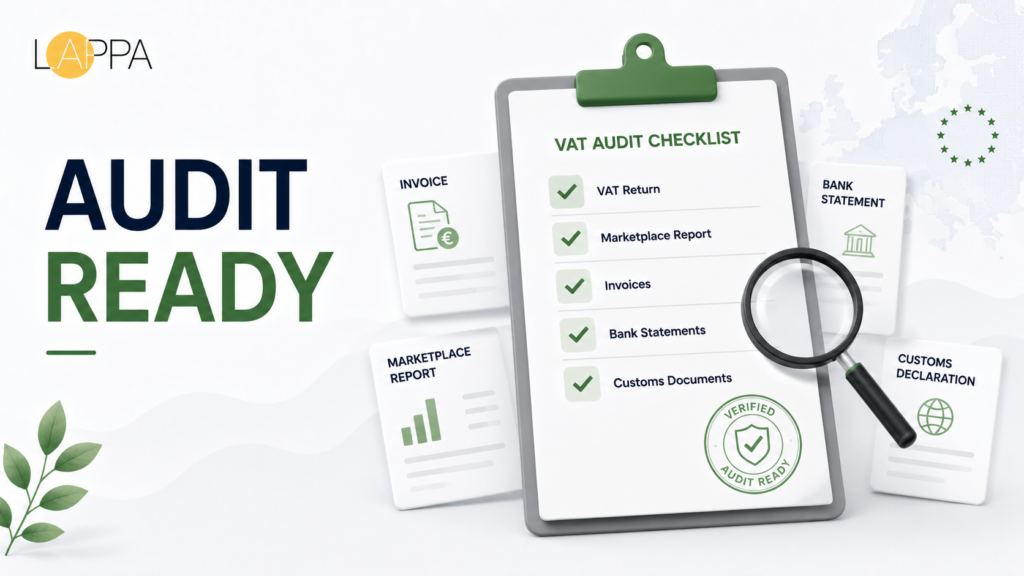
- Filed VAT returns for every jurisdiction — going back five to ten years depending on where you’re registered (Germany demands ten years under GoBD, the UK wants six)
- Sales invoices with rates, customer VAT numbers for B2B, clear net and gross breakdowns
- Purchase invoices showing valid supplier VAT numbers
- Bank statements for every business account, reconciled against what you declared
- Settlement reports from Amazon, eBay, Etsy, Shopify — every platform you sold through during the period under review
- Customs declarations, shipping documents, tracking records — anything proving goods physically left the country for zero-rated supplies
- VAT registration certificates for each country you’re registered in
- Customer location proof for digital services: IP logs, billing addresses, payment processor data
- Credit notes with documented reasons for every refund or adjustment
One thing people forget: system access. Auditors sometimes want to log into your ERP or marketplace account themselves. A read-only login prepared in advance signals cooperation. It also speeds things up massively.
Here’s what we keep seeing: a seller assumes their accountant or bookkeeper has everything sorted. They don’t. Amazon settlement data sits in Seller Central. FBA inventory movement logs are somewhere else entirely. Customer location proof lives in Stripe. Nobody consolidated any of it. An audit checklist covering only the traditional accounting stack — ledgers, invoices, bank feeds — will have holes. Auditors are trained to find holes.
| Document | Purpose | Who Provides It | When to Prepare |
| VAT returns and filings | Proof of declared amounts | Internal finance team or advisor | Monthly or quarterly as filed |
| Sales invoices | Evidence of taxable supplies | ERP or accounting system | At point of sale |
| Purchase invoices | Evidence of input VAT claims | Suppliers | At point of purchase |
| Bank statements | Cross-reference with declared revenue | Bank | Monthly |
| Marketplace settlement reports | Proof of platform-facilitated sales | Marketplace (Amazon, eBay, etc.) | Monthly or per settlement |
| Proof of export or intra-community supply | Evidence for zero-rated supplies | Logistics provider, customs | At point of shipment |
VAT Compliance Audit — Common Triggers and Red Flags
Nobody draws your name out of a bowl. A vat compliance audit happens because something in your data tripped a wire. If you know what trips the wire, you’ve got a fighting chance at staying off the list.
Refund claims that don’t add up. This one nails ecommerce importers constantly. You bring €500,000 of stock into the EU, claim input VAT on it, but your declared output is only €200,000 in sales. The authority sees that gap and has one obvious question: where is the rest? Are you sitting on unsold stock, or did you sell it and not report it?
Cross-border numbers that contradict each other. Your German return says one thing. Your OSS filing via France says something else. Authorities share data — VIES, DAC7 exchanges, bilateral agreements. A compliance audit often starts because a human being couldn’t make your filings across three countries tell a coherent story. With automated matching now standard, the system catches mismatches nobody would have noticed five years ago.
Late registration. This is the one that costs the most money. Amazon’s data shows you were shipping orders from a German warehouse since March 2023. You didn’t register for German VAT until November 2024. That’s twenty months of backdated liability, plus interest, plus penalties. The €10,000 OSS threshold for cross-border B2C sales catches smaller sellers who had no idea they’d crossed it.
Here’s where it gets tricky. Under DAC7, Amazon literally hands your gross revenue, credits, and fee breakdowns to the government. Your return says €47,000. Amazon’s report says €52,000. That five thousand euro gap gets flagged automatically. Nobody had to audit you — the system did it. Preventing a vat compliance audit comes down to one habit: reconciling platform data against filings every single month.
Big revenue swings draw attention too. Going from €50,000 a quarter to €300,000 in one jump needs a paper trail. Were you running a viral product? Did you open new markets? If there’s no documented explanation, the assumption will be that earlier returns were wrong.
| Trigger | Why It Raises a Flag | Risk Level | How to Prevent It |
| High VAT refund claims | Refunds exceed industry norms | High | Ensure supporting documentation is complete |
| Inconsistent cross-border filings | Amounts differ between countries | Medium-High | Reconcile multi-country data monthly |
| Late or missing VAT registration | Sales started before registration | High | Register before reaching thresholds |
| Marketplace data discrepancy | Platform reports differ from filed returns | Medium | Cross-check marketplace reports with filings |
| Sudden revenue changes | Large spikes or drops without explanation | Medium | Keep records explaining business changes |
Ecommerce businesses that want to check whether their VAT records are audit-ready can use Lovat to review filings and identify gaps before an audit starts.
VAT Audit Preparation — How to Organise Records Before You Get the Letter
Vat audit preparation isn’t a project you start. It’s a habit you maintain. The sellers who get through audits without drama are the ones who never let their records fall behind in the first place.
Monthly reconciliation. That’s the backbone. Pull settlement reports from every marketplace. Line them up against your accounting entries and filed returns. Match? Good, move on. Mismatch? Fix it now, while it’s fresh and small. Not in two years when an auditor is staring at it. Sellers juggling three or four Amazon marketplaces know this pain — each one generates its own settlement report, each one needs to trace back to the right country’s VAT return.
Document retention has to follow the toughest rule you’re subject to. Germany: ten years. UK: six. Selling in both? Keep everything for ten. Go fully digital. Sort invoices by country and period. Bank statements by month. Marketplace reports by platform and settlement date. When auditors ask for Q2 2024 Amazon.de data, you want it in thirty seconds, not three weeks.
Quarterly checks matter. Assign somebody — your in-house accountant, your external advisor, whoever — to run through recent transactions and confirm the VAT treatment was right. Did zero-rated exports get backed up with shipping proof? Were reverse charges documented correctly? Do your OSS returns actually match the sales data that fed into them?
These are the mistakes that burn sellers during vat audit preparation — and we see every single one of them regularly:
- Filing VAT returns without first reconciling marketplace data against accounting records
- Storing documents as random email attachments, WhatsApp screenshots, or downloads nobody can find six months later
- Running personal purchases through business bank accounts (auditors love catching this one)
- Issuing credit notes with no explanation of why the refund was given
- Ignoring VAT in countries where Amazon FBA parked your inventory — you didn’t choose the warehouse location, but the obligation followed the stock there anyway
- Submitting OSS returns without checking place-of-supply rules transaction by transaction
- Treating “organise our records” as a future task that keeps getting pushed to next quarter
Get an advisor or compliance platform involved before anyone sends you a letter. An advisor who already understands how your transactions flow will answer auditor questions ten times faster than someone handed a mess after the fact. Good audit preparation means everyone on your team knows exactly where to find every document. No scrambling. No “I think the accountant has that.” No panic.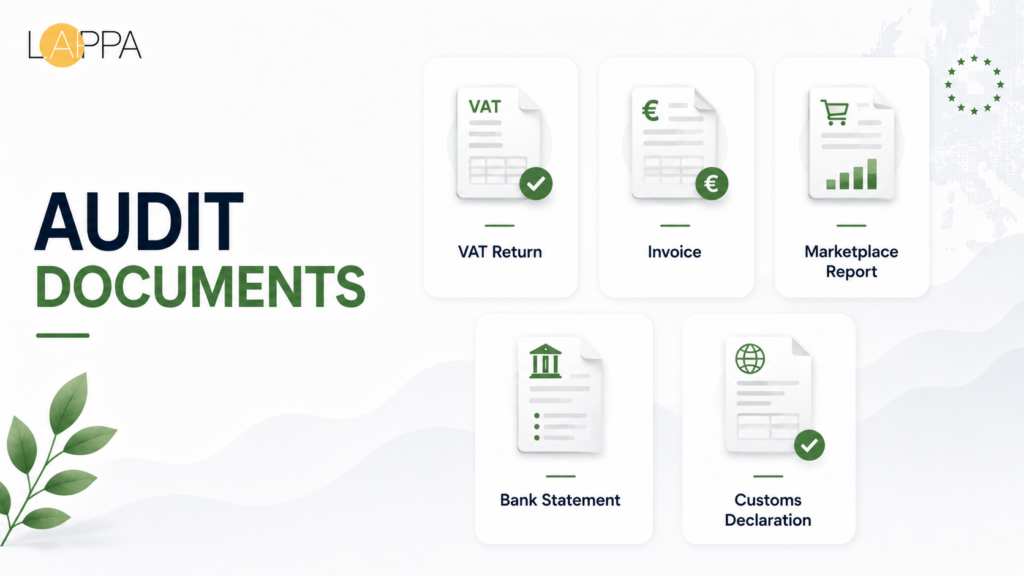
How Lovat Helps Ecommerce Businesses Prepare for VAT Audits
Keeping VAT clean across five countries, three platforms, and two years of filings is genuinely difficult work. Most ecommerce businesses cobble it together with spreadsheets, CSV exports, and a prayer. That approach survives right up until the audit letter arrives.
Lovat plugs directly into Amazon, Shopify, eBay, and other platforms. Your transaction data flows into one place. No more toggling between Seller Central, your accounting app, a bank portal, and three browser tabs trying to match numbers. When an auditor asks for German returns alongside the Amazon settlement data from the same quarter — Lovat pulls both out of one system.
VAT return prep is automated across 100+ countries. If you’re on OSS, Lovat calculates the destination country rate and builds returns ready for filing. Automated calculations cut the manual errors that tend to trigger audits in the first place. That’s the ugly irony — messy filings invite the scrutiny that uncovers more mess.
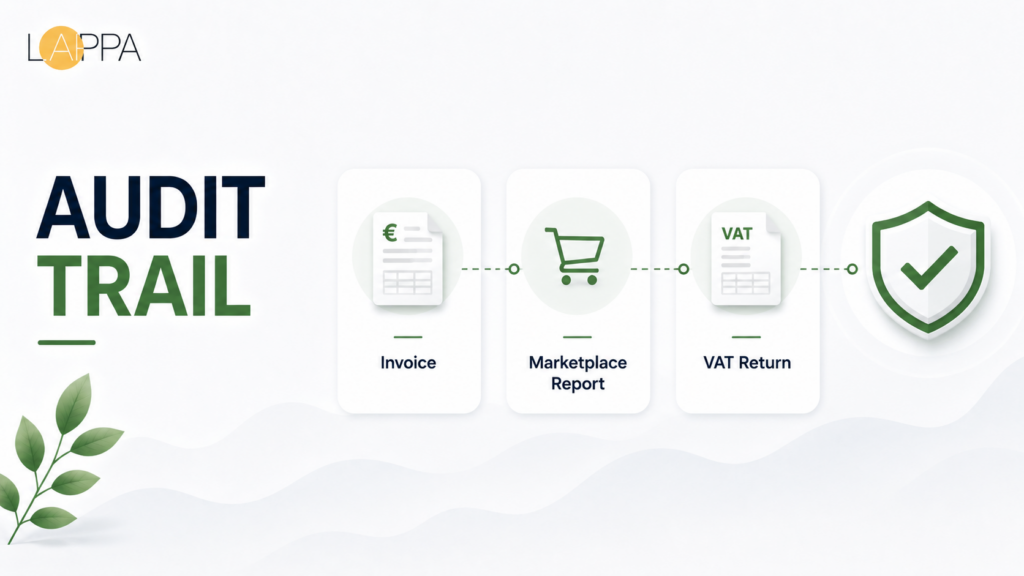
The reporting side is where most sellers feel the biggest relief. Multi-country transaction logs, reconciliation reports, filing history — all there on demand. Lovat also covers DAC7 reporting for marketplace operators and handles e-invoicing in 30+ countries. Presenting an automated VAT audit trail to an auditor lands very differently than handing over a USB stick full of CSVs.
There’s a predictive layer too. AI analyses your historical patterns, transaction data, and filing behaviour to flag problems before they become triggers. Instead of bracing for audits, you’re headed them off. That’s the shift — from dreading compliance to just… running it in the background.
If your ecommerce business sells across EU borders and needs a reliable VAT compliance process, Lovat can help you automate filings, organise records, and stay audit-ready.