
PPWR Recycled Content Requirements for Plastic Packaging in the EU
PPWR Recycled Content Requirements for Plastic Packaging in the EU
A production line in Rotterdam is switching to secondary resin next spring. Nobody on that line is debating the decision. Brussels already made it for them. Regulation (EU) 2025/40 is known as the PPWR. It turned reprocessed plastic from a marketing claim into a legal floor. Firms placing plastic packs on the EU market now face fixed shares. Fixed deadlines follow close behind. A paper trail sits underneath both.
This guide walks through PPWR recycled content duties from the ground up. It covers which formats count. The actual numbers follow next. A final section covers the proof a firm needs before shipping into the Union.
What PPWR recycled content means for companies selling into the EU
The Packaging and Packaging Waste Regulation was published on 22 January 2025. It entered into force on 12 February 2025. It applies across every Member State from 12 August 2026. Article 7 carries the rules that matter most here.
Before Article 7, secondary plastic share stayed voluntary. A brand could claim it, skip it, or stretch the truth. Risk stayed low either way. That era is closing fast. A short list of shifts follows from this one article.
- Secondary plastic share becomes a binding floor, not a marketing line
- The duty follows the pack itself, wherever the manufacturer sits
- Only post-consumer material counts toward that floor
- Paperwork must now survive a regulator’s request, not just a buyer’s question
Grasping PPWR recycled content requirements takes one sentence. Building a supply chain around them takes far longer. Certified recyclate at scale stays hard to find for several polymers.
Which plastic packaging falls under PPWR recycled content requirements
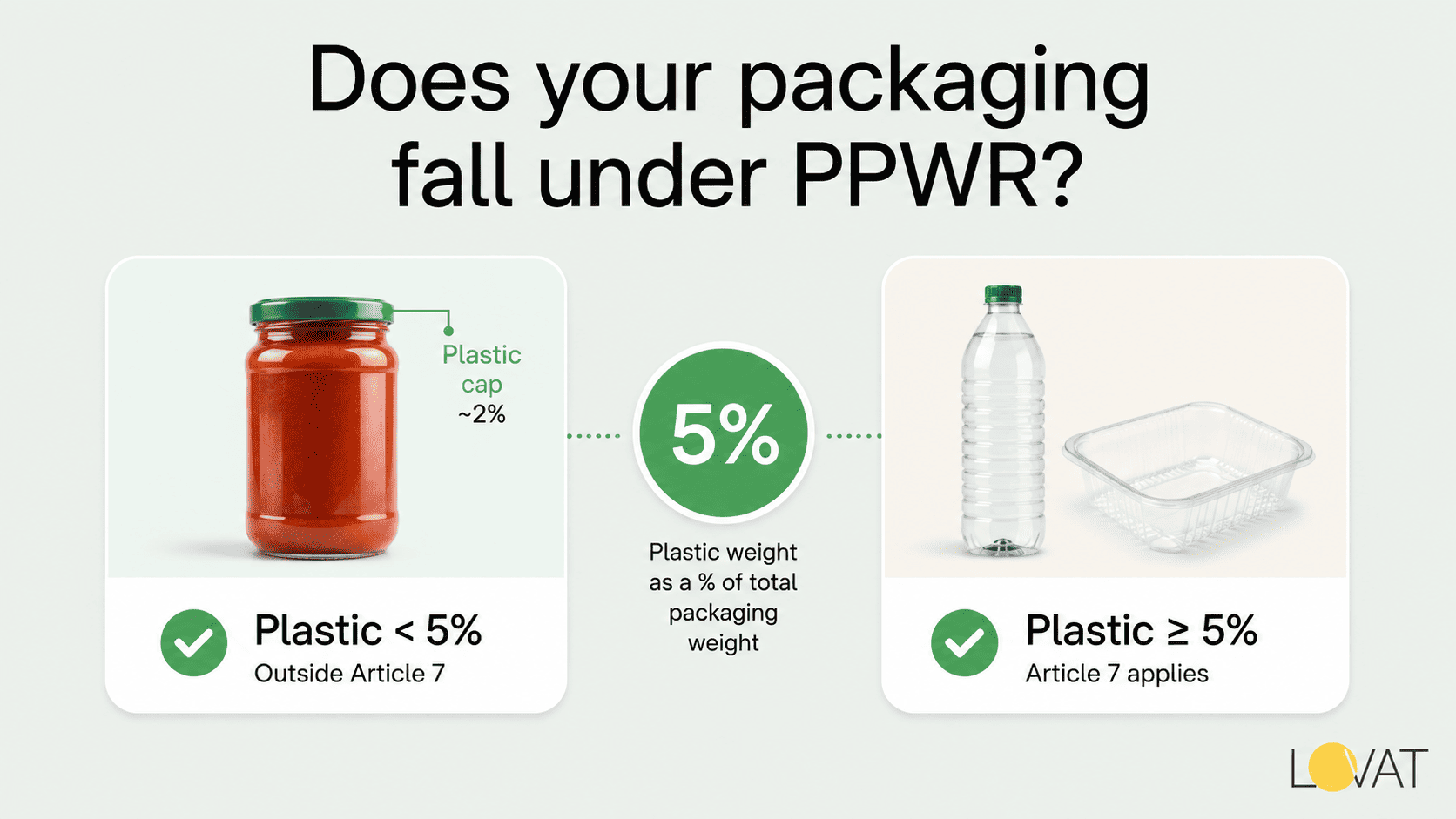
Not every plastic part triggers this duty. Article 7 applies once plastic reaches at least 5% of a pack’s total weight. A thin cap on a glass jar sits under that line. That cap escapes the rule on its own.
Once a unit clears that 5% threshold, several familiar formats sit inside scope.
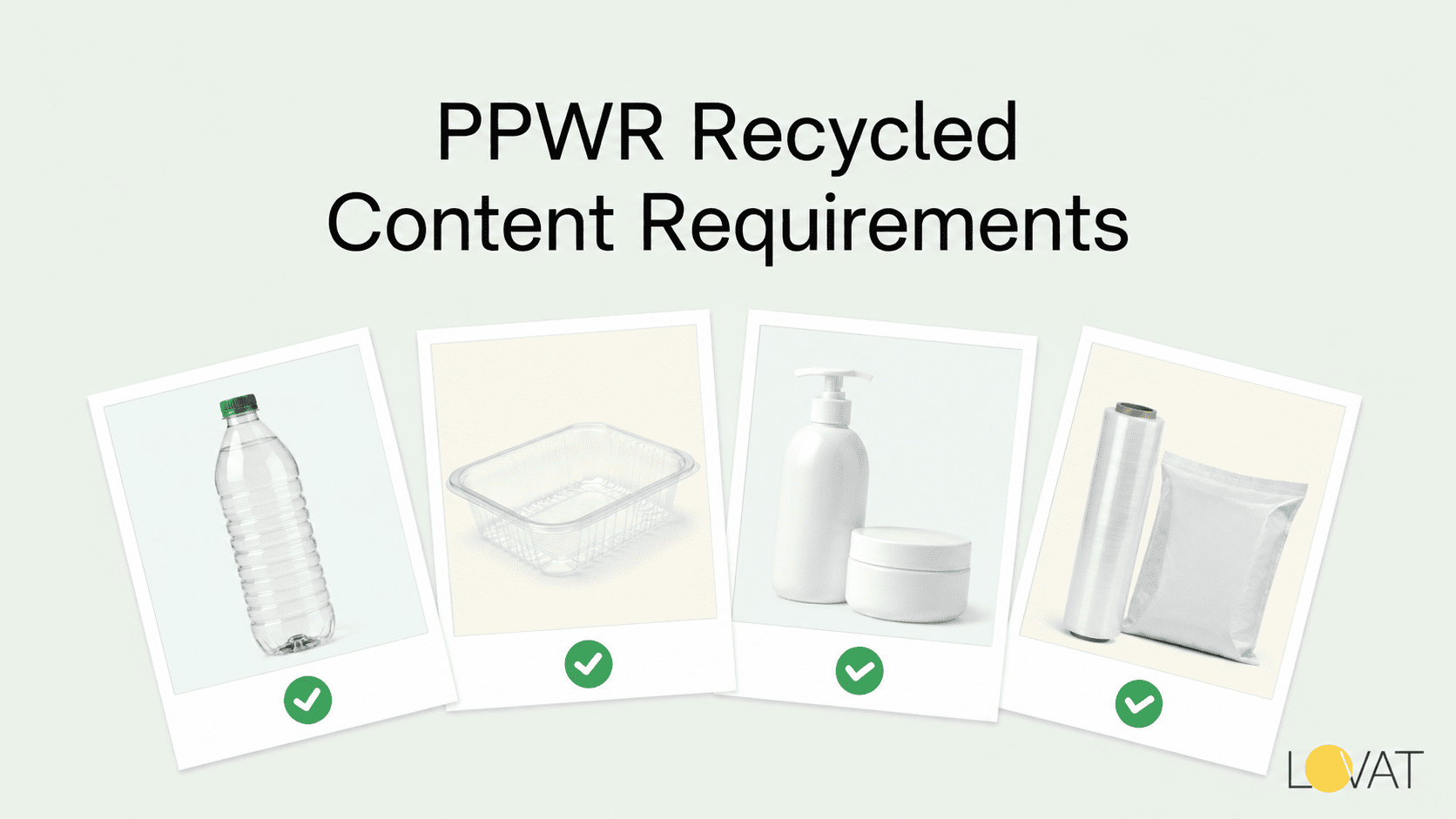
- Single-use beverage bottles
- Contact-sensitive packs, covering food, pharma, and cosmetics
- Other plastic packaging, meaning most retail and transport formats
- Any component crossing the 5% weight line, assessed separately
A single product often holds several plastic parts. Each part gets judged on its own against that 5% line. A bottle, its cap, and its label can each carry a different obligation.
EU PPWR recycled content targets 2030
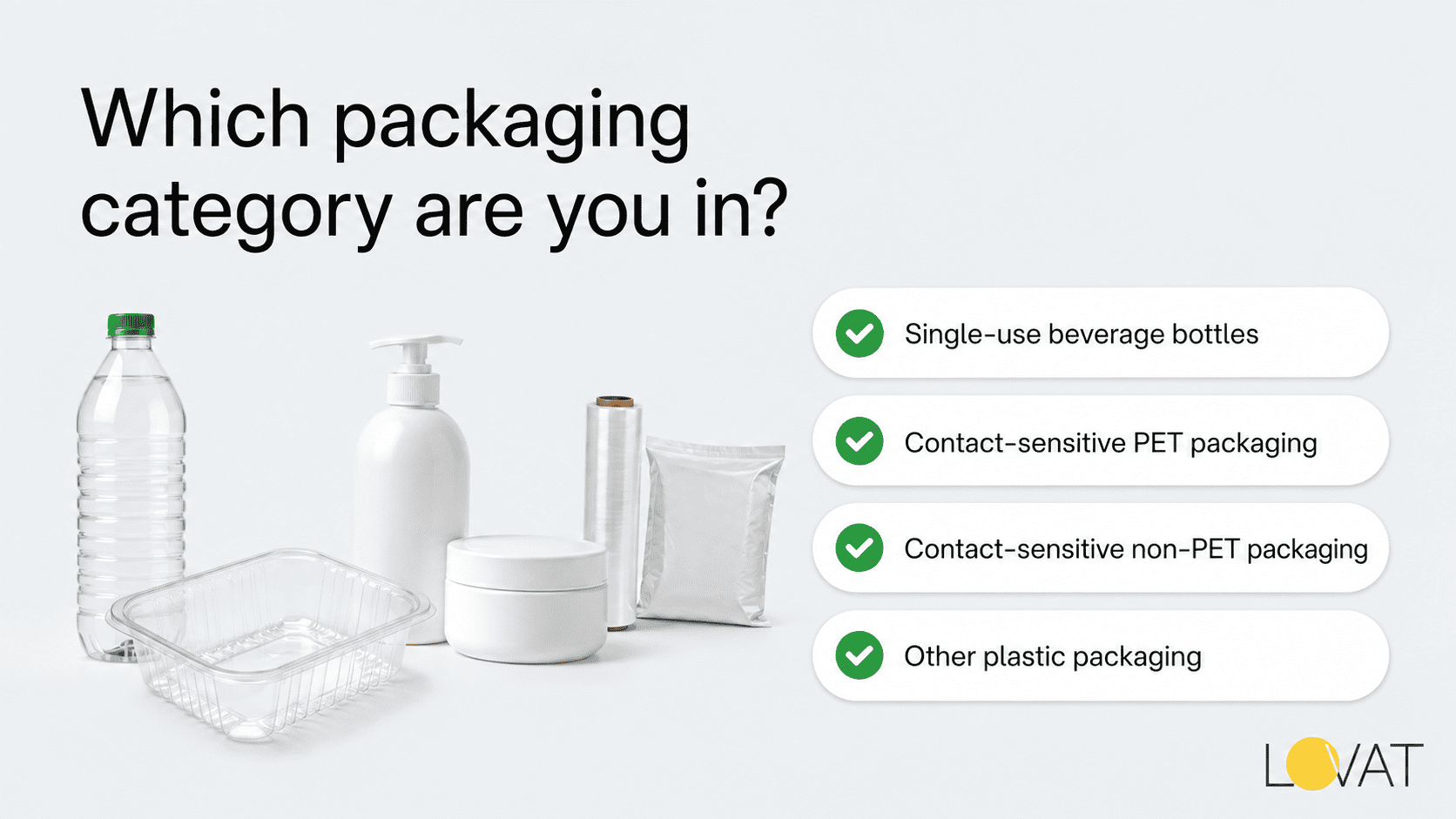
EU PPWR recycled content targets 2030 sit at the center of Article 7. They apply from 1 January 2030. That date can shift later, tied to when the calculation methodology takes effect. Four categories carry four separate floors.
| Packaging category | Minimum share from 2030 |
| Single-use plastic beverage bottles | 30% |
| Contact-sensitive PET packs, other than beverage bottles | 30% |
| Contact-sensitive packs made from plastics other than PET | 10% |
| Other plastic packaging, not contact-sensitive | 35% |
These figures work as an annual average. That average covers everything one plant produces in a given category. A site does not need every single unit sitting exactly at 30%. It needs the yearly average to clear that line.
EU PPWR recycled content targets beyond 2030
The 2030 figures mark only the first step. A second, steeper wave lands on 1 January 2040. Firms planning a redesign now should build toward that later figure too.
- Single-use beverage bottles rise from 30% to 65%
- Contact-sensitive PET packs rise from 30% to 50%
- Contact-sensitive non-PET packs rise from 10% to 25%
- Other plastic packaging rises from 35% to 65%
EU PPWR recycled content targets roughly double for most categories inside one decade. A format redesigned only for 2030 will likely need a second redesign for 2040. Sourcing material against the later number from the start avoids that repeat cost.
EU PPWR recycled content targets plastics packaging must meet by category
The gap between contact-sensitive and general packs is no accident. Food-grade recyclate stays scarce. Reprocessing must clear strict food-safety checks first, before that material touches anything a person eats or drinks.
The table below sets both groups side by side.
| Factor | Contact-sensitive packs | Non-contact-sensitive packs |
| Typical products | Food, pharma, cosmetics, animal feed | Retail boxes, wraps, transport packaging |
| 2030 minimum (PET) | 30% | 35% (general category) |
| 2030 minimum (non-PET) | 10% | 35% (general category) |
| Main constraint | Food-safe supply | Sourcing volume at scale |
When people search for EU PPWR recycled content targets plastics, they are usually asking one thing. How do the numbers shift once end use changes? A cosmetics jar and a shipping box, built from identical PET, can face different legal floors. One touches a product. The other never does.
Exemptions from PPWR recycled content requirements
A handful of packaging types sit outside Article 7 entirely, at least for now. Spotting these early saves a firm from chasing a target that never applied.
- Packaging for medical devices, under existing EU medical device law
- Packaging for medicinal products, for human or veterinary use
- Packaging for in vitro diagnostic devices
- Compostable plastic packaging, which sits under its own regime
- Any plastic part under the 5% total-weight threshold
The Commission must review this exemption list by 1 January 2028. It may extend, narrow, or adjust the current entries. A firm relying on one of these carve-outs today should treat that position as open to change.
How recycled content is calculated and verified
Only post-consumer material counts toward the Article 7 floor. That means waste a household or business used and threw away first. Scrap looped straight back into a factory’s own line does not qualify. That holds true no matter how established the internal habit already is.
The precise calculation method is still unfinished. The Commission must adopt an implementing act on calculation and verification by 31 December 2026. A separate delegated act, due the same date, sets sustainability criteria for eligible reprocessing routes. Until both texts land, the floor stays fixed. The exact arithmetic behind it stays open.
A few features already look settled enough to plan around.
- Recycled share gets calculated as an annual average, per manufacturing site
- Chain-of-custody or mass balance accounting will likely anchor the final rules
- Third-party audits are widely expected once those rules take effect
- A supplier declaration alone will probably not satisfy a future check
Materials that qualify toward the minimum
Sourcing choices made today will decide whether a firm clears its PPWR recycled content targets in 2030 without a scramble. The regulation draws one firm line between two kinds of input. Only one side of that line counts.
Qualifying material generally means plastic waste collected from households or businesses. Existing collection schemes can also supply it. That waste must then run through genuine mechanical or chemical reprocessing. Non-qualifying material means production offcuts, trial runs, and scrap that never left a factory as consumer waste. A supplier can market a blend as reprocessed in good faith. That claim will still fall short of the legal floor if it skips post-consumer origin entirely.
Ask any supplier for a clear split between the two volumes. Get that split before either one enters a bill of materials.
Documentation and proof producers must keep
PPWR recycled content requirements reach well past the percentage itself. A manufacturer or importer must show, on request, exactly how a stated figure was reached.
- Maintain a technical file for every packaging format placed on the EU market
- Keep a Declaration of Conformity confirming the claim per category
- Retain that documentation for five to ten years, depending on packaging type
- Support traceability through batch numbers, barcodes, or QR codes
- Collect supplier mass balance certificates for every input used
None of this paperwork needs to exist only for one audit day. Fold it into standard production records instead. That beats a rushed scramble later, once enforcement starts.
Producer and importer obligations under PPWR recycled content requirements
The duty follows the pack into the EU market. It makes no difference where the company placing it there happens to sit. A manufacturer outside the Union carries the same duty as one based inside it.
- Confirm which formats cross the 5% plastic weight threshold
- Identify the right target category for each one, contact-sensitive or otherwise
- Track current share against both the 2030 and 2040 figures
- Secure supplier proof of post-consumer origin for any material used
- Prepare technical files and Declarations of Conformity ahead of each deadline
- Watch for the Commission’s implementing act, due by the end of 2026
Distributors and marketplaces acting for non-EU manufacturers carry a check of their own. Confirm, in writing, that upstream suppliers are actually tracking these duties. Do not assume compliance by default.
Not sure which of your formats already meet the EU PPWR recycled content targets, and which still need work? Book a free consultation and our team will map your portfolio against Article 7, category by category.
A pre market checklist before selling packaging into the EU
A short internal review, run well before 2030, catches most gaps early. Finding a gap in-house always costs less than a customs officer or market surveillance body finding it first.
- List every SKU holding 5% or more plastic by weight
- Sort each one into its correct target category
- Document current share, split by post-consumer and post-industrial source
- Compare that figure against both the 2030 and 2040 minimums
- Contact suppliers for audited proof of post-consumer origin
- Set a redesign timeline for any SKU sitting below its 2030 floor
- Assign internal ownership for tracking the Commission’s methodology once published
Firms that finish this sweep now usually face a straightforward sourcing project. Firms that wait until 2029 often face a redesign, a supplier search, and a deadline landing in the same quarter. Treat the EU PPWR recycled content targets 2030 as the first checkpoint on a longer road, not the final one, since the 2040 figures follow close behind.
Building your EPR and packaging compliance workflow from scratch? Our EPR registration and EPR reporting services, together with our EPR guides, cover the wider PPWR picture too.