
DDP VAT and DAP VAT rules Under Incoterms
DDP VAT and DAP VAT rules Under Incoterms
A shipment leaves the warehouse. Weeks later, a tax notice arrives. Nobody budgeted for it. Incoterms VAT treatment gets decided at contract stage, not at delivery. Get the term wrong, and the bill lands on the wrong desk.
This guide breaks down DDP VAT and DAP VAT rules in plain terms. It covers who pays, who registers, and which deadlines matter in 2026. Expect short answers, comparison tables and checklists you can use today.
What incoterms VAT rules Actually Cover
Incoterms are trade terms published by the International Chamber of Commerce. They fix delivery points and risk transfer. They also split costs between the two trading parties.
They do not set tax law on their own. But incoterms VAT outcomes follow directly from the chosen term. The choice decides who becomes the party named on the customs entry. That single fact drives every tax and tariff consequence afterward.
Three points matter most:
- The Incoterm sets commercial responsibility, not legal tax liability
- Tax authorities still apply their own domestic requirements
- A mismatch between the contract wording and the customs entry creates real risk
Businesses that treat incoterms VAT provisions as one package avoid most costly surprises. Splitting them into two separate systems is where support tickets usually start.
DDP VAT: Full Seller Responsibility Explained
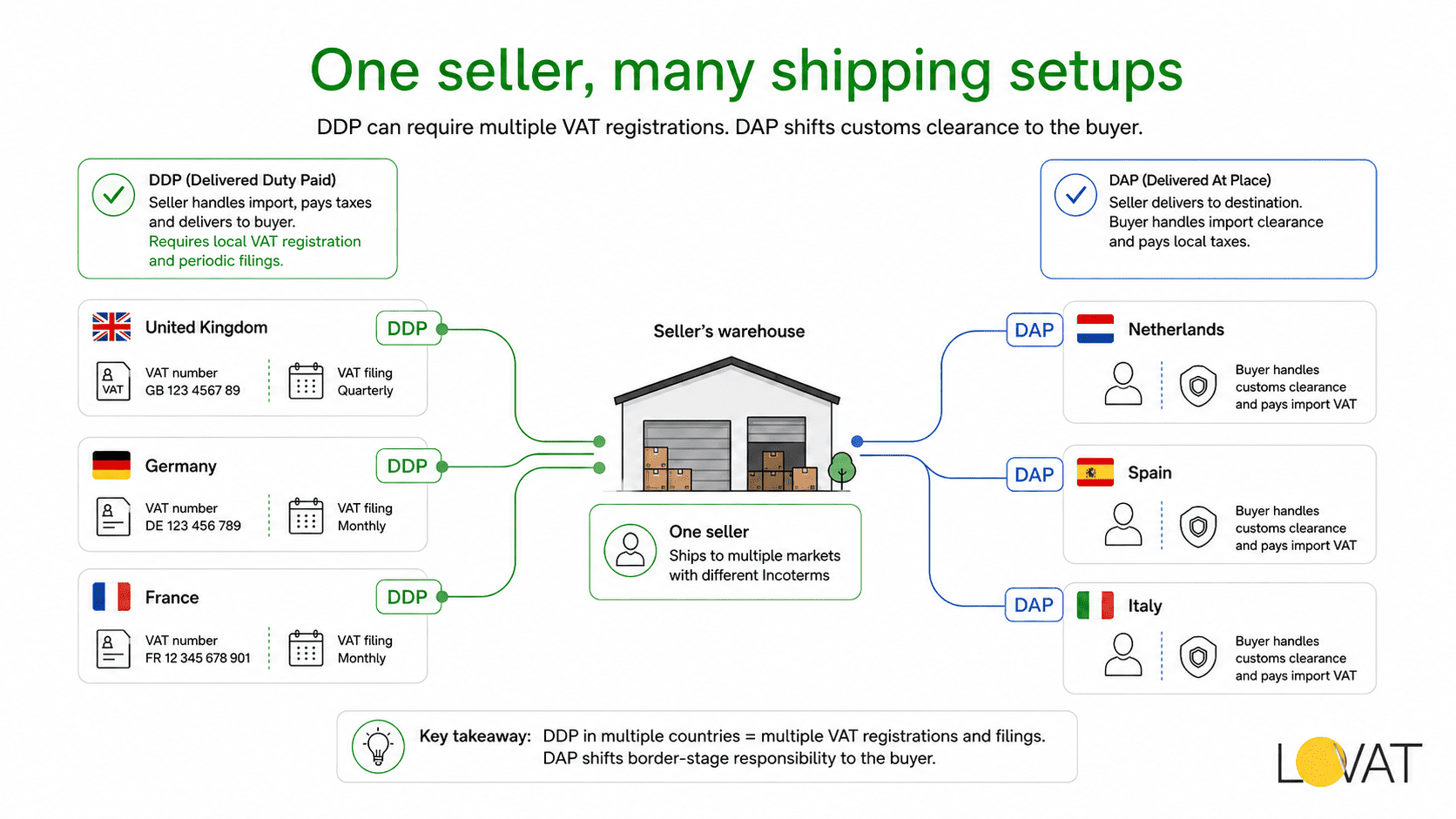
DDP stands for Delivered Duty Paid. Under this arrangement, the exporter carries goods all the way to the recipient’s door. That covers export clearance, freight, entry formalities, tariffs and tax.
DDP VAT means the exporting business becomes the party responsible on paper. This holds true in the destination country. In most cases, it forces a foreign tax registration. The vendor must charge local tax, file returns and keep local records.
A modified version of this arrangement shows up often in practice. Traders describe deals as DDPs, shorthand for several linked shipments running under one contract. The mechanics stay the same either way.
Why exporters still choose it:
- Customers see one clean, all-in price with no surprise fees
- Checkout friction drops sharply compared with recipient-pays models
- Delivery timelines stay predictable, since border delays sit with the sending party
The cost is real. A business shipping this way into five countries may need five tax numbers. That means five filing calendars and five sets of local requirements.
DAP VAT: Where the Buyer Takes Over
DAP means Delivered at Place. The sending party delivers goods to a named location but stops short of border clearance. DAP VAT treatment shifts that entry-stage tax onto the recipient.
Under this term, the recipient becomes the party named on the declaration. They clear the border and cover the tax due there. A handling fee from the courier often follows too.
Risk moves away from the exporter. Friction moves toward the customer instead, who may face an unexpected bill at the door. For trade between two businesses, this rarely causes trouble, since the receiving side already runs its own clearance process. For consumer sales, unhappy shoppers and refused parcels are common.
Incoterms DDP VAT vs DAP VAT: Quick Comparison
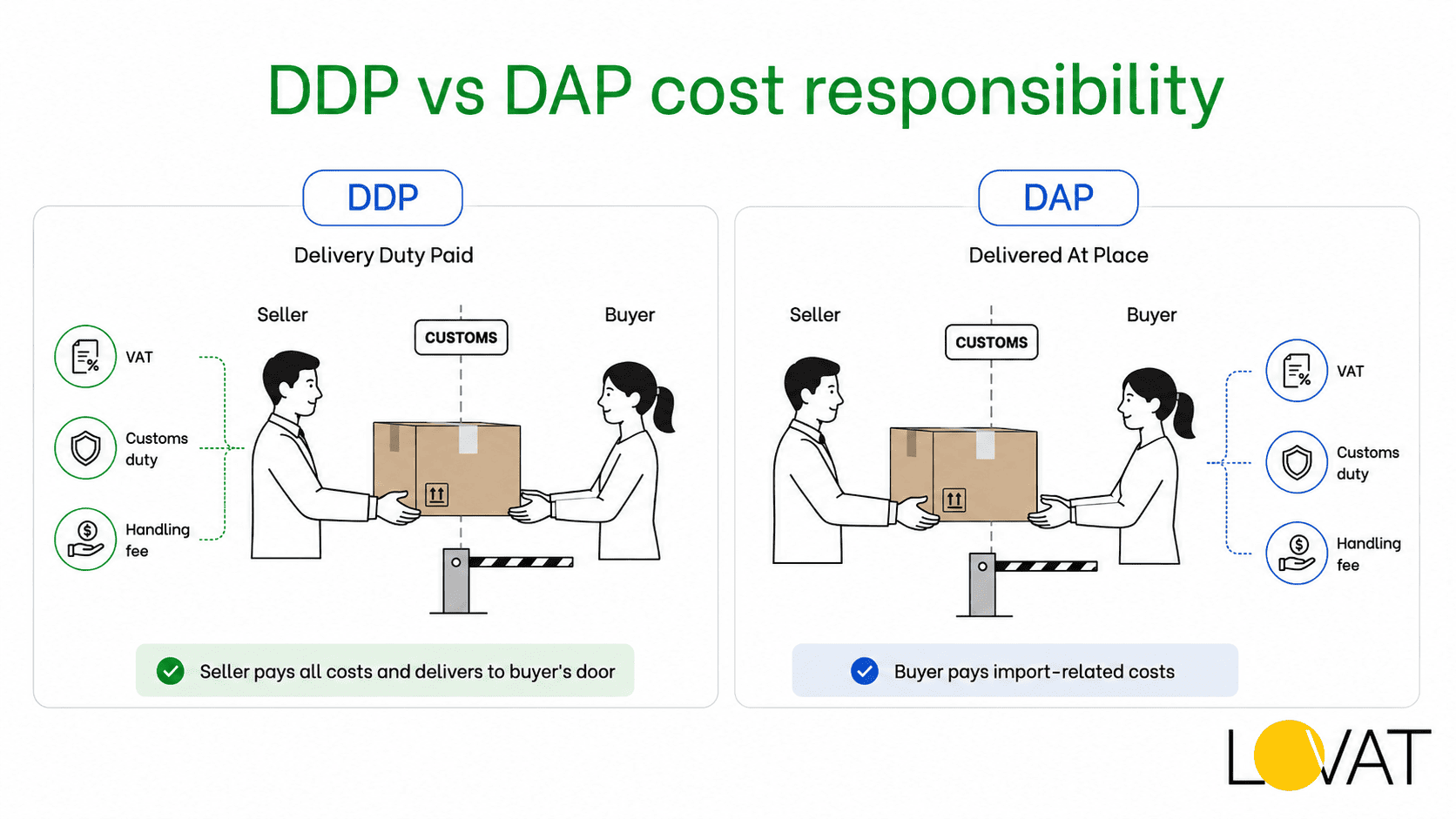
Choosing between these two arrangements is really a choice about tax risk, and which side carries it.
| Factor | DDP | DAP |
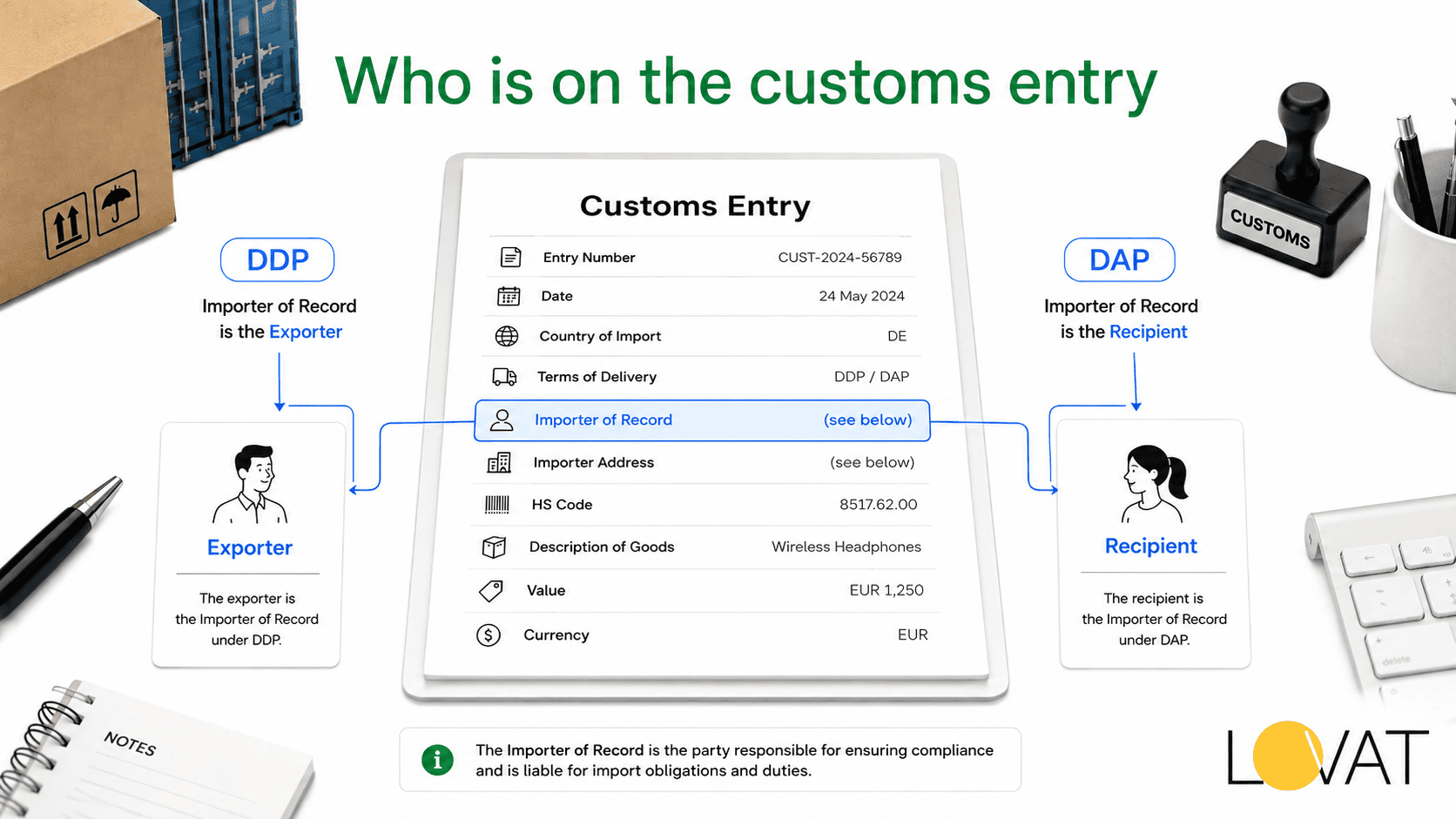
| Party named on entry | Exporter | Recipient |
| Foreign tax registration needed | Usually yes | Usually no |
| Extra charges at delivery | No | Often yes |
| Compliance workload for the seller | High | Low |
| Best fit | B2C, premium service | B2B, occasional shipments |
Both incoterms DDP VAT and the alternative setup are legal and common. Neither wins in every scenario. The right pick depends on volume, destination and what customers expect.
An incoterms DDP VAT clause should always state the destination country clearly, so liability is obvious from the start.
Who pays VAT DDP: The Named Party Question
The question of who pays VAT DDP trips up more businesses than any other part of this topic. Under this arrangement, the exporter pays. That sounds simple. In practice, it raises three separate obligations at once.
First, the sending business needs an EORI number in the destination country, or must appoint an agent who already holds one. Second, it needs a tax registration wherever goods land. Third, it must file returns on a fixed schedule, even in a quiet month.
A courier or freight forwarder can complete the paperwork. A forwarder does not automatically carry legal responsibility though. Traders who assume otherwise often learn this only after a border hold.
The short version of who pays VAT DDP: whoever is named on the customs entry. Under DDP, that name should always be the exporting business.
Not sure who should sit on your customs entry? Book a free consultation and we will map your DDP setup together.
Import VAT responsibility by Incoterm
Import VAT responsibility always traces back to the party named on the entry. That name comes from the Incoterm agreed inside the sales contract.
Three common outcomes:
- Under DDP, the exporter is named and accounts for entry-stage tax
- Under DAP, the recipient is named and accounts for entry-stage tax
- Under a hybrid setup, sometimes called DDP light, the recipient is legally named while the exporter reimburses the cost
That third pattern is common in the UK. It carries real risk. Customs law does not clearly define it. If it goes wrong, liability can land back on the exporting side anyway.
Getting import VAT responsibility straight before the first shipment saves weeks of correction later. Confirming import VAT responsibility on paper, inside the contract itself, removes most disputes before they start.
How import VAT Works in Practice
This entry-stage charge applies when goods cross into a customs territory. The rate usually matches the destination country’s standard tax rate.
A registered business can often defer or reclaim it. In the UK, this happens through Postponed VAT Accounting, letting a company declare and recover the sum on the same return. It is not automatically a lost cost. A properly registered trader with the right structure can treat it as recoverable input.
Where no local registration exists, the charge becomes a real cost. It gets paid at the border with no way to claim it back.
Customs duties and VAT: What Gets Charged and When
customs duties and VAT are two separate charges, though they often get lumped together on one invoice line.
The tariff figure depends on a product’s classification code and origin. The tax figure depends on the destination country’s own rate, applied to a base that usually includes goods value, freight and tariff combined.
| Charge | Based on | Who sets the rate |
| Customs duty | Tariff code, origin | Destination country’s tariff schedule |
| Entry tax | Value plus tariff plus freight | Destination country’s standard rate |
| Handling fee | Courier’s own policy | The courier or postal operator |
Since the tax figure includes tariff in its base, a classification error pushes both numbers off. One mistake compounds into two.
Getting customs duties and VAT right on the same invoice line matters more than it looks. A courier that miscodes a product changes both charges at once.
VAT on international shipping: A Practical Breakdown
VAT on international shipping depends on shipment value, destination and the chosen Incoterm. A single flat formula rarely applies across every lane a business ships through.
For low-value parcels into the EU, requirements changed sharply through 2025 and 2026. The old exemption for goods under €22 disappeared back in 2021. From 1 July 2026, the bloc also removed the remaining duty-free treatment for parcels valued at €150 or less. A flat customs charge per item now applies to most low-value shipments instead. This shift touches a large share of small parcels moving across the border.
For UK-bound shipments, a different split applies. Goods valued at £135 or less follow a supply-tax model. Above that figure, standard entry-stage tax and tariff requirements apply, and the DDP or DAP choice decides who carries that cost.
Treating VAT on international shipping as one fixed number rarely works. Each lane can carry its own threshold and its own scheme.
Practical steps to follow:
- Check the shipment value against the destination country’s low-value threshold
- Confirm which Incoterm the sales contract actually uses
- Match the correct scheme, whether marketplace, simplified, or standard entry-stage tax
EU VAT rules on Low-Value Imports in 2026
EU VAT rules for cross-border e-commerce sit on top of the Incoterms question. They do not replace it.
The Import One Stop Shop lets a business register once and cover checkout-stage tax for consignments up to €150. This removes the surprise-bill problem for shoppers, since the charge is already folded into the price shown at checkout.
Traders who skip this scheme still face a fallback arrangement, where the courier collects the sum from the recipient on delivery instead. From July 2026, a flat per-item customs charge now applies too, regardless of which scheme covers the shipment.
Selling into several EU states and unsure which scheme fits your shipments? Talk to our team about registering for the right EU scheme.
UK VAT rules for Cross-Border Sellers
The UK runs a parallel but separate system. For direct sales worth £135 or less, the sending business charges tax at the point of sale, and no entry-stage charge applies at that level. If a marketplace handles the sale instead, that platform usually takes on the duty.
Above £135, goods follow standard entry-stage tax and tariff requirements. Here, the Incoterm agreed between both parties decides who is named on the declaration. That party then pays.
A UK registration becomes mandatory once a business crosses the registration threshold. Roughly thirty days are allowed to notify HMRC once that happens.
UK requirements and EU VAT rules sit on separate legal bases. A business trading into both markets needs two distinct compliance calendars, not one shared checklist.
A Checklist Before You Choose an Incoterm
Run through this list before locking a shipping term into a new contract.
- Confirm the shipment value against local low-value thresholds
- Decide who should legally be named on the customs entry
- Check whether a foreign registration is already active
- Confirm your freight partner understands the chosen term correctly
- Set a filing calendar wherever a new registration starts
Skipping this short review is a common cause of blocked shipments. We see this often during onboarding calls.
Common Mistakes With DDP VAT and DAP VAT
A handful of patterns repeat across support tickets.
- Assuming a freight forwarder automatically carries legal responsibility
- Shipping under DDP terms into a new country without registering first
- Mixing DDP and DAP shipments in one contract without clear paperwork
- Ignoring the new EU low-value charge that started July 2026
- Treating a “DDP excluding tax” clause as standard DDP, when the split differs
Each pattern is fixable early. Fixing it after a border hold costs far more.
When to Use DDP and When to Use DAP
Neither arrangement suits every business model. A short comparison helps narrow the choice.
| Situation | Better fit |
| High-volume consumer sales, premium checkout wanted | DDP |
| Occasional B2B shipments to established trade partners | DAP |
| Selling into many countries at once | DAP, or DDP with a registered agent in each |
| Limited compliance resources in-house | DAP, or a managed VAT rules service |
Businesses shipping at scale rarely stick to one arrangement everywhere. Many run DDP in core markets and the alternative elsewhere, matched to registration capacity.
Record Keeping for Cross-Border Sellers
Whichever arrangement a business uses, the paperwork duty does not disappear. Authorities expect clear records covering:
- The Incoterm used on each shipment
- The name of the party declared on the entry
- Tax invoices issued at the point of sale, where relevant
- Copies of customs declarations and tariff calculations
Most tax offices expect these on file for several years. Losing access to a courier’s portal should never mean losing your own copy.
Key Deadlines Businesses Should Track in 2026
Save this short list of dates. New requirements tend to land at fixed points.
| Change | Date | Effect on sellers |
| EU duty-free treatment under €150 ends | July 1, 2026 | Flat per-item charge applies |
| UK £135 low-value model continues | Ongoing | Supply tax below, entry-stage tax above |
| Wider EU customs reform package | From 2028 | Further changes to low-value handling expected |
Businesses shipping under old assumptions risk undercharging tax. They also risk under-declaring tariffs from these dates onward. Planning VAT on international shipping around these fixed dates keeps a filing calendar calm instead of rushed.
Getting Your incoterms VAT Setup Right
Incoterms VAT decisions are not a one-time task. New thresholds and schemes keep arriving. An arrangement chosen two years ago may no longer fit today’s requirements.
A steady partner tracks these shifts, so a growing business does not need to monitor dozens of separate government sites alone. Whether a business ships under DDP, DAP, or a mix of both, the underlying filing duties still need active management.
A last note on customs duties and VAT rules: both keep moving each year. A static playbook from last year rarely still fits this year’s shipments.
We help traders register for tax and OSS or IOSS schemes, manage filings across several countries, and confirm which party should be named on each lane. Explore our VAT registration service or our OSS and IOSS registration support to see how this works in practice.
Shipping under DDP or DAP into the EU or UK and want a clear compliance map? Schedule a free call with our team and we will review your setup.