
EPR Scheme — How Extended Producer Responsibility Schemes Work
EPR Scheme — How Extended Producer Responsibility Schemes Work
Every boxed product on a European shelf leaves a trace once the wrapper hits the bin. Somebody funds the tidy-up. For decades the local council swallowed that cost, and voters paid through their taxes. That deal is dead. The rules now hand the invoice to whoever first sold the goods. They collect it through big shared systems you are obliged to join. Sell into the EU and one of them will find you quickly. Below is the plain-English version of how they run, and what you owe.
What an EPR Scheme Does
An EPR scheme is the plumbing that converts a paragraph of law into bins on a kerb. You feed it two things, numbers and cash. In return it wires up the trucks and the sorting halls. Those same reprocessing lines swallow your waste later. Picture a shared utility that tens of thousands of sellers bankroll at once.
That pooling is the clever bit. No lone brand could bankroll a national pickup network, and none should try. A middleman the trade calls a producer responsibility organisation gathers everyone’s contributions. It then does the grubby work. Germany’s Grüne Punkt and France’s Citeo are two you have almost certainly leaned on without noticing.
Why EPR Schemes Exist
EPR schemes trace back to an overflowing-bin problem. Municipal tips filled with discarded wrappers, and the clean-up drained public coffers. Legislators flipped the burden onto the makers instead. That principle first surfaced in the 1994 Packaging Directive, then crept across one product category after another.
The thinking runs deeper than neat bookkeeping. Bill a seller by the tonne and they start obsessing over every needless gram. A lighter, cleaner design suddenly protects the margin, not just the planet. That nudge is the entire purpose, and the newer Packaging Regulation leans on it even harder.
How an Extended Producer Responsibility (EPR) Scheme Operates
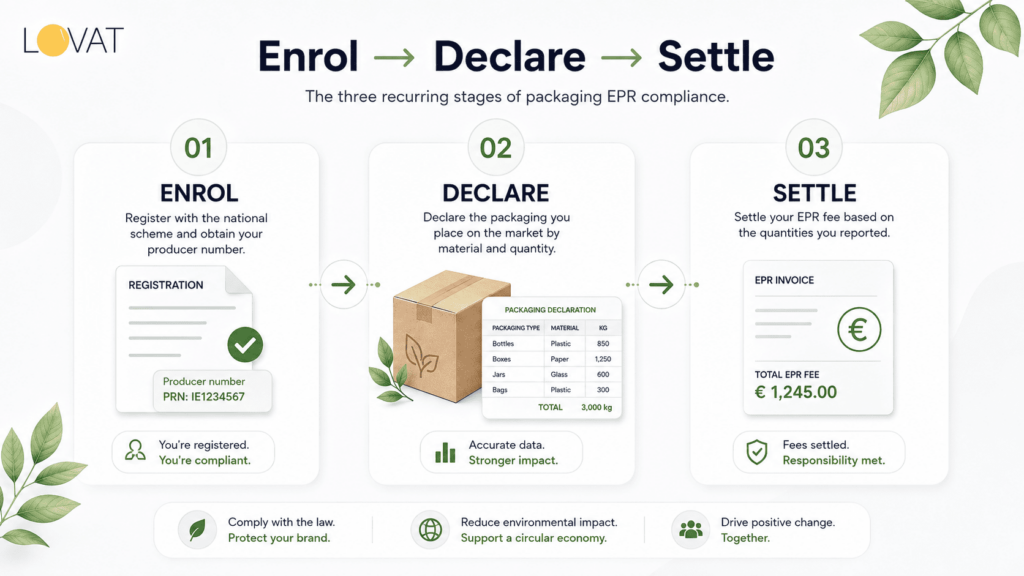
An extended producer responsibility (EPR) scheme cycles through the same three beats each year: enrol, declare, settle. You sign onto the national body before a single unit ships. Next you disclose how much wrapping you released onto that market, broken out by material. A charge lands afterwards, sized to those volumes and to how easily each format recycles.
From there the organisation runs the show. It hires the waste contractors and bankrolls kerbside pickup. Recovery figures then travel upward to the government. Your money never touches a lorry directly, yet it keeps the loop spinning. The catch: the legal liability stays glued to you if the numbers are off.
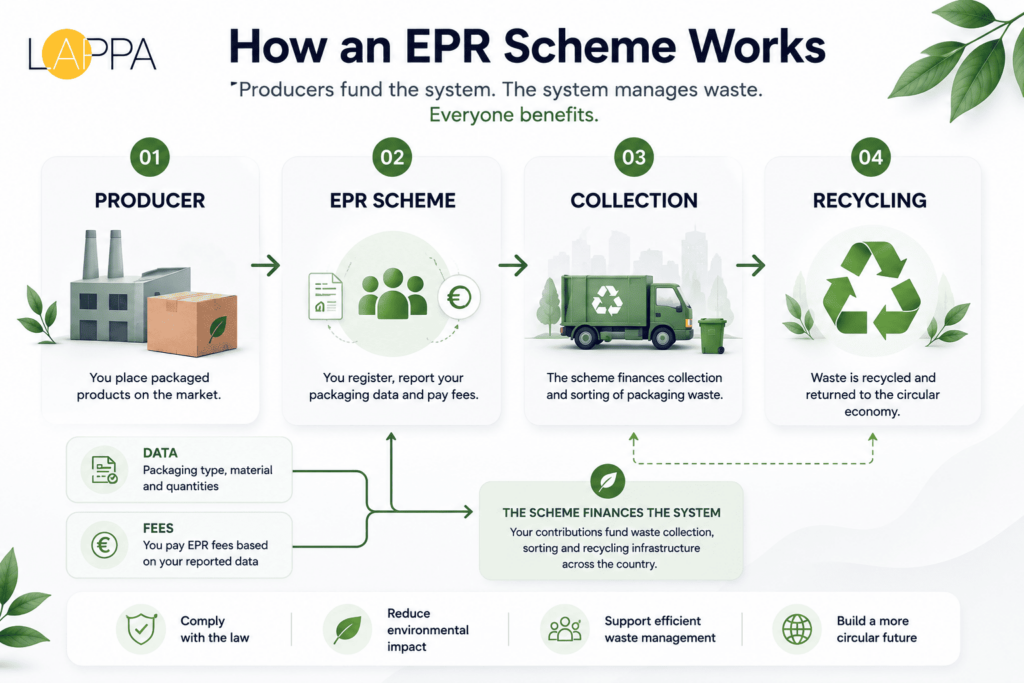
The Extended Producer Responsibility EPR Scheme in Practice
Day to day, an extended producer responsibility EPR scheme behaves like a tax return wearing a green jacket. You key tonnages of card, film, glass, and metal into a government portal. Slip past the deadline and the penalties pile on fast. We see this happen often when finance treats the filing as a nice-to-have rather than a hard date in the diary.
Precision is the usual sticking point. Low-ball your quantities and an inspection can reclaim years of skipped charges. Pad them and you gift the organisation cash for nothing. Tidy records on weights and materials rescue you from both directions.
Who Must Join
Loads of firms quietly assume the net floats past them. It almost never does. Be the first to drop packaged goods onto a national market and you are that country’s producer, no asterisk. Makers, importers, and own-label retailers all sit inside that definition.
Cross-border web sellers are the reliable blind spot. Post a parcel from Warsaw to a shopper in Lyon and France counts you as its producer. Platforms like Amazon now vet registrations before they wave your listing through. Expand into a fresh market without enrolling and a suspended listing is often the first tap on the shoulder.
Joining an EPR Compliance Scheme
Enrolling in an EPR compliance scheme means one sign-up per country, never a single continental pass. Every state fields its own portal, code, and pricing formula. The motions echo from one border to the next, yet the forms refuse to line up. Lovat absorbs that mess so you submit once and let the platform steer the rest.
Pull these together before you begin:
- Company particulars and the local tax codes
- Rough wrapping volumes, sorted by material and weight
- The product ranges and the markets you feed
- A local stand-in wherever a country insists on one
Want to enrol without the migraine? Start your EPR registration and let Lovat plot the schemes you actually need.
EPR Schemes in Europe Country by Country
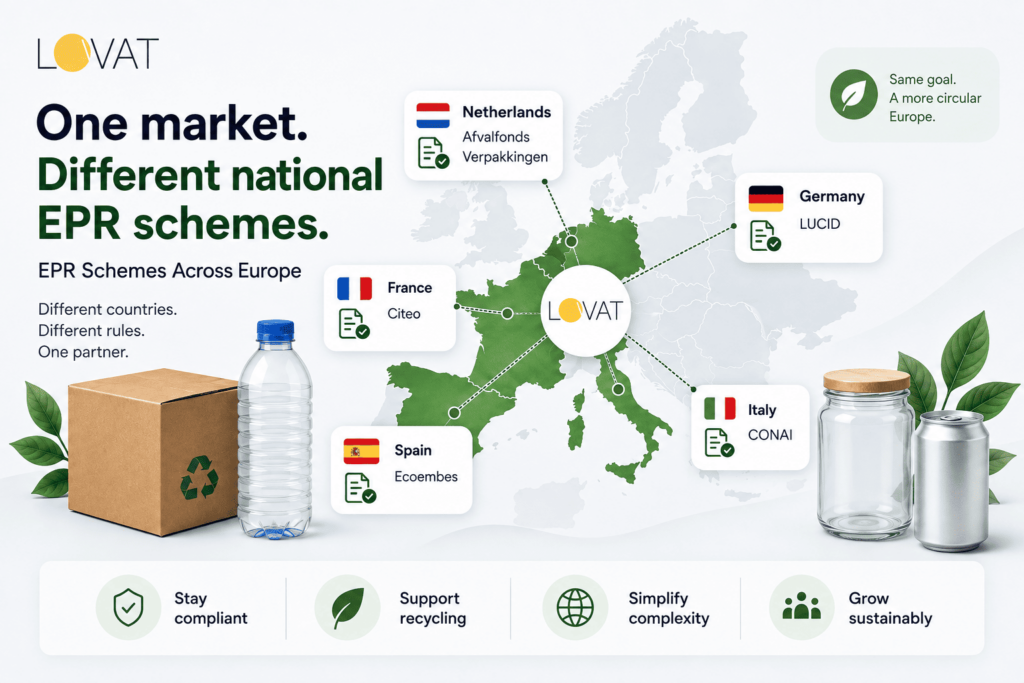
The EPR schemes in Europe diverge enough to blindside the unprepared. Entry thresholds, filing dates, and price tiers seldom agree between states. Germany insists you appear in the LUCID register before a box moves. France wants its unique identifier stamped across your paperwork.
The grid below lists a few you will bump into early.
| Country | Scheme or Register | Worth Knowing |
| Germany | LUCID plus a dual system | Enrol in the register, then contract an operator |
| France | Citeo with a unique identifier | The IDU code gets asked for constantly |
| Italy | CONAI | A veteran national consortium |
| Spain | Ecoembes and a public register | Producer and operator duties split apart |
| Netherlands | Afvalfonds Verpakkingen | Filing starts once you clear a weight line |
Streams past packaging carry their own machinery too. This second grid sketches the ones you might run into.
| Waste Stream | Governing Rule | Typical Duty |
| Packaging | Packaging Regulation and national law | Enrol, declare tonnage, settle fees |
| Electronics | WEEE Directive 2012/19/EU | Bankroll take-back of old gadgets |
| Batteries | Battery Regulation 2023/1542 | Hit collection targets and file data |
Fees, Reporting, and Eco-modulation
Flat charges are history, and that rewrites your sums. The Packaging Regulation makes eco-modulation compulsory, so the bill shadows how recyclable a format is. Fiddly, hard-to-sort wraps and virgin-plastic-heavy builds crowd the dear end. Clean, single-polymer choices claw back a discount you can genuinely see on paper.
Filing is the flip side of the bargain. You lodge tonnages on a fixed beat. That might be monthly, quarterly, or once a year, depending on the state. Late or careless returns invite fines and inspections.
Budgeting for the charges rewards a bit of homework. Rates lurch between materials, so a glass-heavy line behaves nothing like a paper one. A few countries also tack a modest sign-up charge onto the annual bill. Model each market up front and the yearly invoice springs no ugly surprises. Handle your EPR reporting from one dashboard and the dates stop ambushing you.
How to Register and Report Without the Scramble
A composed start always beats a panicked one. Chart where your wrapping first touches down, one market at a time. Sort those markets by volume and exposure, then hit the heaviest first. A single shared tracker keeps sign-ups, dates, and charges under one roof.
Move through these stages in sequence:
- Note every country where your goods first enter trade
- Pin down the operator and register for each
- Assemble volume figures by material and weight
- Line up local stand-ins wherever the rules demand
- Lodge the sign-up, then diarise every filing date
Wondering what the whole thing runs to across your markets? Request a fee quote and see the figures before you commit.
Common Mistakes to Avoid
The identical slips snare beginners over and over. Shrugging off a small market until sales there spike is the crowd favourite. One skipped sign-up in a single state can lock your listings across an entire platform. Blank spots in the data wreck every charge downstream. Missing weights are the usual culprit.
Filing once and forgetting is the other classic. Fresh products and fresh markets keep arriving, so the duty never truly rests. A brand that revisits its footprint each quarter stays a step ahead of the nasty shocks. Rather talk it through with a person? Book a call with Lovat and get straight answers to your questions.