
EU €2 Handling Fee from 1 November 2026: Who Pays It and How Does It Work with IOSS
EU €2 Handling Fee from 1 November 2026: Who Pays It and How Does It Work with IOSS
Updated: 2 November 2026
From 1 November 2026, online sellers shipping goods from outside the European Union face a new €2 Union Handling Fee per customs item. It comes on top of the temporary €3 customs duty introduced on 1 July 2026.
For many low-value e-commerce shipments, this means €5 in customs charges per distinct item — before considering VAT and any separate carrier fees.
But for businesses using the Import One Stop Shop (IOSS), the most important change is not the amount. It is understanding who must pay these charges, how they are collected and whether they belong in the monthly IOSS VAT return.
The short answer: both charges are handled through customs, not paid through IOSS. The declarant is responsible for payment. However, if the seller charges these amounts to the customer at checkout, they can affect the VAT amount reported under IOSS.
What Changed on 1 November 2026
The EU has introduced two separate customs-related measures as part of its customs reform.
| Charge | Start date | Amount | Applicable shipments |
|---|---|---|---|
| Temporary customs duty | 1 July 2026 | €3 per item | Distance-sale consignments up to €150, including IOSS imports |
| Union Handling Fee (UHF) | 1 November 2026 | €2 per item | Distance-sale imports of any value |
The temporary €3 duty replaces the previous customs duty exemption for qualifying low-value imports. It is scheduled to apply until 30 June 2028, after which normal customs tariff rules are expected to apply.
The new €2 handling fee covers customs processing and supervision costs. Unlike the €3 duty, it is not limited to consignments worth €150 or less.
Importantly, the €150 eligibility threshold for IOSS has not changed. Businesses can continue using IOSS for qualifying consignments up to €150, even though those imports are now subject to customs charges.
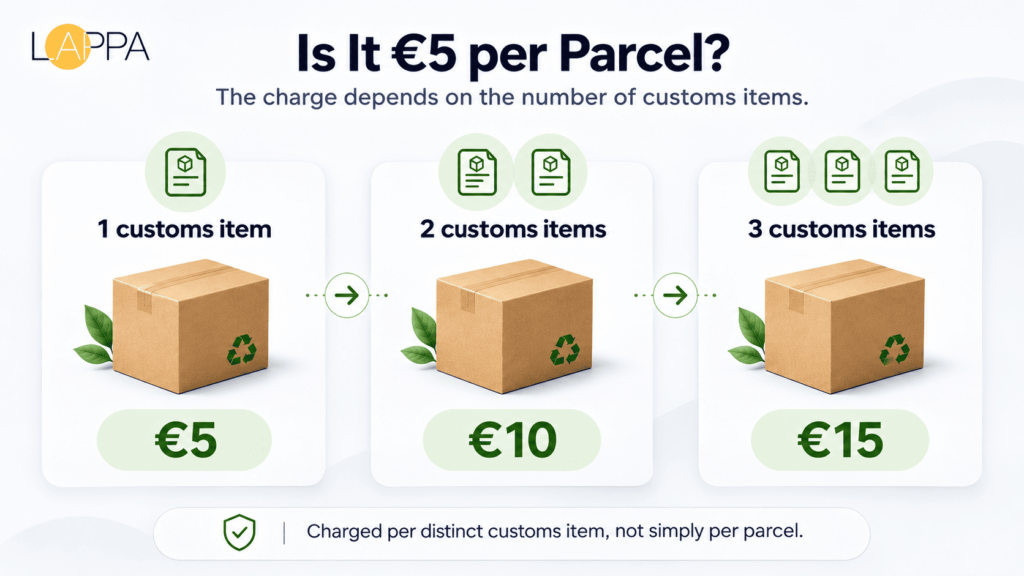
Is the New EU Import Charge €5 per Parcel?
Not necessarily.
The charges apply per distinct customs item, generally reflected as a separate goods line in the customs declaration, rather than per parcel or individual physical unit.
For example:
- One parcel containing five identical T-shirts, correctly declared as one goods item: €3 customs duty + €2 handling fee = €5.
- One parcel containing a T-shirt and a watch, declared as two different goods items: €6 customs duty + €4 handling fee = €10.
- One parcel containing three different product categories, declared on three goods lines: €9 customs duty + €6 handling fee = €15.
The customs classification, goods description and applicable declaration rules determine how items are grouped. Sellers should not assume that different products can be combined into one declaration line simply to reduce fees.
For consignments exceeding €150, normal applicable customs duties are charged instead of the temporary €3 duty, while the €2 handling fee still applies to each relevant customs item.
Who Is Legally Responsible for Paying the €3 Duty and €2 Handling Fee?
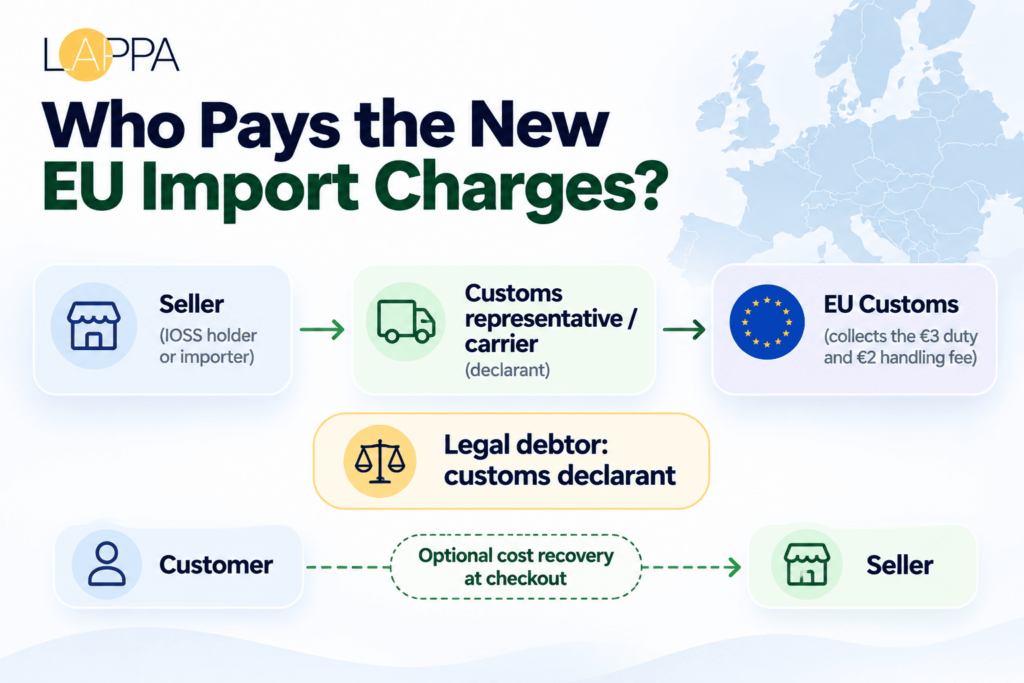
Under EU customs legislation, the declarant is the primary debtor for both the temporary customs duty and the Union Handling Fee.
The declarant may be the seller, an online marketplace or an authorised customs representative, depending on the transaction and representation arrangements.
For shipments using IOSS, EU rules prioritise the IOSS holder or its indirect customs representative as the declarant.
This distinction is especially important for independent sellers operating their own online stores.
If You Have Your Own IOSS Number
Holding an IOSS number does not mean your customs duties are automatically paid.
IOSS is a VAT collection and reporting mechanism. It allows eligible sellers to charge VAT at checkout and report that VAT through a single monthly return.
It does not provide a customs duty payment account or automatically settle the new handling fee.
An EU-established IOSS holder may act as the customs declarant directly or use an authorised representative.
A non-EU-established seller generally needs an indirect customs representative to act as the declarant. This could be arranged through a carrier, customs broker or logistics provider.
Your IOSS VAT intermediary and your customs representative are not necessarily the same company.
If an indirect customs representative acts on behalf of the seller, both the representative and the represented party may be liable for the customs debt under the applicable rules.
Does the EU Consumer Have to Pay
The new system is designed to place customs obligations primarily on businesses involved in importing the goods, rather than making consumers responsible for customs declarations.
However, the party legally responsible to customs and the party ultimately bearing the cost are not always the same.
A seller may choose to absorb the charges, include them in the sales price or recover them from the customer, subject to its contractual and consumer-law obligations.
The important point is that passing a charge to the customer does not, by itself, transfer the legal customs obligation away from the declarant.
How to Pay the New EU Customs Charges If You Have Your Own IOSS Number
Unlike IOSS VAT, these charges are collected through the customs clearance process.
For most e-commerce sellers, the practical solution is to arrange payment through their customs representative, carrier or logistics provider.
Here is what sellers should do.
Step 1. Identify who acts as the customs declarant
Ask your carrier or customs broker who is named as the declarant on your EU import declarations.
Do not assume the shipping company automatically accepts this responsibility simply because it delivers your parcels.
For non-EU businesses, confirm that an appropriate indirect customs representation arrangement is in place.
Step 2. Confirm how customs charges will be settled
Agree on the payment mechanism with your customs representative.
Depending on the customs arrangements and Member State, charges may be settled when the declaration is accepted or through an authorised deferred-payment or customs account arrangement.
Your representative may pay customs and subsequently invoice your business.
Where multiple shipments are processed, customs authorities may also require a financial guarantee covering the customs debt.
Step 3. Ensure your shipment data is complete
Your carrier or broker needs accurate product descriptions, classification data, declared values and the appropriate IOSS information.
From 1 November 2026, the customs declaration must also include the relevant Union Handling Fee reference, including TARIC code Y126 for applicable H1, H6 and H7 declarations.
Step 4. Agree who ultimately bears the charges
If you promise customers a delivered-duty-paid experience, arrange for the customs charges to be paid without an unexpected request for payment upon delivery.
If customers are expected to bear the charges, explain this clearly before checkout and confirm how your logistics provider handles collection.
Step 5. Reconcile customs payments separately from IOSS
Keep customs declarations and carrier invoices identifying the €3 duty and €2 handling fee.
Reconcile these costs against shipments, customs declaration lines and any customer charges.
They should be recorded separately from the VAT amounts remitted through the monthly IOSS return.
Do You Need to Declare the €3 Duty or €2 Handling Fee in Your IOSS VAT Return?
No. Neither the €3 customs duty nor the €2 Union Handling Fee is itself a VAT liability payable through IOSS.
Both are customs-side charges. Customs authorities collect them through the import declaration, and their legal debtor is the declarant.
However, there is an important distinction between paying the customs charges and calculating VAT on the amount collected from the customer.
According to the European Commission’s revised VAT guidance of 6 October 2026, the treatment depends on whether the seller charges these costs to the customer at the time of sale.
Scenario 1: The Seller Absorbs Both Charges
Suppose an online merchant sells an item to an EU consumer for €50, excluding VAT.
The shipment qualifies for IOSS and contains one customs item.
At a hypothetical destination VAT rate of 20%:
| Component | Amount |
|---|---|
| Product price, excluding VAT | €50 |
| VAT collected at checkout | €10 |
| Total paid by customer | €60 |
| Customs duty paid separately | €3 |
| Handling fee paid separately | €2 |
The seller bears the €5 customs cost.
Because the customs charges were not charged to the customer at the time of sale, they are not added separately to the IOSS taxable amount.
The seller reports the €50 taxable sale and €10 VAT in its IOSS return, while settling the €5 customs charges through the customs payment arrangement.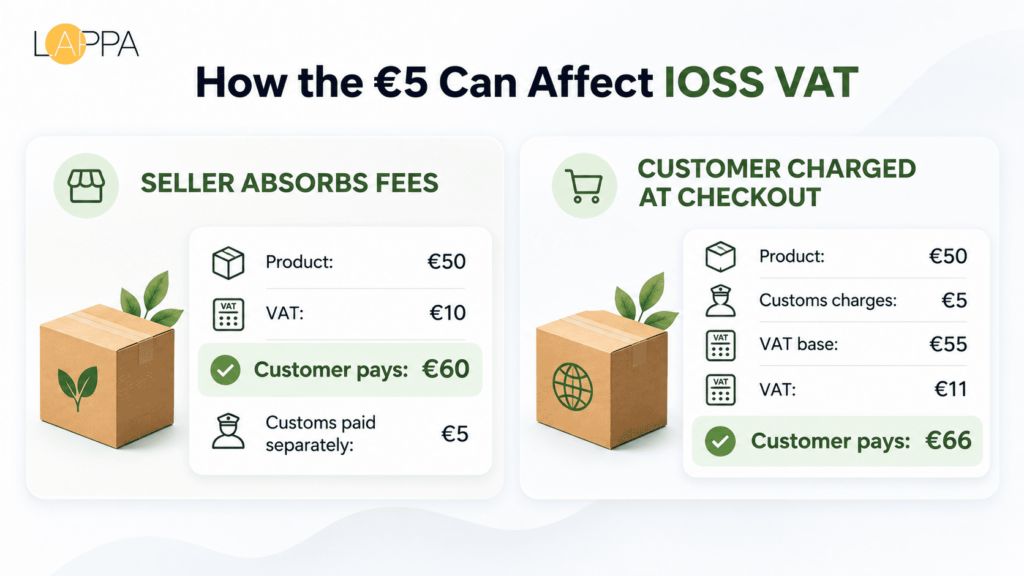
Scenario 2: The Seller Charges Both Fees to the Customer at Checkout
Now suppose the same merchant adds the €5 customs-related charges to the customer’s checkout price.
| Component | Amount |
|---|---|
| Product price, excluding VAT | €50 |
| Customs charges passed on at checkout | €5 |
| VAT taxable amount | €55 |
| VAT at 20% | €11 |
| Total paid by customer | €66 |
In this scenario, the charges form part of the consideration received by the seller.
As a result, the VAT taxable amount reported under IOSS is €55, with €11 VAT due.
The €5 itself is still settled through customs, not through the IOSS VAT payment.
This is the distinction sellers must understand:
Customs duties and handling fees are not declared as separate taxes in IOSS. But amounts recovered from customers at checkout can increase the VAT taxable amount.
For IOSS imports, no additional import VAT is due on these charges at the border where the IOSS import VAT exemption applies.
What If the Order Was Placed Before 1 November but Arrived Afterwards?
The timing of the customs declaration matters.
The Union Handling Fee becomes due when the relevant customs declaration is accepted.
For example, a customer orders a €40 product on 29 October 2026, but the parcel is declared for release into free circulation on 3 November 2026.
The new €2 handling fee applies because the customs declaration is accepted after the measure takes effect.
The timing of the IOSS VAT transaction is different: IOSS VAT is generally accounted for when payment for the order is accepted.
This is another reason why businesses should reconcile customs charges against clearance records rather than simply adding a fixed customs amount to each monthly IOSS report.
What About Sellers Using Amazon, eBay or Other Marketplaces?
The process may be simpler for sellers using a marketplace’s IOSS arrangements.
Where a marketplace qualifies as the deemed supplier for VAT purposes, it collects and reports VAT under its own IOSS registration.
The marketplace or its appointed customs representative may also arrange the customs declaration and payment of import charges.
Sellers should nevertheless confirm the relevant marketplace’s arrangements, especially which party bears the new customs costs and whether the shipping service supports them.
Businesses making their own direct-to-consumer sales outside the marketplace need to manage those shipments under their own applicable IOSS and customs arrangements.
A marketplace’s IOSS number should not be used for an independent sale made through the seller’s own website.
Another Change from 1 November: Product Identifiers
The introduction of the €2 handling fee is not the only customs change taking effect on 1 November 2026.
New product identification requirements also become mandatory for relevant distance-sale customs declarations.
These include:
- Merchant Product Identifier (M-PID): an identifier assigned by the online seller or marketplace to identify the product offered for sale.
- Non-standardised Manufacturer Product Identifier (NS-PID): a product identifier assigned by the manufacturer, producer or product supplier.
- Standardised Manufacturer Product Identifier (S-PID): an internationally standardised identifier, such as an EAN or ISBN, where one exists.
These identifiers must be provided or made available in accordance with the customs declaration requirements.
Sellers should coordinate with their fulfilment partners and customs representatives to ensure the necessary product data is available.
Are the EU Handling Fees Refundable If the Customer Returns the Product?
The €2 Union Handling Fee is non-refundable, including when goods are returned, delivery fails or the accepted customs declaration is subsequently invalidated.
The €3 customs duty is governed by the applicable customs repayment and remission rules and is not automatically refunded when a customer returns an order.
Any adjustment to VAT on a refunded IOSS sale must be considered separately under the normal IOSS rules.
For sellers with high return rates, the non-refundable handling fee is therefore a genuine additional operating cost.
Keep Your IOSS VAT Reporting Accurate with Lappa
VATCompliance by Lappa supports cross-border online sellers with IOSS registration, VAT calculation and monthly IOSS reporting.
Whether you sell through Shopify, your own online store or multiple sales channels, your VAT records should accurately reflect the amounts collected from customers.
The new customs charges must still be arranged with your carrier or customs representative.
Explore IOSS registration and compliance services or read our guide to EU VAT, OSS and IOSS rules in 2026.
Official Sources
- European Commission — VAT e-Commerce Guidelines, revised 6 October 2026
- European Commission — Guidance on the €3 Customs Duty and Union Handling Fee
- Council of the EU — Action on the Influx of Small Parcels
- Commission Delegated Regulation (EU) 2026/2152
- Dutch Customs — Handling Fee for E-commerce
This article explains the general EU rules as of 2 November 2026. Specific customs representation, payment and VAT arrangements should be checked against the applicable transactions and Member State procedures.