
VAT for SaaS companies selling subscriptions in Europe
VAT for SaaS companies selling subscriptions in Europe
VAT for SaaS companies selling subscriptions in Europe
Selling software subscriptions across Europe creates VAT obligations that are easy to overlook. A SaaS company may charge customers the same monthly subscription fee, yet the tax treatment can change depending on the customer’s location, business status and the seller’s country of establishment.
Consider a software company based in the United States. It sells a €49 monthly subscription to a consumer in France and the same plan to a VAT-registered business in Germany. The French sale will generally require French VAT. The German B2B subscription may fall under the reverse charge mechanism, meaning the customer accounts for VAT instead.
The difference affects checkout prices, invoices, recurring billing and VAT reporting.
VAT for SaaS companies is therefore more than selecting the correct tax rate. Businesses must identify customer locations, distinguish B2B from B2C transactions, determine registration requirements and maintain accurate records throughout the subscription lifecycle.
This guide explains the EU VAT rules for software subscriptions, including OSS registration, reverse charge, customer location evidence, refunds and automated compliance.
How VAT applies to SaaS and digital subscriptions
Most cloud-based software subscriptions qualify as electronically supplied services under EU VAT legislation.
Article 7 of Council Implementing Regulation (EU) No 282/2011 defines electronically supplied services as services delivered through the internet or an electronic network that are essentially automated, require minimal human intervention and depend on information technology.
Typical examples include:
- Cloud-based CRM and accounting software
- Project management and collaboration platforms
- Subscription-based analytics and reporting tools
- Automated design, marketing and productivity applications
- Cloud storage and cybersecurity subscriptions
- Software licences, upgrades and automated digital features
These services generally fall within the rules for EU digital services VAT.
However, not every service delivered online automatically qualifies. A subscription that primarily provides live consulting, individual training or substantial human-delivered services may require a different assessment.
A SaaS business offering software access together with professional onboarding, implementation or consulting should assess whether the arrangement represents one supply or several distinct services.
This distinction matters because electronically supplied services have specific B2C place-of-supply rules.
For a typical automated SaaS subscription, the customer’s country is often the deciding factor.
B2B and B2C VAT rules for SaaS subscriptions
The most important distinction in VAT on SaaS subscriptions is whether the customer is a business purchasing in its business capacity or a private consumer.
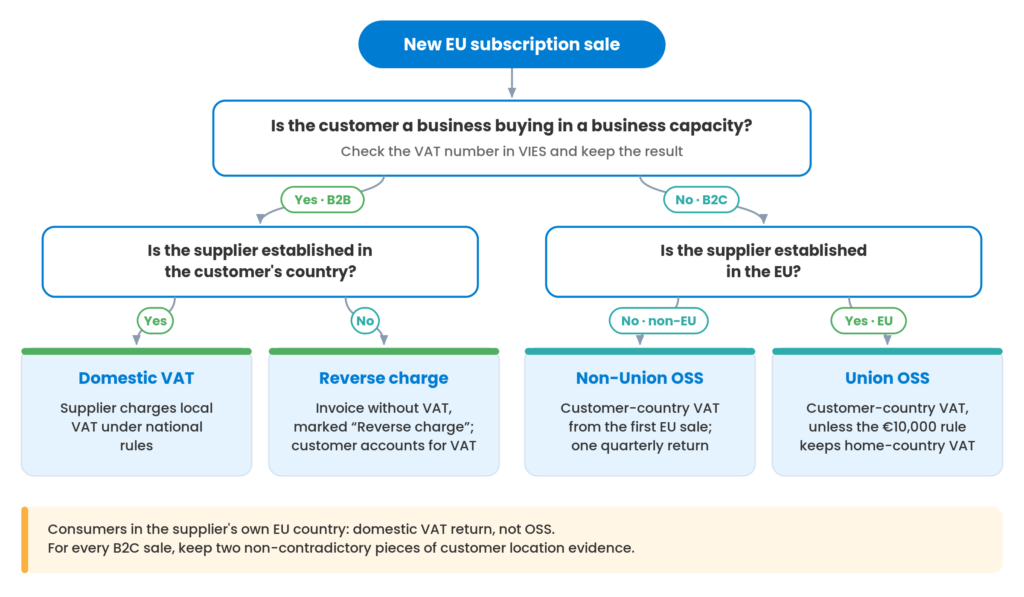
EU legislation treats these transactions differently.
VAT on B2B SaaS subscriptions
Under Article 44 of the EU VAT Directive, the place of supply for most B2B services is where the business customer is established or where the relevant fixed establishment receives the service.
For qualifying cross-border B2B transactions, Article 196 generally makes the customer responsible for accounting for VAT when the supplier is not established in the customer’s Member State.
This is known as the reverse charge mechanism.
For example, a Lithuanian SaaS company sells a €200 monthly subscription to a VAT-registered German business.
Under the normal reverse charge rules:
- The Lithuanian supplier issues an invoice without Lithuanian VAT.
- The invoice includes the relevant VAT information and the wording Reverse charge.
- The German customer accounts for the VAT under German rules.
- The supplier retains evidence supporting the B2B classification.
The supplier should verify the customer’s VAT identification number through the European Commission’s VIES VAT validation system.
A VAT number is important evidence, but its absence does not automatically prove a customer is a consumer. The actual business status and available supporting documentation must be considered.
For domestic B2B sales, normal national VAT rules generally apply unless a specific exemption or other mechanism changes the treatment.
VAT on B2C SaaS subscriptions
The position changes when the buyer is a private individual.
Under Article 58 of the VAT Directive, electronically supplied B2C services are generally taxed where the consumer is established, has a permanent address or usually resides.
A SaaS company established in Germany, for example, may need to apply French VAT to a subscription sold to a French consumer.
The supplier’s headquarters, server location and payment processor do not, by themselves, determine which country’s VAT rate applies.
There are limited exceptions, including the €10,000 cross-border threshold for eligible EU-established suppliers, discussed below.
B2B and B2C VAT comparison
| Subscription scenario | General VAT treatment | Who accounts for VAT |
| German SaaS company → German consumer | Domestic German VAT rules | Supplier |
| German SaaS company → French consumer | French VAT, unless an applicable exception applies | Supplier |
| German SaaS company → French VAT-registered business | Usually reverse charge | Customer |
| US SaaS company → German consumer | German VAT under B2C digital services rules | Supplier |
| US SaaS company → German business | Usually reverse charge | Customer |
| EU SaaS company → consumer outside the EU | Generally outside the scope of EU VAT | Check destination-country tax obligations |
The table assumes a conventional electronically supplied SaaS service. Specific establishments, exemptions and other circumstances may affect the result.
SaaS companies selling to both businesses and consumers need a reliable way to identify customer types before calculating VAT.
For a broader explanation, see our guide to B2B and B2C VAT rules on cross-border sales.
How VAT rates affect monthly and annual SaaS pricing
There is no single EU VAT rate for software subscriptions.
Each Member State establishes its own VAT rates within the EU legal framework. Standard VAT rates vary by country, and most conventional SaaS subscriptions are subject to the applicable standard rate.
This means that an identical subscription may have different final prices depending on the consumer’s country.
For SaaS companies, the difference is particularly important when displaying VAT-inclusive or VAT-exclusive prices.
Example of VAT exclusive subscription pricing
Suppose a software provider charges €50 per month before VAT.
If the applicable VAT rate is 20%:
| Item | Amount |
| Monthly subscription excluding VAT | €50.00 |
| VAT at 20% | €10.00 |
| Customer pays | €60.00 |
The 20% rate is illustrative. The actual rate must be determined according to the relevant jurisdiction and supply.
Example of VAT inclusive subscription pricing
Now consider a SaaS provider advertising a fixed consumer price of €60, including VAT.
At an illustrative VAT rate of 20%:
- Subscription price including VAT: €60.00
- Net revenue excluding VAT: €50.00
- VAT collected: €10.00
If the supplier maintains the same VAT-inclusive price across countries with different tax rates, its net revenue will also differ.
For subscription businesses, this affects pricing strategy, margins and revenue reporting.
The pricing system must therefore distinguish between net and gross subscription amounts and apply the correct rate to the right customer.
VAT for SaaS should be considered when creating subscription plans, not only when preparing tax returns.
EU businesses can consult the European Commission’s VAT rates information and national tax authorities for applicable rates.
When the €10,000 EU VAT threshold applies to SaaS
The EU provides a limited simplification for certain small businesses supplying telecommunications, broadcasting and electronically supplied services to consumers in other Member States.
Where the conditions are met, a supplier established in only one EU Member State can continue applying the VAT rules of its own country while relevant cross-border turnover remains within €10,000 excluding VAT.
This is not a €10,000 threshold for each destination country.
The threshold combines qualifying cross-border B2C telecommunications, broadcasting and electronic services with relevant intra-Community distance sales of goods.
It must not have been exceeded in either the current or the preceding calendar year.
For example, a SaaS company established only in Lithuania sells digital subscriptions to consumers in France, Germany and Spain.
If its relevant cross-border sales remain within the threshold in both years, the company may qualify to apply Lithuanian VAT rather than the different destination-country rates.
Once the applicable threshold is exceeded, the customer-location rule applies to relevant supplies from that point.
Eligible businesses can also choose to apply destination-country VAT voluntarily, subject to the applicable election rules.
Important: the €10,000 simplification generally does not apply to SaaS providers established outside the EU.
The EU small enterprise VAT exemption
A separate cross-border SME VAT scheme has applied since 1 January 2025.
Under this scheme, eligible EU-established small enterprises may benefit from VAT exemptions in participating Member States, provided both the EU-wide annual turnover ceiling of €100,000 and the relevant national thresholds and conditions are satisfied.
Participation requires the appropriate procedures and identification. It is not an automatic exemption for every SaaS startup.
The €10,000 place-of-supply threshold and the €100,000 cross-border SME scheme are different rules serving different purposes.
Businesses should assess both schemes before deciding how to register and charge VAT.
Figure 2. Three EU VAT thresholds that SaaS teams often confuse, and what each one controls.
VAT registration for SaaS companies established outside the EU
A SaaS company does not need an office in Europe to create EU VAT obligations.
Businesses established in the United States, United Kingdom, Canada, India or other non-EU countries can become liable to collect EU VAT when selling qualifying digital subscriptions to EU consumers.
For typical electronically supplied B2C services, there is no general EU-wide sales threshold that allows non-EU suppliers to ignore destination-country VAT until they reach a particular turnover.
Consider a US software provider launching a €29 monthly productivity subscription.
Its first consumer customers live in Germany, France and the Netherlands.
The provider needs to assess the VAT treatment of those subscriptions from the beginning of its taxable EU B2C activity.
One way to manage these obligations is through the Non-Union One Stop Shop.
How Non-Union OSS works for SaaS companies
The Non-Union OSS scheme allows an eligible supplier with no business or fixed establishment in the EU to register in one Member State and declare qualifying B2C services supplied throughout the EU.
The supplier can choose its Member State of identification.
Instead of managing a separate local VAT registration for every qualifying consumer market, the business submits one Non-Union OSS return covering the eligible services.
The scheme is optional, but once selected it must be applied consistently to all supplies within its scope.
Non-Union OSS does not eliminate the need to identify customers’ countries or apply the correct VAT rates.
It simplifies registration, declaration and payment procedures.
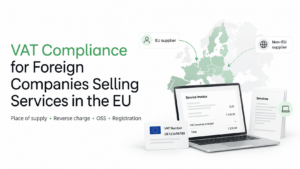
For more information, read our VAT compliance guide for foreign companies selling services in the EU
OSS VAT reporting for SaaS subscription businesses
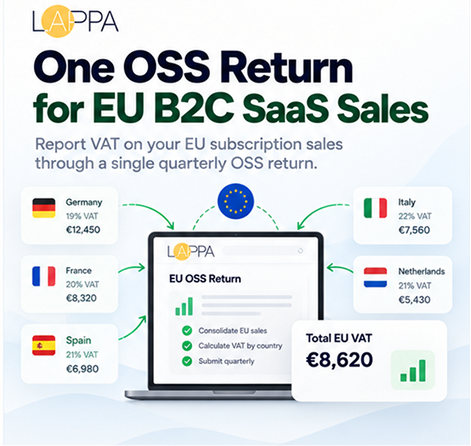
The One Stop Shop system allows eligible businesses to declare VAT on qualifying cross-border B2C supplies through one selected EU Member State.
For SaaS providers, the relevant schemes are usually Union OSS and Non-Union OSS.
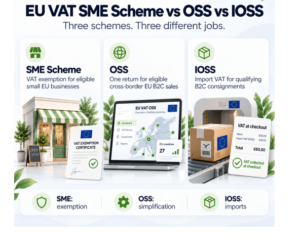
| Scheme | Suitable SaaS supplier | Main purpose |
| Union OSS | EU-established SaaS businesses | Report qualifying B2C services taxable in Member States where the supplier is not established |
| Non-Union OSS | SaaS businesses without an EU establishment | Report qualifying B2C services taxable in EU Member States |
| IOSS | Sellers of qualifying low-value imported goods | Not intended for ordinary SaaS subscriptions |
IOSS should not be confused with OSS. The Import One Stop Shop applies to qualifying distance sales of imported goods, not software subscriptions delivered electronically.
How frequently must SaaS companies submit OSS returns
Union OSS and Non-Union OSS returns are submitted quarterly.
Returns and payments are generally due by the last day of the month following the reporting quarter.
For example:
| Reporting period | OSS deadline |
| January–March | 30 April |
| April–June | 31 July |
| July–September | 31 October |
| October–December | 31 January of the following year |
The deadlines follow the OSS calendar rules. Businesses should not assume that weekends or public holidays automatically extend them.
OSS returns report the VAT due in the relevant Member States of consumption. The authority in the Member State of identification distributes the declared VAT through the EU system.
For EU-established companies, an OSS return does not replace domestic VAT reporting obligations.
A Lithuanian SaaS company, for example, may submit domestic returns for its Lithuanian taxable activities while using Union OSS for qualifying B2C services in other Member States.
Companies must also maintain records supporting the amounts reported.
Under the OSS record-keeping requirements, transaction records generally need to be retained for ten years from the end of the year in which the transaction occurred.
How SaaS companies verify customer location for VAT
Determining a customer’s country is one of the most important aspects of SaaS VAT compliance in Europe.
A billing address alone is not necessarily sufficient in every situation.
For B2C electronically supplied services, the EU VAT implementing rules generally rely on two pieces of non-contradictory evidence to support the customer’s location, subject to specific presumptions and simplifications.
Accepted types of evidence can include:
- Customer billing address
- IP address or other geolocation data
- Bank or payment account information
- Mobile country code
- Other commercially relevant information
A simplified one-item evidence rule may apply to certain qualifying EU-established suppliers with relevant electronically supplied services not exceeding €100,000 in the current and preceding calendar years, provided the regulatory conditions are met.
This evidence threshold is separate from the €10,000 place-of-supply threshold.
A practical example of conflicting customer data
A customer enters a German billing address but uses a payment method associated with France.
The SaaS provider should not automatically assume the customer belongs to Germany.
Its checkout and tax processes should identify inconsistent location evidence and establish a defensible customer location before finalising the VAT treatment.
Customer evidence should be retained with the corresponding transaction information so the business can demonstrate how the tax jurisdiction was determined.
VAT number validation for B2B customers
Business subscriptions require another control: validating customer tax status.
When a customer provides an EU VAT number, the SaaS provider should check it through VIES and retain the validation result where appropriate.
This supports the application of cross-border B2B VAT rules.
A customer changing from a personal account to a business account should also trigger a review of the VAT treatment for future invoices.
The key principle is that tax classification should reflect verified customer information, not merely the type of subscription plan selected.
VAT on recurring payments, annual plans and refunds
Subscriptions introduce VAT issues that do not always arise in conventional one-off sales.
A SaaS provider may sell monthly plans, annual subscriptions, additional user seats and usage-based features. Each billing event must be reflected correctly in its tax records.
Monthly and annual SaaS subscriptions
An annual subscription paid upfront and a monthly subscription charged periodically may have different VAT tax-point considerations.
The exact tax point depends on the applicable national rules, the nature of the supply and the payment arrangements.
SaaS companies should not assume that VAT is always due only when revenue is recognised for accounting purposes.
Tax liability and accounting revenue recognition are separate matters.
The system should retain the subscription period, payment information, invoice date and relevant tax details.
Free trials and promotional discounts
A genuinely free software trial normally does not involve consideration for the digital service itself.
When the trial converts into a paid subscription, the new taxable transaction must be handled under the applicable VAT rules.
Discounts can also affect the taxable amount.
For example, if a company gives a customer a 25% discount on its first paid month, the tax calculation should reflect the actual taxable consideration, subject to the applicable rules.
Promotional codes, free months, credits and bundles should be recorded consistently.
Refunds, cancellations and credit notes
A SaaS customer may cancel halfway through an annual contract and receive a partial refund.
The tax treatment must follow the underlying adjustment and applicable national rules.
For OSS reporting, the European Commission provides procedures for corrections relating to previous returns.
Where a credit note affects a transaction declared in an earlier OSS period, the relevant correction is generally made through a subsequent OSS return, identifying the original period.
A refund should therefore not simply disappear from the transaction history.
The platform needs sufficient records to connect the original sale, adjustment and resulting VAT treatment.
VAT invoicing requirements for European SaaS customers
Correctly calculated VAT is not enough if subscription invoices contain inaccurate information.
For most B2B supplies, EU legislation requires a VAT invoice.
Invoices should contain the information relevant to the transaction, which may include:
- Supplier’s legal details and VAT number where applicable
- Customer’s legal details
- Customer VAT identification number where required
- Invoice date and unique identification number
- Description of the software subscription
- Taxable amount and applicable VAT rate
- VAT amount or the applicable reverse charge wording
In a cross-border B2B reverse charge scenario, the invoice generally needs to identify the reverse charge treatment clearly.
For B2C supplies, invoice requirements vary according to the scheme and the applicable national rules. Not every consumer subscription requires an invoice under the same conditions as a B2B transaction.
SaaS businesses must also distinguish VAT invoices from payment receipts.
A payment confirmation from a subscription processor is not automatically a compliant VAT invoice.
As European e-invoicing obligations develop, companies with larger B2B customer bases may also need to support country-specific invoice formats and electronic reporting processes.
The European Commission publishes the relevant EU VAT invoicing framework.
Integrating SaaS billing systems with VAT reporting
Subscription companies often collect financial data through several systems.
A typical SaaS business might use Stripe for payments, Chargebee or Recurly for subscription billing, and an ERP or accounting platform for financial reporting.
Without a coordinated process, tax teams may need to reconcile separate exports containing invoices, customer details, refunds, subscription changes and payment information.
This can become difficult when the business sells across multiple VAT jurisdictions.
The role of subscription billing integrations
The ideal reporting workflow connects the original subscription transaction to the information needed for its tax treatment.
For example:
- A customer purchases or renews a software subscription.
- The billing system records the transaction and available customer information.
- Relevant financial and tax data is transferred into the compliance workflow.
- The transaction is classified according to its VAT treatment.
- Reporting data is consolidated by country and filing period.
- The finance team reviews the results and prepares the required declarations.
This process helps prevent missing transactions and inconsistent treatment of recurring payments.
The exact level of automation depends on the integration, configuration and accounting workflow.
ERP integrations for multi-country VAT compliance
Growing SaaS businesses may use systems such as SAP ERP, Oracle NetSuite or Microsoft Dynamics 365.
Connecting ERP and VAT reporting workflows can help finance teams work with consistent transaction records instead of manually combining separate spreadsheets.
Lappa’s integration catalogue includes subscription and payment systems such as Stripe, Chargebee and Recurly, alongside ERP and accounting applications.
Actual connector capabilities, availability and setup requirements should be confirmed for the selected L’Tax workflow.
For a company managing subscriptions across Europe, the objective is not simply to connect more software. It is to maintain consistent data from the original billing event through to tax reporting.
How Lappa helps SaaS businesses manage European VAT
As SaaS businesses expand into new markets, VAT compliance becomes a recurring operational responsibility.
A growing company may need to manage thousands of subscription transactions, multiple currencies, different customer types and several VAT reporting periods.
Lappa L’Tax provides tools for managing VAT calculation, transactions, reporting and tax obligations within a centralised environment.
Transaction monitoring
L’Tax includes a transaction interface where users can review sales data and the associated tax treatment.
Available views include transaction amounts, taxes, jurisdictions, dates and other reporting information.
This allows finance teams to examine transaction data and identify items requiring review before reporting.
For SaaS businesses, centralising subscription transactions can support more consistent reconciliation between billing records and tax reporting.
Multi-country VAT returns
The L’Tax VAT Returns interface supports multiple reporting types, including national VAT returns, Union OSS and IOSS.
Users can review relevant reporting periods, countries, amounts and submission statuses.
For businesses selling digital subscriptions across Europe, the ability to manage different VAT reporting obligations in one interface can simplify internal oversight.
Tax audit reports and liabilities
L’Tax also includes reporting tools for viewing VAT liabilities, preparing tax audit reports and reviewing upcoming obligations.
These features can help finance teams organise information for periodic tax reviews.
Accurate source data and appropriate checks remain essential. Automated calculations do not eliminate the need to verify customer status, transaction classification or reporting requirements.
Tax authority communication
The platform includes a Messages section for correspondence, document requests and related communication.
Having communications and supporting documents accessible within a shared compliance workflow can help businesses handle inquiries without relying entirely on separate email threads.
This is particularly relevant to companies managing VAT obligations across several countries.
VAT compliance alongside subscription billing
Lappa also offers integration options for financial and subscription systems.
By combining data collection, VAT calculation and reporting tools, SaaS businesses can establish a more structured compliance process as subscription volumes increase.
Learn more about Lappa VAT compliance software, or compare the available VAT software plans.
Common VAT mistakes SaaS businesses should avoid
Many errors arise not from the complexity of the VAT rate itself, but from incomplete or inconsistent subscription data.
| Common mistake | Potential consequence | Recommended control |
| Treating every subscription as B2C | Incorrect VAT charged to business customers | Validate customer tax status |
| Applying the supplier’s domestic VAT to all EU consumers | Incorrect destination-country VAT | Determine the customer’s place of supply |
| Assuming the €10,000 threshold applies to non-EU suppliers | Unreported VAT obligations | Verify eligibility for the threshold |
| Confusing OSS with IOSS | Using an inappropriate tax scheme | Distinguish digital services from imported goods |
| Ignoring customer location evidence | Inability to support VAT treatment | Retain appropriate location records |
| Missing annual subscription refunds | Inaccurate taxable amounts | Reconcile credits and corrections |
| Assuming payment receipts satisfy all invoicing requirements | Incomplete VAT invoice records | Review national invoicing requirements |
| Not reconciling billing and tax reports | Missing or duplicated transactions | Review transaction data before filing |
SaaS companies should assess these risks before entering additional markets.
Correcting historical VAT errors may involve amended returns, additional payments and correspondence with tax authorities.
A structured review is usually easier than rebuilding subscription records after an audit begins.
Preparing SaaS VAT compliance for the next EU reforms
European VAT requirements will continue to evolve.
The VAT in the Digital Age (ViDA) package, adopted in March 2025, introduces changes across several implementation stages.
Under the current European Commission timetable:
- 1 January 2027: targeted changes and clarifications affecting OSS and IOSS.
- 1 July 2028: major Single VAT Registration reforms and further OSS developments.
- 1 July 2030: digital reporting requirements for relevant cross-border B2B transactions, alongside mandatory e-invoicing under the EU framework.
Not every measure directly changes the VAT treatment of a SaaS subscription. Nevertheless, businesses providing cross-border digital services should monitor developments in registration, reporting and invoicing.
SaaS businesses should ensure their systems can accommodate changes in customer classification, invoice requirements, tax reporting and documentation.
Preparing consistent transaction data now can make future compliance changes easier to manage.
Manage European SaaS VAT with Lappa
Selling subscriptions internationally should not require a separate manual reporting process for every customer location.
The right VAT workflow starts with reliable customer classification and location evidence. It continues through accurate tax calculation, recurring invoicing, refunds and timely reporting.
Lappa helps SaaS businesses bring these processes into a more centralised compliance environment.
Whether your company is launching its first European subscription plan or managing recurring revenue across multiple markets, a structured VAT approach supports more consistent financial operations and international growth
This guide reflects the EU VAT framework as of October 2026. Specific circumstances, national rules and subsequent legislative changes may affect the treatment of individual transactions.