

VAT Adjustments for Returned Goods — How Ecommerce Sellers Correct VAT
VAT Adjustments for Returned Goods — How Ecommerce Sellers Correct VAT
A customer in Lyon sends back a jacket. You repay her three weeks later. By then the sale was already declared and taxed. Each case like this needs a VAT adjustment, or you keep paying tax on money you no longer hold. Returns are routine in online retail, so the fix must be routine too. This guide covers the rules, the timing and the bookkeeping for sellers in the EU and the UK.
When a VAT Adjustment Is Required After a Return
Output tax follows the consideration the seller actually keeps. When goods come back and money goes back, that consideration falls. The seller must then reduce the taxable amount it reported. A correction is usually due when three conditions meet:
- The original order was reported in an earlier filing period.
- The customer returned the goods or cancelled the order.
- The money was repaid to a card or offset against another invoice.
If the sale and its reversal fall in the same period, report only the net figure. No separate correction appears anywhere. A VAT adjustment becomes visible only when the repayment lands in a later period.
An exchange for an identical item at the same price changes nothing. The consideration stays the same, so there is nothing to correct. A replacement at a lower price, however, reduces the base by the difference.
The EU and UK Legal Basis for Correcting Output Tax
Inside the Union, Article 90 of Directive 2006/112/EC sets the principle. Where a supply is cancelled or refused, or the price falls afterwards, the taxable amount is reduced. Each member state sets its own conditions. That is why deadlines and paperwork differ between countries.
Article 219 adds a documentary rule. Any document that amends and clearly refers to the initial invoice is treated as an invoice. In practice, that document is the credit note. Business customers must mirror the change on their side. Under Article 185, they reduce their deduction when a purchase is cancelled.
The UK kept a similar logic after Brexit. Regulation 15C of the national regulations of 1995 governs credit notes. Regulation 24B fixes the timing: a decrease occurs when the supplier pays the amount back. A compliant credit note normally shows:
- A unique number and the date of issue.
- Supplier and customer details, with tax numbers for B2B deals.
- The number and date of the original invoice.
- A description and quantity of the returned items.
- The net amount, the rate and the tax reversed.
How to Calculate a VAT Value Adjustment for Full and Partial Refunds
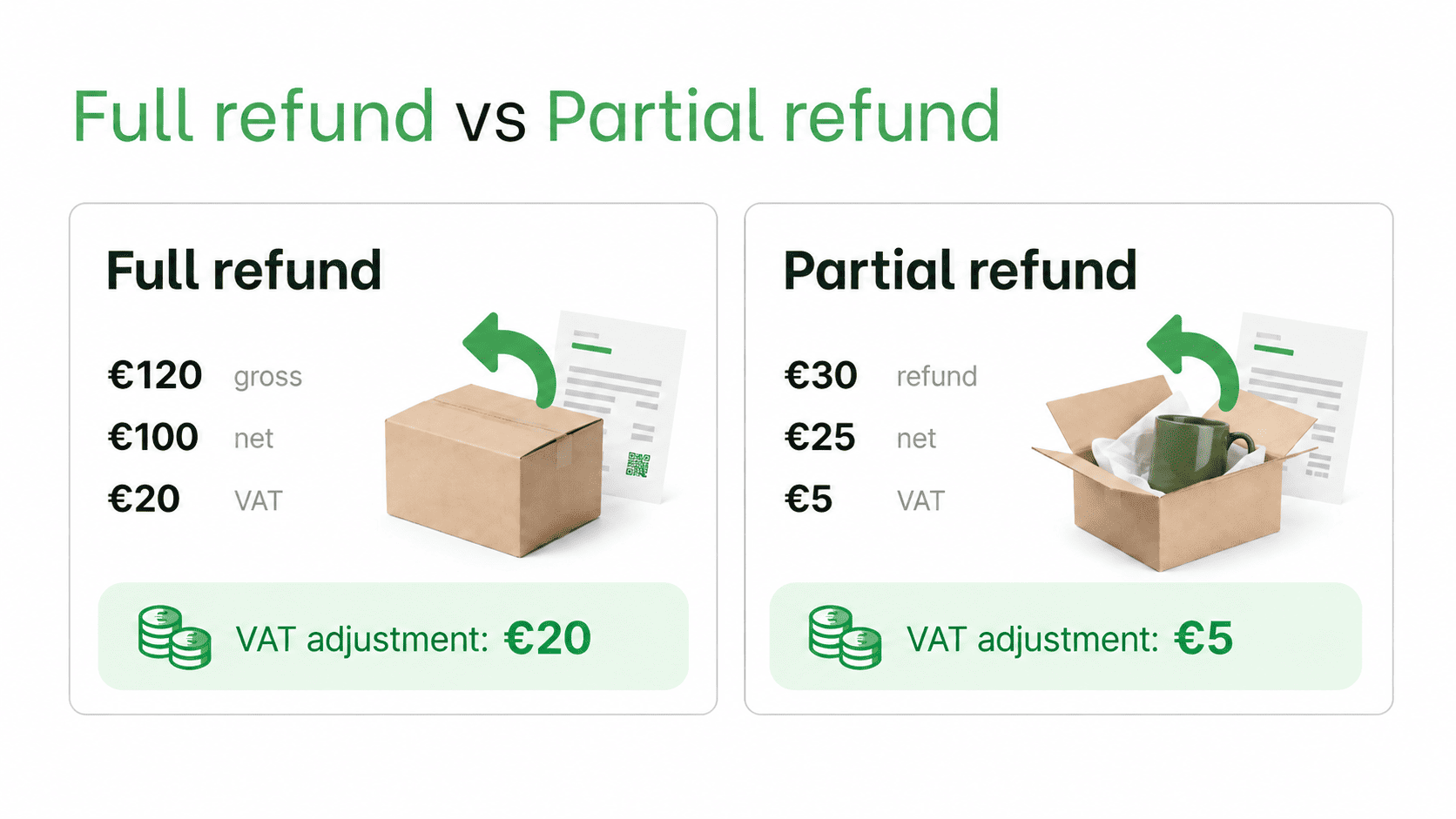
Most online prices are gross. The tax inside a gross repayment equals amount × rate ÷ (100 + rate). That result is your VAT value adjustment for the order.
Take a French consumer who pays €120 at the 20% standard rate. The price holds €100 net and €20 tax. Taking the item back in full reverses both amounts.
Partial refunds follow the same formula. Say the buyer keeps a scratched item for a €30 discount. The tax share is €30 × 20 ÷ 120, which gives €5. Net turnover falls by €25.
Link every adjusted VAT value to its credit note in your system. Auditors will trace each figure back to one order.
Delivery charges need care. If you repay shipping, reduce the tax on it as well. A restocking fee you keep stays taxable. Only the amount actually paid back lowers the base.
Always use the rate shown on the original invoice. A rate change between the sale and the return does not alter the maths. The VAT value adjustment must mirror the tax first charged.
Need the rate that applied in the buyer’s country on the sale date? Check it in our free rate calculator or open our country guides.
Recording the VAT Adjustment Entry in Your Books
The accounting mirrors the original sale in reverse. For the €120 French order, a standard VAT adjustment entry debits sales returns €100 and output tax payable €20. On the other side, the bank or customer account takes €120. A clean workflow runs in six steps:
- Receive the goods and log the date they arrived.
- Pay the refund or offset it on the customer account.
- Issue a credit note that references the original invoice.
- Post the reversal of net sales and output tax.
- Tag the record with country, rate and original period.
- Carry the figure into the correct filing.
Tagging matters most for cross-border sellers. One VAT adjustment entry may belong to Italy, the next one to Spain. Without the tag, corrections end up in the wrong country’s totals.
Shop platforms often generate VAT adjustment entries automatically. Still, reconcile them monthly against payment provider reports. Repayments sent outside the platform, such as bank transfers, are the ones most often missed.
Correcting OSS and IOSS Declarations After Customer Refunds
The One Stop Shop has its own method. You never reopen the original quarter. Changes go into a later declaration instead. That later filing must name three details: the member state of consumption, the original period and the tax amount corrected. Articles 369g and 369t of the Directive allow this within three years of the date the first declaration was due.
Here is a worked timeline. A German seller ships the €120 jacket to Lyon on 18 June 2026. The sale goes into the Q2 filing, due 31 July 2026. The customer is repaid on 9 July 2026. The correction then appears in the Q3 filing, due 31 October 2026, against France and Q2. The last possible date for this change is 31 July 2029.
Totals for one country can turn negative. This happens when returns there exceed new orders. The member state of consumption then repays the excess directly. A quarter with only corrections still requires a filing. The same logic applies to monthly IOSS declarations for imported parcels.
| Situation | Where the correction goes | When | Time limit |
| Sale and return in one period | Net figure in the current filing | Same period | Not needed |
| Domestic EU order, later return | Current national filing | Period the change occurs | National rules |
| OSS or IOSS order, later return | Correction section of a later filing | Any later period | 3 years from the original due date |
| UK order, later return | Current UK filing | Period of the decrease | Credit note within 14 days |
Handling hundreds of refunds across OSS countries each quarter? Our OSS IOSS registration service and compliance platform map every correction to the right country and period automatically.
Country Rules and Deadlines in the UK, Germany, France and Poland
United Kingdom
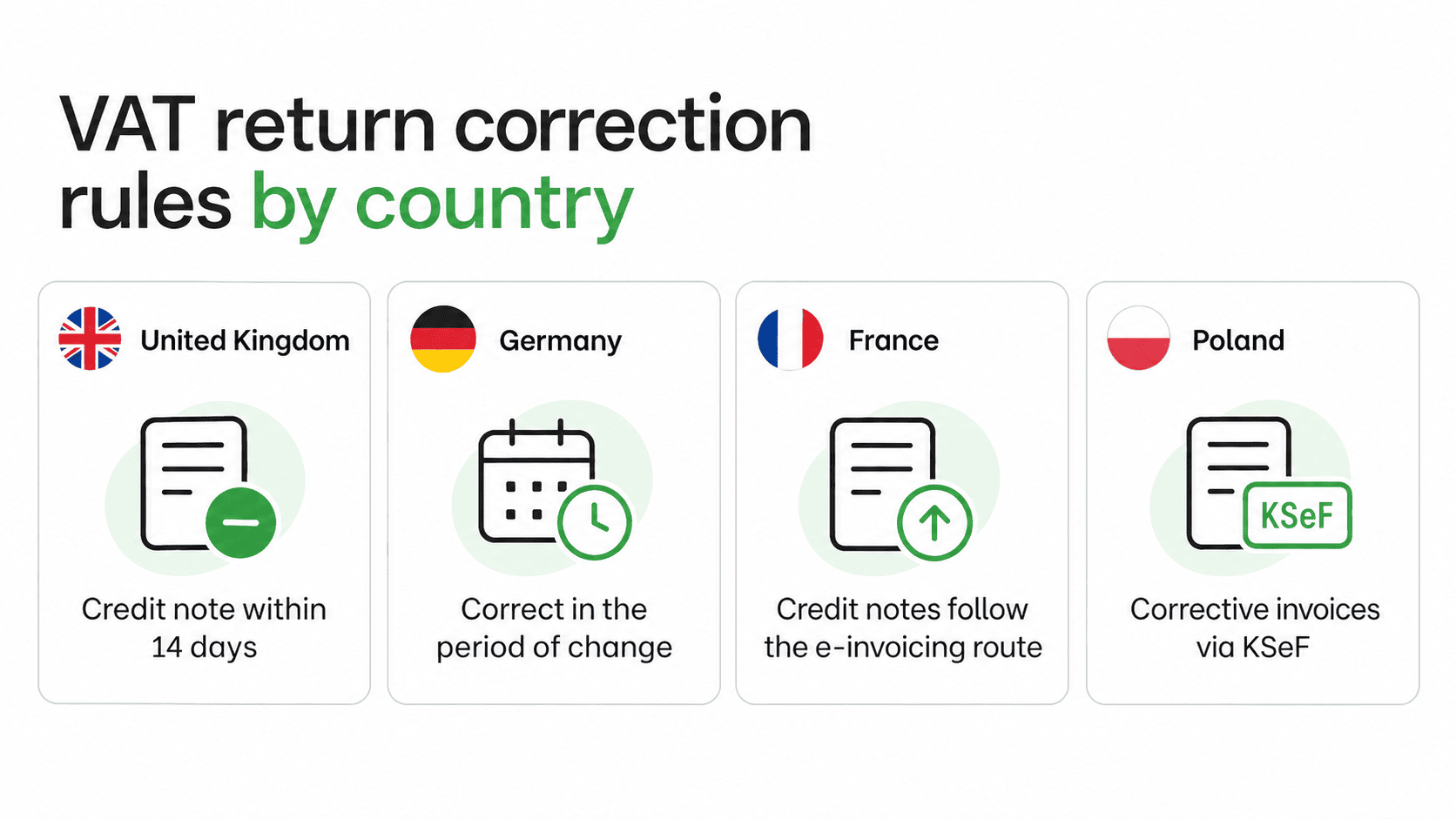
A supplier must issue a credit note within 14 days of the decrease. The decrease happens on the day the money is repaid or offset. The change belongs to the period in which that decrease falls. It is not an error, so the error thresholds in Notice 700/45 do not apply. Those limits cover genuine mistakes only: up to £10,000, or 1% of Box 6 capped at £50,000, within four years. Our UK guide explains filing frequencies.
Germany
Section 17 UStG obliges the seller to correct the tax owed when the taxable amount changes. The business buyer must correct its input deduction at the same time. Both corrections belong to the period in which the change occurred. A reversed delivery triggers the same rule. For a paid order, the base falls only once the money is actually returned. See our Germany guide for return periods.
France
French sellers issue an avoir that refers to the original invoice. The reform in force since 1 September 2026 changed the channel for B2B documents. Every business must now be able to receive electronic invoices. Large and midsize companies issue them through an approved platform already. Small firms follow from 1 September 2027. Credit notes travel the same route. Read our France guide for rates and registration.
Poland
Corrective invoices go through KSeF, the national e-invoicing system. It became mandatory on 1 February 2026 for firms with 2024 sales above PLN 200 million. All other taxpayers joined on 1 April 2026. Very small sellers, with monthly sales up to PLN 10,000, have until the end of 2026. Our Poland guide covers local filing.
Keeping stock in several markets and handling returns locally? Our local registration service sets up the numbers you need, so every return lands in the right national filing.
Marketplace Sales, Stock Held Abroad and Other Special Cases
Some orders are declared by the platform, not the seller. Under the deemed supplier rules, a marketplace accounts for certain consumer orders. These include imports up to €150 and EU deliveries by non-EU sellers. The platform then corrects the consumer side when a customer is repaid. The seller still keeps records of its own supply to the platform.
Returned parcels do not always travel home. Some sellers route them to a warehouse in the buyer’s country. Goods held there without a new buyer may count as a transfer of own stock. That can trigger local registration.
Store credit and vouchers raise timing questions. In the UK, offsetting a credit against the customer account counts as payment. EU countries set their own conditions under Article 90. Check the national rule before booking VAT adjustments without cash moving.
Selling through Amazon, Zalando or other platforms? Our marketplace tax management tool separates platform-declared sales from your own, so refunds are never corrected twice.
Credit Notes Under Electronic Invoicing Mandates
Structured invoicing is spreading fast across Europe. Belgium made domestic B2B e-invoices compulsory from 1 January 2026. France and Poland followed this year. Under these systems, a credit note is an electronic document too. A PDF emailed to a customer no longer counts for B2B deals there.
The ViDA package adds another layer. From 1 July 2030, intra-EU B2B trade moves to near real-time digital reporting. Authorities will match credit notes against sales data automatically. Mismatched corrections will surface faster than ever.
Issuing credit notes in several e-invoicing formats? Our Global E-Invoicing Software produces compliant documents market by market, and you can book a free consultation to review your returns process.
Mistakes That Turn Routine Refunds Into Audit Findings
Most problems come from process gaps, not from the law. The same issues appear in audit after audit:
- Reducing output tax before the money is actually repaid.
- Applying today’s rate instead of the rate on the original invoice.
- Booking an OSS correction against the seller’s home country.
- Issuing a UK credit note later than 14 days after the decrease.
- Correcting a sale the marketplace had already declared.
- Losing proof that goods came back, such as carrier tracking.
Keep return evidence together with the credit note. OSS records must be kept for ten years from the end of the transaction year. National limits may be shorter, but the longest one should guide your policy.