
VAT Compliance for Foreign Companies Selling Services in the EU
VAT Compliance for Foreign Companies Selling Services in the EU
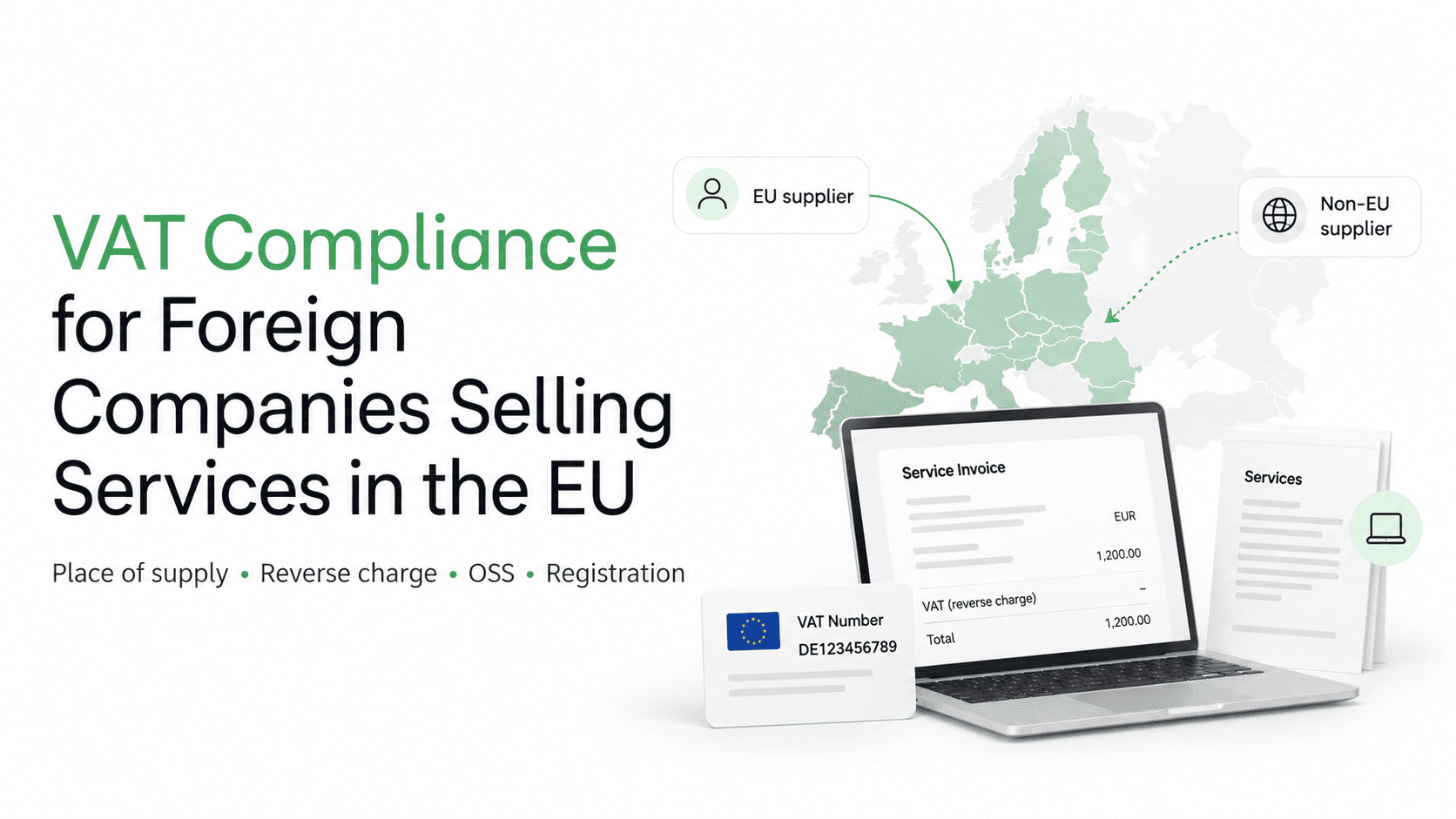
A software firm in Toronto signs a client in Munich. A design studio in Warsaw bills a buyer in Lisbon. Both need the same answer: which country taxes the deal? VAT on services inside the Union follows a fixed logic. Once you know it, most invoices become routine. This guide sets out the rules, exceptions and deadlines that apply in late 2026.
Two groups are treated separately throughout. Suppliers based in another EU country have one set of tools. Businesses established outside the Union have another. Mixing the two is the most common source of errors.
How VAT on Services Is Decided in the EU
Everything starts with the place of supply. It decides which country’s rules, rates and invoice formats apply. Two facts settle it: what the service is and who buys it. Directive 2006/112/EC sets two basic rules, as the European Commission explains:
- B2B services are taxed where the customer is established (Article 44).
- B2C services are taxed where the supplier is established (Article 45).
A buyer counts as a business when it acts in a business capacity. A public body registered for VAT is treated the same way. Exceptions override both rules for certain service types. They are covered in the next section.
Customer status needs evidence. A valid VAT number checked in VIES is the standard proof of a business buyer. Our VAT number checker runs that test in seconds. Save a dated record of each result. A buyer without a number is usually treated as a consumer. That changes who accounts for VAT on the service and where.
Exceptions That Move VAT for Services to Another Country
Some services are taxed where they are used, not where the parties sit. Getting VAT for a service wrong usually starts here. The table lists the main exceptions in force today.
| Service type | Place of taxation | Applies to | Article |
| Services connected with immovable property | Where the property is located | B2B and B2C | 47 |
| Passenger transport | In proportion to distance covered | B2B and B2C | 48 |
| Restaurant and catering | Where physically carried out | B2B and B2C | 55 |
| Short-term hire of means of transport | Where put at the customer’s disposal | B2B and B2C | 56 |
| Admission to events attended in person | Where the event takes place | B2B | 53 |
| Cultural, educational and similar activities | Where held; if streamed, where the customer lives | B2C | 54 |
| Telecom, broadcasting and electronic services | Where the customer lives | B2C | 58 |
| Services of intermediaries | Where the main transaction is taxed | B2C | 46 |
Virtual events changed on 1 January 2025. B2B admission to a streamed event now follows the customer rule. For consumers, streamed content is taxed where the viewer lives. Sellers of webinars and online courses felt this most.
Member states may also apply use and enjoyment rules under Article 59a. These can pull a service into their territory or push it out. Check national law before relying on the basic rule for VAT for services such as hiring or telecoms.
How VAT Reverse Charge Services Work Between Businesses
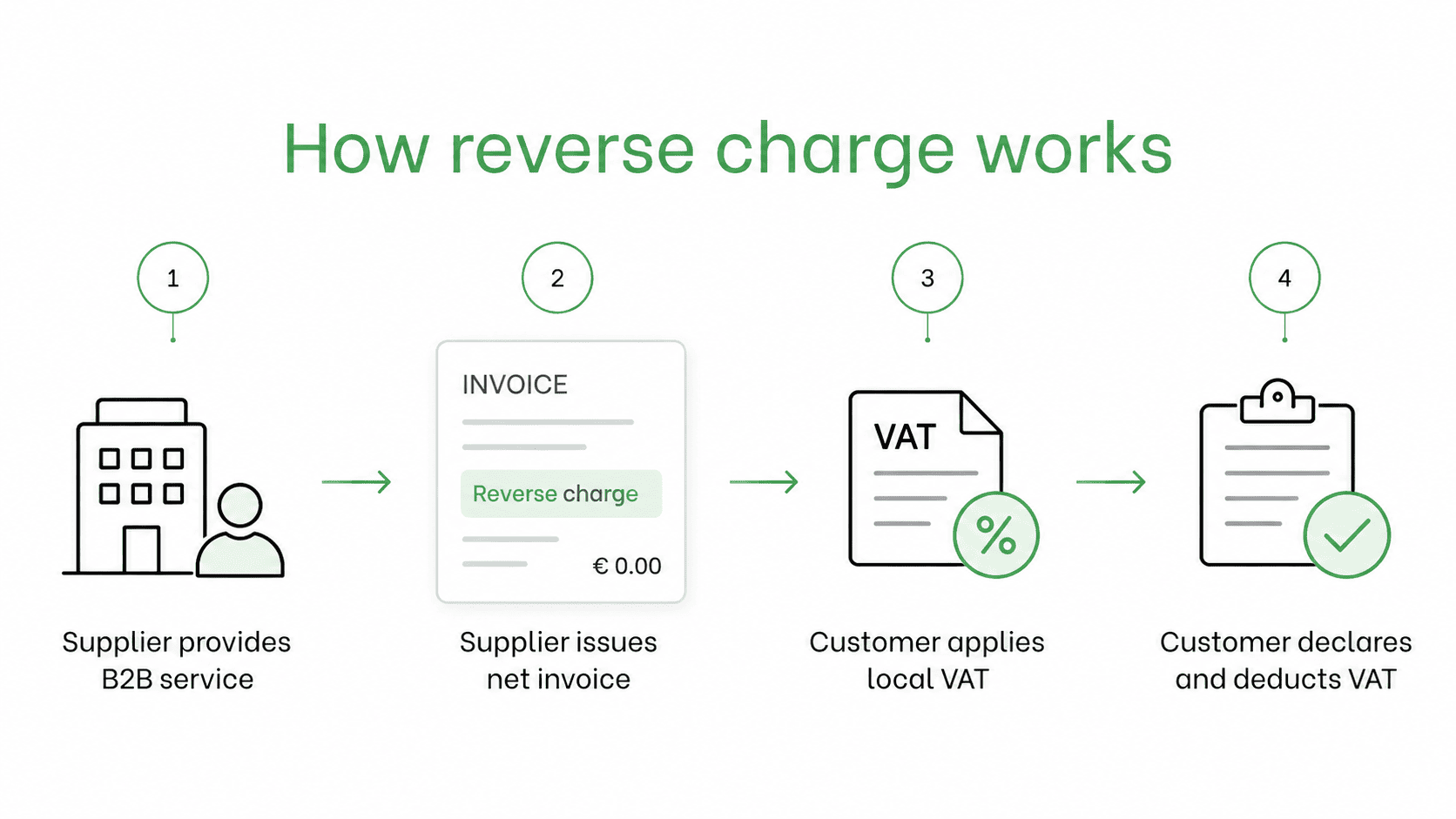
In most B2B deals, the buyer pays the tax, not the seller. This is the reverse charge under Article 196. The supplier issues a net invoice. The customer applies its local rate and declares the tax in its own return. A fully taxable buyer usually deducts the same amount there. Its net cash cost is zero.
The rule covers VAT reverse charge services supplied under the general B2B rule. Consulting, marketing, licensing and IT support all qualify. One condition matters most. The supplier must not be established in the country where the tax is due.
A reverse-charged invoice should contain these details:
- The supplier’s full name, address and, for EU suppliers, VAT number.
- The customer’s VAT identification number.
- A clear description of the service and its date.
- The net amount, with no VAT charged.
- The mention “Reverse charge” required by Article 226(11a).
EU suppliers must issue such invoices by the 15th day of the following month. Article 222 sets this limit. A project finished on 20 October 2026 needs an invoice by 15 November 2026. Auditors often flag late documents in VAT reverse charge on services.
Reverse Charge VAT Services Supplied From Inside and Outside the EU
For the buyer, the mechanism looks identical either way. The supplier’s duties differ. The table compares both positions.
| Obligation | Supplier in another EU country | Supplier outside the EU |
| B2B general rule | Reverse charge, net invoice | Reverse charge, net invoice |
| EC Sales List | Required in the home country | Not required |
| B2C general services | Home country VAT | Outside EU scope, unless an exception applies |
| B2C electronic services | Customer’s country above €10,000 a year EU-wide | Customer’s country from the first euro |
| OSS scheme | Union scheme in the home country | Non-Union scheme in any EU country |
| Refund of EU input VAT | Electronic claim, Directive 2008/9/EC | 13th Directive, reciprocity may apply |
| Tax representative | Not required | May be required (Article 204) |
EU suppliers must also list reverse charge VAT services in their EC Sales List under Article 262. Filing is monthly or quarterly, depending on the home country. Your figures should match the buyer’s declared purchases. Tax offices compare both sides through VIES.
Suppliers outside the Union have no such report. They still need proof that the buyer is a business. Keep the VAT number, the check result and the contract together. Without them, the sale may be treated as B2C.
One trap concerns a fixed establishment. An office with its own staff in the buyer’s country can make you local. Then reverse charge VAT services delivered through that office stop qualifying. Local VAT must be charged instead. Implementing Regulation 282/2011 sets the test: permanence plus human and technical resources.
Selling Services to Consumers Through the One Stop Shop
Consumer sales follow a different path. A private buyer cannot self-account, so the supplier owes the tax. The open question is where.
An EU business taxes general B2C services at home. Exceptions such as electronic services move the tax to the buyer’s country. Article 59c sets a €10,000 annual threshold for these cross-border sales. Below it, home country VAT may apply. Above it, the destination rate is due. The Union scheme lets you declare all of this in your own country.
A company outside the Union faces stricter terms. There is no threshold at all. Digital services to an EU consumer are taxable from the first sale. Under the basic rule, other B2C services fall outside EU scope. Exceptions and national use rules can still bring them in. That is why VAT for foreign companies selling online often starts with the non-Union OSS.
Key facts about the non-Union scheme:
- You register in one EU country of your choice.
- Each customer pays the rate of their own member state.
- One quarterly return is due by the end of the following month.
- A nil return is still filed in quarters without sales.
- Records must be kept for ten years.
Timing of entry matters. A scheme normally starts on the first day of the next quarter. It can start from your first supply instead. For that, notify the tax office by the 10th day of the following month. A first sale on 14 November 2026 means notifying by 10 December 2026.
OSS covers consumers only. B2B sales never enter the return. Domestic sales in your own country stay in your usual return. A member state cannot force a non-Union scheme user to appoint a tax representative.
Selling digital or event services to EU consumers? Our OSS IOSS registration service sets up the right scheme, and our compliance platform prepares each quarterly return with the correct country rates.
When VAT Registration for Foreign Companies Becomes Unavoidable
OSS and the reverse charge remove most local filings. They do not remove all of them. VAT registration for foreign companies is still needed in several typical cases:
- B2B services taxed locally where no domestic reverse charge applies, such as property work or event admission.
- B2C services taxed in a member state when you do not use OSS.
- Goods supplied together with services, such as installation or local stock.
- A fixed establishment that takes part in the supply.
Rules on domestic B2B supplies vary. Article 194 lets countries shift the tax to local business buyers. Germany does this widely under Section 13b UStG. France applies it when the buyer holds a French VAT number. In those cases the buyer accounts for each reverse charge VAT service itself. Other states expect the supplier to register. Compare the rules in our Germany guide, France guide, Italy guide and Spain guide.
Firms outside the EU may also need a tax representative. Article 204 allows this when no mutual assistance agreement covers your home country. The representative may share liability for your tax. This adds cost to VAT registration for a foreign company. Check the Poland guide or Netherlands guide for local practice.
Need a local number in one or several EU countries? Our VAT registration service handles the application, and our authorised representative service covers countries that require a local contact.
Deadlines Calendar for VAT for Foreign Companies
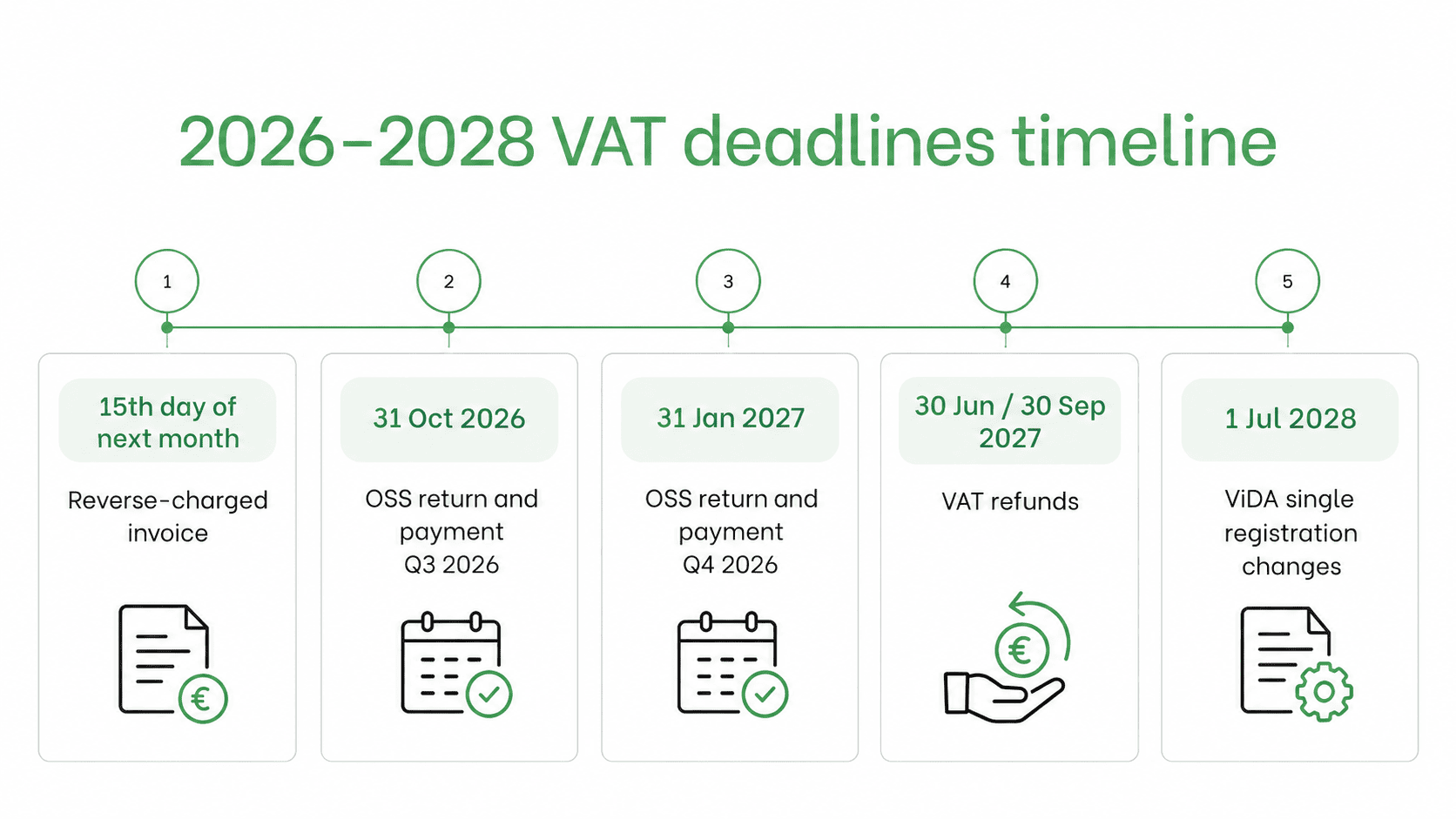
The dates below apply as of October 2026. National returns follow local rules, so confirm them country by country.
| Obligation | Who | Deadline |
| Reverse-charged invoice | EU suppliers | 15th day of the month after supply |
| EC Sales List for services | EU suppliers | Monthly or quarterly, per home country |
| OSS return and payment, Q3 2026 | OSS users | 31 October 2026 |
| OSS return and payment, Q4 2026 | OSS users | 31 January 2027 |
| OSS start from first supply | New OSS users | 10th day of the month after that supply |
| Refund of 2026 input VAT | EU businesses | 30 September 2027 |
| Refund of 2026 input VAT | Businesses outside the EU | Usually 30 June 2027 |
OSS deadlines do not move when they fall on a weekend. Pay early enough for the money to arrive in time. Repeated late filing can lead to exclusion from the scheme. Exclusion means separate registrations in each country of sale. That multiplies the cost of VAT for a foreign company.
Recovering EU VAT Paid on Business Costs
Foreign suppliers often pay local VAT on travel, events or office rent. Refund claims cover VAT for services like these. An EU business files electronically through its home tax portal. The deadline is 30 September of the following year.
A business outside the Union uses the 13th Directive procedure. Most member states set 30 June of the following year. Some refund only when your home country offers reciprocity. Claims filed late are usually rejected. Our guide on VAT refunds in Europe walks through each step.
Unclaimed refunds are a quiet cost of VAT for foreign companies. Many firms simply miss the date. Put both refund deadlines in your finance calendar now.
What Changes Under ViDA From July 2028
The ViDA package was adopted on 11 March 2025 as Directive (EU) 2025/516. Its single registration pillar applies from 1 July 2028. The domestic reverse charge under Article 194 then becomes mandatory. It will cover suppliers without a local VAT number who sell to VAT-identified buyers. OSS will also expand to more supply types. Many current cases of VAT registration for foreign companies will disappear as a result.
From 1 July 2030, digital reporting applies to intra-EU B2B trade. Near real-time reports will replace today’s EC Sales Lists. Reverse-charged invoices must then be issued within ten days. Platforms for short-term rentals and passenger transport face deemed supplier rules from 2028. Member states may delay that part until 2030.
Preparing your invoicing for ViDA and national e-invoicing mandates? Our Global E-Invoicing Software issues compliant documents market by market, and you can book a free consultation to review your current flows.
Mistakes Auditors Find Most Often
Most errors come from weak processes, not from complex law. The same issues return in audit after audit:
- Treating a buyer as a business without a verified VAT number.
- Charging home country VAT on electronic services sold to consumers abroad.
- Reporting B2B sales in an OSS return.
- Leaving out the “Reverse charge” mention on the invoice.
- Ignoring a fixed establishment that took part in the supply.
- Applying the general rule to events, property or transport.
Each risk has a simple control. Validate numbers at onboarding. Map every product to its place of supply rule. Review that map whenever you launch something new. This keeps VAT on services predictable across all markets.
Tag each contract once in your billing system. Tags should separate OSS sales, VAT reverse charge services and domestic sales. Clean tags make every return faster to prepare and easier to defend.
Selling services into several EU countries? Check rates in our VAT calculator, open our country guides, or try the platform for free to automate filings across the Union.