
How Much Does EPR Compliance Really Cost in 2026
How Much Does EPR Compliance Really Cost in 2026
Ask three online sellers what packaging compliance set them back last year and you get three wildly different answers. An Amazon merchant shipping into Germany alone might have spent under €400. A mid-sized cosmetics brand selling across France, Spain, Italy and the Netherlands cleared €6,000 once registration, scheme membership and tonnage charges stacked up. A US producer caught by Oregon and Colorado at once watched invoices land in January and July with almost no warning. The figure nobody prints on a pricing page is the one your finance team actually needs.
Extended producer responsibility fragments into pieces that arrive at different moments, in different currencies, from different bodies. There is the one-off registration, the recurring scheme membership, the per-kilogram or per-pound material charge, and the quiet administrative drain of reporting four times a year in five languages. Treat any single piece as the whole and you under-budget by half.
This guide pulls the real 2026 numbers together so you can size the obligation before it sizes you. We map the EPR registration cost across Europe, show how US states price their programs, explain what producer responsibility organisations bill to carry your obligation, and expose where the running expenses hide. Sellers who plan for all four layers rarely get blindsided by an audit. Those who budget for registration alone find the gap during their first reconciliation.
What the EPR Registration Cost Actually Covers
The phrase gets thrown around loosely, so precision helps. Your EPR registration cost is only the entry ticket: the charge a national authority or scheme levies to open your producer account and issue the number you quote on marketplaces and customs paperwork. Germany’s LUCID registration is free. Italy’s equivalent setup can reach €200 once consortium enrolment counts, since producers there join CONAI and a material-specific consortium such as COREPLA for plastic or COMIECO for paper.
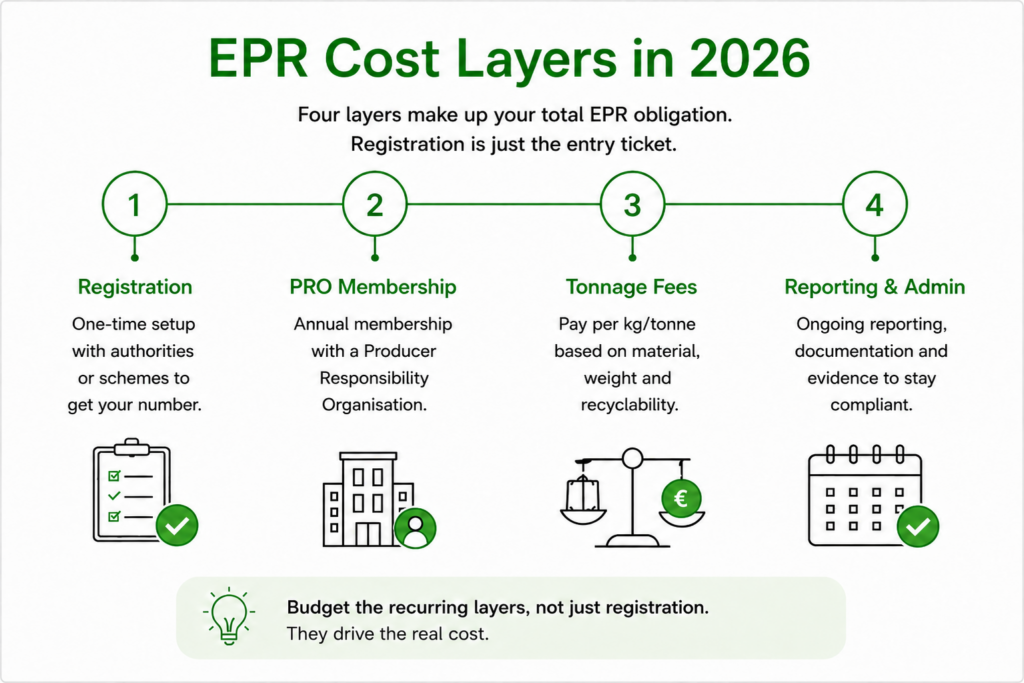
What follows registration is where the money drains away. You join a producer responsibility organisation, report packaging tonnages by material, and pay charges scaled to weight and recyclability. The EPR registration cost is therefore the smallest line on most invoices, even though sellers fixate on it. Think of registration as the door fee and the tonnage charges as the bar tab. Lappa’s EPR registration service clears the door across several markets at once, which matters more than it sounds when every country runs its own portal, login and language.
A concrete walk-through helps. A homeware brand entering Germany pays nothing to register in LUCID, then signs a dual-system contract priced on its declared tonnage, then files quarterly volume reports. The same brand entering Italy pays a consortium enrolment, joins CONAI, and adds COREPLA or COMIECO depending on whether the box is plastic or fibre. Two markets, the registration line near zero in one and a few hundred euros in the other, yet the recurring tonnage charges dwarf both within a single year. Anchor your forecast on the recurring layer, not the headline entry charge, and the budget stops surprising you.
EPR Fees Europe Charges Are Far From Uniform
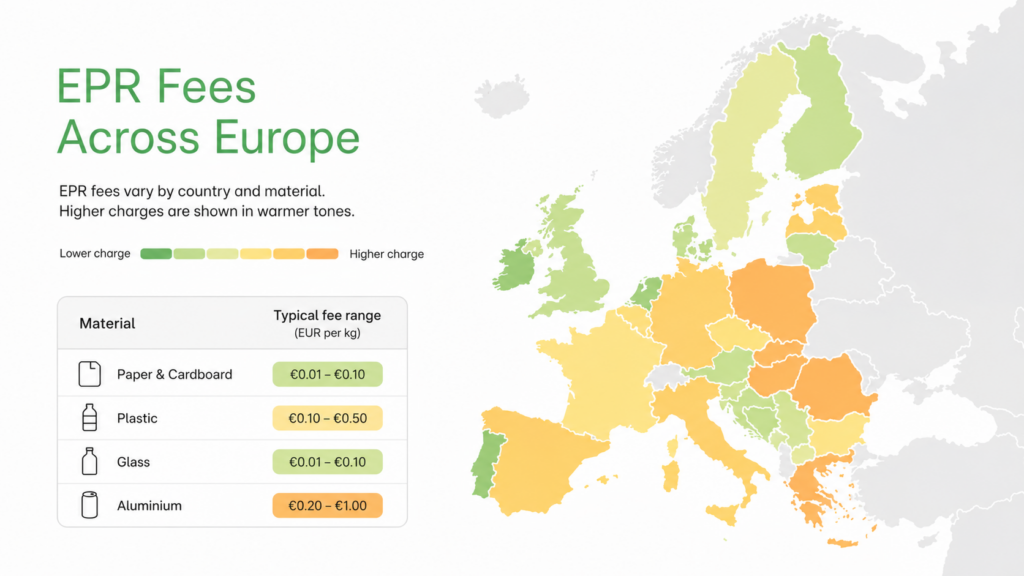
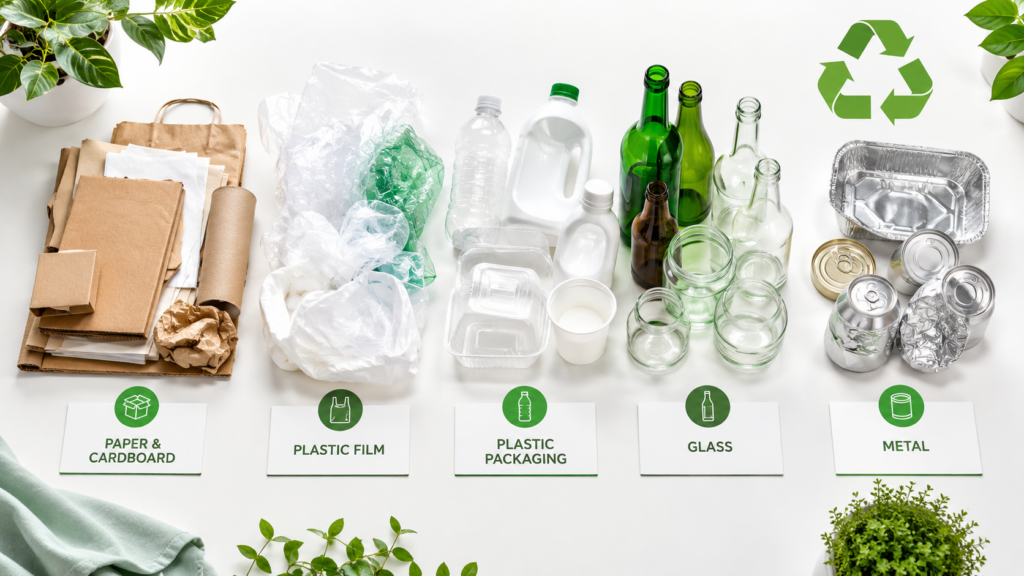
Anyone expecting one rate card across the bloc is in for a shock. The EPR fees Europe applies are set country by country, material by material, and the spread is enormous. Identical plastic film priced at €0.30 per kilogram in one market hits €0.80 in another. Glass and paper stay cheap almost everywhere because they recycle easily and weigh a lot. Lightweight plastics carry the heaviest charge precisely because processing them is hard.
Western and Nordic markets price highest. Denmark, Sweden and the Netherlands fund gold-plated collection systems, and producers foot the bill. Central and Eastern Europe runs leaner, which is why brands often pilot in Poland or the Czech Republic before committing to pricier neighbours. The table maps where the EPR fees Europe lands by material before any national modulation kicks in.
| Material type | Average charge (per kg) | Recycling complexity |
| Paper and cardboard | €0.02 – €0.15 | Low |
| Plastic (PET, PE) | €0.30 – €0.80 | Medium |
| Glass | €0.01 – €0.05 | Low |
| Aluminium | €0.15 – €0.40 | Medium |
Volume changes the calculation too. A producer placing half a tonne of cardboard pays almost nothing across most of the bloc, because paper modulation stays near the floor everywhere. The same producer placing half a tonne of laminated film into Denmark or the Netherlands sees a charge an order of magnitude larger, since those systems price flexible plastics aggressively. The lesson for a planning spreadsheet is blunt: weight matters less than material mix. Two pallets of identical mass can differ threefold in annual charge purely on what the packaging is made of, which is why material substitution beats volume reduction as a savings strategy in nearly every market.
France adds a twist worth pricing in early. Its 2026 bonus-malus model, run through CITEO, rewards recycled content sourced within 1,500 km of mainland France and penalises packaging that ignores design rules. Cardboard runs near €80 per tonne; aluminium sat around €186.50 per tonne in 2025. Germany layers an €800 per tonne levy on non-recycled plastic waste on top of the dual-system charge. Two countries, two logics, one budget that absorbs both. For the full country breakdown, Lappa keeps an updated EPR guide alongside this analysis.
Fixed Costs and Variable Costs Inside Your EPR Budget
Split the obligation into two buckets and it turns forecastable. Your fixed costs stay flat no matter your sales volume. Registration, annual scheme membership, and any authorised-representative retainer live here. A scheme bills a minimum even if you place a single pallet on the market, so low-volume sellers still carry a floor they cannot design away.
Your variable costs track tonnage. Every extra kilogram of plastic, every additional glass shipment, every reformulated box shifts the number. This half of the EPR budget responds to packaging decisions, and it pays back fastest. Swap a multi-material pouch for mono-material recyclable film and your variable costs drop sharply in any market that modulates by recyclability.
Timing is why the split matters for your budget. Fixed costs are predictable and easy to approve. Variable costs depend on data you may not yet collect cleanly, and that uncertainty wrecks annual forecasts. Model both columns and you answer the only question your CFO cares about: what the next twelve months hold, not what you paid once at signup. A working template lists registration, membership and representation in one column and material tonnage by country in the other, refreshed every quarter.
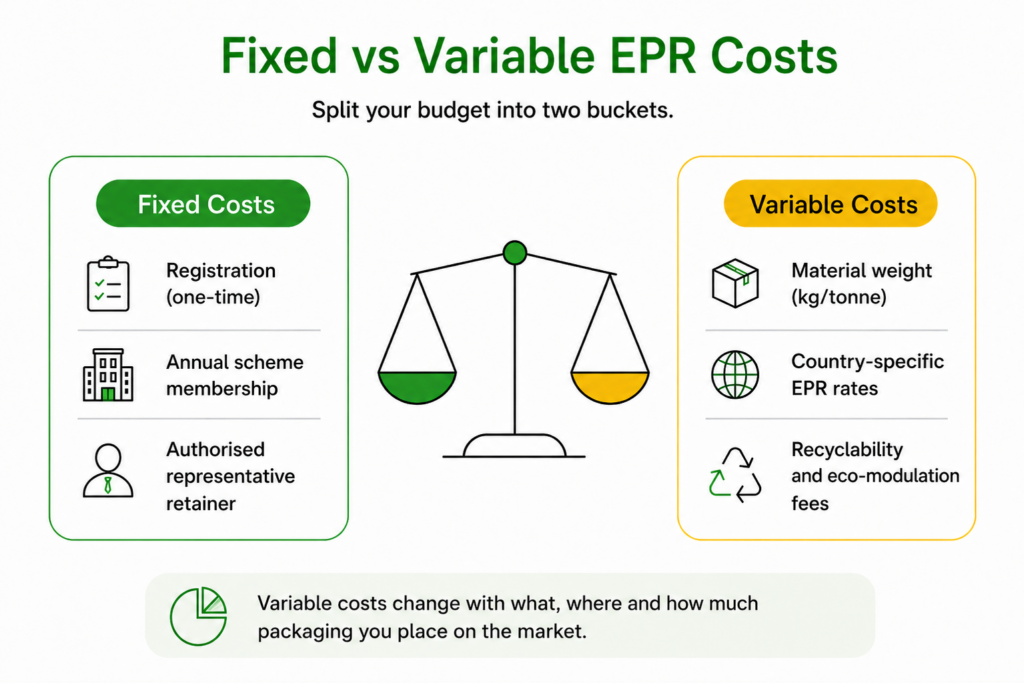
Walk a single number through the model. Suppose you place three tonnes of mixed packaging across four EU markets: roughly €400 sits in the fixed column for registrations and scheme minimums, while the tonnage column swings between €900 and €2,400 depending on how much of that weight is plastic film versus cardboard. Shift one tonne from a multi-material pouch to mono-material PET and the variable column can fall by a third in markets that modulate by recyclability. The fixed column never moves; the variable column is where design choices pay rent, and that is the half worth revisiting before every product launch.
PRO Fees and What Producer Responsibility Organisations Bill
A producer responsibility organisation takes on your collection and recycling duty in exchange for payment. Grasping PRO fees sits at the centre of any honest estimate, because most countries bar you from compliance unless you join one. The organisation pools thousands of producers, contracts the recyclers, and bills you a share scaled to reported volumes. Germany alone hosts competing schemes such as Der Grüne Punkt, Interzero and Reclay.
Two charges sit under the PRO fees label. First, a membership or administration component, often a fixed annual minimum: one French scheme quotes a 2026 floor of €95 HT, so even a tiny producer pays that before a single kilogram counts. Second, the tonnage component described above. Germany’s dual-system design lets schemes compete, so PRO fees there can undercut single-provider countries when you shop the contract and rebid annually.
Producers underestimate pro fees most in multi-scheme markets. Germany expects a dual-system contract plus separate LUCID reporting. Hungary lets you pay the Environmental Product Fee straight to the tax authority or hand the duty to a stewardship organisation instead. Each route carries a different shape, and choosing without modelling both is how teams overpay. Lappa’s EPR reporting workflow keeps scheme submissions and authority filings in one place so the two never drift apart.
Multi-Country EPR Cost for Cross-Border Sellers
Selling into one market is a line item. Selling into eight is a programme. The multi-country EPR cost is not simply eight registrations added together, because each jurisdiction layers on its own portal, currency, billing calendar and reporting rhythm. Administrative weight compounds faster than the charges themselves.
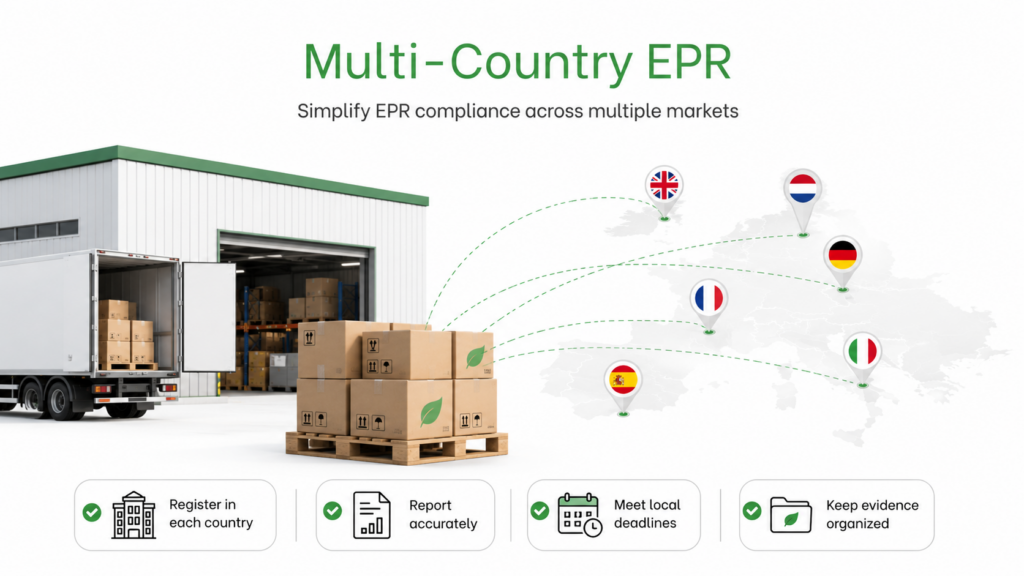
The most expensive misconception in this space holds that one EU registration covers the bloc. It does not. You register separately in every market where you place packaging, full stop. A seller who assumed otherwise meets the gap during an audit, usually with backdated charges and a penalty attached; German fines alone reach €200,000 per breach. Pull these rules together and register market by market, because that is the only path that survives scrutiny. The table gives a planning view across fifteen European markets for a small to mid-sized seller placing roughly two to five tonnes of mixed material.
| Country | Registration charge | Packaging rate (per kg) | Estimated annual spend |
| Germany | €0 (LUCID) | €0.15 – €0.60 | €300 – €1,200 |
| France | €0 – €150 | €0.08 – €0.45 | €250 – €900 |
| Italy | €100 – €200 | €0.10 – €0.50 | €400 – €1,100 |
| Spain | €0 – €100 | €0.12 – €0.48 | €350 – €950 |
| Poland | €50 – €150 | €0.05 – €0.35 | €200 – €700 |
| Netherlands | €0 | €0.18 – €0.65 | €450 – €1,300 |
| Belgium | €125 – €250 | €0.20 – €0.70 | €500 – €1,400 |
| Austria | €0 – €100 | €0.14 – €0.55 | €350 – €1,000 |
| Czech Republic | €30 – €80 | €0.06 – €0.30 | €180 – €600 |
| Hungary | €0 (EPF) | €0.08 – €0.40 | €200 – €800 |
| Portugal | €50 – €120 | €0.09 – €0.42 | €280 – €850 |
| Romania | €25 – €75 | €0.04 – €0.28 | €150 – €550 |
| Sweden | €0 | €0.16 – €0.58 | €400 – €1,150 |
| Denmark | €0 | €0.22 – €0.75 | €550 – €1,500 |
| Slovakia | €40 – €100 | €0.07 – €0.33 | €220 – €650 |
Add the UK and the multi-country EPR cost climbs again. British pEPR base charges for the 2025 to 2026 year landed at £423 per tonne for plastic, £192 per tonne for glass and £461 per tonne for fibre-based composite. From 2026 to 2027 a red-amber-green rating modulates those rates, multiplying red-rated packaging by 1.2 in 2026, 1.6 in 2027 and 2.0 in 2028. Treat the UK as basically the EU and you mis-budget by a wide margin. An authorised representative is mandatory in several markets for non-resident producers, itself a recurring line worth pencilling in.
How Much Does EPR Cost Once You Cross Into the United States
American programmes run on a different clock and currency, so the question of how much does EPR cost earns a separate answer west of the Atlantic. Five state laws are live or imminent, each with its own producer responsibility organisation, and most route through the Circular Action Alliance.
Oregon went first, with payment obligations starting 1 July 2025. Its rates illustrate how much does EPR cost per pound rather than per tonne: roughly 6 cents for paper and fibre, 24 cents for rigid plastic and 34 cents for flexible plastic in the base case. Across the full schedule of about sixty materials, rates run from $0.05 per pound for paper to $1.38 per pound for rigid plastic foam containers. Colorado switched on in January 2026, with interim dues reaching $1.60 per pound for rigid plastics and roughly 70 cents per pound for flexible films and laminates.
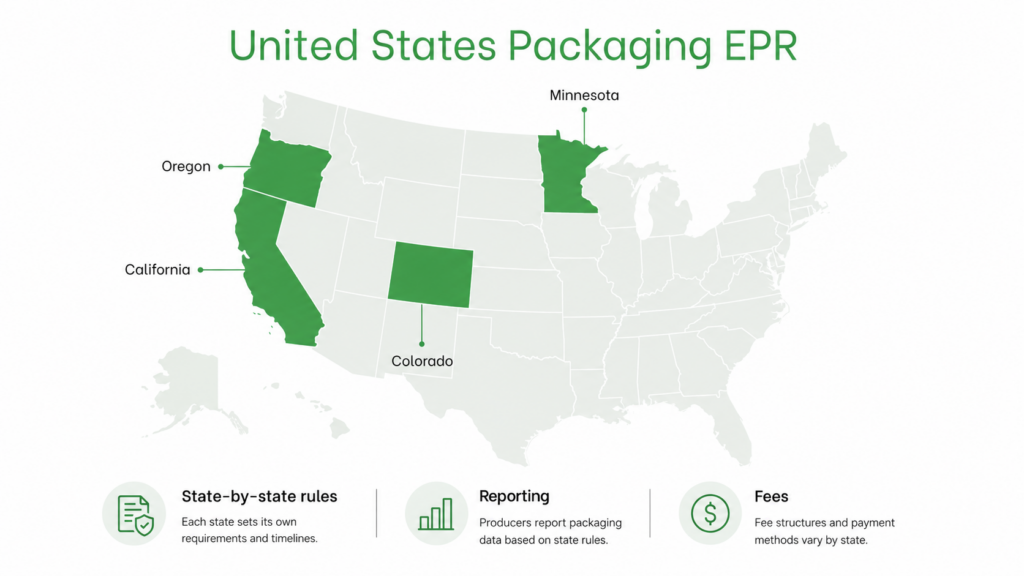
California’s SB 54 charges do not bite until January 2027, though baseline reports fell due by 31 May 2026, and most analysts borrow Oregon as the ballpark until California publishes its own schedule. Minnesota spent 2026 in a needs-assessment phase, with producer dues expected around 2028 to 2029 and producers eventually funding a large share of state recycling spend. So the honest answer to how much does EPR cost in the US turns on which states you ship into and what your packaging is made of; even so, six states already demanded reporting by 31 May 2026. Lappa’s breakdown of US packaging EPR laws state by state tracks deadlines as they shift.
Two structural quirks catch European sellers off guard when they expand westward. First, the reporting threshold and the payment threshold rarely align: a producer can owe a baseline report in a state a full year before any dollar comes due, so the calendar obligation arrives long before the invoice. Second, the Circular Action Alliance acts as the single producer responsibility organisation across most live states, which sounds simplifying until you realise each state still sets its own rate schedule and material categories underneath that one wrapper. Register once with the alliance, yes, but budget state by state, because a pound of flexible film priced at 34 cents in Oregon is not the same line in Colorado.
Running Costs of Extended Producer Responsibility EPR Compliance
Charges are the visible part. The running costs are what the obligation demands of your team every quarter, and they rarely surface in a vendor quote. Genuine extended producer responsibility EPR compliance means weighing and classifying every packaging component, tracking supplier changes, and filing reports on each market’s schedule, monthly to a German dual system and quarterly to LUCID, for instance.
A small compliance business selling in one or two markets with simple packaging can self-manage. You lose a few hours a quarter and keep tidy records. The calculus flips at scale. A compliance business spread across six countries faces six portals, six billing cycles and six languages, and that staff time becomes a running costs line dwarfing the registration charge. The classic slip is filing composite materials as single-material types, which underpays the levy and surfaces as a penalty during an audit.
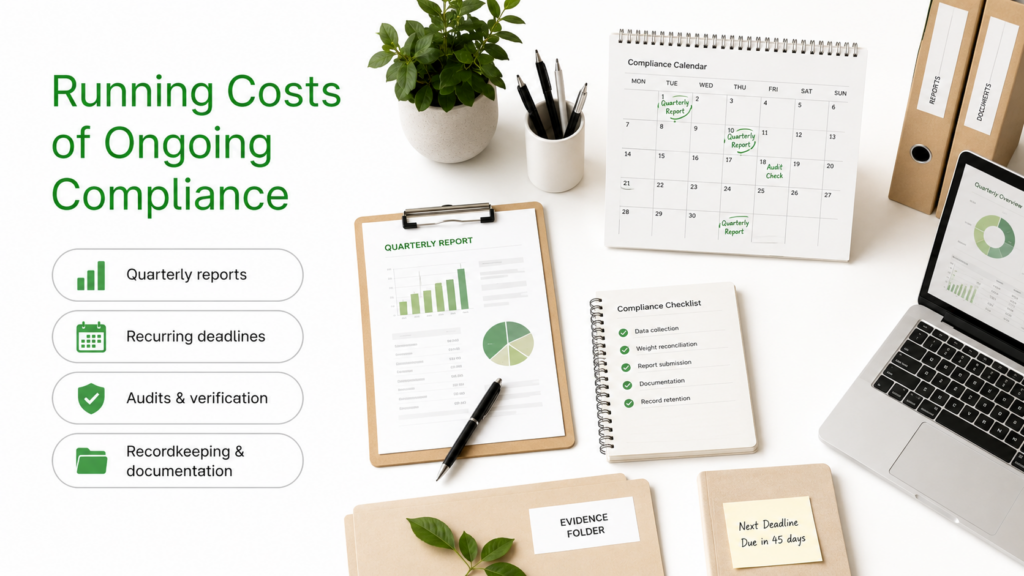
Audits make the running expense concrete. A German dual system or a French scheme can request your underlying weight data and supplier declarations, and a mismatch between what you reported and what you actually placed triggers back-billing plus a penalty. Producers who keep a live packaging specification sheet, updated whenever a supplier swaps a film or a box gauge changes, clear these checks in an afternoon. Those reconstructing a year of shipments from memory and scattered invoices lose days and usually pay more, because the safe move under time pressure is to over-declare. The record-keeping habit is cheaper than the scramble every time.
Other running costs hide in version control. Change a packaging supplier or reformulate a product and the reported weights move; a registration left unupdated drifts out of extended producer responsibility EPR compliance without anyone noticing. Sustained compliance is a maintenance habit, not a one-time setup, and pricing it as a habit separates accurate budgets from optimistic ones. Assign one owner, calendar every deadline, and archive certificates, government letters and receipts in a single place.
Cutting Your EPR Registration Cost Without Cutting Corners
Lower charges come from design and discipline, never from skipping obligations. Recyclability is the fastest lever. In every market that modulates rates, trading hard-to-recycle multi-material packaging for mono-material recyclable formats slides you toward the cheaper end of the rate card and, in France and the UK, away from the penalty multipliers. Lightweighting helps too, since most charges scale by weight, so shaving 10 grams off a box repeated across 100,000 units moves the annual number.
Consolidation is the second lever. Routing registration, fee tracking and reporting through one platform turns scattered EPR registration cost payments into a single managed workflow, trimming the administrative drain even when the statutory rates hold firm. The aim is not to dodge the registration cost but to stop paying twice for the labour of managing it across markets. Weigh what fragmented self-management burns in staff hours against Lappa’s EPR pricing before assuming in-house wins.
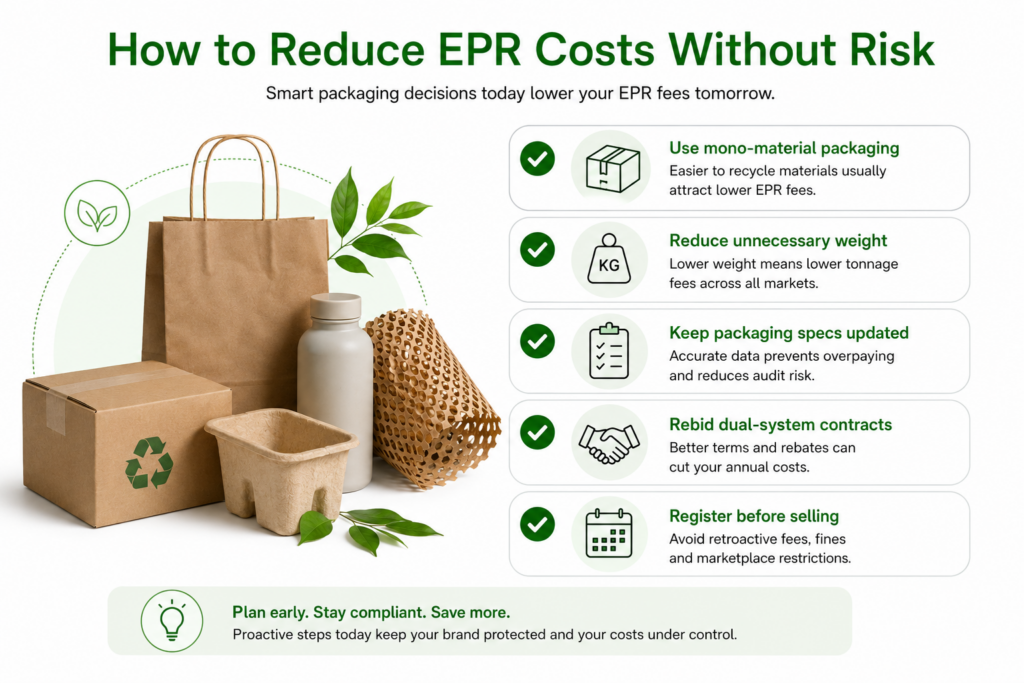
Timing is the third lever. Register before product hits the market, never after, because retroactive compliance drags backdated charges and fines behind it. Review packaging specifications every quarter as volumes and formats shift. Sellers who fold compliance into the operating rhythm absorb rate changes calmly. Those who treat it as an afterthought pay the premium disorganisation always charges.
FAQ
Is the EPR registration cost a one-time charge or recurring
- Registration itself is usually a one-time or annual setup charge, and in several countries it is zero. The recurring money sits in scheme membership and tonnage rates, billed annually or quarterly as long as you place packaging on the market.
Does one EU registration cover every member state
- No. You register separately in each country where you place packaging. There is no single bloc-wide registration, and assuming otherwise is the most common and most expensive compliance gap.
Why do plastic rates run so much higher than glass or paper
- Rates scale with recycling difficulty and environmental impact. Lightweight plastics are expensive to collect and process, so they draw the highest per-kilogram charge, while heavy, easily recycled glass and paper stay cheap.
How do US EPR charges compare with Europe
- The US prices per pound rather than per tonne and runs state by state through bodies like the Circular Action Alliance. Oregon and Colorado are live, California starts in 2027, and rates top a dollar per pound on rigid plastics.
Can a producer responsibility organisation reduce my bill
- A PRO administers your obligation but does not discount statutory charges. Lower bills come from sharper packaging design and, in competitive markets like Germany, from rebidding the dual-system contract.