

United Arab Emirates
Provinces
General
Provinces
General
About
General
About
General
General
General
The United Arab Emirates is rolling out a nationwide structured e-invoicing system to tighten VAT compliance, cut down on manual reporting errors, and give the Federal Tax Authority (FTA) real-time visibility into business transactions. Unlike a PDF or a scanned invoice sent by email, a UAE e-invoice is a machine-readable document that moves between an approved network of certified providers before it ever reaches the customer.
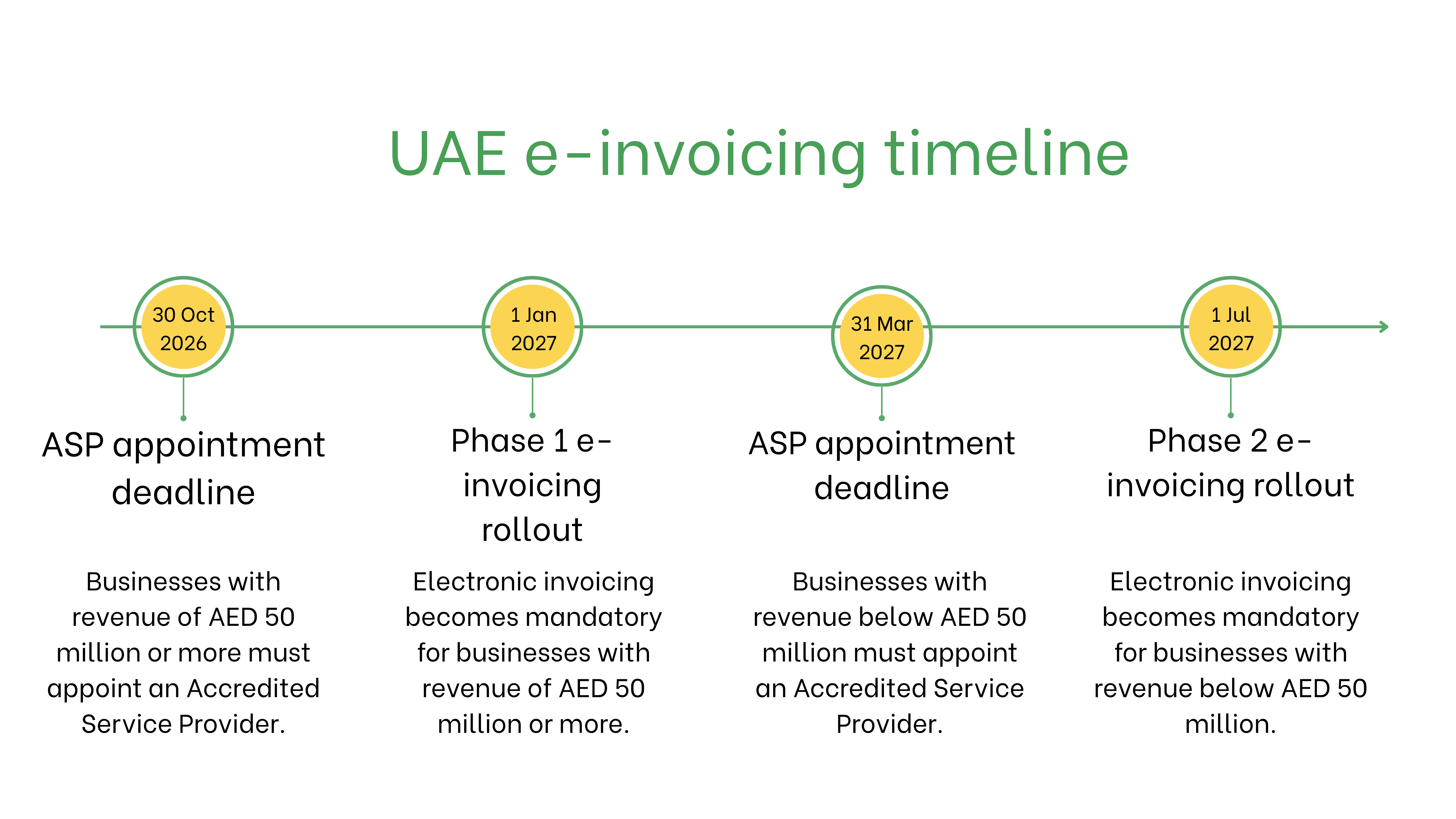 The UAE is introducing e-invoicing through a phased, revenue-based rollout overseen by the Ministry of Finance (MoF) and the Federal Tax Authority (FTA):
Implementation of mandatory e-invoicing in the UAE
The UAE is introducing e-invoicing through a phased, revenue-based rollout overseen by the Ministry of Finance (MoF) and the Federal Tax Authority (FTA):
- 1 July 2026 — the Electronic Invoicing System (EIS) opens for voluntary use and pilot participants, giving businesses a window to test their setup before any deadline applies.
- 30 October 2026 — businesses with annual revenue of AED 50 million or more must have appointed an Accredited Service Provider (ASP).
- 1 January 2027 — mandatory e-invoicing begins for that same group of larger businesses.
- 31 March 2027 — businesses below the AED 50 million threshold must appoint an ASP.
- 1 July 2027 — mandatory e-invoicing extends to the remaining in-scope businesses.
Who needs e-invoices in the UAE?
E-invoicing in the UAE applies broadly, regardless of VAT registration status, subject to specific exclusions:- Large businesses (AED 50 million+ annual revenue): must appoint an ASP by 30 October 2026 and comply from 1 January 2027.
- Smaller businesses (below AED 50 million): must appoint an ASP by 31 March 2027 and comply from 1 July 2027.
- Free zone businesses: in scope wherever their transactions fall under the Electronic Invoicing System, and in some cases must include additional beneficiary details.
- Non-resident businesses trading in the UAE: not part of the first mandatory phases, but should monitor guidance as the rollout matures, since obligations follow where the transaction takes place rather than tax residency alone.
E-Invoicing vs. E-Billing
| Aspect | E-Invoicing | E-Billing |
| Purpose | Tax compliance, mandatory under FTA rules | Billing and payments, customer-focused |
| Format | Structured XML (PINT AE), sent via an ASP | Flexible and informal (PDF, email, portal) |
| Platform | Peppol-based Electronic Invoicing System | Non-mandatory internal or third-party systems |
| Archiving | Minimum 5 years, longer in specific cases | Not legally required |
Key features of the UAE's e-invoicing system
The Electronic Invoicing System is built around structured data exchange rather than document digitisation. Businesses need to prepare for:- Structured format only: invoices must be issued as XML aligned with PINT AE (a UAE localisation of the Peppol International Invoice standard) — PDFs, scanned copies, and Word documents no longer count as legal invoices.
- Mandatory use of an ASP: every invoice is checked, signed, and routed by an Accredited Service Provider connected to the FTA's network; businesses cannot exchange e-invoices directly with each other.
- Standardised data fields: invoice content must follow the official Data Dictionary so every field, from tax breakdowns to buyer identifiers, is consistent across providers.
- Advance and final invoice linking: under Guidelines v1.1 (effective 1 June 2026), an advance payment invoice must be referenced in the corresponding final invoice using the "Preceding Invoice Reference" field.
- Archiving: e-invoice data must be retained within the UAE (or in a way that still allows FTA retrieval) for a minimum of 5 years after the relevant tax period, extending up to 15 years for real estate-related transactions or active disputes.
E-invoicing dataset
A compliant UAE e-invoice must carry the data required under the Mandatory Fields specification, which sets out roughly 51 required fields, including:- Seller and buyer identification: Tax Registration Numbers (TRNs) and legal entity details.
- Invoice metadata: invoice type code, transaction type flag, invoice number, and issue date.
- Line-item detail: description, quantity, unit price, and applicable VAT treatment for each good or service.
- Tax breakdown: VAT rate and amount shown separately for every tax category on the invoice.
- Payment and reference data: total payable, payment terms, and, where relevant, a reference to a preceding advance invoice.
E-invoicing across transaction types
B2B Transactions:- Mandatory in phases: from 1 January 2027 for businesses above AED 50 million revenue, and from 1 July 2027 for the rest.
- Forms the core of the initial rollout, alongside B2G.
- Covered from the same initial phase as B2B, with government entities exchanging invoices through the same Peppol-based network.
- Currently outside the scope of the mandate. Consumer-facing invoices are expected to be addressed in a later phase, once the B2B and B2G rollout is established.
Penalties for non-compliance
Non-compliance with the UAE's e-invoicing framework is enforced through a dedicated penalty schedule tied to the Electronic Invoicing System:- Failure to implement or appoint an ASP: a recurring fine per month (or part of a month) for as long as the business remains non-compliant with the prescribed timeline.
- Failure to issue or transmit an e-invoice: a fine applied per invoice, capped at a set monthly maximum, so repeated small failures can still add up over a reporting period.
- Record-keeping failures: incomplete or inaccessible e-invoice archives can trigger separate exposure during an FTA audit, on top of any invoice-level penalties.
Subscribe to the newsletter
No spam, only interesting news